Salesforce Grant Management for Nonprofits: A Full Guide
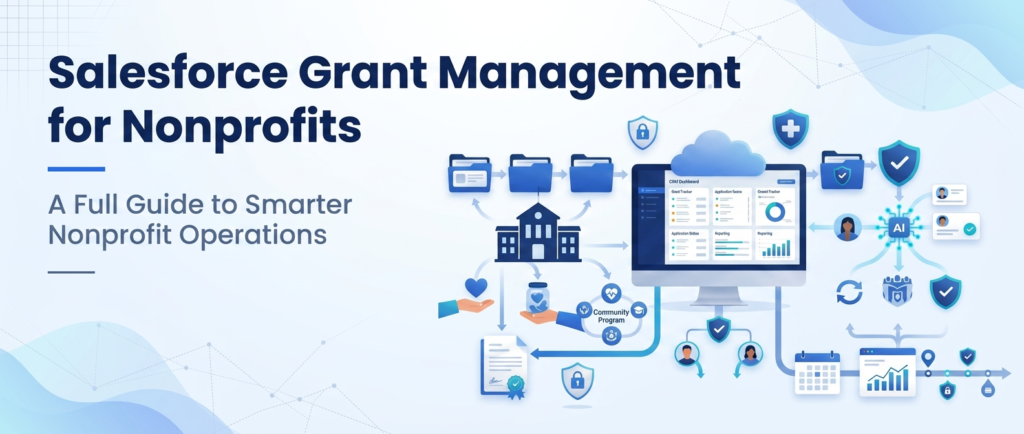
One of the most challenging parts of running a nonprofit is grant management. There’s a whole lot of administrative load that can divert teams from the work that they are trying to do. This is where Salesforce grant management for nonprofits comes in. From application intake to post-award reporting and impact analysis, Salesforce offers a comprehensive solution to give structure, visibility, and automation to every part of the process. This blog explores the various Salesforce features, grant lifecycle stages, and how to leverage AI to better manage grants in nonprofits.
Why Are Nonprofits Turning to Dedicated Grant Management Software?
In 2024, the grant management software market was worth more than $2.6 billion and is expected to reach $6.19 billion by 2033, marking a 10% CAGR — a definite sign that organizations from all industries are shifting away from using spreadsheets and manual processes and embracing dedicated software.
The risk is especially high for nonprofits. Grants can make up a major part of any budget, and a single reporting deadline or non-compliance can tarnish the goodwill of funders who took years to cultivate. With multi-year grants, sub-grants, federal compliance requirements, and outcome reporting, generic CRM tools just don’t have the capacity to manage the complexity of the funding.
That’s why Salesforce grant management for nonprofits has become a popular option. Salesforce is not simply a CRM solution that has been tailored for the nonprofit sector—it’s an entire platform that is designed from the ground up for the unique nonprofit environment.
What Is Salesforce Grant Management for Nonprofits, and What Does It Cover?
Simply put, Salesforce grant management for nonprofits is the way that organizations can use Salesforce’s specifically designed nonprofit tools to manage the entire grant lifecycle, from identifying opportunities to managing applications, tracking awards, ensuring compliance, handling disbursements, and more, all the way to reporting impact.
Salesforce offers two primary paths for nonprofits managing grants:
Nonprofit Success Pack (NPSP)
NPSP has long been the foundation for smaller nonprofits on Salesforce, and choosing between NPSP vs Nonprofit Cloud is often the first major decision organizations face.Within NPSP, organizations can choose between two modules:
- Outbound Funds Module — A free, lightweight option ideal for nonprofits that need basic grant tracking without building out a full applicant portal. It’s particularly useful for foundations tracking scholarships or small grant disbursements.
- Grants Management Module — A paid option that goes much deeper, offering applicant portals, task management, due diligence workflows, and the ability to customize application processes using Salesforce Flows. This option is built for organizations with a heavier volume of grantmaking activity.
Nonprofit Cloud Grant Management (Now Agentforce Nonprofit)
In October 2025, Salesforce rebranded Nonprofit Cloud as Agentforce Nonprofit, prompting many organizations to plan their migration from NPSP to Agentforce Nonprofit as the most advanced path available today. Nonprofit Cloud grant management builds on everything NPSP offers and layers in industry-specific components, AI agents, and automation that simply aren’t available in the older stack.
For organizations with complex needs, Nonprofit Cloud grant management is where the real transformation happens.
What Does the Grant Management Lifecycle Look Like in Salesforce?
Understanding the grant management lifecycle in Salesforce helps nonprofits see exactly where time and effort are saved. Here’s how Salesforce structures each phase:
Opportunity Setup and Promotion
Grant programs can be configured as funding opportunities within Salesforce. Teams can define eligibility rules, set application windows, and customize the applicant experience — all from one place. For public grants, Salesforce helps teams promote opportunities and attract a wider applicant pool, supporting more equitable grantmaking.
Application Intake and Review
The branded, mobile-friendly application forms that Salesforce enables you to create are called application forms. The applicants can save their progress, upload documents, and work collaboratively in the application. Reviewers can view all applications in a single workspace, score applications using scoring rubrics, and move applications through multi-stage review processes without changing tools.
The Business Rules Engine, available in Nonprofit Cloud grant management, automates eligibility checks in the background — surfacing gaps in submitted applications so staff can provide targeted support before disqualifying an applicant.
Award and Disbursement Management
Once a grant is awarded, Salesforce grant tracking for nonprofits makes it easy to manage funding award records, disbursement schedules, and budget monitoring in real time. Teams can attach compliance requirements directly to award records and track whether each requirement has been fulfilled.
Reporting and Outcome Measurement
Grantee reporting is built into the workflow. Salesforce grant management for nonprofits centralizes all reporting submissions, flags overdue reports, and connects outcomes data directly to program records. Leadership gets real-time dashboards showing grant performance across the entire portfolio.
Post-Award Analysis and Calibration
Every grant cycle is an opportunity to learn. Salesforce makes it straightforward to run post-award analysis — comparing what was promised versus what was delivered, identifying high-impact grantees, and using that data to inform future Salesforce grantmaking decisions.
How Does Nonprofit Cloud Grant Management Go Beyond Basic Tracking?
Salesforce grant management for nonprofits through Nonprofit Cloud brings in a set of capabilities that fundamentally change how grantmaking teams operate. These aren’t incremental improvements — they represent a different approach to how work gets done.
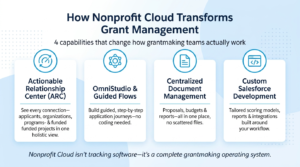
Actionable Relationship Center (ARC)
ARC gives grantmakers a holistic view of every relationship in their ecosystem — seeing how individual applicants, organizations, programs, and funded projects connect to each other. This is especially valuable for foundations managing multi-layered funding relationships where one grantee may be connected to several programs simultaneously.
Omni Studio and Guided Flows
OmniStudio allows teams to build step-by-step guided experiences for applicants and internal reviewers without heavy development work. This is a significant advantage for managing grants in Salesforce when the goal is to create a polished, user-friendly process that reduces errors and incomplete submissions.
Document Management
All grant-related documents — proposals, budgets, interim reports, audit materials — are centralized within Salesforce. Reviewers never need to download files separately or work across disconnected systems.
Customization Through Salesforce Development Services
Every grantmaking organization has unique workflows, and Salesforce development services allow nonprofits to extend and tailor the platform to fit those specific needs. Whether that’s a custom applicant scoring model, a bespoke reporting template, or integration with a financial system, expert Salesforce development services make it possible without rebuilding from scratch.
What Role Does Agentforce Play in Nonprofit Grantmaking?
This is where Salesforce grant management for nonprofits is heading into genuinely new territory. Agentforce Nonprofit grantmaking takes the existing Salesforce foundation and brings Salesforce AI agents for nonprofits directly into the grantmaking workflow — not just surfacing information, but taking action.
Here’s what that means in practice:
- Automated compliance monitoring — AI-powered agents monitor grantee submissions for compliance and compliance conditions and alert to issues before they arise.
- Intelligent applicant support — Agents can answer frequently asked applicant questions, direct users along the completion process, and identify the gaps in the applicant’s application in real time.
- Grant summary generation — Instead of a program officer manually reviewing every funding award record, Agentforce Nonprofit grantmaking can generate structured summaries of award status, disbursements, and outstanding requirements on demand.
- Prospect research automation — For organizations that both seek and award grants, agents help fundraising and grantmaking teams work in parallel, surfacing wealth signals and philanthropic activity without manual research.
In December 2025, Salesforce announced that Agentforce Nonprofit grantmaking will enable small and mid-sized nonprofits to operate like larger ones by leveraging automation to reduce the repetition of administrative work to free up staff to work on relationships and mission delivery.
What Are the Core Benefits of Salesforce Grant Tracking for Nonprofits?
By using Salesforce grant management for nonprofits, organizations experience benefits on various fronts:
- Visibility across the entire grant portfolio – from active grants to expired grants and applications submitted, everything is tracked in a single system of record.
- Reduced administrative overhead — Reminders, eligibility verification, and reporting processes are automated, saving staff time.
- Stronger funder relationships — Reporting on a regular and timely basis helps to establish trust with the funder. If the outcomes data is clear and available, it makes renewal conversations much easier.
- Compliance confidence — Especially for nonprofits managing federal grants or multi-funder programs the ability to track compliance requirements at the award level reduces audit risk significantly.
- Scalability — As a nonprofit grows its grantmaking activity, Salesforce scales with it. There’s no need to migrate to a new platform when grant volume doubles.
- Ecosystem integration — Salesforce grant management for nonprofits connects natively with fundraising, program management, donor engagement, and volunteer coordination — eliminating the data silos that plague organizations using disconnected tools.
How to Manage Grants in Salesforce: Getting the Implementation Right
Implementing Salesforce grants management software isn’t a plug-and-play exercise. Getting it right requires thoughtful planning, especially when it comes to configuring the data model for your specific grant types, workflows, and reporting needs.
Key steps for a successful implementation include:
- Mapping your grant lifecycle before configuration begins — understanding every stage, every stakeholder, and every document requirement
- Choosing the right product tier — NPSP with Grants Management Module vs. Nonprofit Cloud grant management, based on organizational complexity and budget
- Defining your applicant experience — how applications are submitted, what fields are required, how reviewers interact with submissions
- Setting up compliance tracking at the award level — tied directly to disbursement schedules
- Building dashboards and reports that leadership and program officers will actually use
- Training the team on how to manage grants in Salesforce consistently across departments
Knowing how to choose the right Salesforce nonprofit consultant makes a measurable difference in how quickly teams reach productivity and how well the system holds up over time.
Conclusion
Salesforce grant management for nonprofits is a powerful capability — but realizing its full potential requires more than a basic setup. The platform is deeply configurable, and the decisions made during implementation directly shape how effective it becomes for your team over time.
AnavClouds Software Solutions works with nonprofits at every stage — from choosing the right Salesforce product to building custom workflows, applicant portals, compliance frameworks, and QuickBooks Salesforce NPSP integration with existing financial systems.
Whether you’re implementing Salesforce grant management for nonprofits for the first time, migrating from NPSP to Agentforce Nonprofit, or looking to optimize what’s already in place — the right partner makes the difference between a system that’s technically functional and one that genuinely transforms how your team works.
FAQs
1. What is Salesforce grant management for nonprofits?
Salesforce grant management for nonprofits is a set of tools and data models built on the Salesforce platform to help organizations manage the full grant lifecycle — from applications to awards, compliance, and reporting — in one place.
2. What is the difference between NPSP and Nonprofit Cloud for grant management?
NPSP offers foundational grant tracking through the Outbound Funds and Grants Management modules. Nonprofit Cloud (now Agentforce Nonprofit) provides more advanced automation, AI capabilities, and industry-specific components for complex grantmaking operations.
3. Can small nonprofits use Salesforce for grant management?
Yes, Smaller nonprofits can start with NPSP’s free Outbound Funds Module for basic grant tracking and scale up to more advanced tools as their grantmaking grows and their needs evolve.
4. How does Agentforce improve nonprofit grantmaking?
Agentforce Nonprofit grantmaking uses AI agents to automate compliance monitoring, generate grant summaries, support applicants in real time, and reduce the administrative workload on staff, allowing teams to focus on mission-critical work.
Search Posts
Popular Posts
Author profile: Saransh Maurya, Content Writer at AnavClouds Software Solutions
Saransh
Maurya
About the author
Saransh Maurya is a dynamic and results-driven professional with a passion for innovation and problem-solving. Known for his analytical mindset and attention to detail, he excels at delivering high-quality solutions that drive business growth and operational efficiency. With strong communication skills and a collaborative approach, Saransh effectively bridges ideas and execution, contributing to successful projects and meaningful outcomes across diverse domains.
Recent Posts