How to Choose the Right Salesforce Nonprofit Consultant
Selecting the right partner is the number one reason for making a Salesforce investment, a working system, or an expensive shelf-ware project. The answer to the question of how to choose Salesforce nonprofit consultant talent for your organization is pretty simple: seek out candidates who have worked with a nonprofit organization and have Salesforce certifications to their names, are ready with a clear implementation process, and have references from other nonprofit organizations of similar size and mission. On a global basis, Salesforce now has more than 56,000 nonprofit organizations as its clients, so the number of consultants who purport to have “nonprofit expertise” has grown just as rapidly — and not all of them are equal. This guide explains how to choose Salesforce nonprofit consultant partners with assurance, what to look for before signing a deal, and what red flags to steer clear of and go back to your short list.
Why Does Choosing the Right Salesforce Consultant Matter So Much?
Nonprofits don’t have the money to experiment with. A poorly executed implementation isn’t just a financial loss; it’s a loss of time, donor faith, and the momentum of your mission. A Salesforce nonprofit implementation partner should also have insight into the needs of the nonprofit space, including donor lifecycle management, grant tracking, volunteer coordination, recurring gift processing, and compliance requirements. Most Salesforce consultants are trained to work on sales pipelines and service tickets, and not hierarchical household accounts and soft credit attributions. This is exactly why learning how to choose Salesforce nonprofit consultant talent carefully, rather than picking the first name that shows up in a Google search, protects both your budget and your long-term scalability.
A generalist Salesforce consultant may be very good at Sales Cloud for a SaaS organization but have little or no experience with the NPSP data models, data entry batches, or mapping of donors to organizations they represent. Once on the air, that chasm is revealed — duplicate records pile up, reports fail, and staff lose faith in the system in months. That’s why it’s crucial to know how to choose Salesforce nonprofit consultant talent from the start — and not after the initial deployment fails.
What Should You Look for When You Hire a Salesforce Nonprofit Consultant?
Here are some of the most important things to consider before you hire Salesforce nonprofit consultant talent:
- Nonprofit-specific portfolio — Request case studies of other nonprofits like yours in size, funding model, and program complexity (fundraising-heavy, program-heavy, multi-chapter, grant-dependent, etc.)
- Certified expertise — Find out if the Salesforce consultants with the certifications are the same individuals who will be working on your project or the company (Nonprofit Cloud Consultant, Salesforce Certified Administrator, Platform App Builder).
- Robust implementation methodology — A clear discovery, build, test, and training process, not a nebulous ‘we’ll see how it goes’ approach that leaves your team with more questions than answers about timeframes
- Post-launch support model — Ongoing managed services and a built-in escalation plan instead of a consultant who vanishes the week after go-live.
- Transparent pricing — Fixed-scope quotes or a clearly defined hourly rate and no change-order surprises in fine print.
This is precisely where most organizations get it wrong. They evaluate consultants purely on cost, when the real question of how to choose Salesforce nonprofit consultant partners should center on long-term fit, communication style, and proven capability — not just the lowest number on a proposal.
How Do You Find a Reliable Salesforce Nonprofit Consultant?
Knowing how to find Salesforce nonprofit partner options is just an extension of how to choose Salesforce nonprofit consultant talent the right way — it starts with where you look and how critically you evaluate what you find:
- Salesforce AppExchange Partner Directory — Filter listings by nonprofit industry specialization and read verified client reviews rather than relying on a company’s self-written description
- Salesforce Nonprofit Trailblazer Community — Peer recommendations from other nonprofit admins and consultants carry real weight, since they’ve usually worked with multiple partners over the years
- Referrals from similar organizations — A consultant who’s implemented Nonprofit Cloud well for a regional food bank may not be the right fit for a multi-site higher-education foundation with complex grant reporting needs
- LinkedIn and published case study research — Look for consultants who actively publish nonprofit-specific content and speak at sector events, not generic Salesforce marketing reposts
A genuine Salesforce nonprofit consulting partner with a strong track record will usually have public testimonials,
, and named client logos they’re comfortable sharing — not just vague claims of “100+ successful projects” with no verifiable detail behind them. If you’re still unsure how to choose Salesforce nonprofit consultant partners from a long shortlist, narrowing verified nonprofit case studies alone will eliminate most of the wrong fits before you even pick up the phone.
What Questions to Ask a Salesforce Consultant Before Signing?
This is where most of the real evaluation work happens, and it’s where many nonprofits rush through too quickly. The questions to ask Salesforce consultant candidates should include:
- How many NPSP or Nonprofit Cloud implementations has your team completed in the last two years, specifically?
- Can you walk me through your discovery and requirements gathering process, step by step?
- What does your team’s certification breakdown look like across admin, consultant, and developer roles?
- How do you handle salesforce data migration from legacy systems like Raiser’s Edge, DonorPerfect, or spreadsheets?
- What’s included in post-launch support, and for how long after go-live?
- Can you provide three references from organizations close to our size and budget?
- Who will be working on our account, and what is their direct experience level?
If a consultant hesitates, gives generic answers, or redirects to marketing language instead of specifics, that’s a signal to keep looking. Vague responses here often predict vague delivery later, and they’re usually the clearest sign you haven’t yet figured out how to choose Salesforce nonprofit consultant partners who’ll follow through on what they promise.
Is Salesforce Certification Important When Selecting a Consultant?
Yes — and this is genuinely non-negotiable, not a nice-to-have. A Salesforce-certified nonprofit consultant has formally tested platform configuration, data architecture, automation, and security models specific to the nonprofit data structure. Relevant Salesforce consultant certifications worth confirming include:
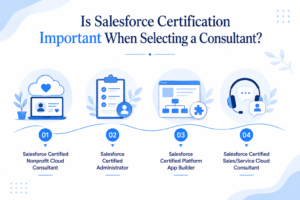
- Salesforce Certified Nonprofit Cloud Consultant — Specific to NPSP vs Nonprofit Cloud architecture, data models, and nonprofit business processes
- Salesforce Certified Administrator — Core platform configuration, security, and ongoing maintenance
- Salesforce Certified Platform App Builder — Custom app, object, and automation development beyond out-of-the-box functionality
- Salesforce Certified Sales/Service Cloud Consultant — Relevant if your organization also uses these modules alongside Nonprofit Cloud for case management or service delivery
Don’t just take a company’s word for certification claims — ask for individual Trailblazer profile links so you can verify credentials directly on Salesforce’s own platform before signing anything. Certification checks are one of the fastest, most objective filters when you’re working through how to choose Salesforce nonprofit consultant candidates under time pressure and a tight evaluation window.
What Does Nonprofit Salesforce Implementation Typically Cost?
Nonprofit Salesforce implementation costs can vary depending on the size of the project. It’s important to have a general idea of the prices, so you can better understand any quotes that you are receiving, rather than taking a guess. Single department implementations that reduce donor management needs to the bare bones are often lower in the five figures, and multi-program, multi-cloud implementations with custom integrations, data migration, and a huge amount of training can cost much more. Managed services are usually not a one-time payment, but are available on an ongoing basis, usually in the form of a monthly retainer.
When comparing quotes from different partners, watch for these cost-distorting red flags:
- Unusually low bids that don’t realistically account for data migration complexity or cleanup
- No clarity on what counts as “in scope” versus a billable change request once the project starts
- Missing line items for staff training and change management support
- No mention of post-launch support pricing, leaving you exposed once the contract ends
The cheapest quote on paper rarely turns into the cheapest total cost of ownership once rework, retraining, and support gaps are factored in down the line. Cost comparison is one piece of how to choose Salesforce nonprofit consultant partners, but it should never be the deciding factor on its own.
Should You Look for an NPSP Implementation Consultant or a Nonprofit Cloud Specialist?
This will greatly vary based on existing infrastructure and the technology’s maturity in your organization. If you have a current implementation of the Nonprofit Success Pack, an experienced NPSP implementation consultant can optimize, clean up, and extend your existing data model without having to rebuild from scratch. For new users and long-term migration, the pick is a Salesforce Nonprofit Cloud consultant who has real-world experience using the newer version of Salesforce, the one that’s now known as Agentforce Nonprofit, as Salesforce has stated that they won’t be adding new features to NPSP moving forward.
If you ask prospective partners explicitly about the best way to go forward with your maturity level, you will be alerted to anyone assuming a single approach without first gaining insight into your existing data, processes, and team capacity. This one conversation often reveals more about how to choose Salesforce nonprofit consultant talent than any polished sales deck ever will.
What’s a Practical Checklist Before You Commit?
Use this Salesforce consultant for nonprofits checklist as a final filter before signing any agreement, no matter how confident the sales conversation made you feel:
- Verified nonprofit-specific implementation history with named checkable references
- Confirmed Salesforce consultant certifications via individual Trailblazer profiles
- At least two completed reference calls with similar-sized nonprofits in your sector
- Clear, written scope of work, timeline, and defined project milestones
- Defined post-launch support terms and response-time commitments
- Transparent cost breakdown, including data migration, training, and change management
- Evidence of ongoing Salesforce development services capability for future scaling needs
If a consultant checks every box here, you’ve found a partner equipped to support your organization well beyond go-live, not just through the initial implementation phase. This checklist is, in many ways, the most practical answer to how to choose Salesforce nonprofit consultant talent you’ll find anywhere — it turns a fuzzy, overwhelming decision into a concrete, repeatable one.
Final Thoughts
Ultimately, how to choose Salesforce nonprofit consultant is about doing proper due diligence: Ask for certifications from Salesforce partners directly, request a few real-life references, get the pricing details from partners in detail, and work with consultants who have dedicated their professional efforts to the nonprofit sector rather than seeing it as a sideline between corporate contracts. First-time decisions make for first-time success: avoid rework and rebuild trust with your team and donors by making the right choices the first time in Salesforce nonprofit consultant decisions. The right consultant is not a one-time payment and a send-off service, but an extension of your team, a long-term partner. At AnavClouds Software Solutions our team works specifically with nonprofits on Salesforce development services, NPSP optimization, and Nonprofit Cloud implementation — not for any generic corporate playbook that was just adapted for nonprofits. If you’re still considering the option of how to choose Salesforce nonprofit consultant for your upcoming fiscal year, then it’s a topic worth discussing before the budget cycle is finalized.
Frequently Asked Questions
1. How much does it cost to hire a Salesforce nonprofit consultant?
The costs range between different configurations and organizations; in most cases, it is a few thousand dollars for an organization that has smaller configurations, and much more expensive for a full multi-cloud rollout, including custom integrations and training.
2. What certifications should a Salesforce nonprofit consultant have?
Search for Nonprofit Cloud Consultant, Platform App Builder, and Salesforce Certified Administrator credentials, which can be confirmed via the consultant’s public Trailblazer profile.
3. How long does a typical Salesforce nonprofit implementation take?
Most implementations take between 8 and 16 weeks, depending on data complexity, number of integrations, and whether you’re migrating from a legacy CRM system.
4. Can a Salesforce consultant help after the nonprofit implementation is complete?
Yes — reputable Salesforce nonprofit consulting partners offer ongoing managed services, including admin support, new feature rollouts, and system optimization post-launch.
Search Posts
Popular Posts
Author profile: Saransh Maurya, Content Writer at AnavClouds Software Solutions
Saransh
Maurya
About the author
Saransh Maurya is a dynamic and results-driven professional with a passion for innovation and problem-solving. Known for his analytical mindset and attention to detail, he excels at delivering high-quality solutions that drive business growth and operational efficiency. With strong communication skills and a collaborative approach, Saransh effectively bridges ideas and execution, contributing to successful projects and meaningful outcomes across diverse domains.
Recent Posts