Salesforce vs Microsoft Dynamics 365: Enterprise Breakdown
When weighing Salesforce vs Microsoft Dynamics 365, the main considerations are the level of customization your team needs, your current Microsoft environment, and your growth rate. Salesforce accounts for almost 25% of the CRM market nearly twice as much as the next largest competitor. If you’re choosing a platform you plan to use for the next 10 years for sales, service, and marketing, the difference will matter. In a Microsoft-dominated landscape, Dynamics 365 has its merits; however, in the quest for flexibility, a well-established partner network, and accelerated AI advancements, the choice between Salesforce vs Microsoft Dynamics 365 often becomes a clear winner.
What Is the Core Difference Between Salesforce and Microsoft Dynamics 365?
From a superficial point of view, they perform the same role: They enable users to monitor leads, manage pipelines, and maintain customer data. However, when you move to the architecture of these platforms, that’s when the Salesforce vs Microsoft Dynamics 365 comparison begins to differ.
Salesforce has been designed from the ground up as a multi-tenant CRM system that is delivered in the cloud. All your updates, new features, and AI functions are rolled out to all customers simultaneously, without forcing your IT teams into disruptive migrations. But Dynamics 365 was born of Microsoft’s legacy of on-premises software. It’s cloud-based, of course, but still has a bit of Windows infrastructure DNA, and a “set-up” that tends to presume that your business already resides in Outlook, Teams, and Azure.
That discrepancy comes to the fore as soon as you begin Dynamics 365 vs Salesforce comparison for a mid-size or enterprise implementation. In contrast, Salesforce is more likely to be platform-agnostic and to be flexible when it comes to working with unconventional processes. The advantage of Dynamics is that it’s a Microsoft product and it will play nicely with Microsoft products, but when your processes don’t fit into the “default” Microsoft Dynamics, it can feel like a bit of a restriction.
How Do Salesforce and Dynamics 365 Compare on Core CRM Features?
This is where the Salesforce vs Microsoft Dynamics 365 discussion turns into the real-world. The two platforms provide CRM fundamentals including contact management, opportunity tracking, opportunity forecasting, and case management, but they are not as deep or as flexible.
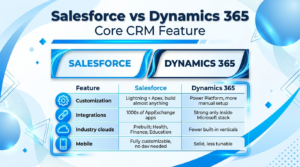
- Customization: Salesforce’s low-code Lightning App Builder and Apex programming language enable developers to construct virtually anything on top of the base CRM. While the Power Platform tools are available in Dynamics 365, some use cases may require more manual configuration when customizing.
- Integrations: There are thousands of pre-built applications and connectors available on Salesforce AppExchange, which include marketing automation, industry-specific tools, and more. If you’re in the Microsoft world, you’ll get a lot from the native Microsoft integration; if you’re not in the Microsoft world, you won’t.
- Industry-specific clouds: Salesforce has cloud solutions that are pre-built for specific industries such as Health Cloud, Financial Services Cloud, and Education Cloud, each of which comes with an industry-specific data model. There are fewer verticalized options in the box with Dynamics 365.
- Mobile experience: They both offer mobile apps, but Salesforce’s mobile CRM is more customizable without having to be a developer to make all the adjustments.
Once you put these features side by side, the Salesforce vs Microsoft Dynamics 365 difference isn’t about which one technically offers the feature; it’s about how much development work is required to get that feature production-ready.
Which Platform Leads on AI and Automation?
In 2026, AI is no longer just a desirable feature; it’s essential for many customers when choosing a CRM. The Salesforce Agentforce and Einstein AI capabilities are integrated into Salesforce’s core platform, providing predictive lead scoring capabilities, summarising cases using generative AI, and even enabling AI agents to complete repetitive service and sales tasks without any human input.
Microsoft responded with Copilot for Dynamics 365, which promises real value in automation where Microsoft 365 apps are currently in use day-to-day. However, independent reviewers recognize that Salesforce’s AI stack has come to maturity more quickly and has been incorporated more deeply into its entire platform, including Sales Cloud, Service Cloud, Marketing Cloud, and more, than it has been added on as an “add-on”.
The Salesforce vs Microsoft Dynamics 365 divide is growing larger, particularly in the area of Artificial Intelligence. AI readiness should be a standalone item on a CRM comparison enterprise team for any business that’s running one in 2026. When it comes to customer service, there’s no denying that Salesforce has the more battle-tested toolset, especially if you’re planning to integrate autonomous agents, predictive analytics, or generative AI.
What Does the Dynamics 365 vs Salesforce Comparison Look Like on Pricing?
One thing in pricing isn’t always a black-and-white issue for either side, and this is one aspect of the Salesforce vs Microsoft Dynamics 365 battle that shouldn’t be won in a hurry.
The base pricing of Dynamics 365 may seem more affordable on the surface, and there might be some discounts for those who already use Microsoft 365. While the base versions of Salesforce may appear more expensive upfront, it’s important to note that these are available as separate line items for Sales Cloud, Service Cloud, or Marketing Cloud Account Engagement.
Total cost of ownership is another story, though. Salesforce’s AppExchange allows for faster integration without the strain of paying for a custom-developed app, as many integrations and add-ons are already available. Many times, more specialized (and expensive) development hours are needed to arrive at the same functionality in a Dynamics implementation, particularly one that is highly customized. With a 3-5 year comparison, the enterprise might find that Salesforce wins when implementation, customization, and scaling expenses are taken into account.
Why Is Salesforce Considered the Best CRM for Enterprise 2026?
The three things that enterprise buyers value more than anything are scalability, ecosystem maturity, and velocity of innovation. After all, Salesforce has ticked all three boxes, and that’s why it’s the best CRM for enterprise 2026 in multiple industry reports.
- Scalability: With Salesforce’s multi-tenant cloud setup, you can manage millions of transactions without the need for infrastructure changes as your business expands.
- Ecosystem maturity: A Trailblazer community, a wealth of certified consultants, and a huge AppExchange marketplace make enterprises unlikely to ever hit a wall they can’t overcome with current applications and people.
- Continuous innovation: AI, automation, and data are three of the major areas where Salesforce has stayed ahead and innovated without the pain of major upgrades and changes that legacy systems require.
- Industry depth: Less custom build-out required for regulated or specialized industries with built-out clouds in healthcare, financial services, manufacturing, and more.
All this isn’t a criticism of Dynamics 365. For organizations that are more ingrained in the Microsoft ecosystem and have more straightforward CRM requirements, it’s a real success. However, in a situation where enterprise-level flexibility and scalability are required, Salesforce vs Microsoft Dynamics 365 comparisons generally point to Salesforce’s superior enterprise-class rollout capabilities.
When Should You Consider a Salesforce Alternative to Dynamics?
So, it’s safe to say that there are times when Dynamics 365 is appropriate, and once you understand those times, you’ll understand why some businesses are looking for a Salesforce alternative to Dynamics 365, or vice versa, before deciding which to use. But not all Salesforce vs Microsoft Dynamics 365 evaluations are created equal, and context is key.
If you’re looking at Dynamics 365, then it may be the answer.
- You are running 100 percent on the Microsoft suite (Azure, Teams, and Power BI) and are seeking excellent native integration.
- You need to deploy on-premises or hybrid and have compliance needs.
- Your CRM’s needs are simple and do not require a lot of customization.
Salesforce becomes the stronger pick when:
- You need a high level of customization without having to wait for the developers to cycle through all the configurations.
- You’re dealing with complex, multi-cloud operations in sales, service, and marketing.
- Growth is built on a foundation of automation and predictive analytics powered by AI.
- Access to a huge community of certified Salesforce professionals.
The vast majority of CRM comparison enterprise projects boil down to this choice: Microsoft ease-of-use vs Salesforce flexibility and innovation speed. Most of the time, it’s that second fact that prevails, and that’s why the Salesforce vs Microsoft Dynamics 365 debate continues as businesses grow.
How Do You Approach Switching from Dynamics to Salesforce?
As more companies are switching from Dynamics to Salesforce, some have experienced the Salesforce vs Microsoft Dynamics 365 trade-offs firsthand and are seeking more customization options, while others are simply looking for more AI features. If you are thinking about moving, let’s take a closer look at what a typical move entails:
- Review existing data and processes. Before you make any changes, map all the custom fields, workflows, or integrations that are deployed in Dynamics 365.
- Establish your desired Salesforce configuration. Choose the Sales, Service, and Marketing clouds that best suit your business and design your object model.
- Move data over a period of time. Lift and transfer contacts, accounts, opportunities, and historical data without losing any information using ETL tools or Salesforce-certified migration partners.
- Rebuild automations natively. Create Dynamics workflows with Salesforce Flow; this can be more powerful and easier to maintain over time.
- Educate your staff in advance. Salesforce’s user experience is different enough from Dynamics that it is critical to do some hands-on training prior to go-live to minimize friction to adoption.
- Conduct a concurrent testing process. Maintain both systems for a short time to check that data is accurate and to identify missing areas before removing Dynamics.
Switching from Dynamics to Salesforce can be accomplished without the disruption of months if done correctly. In fact, most mid-size businesses are migrated in a few months, not years, and no longer face the dilemma of Salesforce vs Microsoft Dynamics 365.
What Should Enterprises Evaluate Before a CRM Comparison Enterprise Decision?
It is best to compare Salesforce vs Microsoft Dynamics 365 against what needs to be accomplished, not on a list of features. Consider:
- Ownership cost, not only year-one licensing.
- Availability of easy-to-hire or train admins and developers for this platform.
- Seamless integration with existing tools and solutions.
- Specific requirements of the industry, particularly in regulated industries such as financial services or healthcare.
- Aligning AI and automation with your business’ direction, instead of where it’s at.
When you look at Salesforce vs Microsoft Dynamics 365 from this perspective, the decision is likely to be more obvious than you would think from a list of features.
How Can Salesforce Development Services Help You Maximize ROI?
Getting the right CRM tool isn’t enough; getting it right is what counts when it comes to ROI. It’s where industry-proven Salesforce development services come into play, turning a CRM from a collection of dust to a game-changer in how your teams sell and service customers.
After you’ve decided between Salesforce vs Microsoft Dynamics 365, you’ll need a good implementation partner who can build your third-party integrations, develop your Apex, design your custom objects, and configure your Einstein AI/agentforce setup for your workflow, not just the default configuration. When looking for a Salesforce development partner, you’re not only looking for someone who can help you realize your Salesforce vision faster, but you don’t want to deal with the hefty rework costs that come from rushing a rollout.
When evaluating Salesforce vs Microsoft Dynamics 365, the platform is important, but the implementation partner is equally crucial.
Conclusion
The Salesforce vs Microsoft Dynamics 365 choice isn’t an objective comparison of the “best” platform versus the “best” platform; it’s about which platform best aligns with your growth plans, tech stack, and customization needs. If you’re looking for flexibility, a sophisticated ecosystem, and a quicker speed of AI evolution, Salesforce is a better long-term investment. Whether you are considering this decision or contemplating a Salesforce migration, AnavClouds Software Solutions works with companies in all sectors to implement, customize, and optimize Salesforce for impactful and measurable ROI. When it comes to platforms or making the switch to Salesforce, the right partner is everything.
Frequently Asked Questions
Is Salesforce better than Microsoft Dynamics 365 for enterprises?
Scalability, customization, and AI are key strengths of Salesforce that it has over Microsoft Dynamics 365 in most Salesforce vs MS Dynamics 365 comparisons. Dynamics 365 may still be a good solution for businesses that are highly invested in the Microsoft environment and have simpler CRM needs.
How much does it cost to switch from Dynamics 365 to Salesforce?
Migration costs vary based on the amount of data, customizations, and integrations needed. For most midsize businesses, it’s prudent to anticipate data migration, configuration, training, and certified implementation-partner fees.
Can Salesforce integrate with Microsoft tools like Outlook and Teams?
Yes. Microsoft Teams rely on Salesforce, but are not able to do so without disrupting workflows? Salesforce integration with Outlook, Teams, and other Microsoft 365 apps on AppExchange can help them do just that.
Which CRM is easier to customize, Salesforce or Dynamics 365?
The customization capabilities feature a low-code Lightning platform and Apex programming language that allow complex and unique workflows without the heavy lifting of manual configuration, giving Salesforce the edge in this area.
Search Posts
Popular Posts
Author profile: Saransh Maurya, Content Writer at AnavClouds Software Solutions
Saransh
Maurya
About the author
Saransh Maurya is a dynamic and results-driven professional with a passion for innovation and problem-solving. Known for his analytical mindset and attention to detail, he excels at delivering high-quality solutions that drive business growth and operational efficiency. With strong communication skills and a collaborative approach, Saransh effectively bridges ideas and execution, contributing to successful projects and meaningful outcomes across diverse domains.
Recent Posts