Salesforce Implementation Cost: What You’ll Actually Pay
As one of the first numbers that businesses look at before implementing Salesforce, Salesforce implementation cost is one of the most difficult to get a straight answer on. Salesforce costs depend on cloud types and the number used. For a small deployment, the price can fall below $10,000, while an enterprise deployment with multiple clouds can exceed $500,000. The amount of money that can be lost or won is significant, as global CRM software spending is expected to reach $103.51 billion by 2026. This guide explains why Salesforce implementation costs vary. It also covers what enterprise buyers should budget for and the hidden costs most quotes overlook. It explains how to calculate the total cost of ownership before signing a contract.
How Much Does Salesforce Implementation Cost in 2026?
This is the first question that comes to mind for most buyers, and the answer is genuine only when it comes to the size and scope of the business. Based on market data from implementations completed so far this year in the United States and globally, here’s what companies are paying.
Small Business Salesforce Implementation Cost
The typical implementation cost for a small business with Salesforce is $5,000 to $25,000. Typically, it includes basic CRM setup, basic automation, and basic reporting for Starter or Professional editions.
Mid-Market Salesforce Implementation Cost
The Salesforce implementation price for growing companies typically falls anywhere between $25,000 and $150,000. This tier typically involves more than one department. It includes a moderate amount of data migration, a few integrations, and workflow automation customized for sales or service processes.
Salesforce Implementation Cost Enterprise Pricing
Salesforce implementation cost enterprise deployments increases to $150,000 to $500,000 and more. Enterprise pricing is driven up by multi-cloud deployments, extensive customization, integrations with legacy ERP systems, and regulatory standards in regulated industries. Unlike implementation, licensing is standalone, with Sales Cloud plans costing about $25 per user/month (on Starter up to $165-$330/user/month on Enterprise and Unlimited editions).
What Factors Influence Salesforce Implementation Cost?
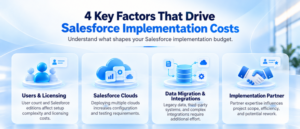
Every Salesforce project is different and will be priced differently due to each business’s starting point. These factors help to find out why there is a wide range in Salesforce implementation costs from one quote to another.
Number of Users and Licensing Tier
The more seats, the more licensing fees, security profiles, and permission sets to configure. The edition you choose (Starter, Professional, Enterprise or Unlimited) also moves the licensing and implementation costs.
Cloud Products Included in the Project
There is a much lower cost of a single Sales Cloud deployment than a Sales Cloud, Service Cloud, and Marketing Cloud rollout. Each new cloud brings in its own configuration logic and test needs.
Data Migration and Integration Complexity
A modern CRM system’s data can be transferred quicker and more cost-effectively than 10 years of spreadsheets and disparate systems. Each added third-party integration to the project requires extra development hours. Additionally, QA hours are needed for ERP platforms, billing tools, and support desks.
Choosing an Implementation Partner
Choosing a certified Salesforce partner adds an upfront cost but generally reduces rework, scope shortfalls, and rollout delays. In some cases, a DIY build may appear to be less expensive on paper, but actually is more so once corrections and re-configuration are taken into account.
What Are the Hidden Costs of Salesforce Implementation?
Breadwinners start to exceed their budgets here. The hidden costs of Salesforce implementation are not always included in the initial proposal but can be seen on the Salesforce invoice.
Data Cleanup and Sandbox Environments
Legacy data can be a lot harder to clean than most teams realize, will take a lot more hours, and can be dirty or duplicated. Other QA and UAT sandboxes also come with additional licensing fees.
AppExchange Subscriptions and Post-Launch Support
These e-signature, CTI, and advanced reporting add-ons have subscription fees added on top of core license fees. During the first 60-90 days after go-live, bugs and adoption issues typically appear. These must be addressed, and they are not always in the initial quote.
Scope Creep and Ongoing Administration
When a project is underway, “just one more field” or “can we also automate this” requests add up quickly. There also needs to be someone, whether it’s an internal administrator who is hired, or a managed services contract in the $10K to $45K per year range.
The one thing that you can do to avoid budget overruns is to build in a contingency buffer of 15-20% for hidden costs of Salesforce implementation.
How Do You Calculate Salesforce Total Cost of Ownership?
The implementation of Salesforce is limited to the launch phase, and only the cost of that is covered. That’s what you’ll need to pay—this is the actual number that counts in the long-term budgeting process—and this is called Salesforce total cost of ownership.
What TCO Includes Beyond Implementation
A full Salesforce total cost of ownership estimate accounts for annual licensing fees across all clouds. It also includes admin and support costs, periodic upgrades, and AppExchange subscription fees. Finally, training costs for new employees accrue over time.
Why TCO Matters More Than the Initial Quote
Businesses that skimp on Salesforce implementation budgets underfunded Salesforce around year two. This is when adoption is most critical and ROI is expected to peak. When it comes to planning the total cost of ownership from the outset, that gap is averted.
Can a Salesforce Implementation Cost Calculator Simplify Budgeting?
While a Salesforce implementation cost calculator cannot replace a true scoping conversation, it’s a great place to begin the discussion with vendors.
What Information a Calculator Needs
Typically, most tools require information on the number of users, the edition (Starter, Professional, Enterprise, Unlimited), the number of clouds to be deployed, data volume to be migrated, and third-party integrations. These, when plugged in, give direction for budgeting.
Limitations of Cost Calculators
A Salesforce implementation cost calculator can identify when a vendor quote is too high. This may indicate excessive customization. It can also reveal when the quote is too low, suggesting scope gaps. Use it as a compass and not a number.
What Will Salesforce Implementation Pricing 2027 Look Like?
Salesforce implementation pricing 2027 is determined by two market trends that are already present: AI pricing based on consumption and a history of Salesforce’s list price increases.
Consumption Based AI Pricing
Salesforce has decided to opt for usage-based pricing for its AI capabilities via Flex Credits, around $500 per 100,000 credits. The latter complicates the estimation of a flat cost of an AI-heavy implementation, as the cost is now proportional to actual usage.
Locking In Rates Before the Next Increase
The market anticipates additional changes. Armed with a multi-year price lock, businesses can anticipate the Salesforce implementation cost for 2027 and secure a frozen price.
How Can Businesses Lower Salesforce Implementation Cost?
Reducing Salesforce implementation cost doesn’t mean selecting the most affordable vendor, as this generally leads to negative consequences in the long term.
Phase the Rollout Instead of Going All-In
Begin with basic CRM features. Then gradually implement advanced automation and secondary clouds to avoid a large initial scope.
Clean Data Before Migration, Not After
The cost of correcting duplicate records, incorrectly formatted fields, and outdated information before migration is much less. This is cheaper than finding the same issues during the project.
Work With an Experienced Implementation Partner
A partner that can scope properly from the start, not realizing it needs to add more items at a later stage, keeps Salesforce implementation cost predictable and avoids late-stage change orders.
Final Thoughts
A fixed Salesforce implementation cost does not exist. It depends on the degree of complexity, customization, and long-term value that your business seeks from the platform. Successful businesses consider invisible costs. They decide on TCO and select a scope that matches actual operational requirements. They avoid a vendor’s upsell pitch, regardless of spend, whether $10,000 or $300,000. Getting Salesforce up and running correctly from the start is cost-effective. It is much better than starting with a flawed plan. Our Salesforce consulting team at AnavClouds Software Solutions provides businesses with maximum transparency in cost upfront, from the initial conversation, without the element of surprise when it comes to go-live.
Frequently Asked Questions
How much does Salesforce implementation cost for a small business?
A basic Salesforce implementation, with core CRM set up and standard automation and reporting (depending on requirements) is typically $5,000 to $25,000 for small businesses, depending on the configuration.
Does Salesforce charge a one-time fee for implementation?
Implementation costs the project; as the business grows, Salesforce incurs per-user license fees plus admin support, AppExchange apps, and upgrades.
Why do Salesforce implementation costs vary so much between vendors?
The fees vary by scope depth, data migration complexity, and integrations involved, and by whether the quote includes hidden fees.
Does a Salesforce implementation cost calculator give an accurate quote?
This guidance helps with decisions based on Users, edition, and Clouds, aiding budgeting and quote comparisons.
Search Posts
Popular Posts
Author profile: Saransh Maurya, Content Writer at AnavClouds Software Solutions
Saransh
Maurya
About the author
Saransh Maurya is a dynamic and results-driven professional with a passion for innovation and problem-solving. Known for his analytical mindset and attention to detail, he excels at delivering high-quality solutions that drive business growth and operational efficiency. With strong communication skills and a collaborative approach, Saransh effectively bridges ideas and execution, contributing to successful projects and meaningful outcomes across diverse domains.
Recent Posts