Shopify vs Salesforce Commerce Cloud: Pick Your Fit
The fact is that picking the inappropriate eCommerce provider is an error that you do not regret at the very moment, yet you regret it once every eighteen months when you find that the business has expanded further, yet the platform has not evolved along with it.
The stakes are higher than ever. Global retail eCommerce sales hit an estimated $6 trillion in 2024 and are projected to reach nearly $8 trillion by 2028. That type of growth rewards companies that are established on the correct basis.
Within the majority of the business, the shortlist will be reduced to two platforms, which are Shopify and Salesforce Commerce Cloud. Both are excellent. However, it is not a coin to Shopify vs Salesforce Commerce Cloud, but rather a business fit choice, and this guide will help you make it with certainty.
What Is Shopify and Who Is It Built For?
Shopify was started in 2006 with a simple mission of ensuring that anyone can sell online, without the need to be technical. Almost 20 years later, that mission continues to influence all aspects of the platform’s functioning.
Millions of stores today are operated on Shopify in 175+ countries. It is the platform of preference for direct-to-consumer brands, startups, and fast-growing retailers who do not require a large technical team or a complex implementation process behind them to get online fast. Here lies the hype: it is possible to create a professional, fully operational store within days, not months.
Its drag-and-drop editor, vast library of ready-made themes, in-built payment processing, and marketplace (8,000+ apps) make it one of the most available platforms in the market. Social commerce integrations, multi-currency support, and in-built analytics complete a feature set that quite literally can meet the needs of a wide range of growing businesses without heavy customization.
Shopify Plus – its business-oriented level (recommended price starting at approximately 2500/month) features further expansion, more B2B options, custom checkout via Checkout Extensibility, and business workflow automation with Shopify Flow. Shopify Plus finds a convenient compromise between high-growth mid-market brands that require increased horsepower but not an enterprise-level implementation.
What Is Salesforce Commerce Cloud and How Does It Work?
Salesforce Commerce Cloud is another type of platform, and the recognition of the difference between Shopify vs Salesforce Commerce Cloud is the most important to see clearly the decision.
Initially, Salesforce Commerce Cloud (SFCC) was formerly known as Demandware when Salesforce acquired it in 2016 and is an enterprise-level eCommerce platform aimed at businesses that operate at serious scale and manage serious complexity. It exists in two center types of Salesforces B2C Commerce Cloud that enable retail interactions with consumers and Salesforce B2B Commerce Cloud that enables wholesale, distributor, and account-based modes of sale.
The real difference between SFCC and other similar products is not only what it can do without the rest of the Salesforce community, but what it can do in connection with it. Since it is a native Salesforce product, it is real-time connected with Sales Cloud, Service Cloud, Marketing Cloud, and Tableau. There is a single connected environment between customer purchase history, open service tickets, marketing engagement, and sales pipeline data. That connectivity is a significant competitive strength to businesses that are dependent on the power of unified customer data as the basis of their whole go-to-market strategy.
Einstein AI takes the next level to the game – it drives predictive product suggestions, intelligent search findings, and automated merchandising choices by utilizing actual behavioral and CRM information. These abilities do not merely enhance customer experience at the enterprise level. They move the revenue figures straight up.
Shopify vs Salesforce Commerce Cloud: A Full Feature-by-Feature Comparison
Having a distinct understanding of both platforms separately, it is time to make Shopify vs Salesforce Commerce Cloud meet each other. This is not the purpose of proclaiming one platform as universally better than the other, but rather to facilitate your knowledge of which one will be more appropriate in your own business reality. The complexity of setup and pricing, as well as scalability and integrations, all tell something significant about the areas of their greatest success and failure.
Ease of Use
Your store life is a fast thing to do, and this is the point of least differentiation between Shopify vs Salesforce Commerce Cloud. Shopify has been built to go fast. It has guided configuration, premade themes, and no-code customization, which implies that non-technical teams can create a functional store in days. Salesforce Commerce Cloud is much more complex. Implementation of Salesforce correctly means it needs certified Salesforce developers, a developed implementation plan, and an expert consulting partner. The tradeoff is apparent: Shopify provides you with speed; Salesforce Commerce Cloud provides you with depth.
Commerce Cloud and Shopify Features
The features of the two platforms are similar; however, Commerce Cloud and Shopify features can be applied to the needs of various operations. While comparing Shopify vs Salesforce Commerce Cloud, Shopify has a very high level of coverage of all the essential eCommerce requirements. This includes inventory management, cart recovery, discount engines, and shipping. Shopify Plus provides support for B2B and workflow automation. Salesforce Commerce Cloud continues with the Einstein AI-based personalization, headless commerce, support, and advanced order management, and native CRM data integration. The Salesforce B2B Commerce Cloud includes contract pricing, account hierarchies, and quote management, which are important features in wholesale businesses that cannot be matched by Shopify.
Scalability and Growth
The debate of Shopify vs Salesforce Commerce Cloud is most critical to growing businesses in terms of scalability. Shopify Plus features stable high traffic and multi-market selling, which is why it is a good fit for fast-growing DTC brands. Its shortcomings are felt, however, as the operation gets more complex. Salesforce Commerce Cloud is an enterprise-scale commerce platform. It is built with multi-site, multi-language, and multi-currency deployments, and millions of SKUs and complex customer journeys are not compromised. Salesforce Commerce Cloud is more robust in the long-term basin of enterprises that have serious scale goals.
Salesforce vs Shopify Pricing
One of the most conclusive aspects of the Salesforce vs Shopify comparison is pricing, and the difference is dramatic. The pricing of Shopify is clear and open, and packages begin at $39/month and Shopify Plus at approximately $2,500/month. Total costs are predictable. Salesforce Commerce Cloud is a GMV-based revenue share platform that does not have flat prices in the market. The total costs can go into six figures when implementation, customization, and continued Salesforce development services are involved. In the case of SMBs, Shopify is obviously more accessible. Between Shopify vs Salesforce Commerce Cloud, Commerce Cloud can be justified by its cost, where the payback of the entire Salesforce ecosystem is worth the investment in the enterprise.
Integrations and Ecosystem
The integration ecosystems of both Shopify vs Salesforce Commerce Cloud are robust and based on diverse philosophies in the Shopify vs Commerce Cloud debate. With 8,000+ third-party integrations in its app store, Shopify integrates with virtually any tool in that stack, whether it is a marketing tool, a logistics tool, an analytics tool, or many others. Salesforce Commerce Cloud does not have as many third-party native integrations, but it can real-time connect with Sales Cloud, Service Cloud, Marketing Cloud, and Tableau. Its access to the Salesforce AppExchange also enhances its enterprise features. When you have a business in Salesforce, the ecosystem connectivity of Commerce Cloud cannot be compared.
Customization and Development
Customization flexibility is a prerequisite for businesses having complex needs, and this is where Salesforce Commerce Cloud Shopify Enterprise features diverge radically. Shopify is based on its Liquid templating language and Checkout Extensibility to be customized. It is architecturally friendly but biased on purpose to ensure that some workflows are standardized. Salesforce Commerce Cloud supports fully headless architectures, which allows development teams to have full control of the frontend, but the platform is responsible for handling commerce logic at the back end. In the case of companies that require highly tailored experiences, collaborating with an experienced team offering Salesforce development services opens the potential of the platform in a way that Shopify can never match.
Analytics and Reporting
Every smart commerce choice is based upon data, and the difference between Shopify vs Salesforce Commerce Cloud counts in this situation. Shopify has good in-built analytics, sales performance, traffic sources, customer behavior, and inventory reporting, which can be extended to third-party BI tools to provide more detailed analysis. Natively connected to Einstein Analytics and Tableau, Salesforce Commerce Cloud provides predictive insights, lifetime value modelling of customers, and cross-channel attribution, all with live CRM data. In businesses where merchandising and personalisation are competitive advantages based on data analysis; the reporting capability of Salesforce Commerce Cloud is in a whole new category.
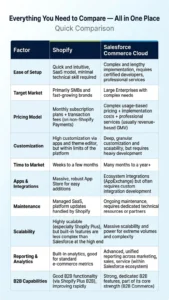
Shopify vs Salesforce Commerce Cloud: Quick Comparison Table
Shopify vs Salesforce Commerce Cloud — Which One Is Right for You?
It is not about which platform is more impressive on paper, but which one works best in the context of where your business is and where it is headed at the end of the day, Shopify vs Salesforce Commerce Cloud. Shopify is most effective when there is speed, ease, and cost control required by businesses. Salesforce Commerce Cloud has been developed to meet the requirements of enterprises requiring deep CRM connectivity, sophisticated personalization, and the framework to support complex operations at scale.
When you have made up your mind that Salesforce Commerce Cloud is the way to go, AnavClouds Software Solutions will ensure that the change will be easy, strategic, and with long-term outcomes. Let’s talk.
Frequently Asked Questions (FAQs)
Which is better — Shopify or Salesforce Commerce Cloud?
Choosing between Shopify vs Salesforce Commerce Cloud can be determined by the size of your business. Shopify is appropriate when there is a need for SMBs to be simple and fast. Salesforce Commerce Cloud is designed to support companies that require a profound CRM solution and sophisticated personalization.
Is Salesforce Commerce Cloud good for small businesses?
Not typically. Small businesses find it expensive and complicated. Shopify is a much more feasible and less expensive starting point for the majority of small business owners.
Can Shopify connect with Salesforce?
Yes, though it needs third-party connectors or custom integration. Salesforce Commerce Cloud is a native Salesforce product that interoperates with the whole platform without any extra middleware.
How much does Salesforce Commerce Cloud cost compared to Shopify?
Shopify begins at 39/month; Plus $2500/month. Salesforce Commerce Cloud operates under GMV-based prices – the costs of the system with implementation on enterprise businesses often exceed six digits. Take important considerations while choosing between Shopify vs Salesforce Commerce Cloud.
Search Posts
Popular Posts
Author profile: Saransh Maurya, Content Writer at AnavClouds Software Solutions
Saransh
Maurya
About the author
Saransh Maurya is a dynamic and results-driven professional with a passion for innovation and problem-solving. Known for his analytical mindset and attention to detail, he excels at delivering high-quality solutions that drive business growth and operational efficiency. With strong communication skills and a collaborative approach, Saransh effectively bridges ideas and execution, contributing to successful projects and meaningful outcomes across diverse domains.
Recent Posts