Choose Salesforce Nonprofit Implementation Partners Right
Being an NGO that works towards a cause is one of the best things an NGO can do. Mission and impact are not solely on passion; it’s on data, relationships, and smart operations. But that is where Salesforce nonprofit implementation comes into play. Many nonprofit and higher education organizations around the world have adopted Salesforce, and why not? The platform combines donor management, fundraising, volunteer coordination, and program tracking all in one. However, it’s not only about purchasing a license; it’s about collaborating with the right Salesforce nonprofit implementation partners with a deep understanding of your vision, your audience, and your communities.
Why Nonprofits Are Choosing Salesforce — And Why Implementation Matters
In 2024, the CRM market for nonprofits was $2.72 billion and is expected to reach $5.12 billion by 2032, adding up to an 8.23% CAGR — a reflection of the amount of investment in purpose-built CRM solutions across industries.
What most generic tools simply can’t do is provide the full picture of your constituents, an AI-powered engagement engine, and the ability to grow as your organization expands. That’s what Salesforce for nonprofits allows you to do: Give you a view of your constituents that’s 360 degrees, an AI-powered engagement engine, and flexibility that scales as your organization grows. However, all of that value is worthless if the nonprofit CRM implementation plan is not in place.
This is the problem; most of the time, it’s not a platform problem. They’re partnership failures. Organizations either try to do it themselves or hire a consultant who does not have nonprofit expertise. The result? Features that aren’t used, disorganized data, low adoption rates, and a CRM system that hinders more than it helps.
Hence, selecting the perfect Salesforce nonprofit implementation partners can be the most crucial choice in your Salesforce journey.
What Do Salesforce Nonprofit Implementation Partners Actually Do?
It’s important to know what certified Salesforce nonprofit consultants offer before you begin narrowing down your list. They don’t just set up the technical pieces; they’re involved in the entire process.
Strategic Discovery & Needs Assessment
The first step in a good partner’s job is to make excellent inquiries. What do you consider to be your major fundraising issue? What do you use in tracking donor interactions? What will the funders want to know about your outcomes? This discovery phase outlines the processes you’ll use and determines whether you should go with NPSP (Nonprofit Success Pack) or with the newer Salesforce Nonprofit Cloud.
Custom Configuration & Development
Each nonprofit is unique. Food banks must keep records of distributions. Arts groups could have to process memberships and ticket sales. You need to customize your Salesforce nonprofit solutions, not the other way around. For example, experienced partners tailor objects, fields, automation, and dashboards to fit the way your team works.
Data Migration
The task of transferring years of donor history, event information, and constituent information into a new system is a high-stakes one. No critical information is lost as you transition to Salesforce nonprofit implementation partners do the data cleansing, field mapping, deduplication, and validation.
Training & Change Management
If your team is not using Salesforce the way it was designed, then the most well-set-up Salesforce org is of no use. Partners train, onboard, and support staff members individually and by organization with confidence in the system, from the executive director to the volunteer coordinator.
Ongoing Support & Optimization
Implementation is not a one-shot deal. Nonprofits change, programs change, and Salesforce gets updated twice a year. The ideal nonprofit CRM consulting services provider remains on the scene post go-live, optimizing, troubleshooting, and growing.
Salesforce Nonprofit Cloud vs. NPSP: What’s the Difference?
One of the early questions we hear as Salesforce nonprofit implementation partners is: “Which platform foundation is right for my organization?”
NPSP (Nonprofit Success Pack) has provided the foundation for Salesforce for nonprofits. It builds core Salesforce, adding objects specifically for the nonprofit sector, such as Households, Affiliations, and Recurring Donations. NPSP is available for new organizations, and many mid-sized nonprofits are effectively using NPSP.
Salesforce Nonprofit Cloud (NPC), on the other hand, is Salesforce’s next-generation solution designed specifically with fundraising capabilities, program management, grantmaking, and enhanced artificial intelligence via Agentforce from the ground up. For companies that need to grow or venture out on their own, it’s the preferred route.
A competent Salesforce implementation partner for a nonprofit does not pressure you to opt for the “high-end” option—rather, they work with you to determine what is the best fit for your budget, team size, and level of complexity.
Key Capabilities You Should Expect from Salesforce Nonprofit Solutions
If you are working with Salesforce nonprofit implementation partners, you should match the features that you configure to your actual operations. Below is a summary of the key areas:
Donor & Constituent Management
The ability to have a detailed and accurate record of any donor, volunteer, grantee, and beneficiary is at the core of nonprofit cloud CRM. Whether it provides history, communication preferences, attendance, case notes, and more, it’s all in one place and visible across your team.
Fundraising & Campaigns
Whether you’re collecting online on a giving page, managing recurring gifts, hosting a peer-to-peer fundraiser, tracking major gifts, or anything in between, Salesforce for nonprofits offers a connected fundraising ecosystem. Partners set up donation pipelines, automate acknowledgements, and seamlessly connect payment processors.
Program & Impact Tracking
Program management is one of the least used capabilities of nonprofit CRM solutions. With Salesforce Nonprofit Cloud, organizations can more easily link participant records, services delivered, and outcomes, so they can tell funders about their impact in data-driven ways.
Grant Management
The built-in Grantmaking suite enables Salesforce nonprofit implementation partners to streamline the entire grant process from proposal creation and tracking to reporting, compliance, and relationship building with funders. Salesforce’s AI can even provide personalized proposal content suggestions according to the donor’s preferences.
Volunteer Coordination
Coordinating volunteers throughout shifts, across sites, and roles is not an easy job to do. Salesforce nonprofit implementation includes volunteer scheduling, hour tracking, automated reminders, and engagement reporting — making your volunteer program as efficient as your fundraising.
Reporting & Dashboards
Data is useless if it’s not in view. Partners develop customized dashboards that surface the metrics that are most important to your leadership and funders, such as donor retention, program outcomes, fundraising performance, and more.
The Salesforce Nonprofit Implementation Process: What to Expect
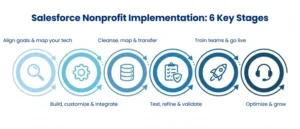
Knowing what a structured Salesforce nonprofit implementation would be like allows you to set realistic expectations and hold your partner accountable. Here’s how quality Salesforce nonprofit implementation partners typically approach the process:
Stage 1: Discovery
Set goals, evaluate current technology, determine key stakeholders, and develop a comprehensive implementation plan with detailed milestones and timelines.
Stage 2: Configuration & Customization
Configure your Salesforce org as outlined in the agreement — create custom objects, automate workflows, integrate with other tools that you already use, and add any platform-specific apps that your team requires.
Stage 3: Data Migration
Cleanse, map, and migrate existing data from spreadsheets, legacy CRMs, or siloed systems to Salesforce, with strict quality control before go-live.
Stage 4: Testing & QA
Perform multiple iterations of testing in all setups, integrations, and flows. At this point, engage end users to bring up issues in real-world use.
Stage 5: Training & Launch
Train Staff, finalize documentation & go live with support plan.
Stage 6: Post-Launch Support
Continuous improvements, troubleshooting, and new features as needed.
How to Evaluate and Hire Salesforce Nonprofit Implementation Partners
Not all Salesforce nonprofit consultants are built the same. Here’s what to look for when you’re ready to hire Salesforce nonprofit implementation partners:
- Salesforce Certification: Make sure your partners have active Salesforce certifications, especially those that relate to Nonprofit Cloud, NPSP, and other Salesforce products. Certification is a minimum level of technical competence.
- Successful Nonprofit Experience: Request case studies or references from similar organizations in mission, size, and/or sector. If your partner has experience serving nonprofits in the health care sector, he or she might look at the needs of an arts program in an entirely different way.
- End-to-End Service Capability: The top Salesforce nonprofit implementation partners don’t simply set up your system and then walk away. They can provide discovery, implementation, data migration, training, and support all in one.
- Understanding of Nonprofit-Specific Workflows: Donor stewardship, grant compliance, program outcome reporting. You need to be able to explain them to your partner, not just teach them in theory.
- Clear Communication: Scope, timelines, and deliverables should be well documented. If your partner is vague during the sale, he will be vague when it actually comes to delivery.
- Post-Go-Live Commitment: Salesforce is an active platform. Select the nonprofit CRM consulting services providers that provide a structured support and optimization program after launch.
Use Salesforce’s Partner Finder tool and the Trailblazer Nonprofit Hub community to get recommendations from other nonprofit leaders who’ve been there before you.
Common Mistakes Nonprofits Make During Salesforce Implementation
Despite best intentions, nonprofits can face challenges when implementing Salesforce. It’s important to know these potential issues in advance to save you quite a bit of time and money.
- Avoiding the discovery phase. If you have not done a thorough process mapping, you will rush into setting up a process that has no resemblance to your organization’s processes.
- Not considering data migration first. If the data is dirty, then the data out is dirty. Data cleansing before migration is a must if you want to make the task a success.
- Under-investing in training. Whether it’s the most robustly set up nonprofit cloud CRM, it’s no use if the staff isn’t trained and supported in the transition.
- Selecting the least expensive partner rather than the most experienced. Salesforce for nonprofit organizations implementation is a specialized task for the nonprofit. The expense of implementing a sub-standard solution will almost always outweigh the savings of going with the cheapest solution.
Failure to plan for continuous improvement. However, Salesforce is not a “set and forget” solution. Establish an ongoing partnership model from the outset.
Conclusion
Selecting the ideal Salesforce nonprofit implementation partners isn’t just a tech decision — it’s a mission-critical one. How you use Salesforce, from donor engagement and automation to impact measurement and grant management, will directly impact the value you gain from it. The main difference between a successful deployment and a frustrating deployment typically depends on the skills, experience, and continued dedication of your implementation partner. We at AnavClouds Software Solutions are certified Salesforce specialists, nonprofit savvy, and dedicated to helping mission-driven organizations achieve more with their technology. When you’re looking to truly make the most of your Salesforce Nonprofit Cloud investment and truly make an impact, we’d love to be a part of your journey.
FAQs
What is the average cost of Salesforce nonprofit implementation?
The price of implementing Salesforce for nonprofits is different in accordance with the organization’s size, the complexity of the requirements, and the volume of customization that is needed. Implementation costs are likely to begin at $5,000 to $15,000 for smaller, less complex nonprofits, but will be much higher for mid-to-large scale nonprofits that have more complex workflows, integrations, and data migration requirements. There are numerous good partners that have different options available that will provide you with a phased approach so that the costs are manageable.
How long does a Salesforce nonprofit implementation typically take?
The time it takes to implement a Salesforce nonprofit organization depends on the scope, but typically ranges from 3 to 12 months. The time to implement and complete a simpler setup with less customization can range from 90 days, whereas a complex setup with deep integration, large-scale data migration, and multi-department implementation can take up to 1 year. A good discovery process up front results in significant de-spinning in the tail.
Do nonprofits get Salesforce for free?
The Power of Us Program provides eligible nonprofits up to 10 free licenses for key Salesforce products, as well as discounts for other products and subscriptions. However, the licenses themselves are just one part of the investment. The cost of working with a Salesforce nonprofit consultant to set up, customise, and deploy the platform effectively is a separate one that’s well worth budgeting for.
What is the difference between NPSP and Salesforce Nonprofit Cloud?
The Nonprofit Success Pack (NPSP) is a managed package built on top of standard Salesforce, offering donor and constituent management tools. Salesforce Nonprofit Cloud is a more recent and mission-specific solution that includes built-in AI features, program management, and fundraising capabilities. The answer lies in your organization’s size, budget, and maturity level — and your favorite Salesforce nonprofit implementation partners will answer with a straightforward recommendation on your needs and not a sales pitch.
Search Posts
Popular Posts
Author profile: Saransh Maurya, Content Writer at AnavClouds Software Solutions
Saransh
Maurya
About the author
Saransh Maurya is a dynamic and results-driven professional with a passion for innovation and problem-solving. Known for his analytical mindset and attention to detail, he excels at delivering high-quality solutions that drive business growth and operational efficiency. With strong communication skills and a collaborative approach, Saransh effectively bridges ideas and execution, contributing to successful projects and meaningful outcomes across diverse domains.
Recent Posts