Salesforce for Healthcare: 2026 Guide to Smarter Patient Care
The challenges facing healthcare organizations today are more than ever before, as their costs continue to climb, data is distributed across a variety of platforms, and administrative burden and workload are high, while patients expect their experience to be as easy as any consumer app. This is where Salesforce for healthcare comes into play. Powered by the world’s CRM platform, Salesforce Health Cloud provides hospitals, clinics, payers, and public health agencies with a single, AI-driven platform to power patient relationships, automate workflows, and provide connected care. Whether you’re seeking HIPAA compliance guidance, exploring the integration of Electronic Health Records, or pondering the use cases for Agentforce, this guide addresses all your pressing concerns, implementation paths, and the essential steps to take when selecting the ideal Salesforce development services partner for your needs.
Why Is Salesforce for Healthcare More Relevant Than Ever in 2026?
In 2024, the U.S. healthcare CRM industry is valued at $12.02 billion and will hit $28.62 billion by 2033, a CAGR of more than 10%, with Salesforce for healthcare at the heart of this transition.
Healthcare has faced issues of silo mentality and clinician burnout for a long time, and the provision of reactive care has been a problem. New tools are needed to solve the complexities of modern care coordination—and that’s a problem legacy tools weren’t built to address. Salesforce for healthcare tackles this head-on by bringing together clinical and non-clinical data, eliminating repetitive admin tasks, and making each interaction a part of a seamless, intelligent conversation all the way around.
Health Cloud’s native healthcare data models, FHIR-aligned interoperability, pre-built Agentforce AI agents, and a 360-degree patient view provide an enterprise solution with the most comprehensive information possible. For healthcare organizations where the needs of care coordination, lifetime value, population health management, and other business objectives are strategic priorities, Salesforce for healthcare delivers proven ROI, especially for smaller independent practices where cost is a concern. The pricing begins at $325/user/month and goes up to $500 (Unlimited) and $700 (Einstein 1 for Service). Indian organizations are charged in USD with 18% GST, and most would have signed a deal with certified Salesforce development services partners to discuss licensing and implementation fees, which normally cost between $80,000 and $200,000 for mid-market deployments.
Is Salesforce Health Cloud HIPAA Compliant in 2026?
This is one of the most common questions from healthcare buyers, and the answer is a clear yes — with important conditions.
Salesforce for healthcare via Health Cloud is purpose-built to support HIPAA compliance, but it doesn’t happen automatically at sign-up. Organizations asking is Salesforce Health Cloud HIPAA compliant in 2026 need to understand three requirements working in tandem:
A Signed Business Associate Agreement (BAA)
Salesforce signs a BAA specifically for Health Cloud and select Enterprise editions of Sales and Service Cloud. The BAA must be explicitly contracted — it is not automatic with your Health Cloud purchase. A BAA on one product does not extend to others like Pardot or Marketing Cloud by default.
The Right Edition
Health Cloud Enterprise, Unlimited, and Einstein 1 editions are HIPAA-eligible. Sales Cloud Standard and Professional are not. Running protected health information on an ineligible edition creates a serious compliance exposure.
Proper Platform Configuration
Health Cloud includes HIPAA-aligned features out of the box — field-level encryption, audit trails, role-based access controls, multi-factor authentication, and secure messaging across channels including chat, email, and video. Organizations requiring deeper protection can add Salesforce Shield, which extends coverage with Platform Encryption for data at rest, Event Monitoring, and Field Audit Trail for compliance-grade history retention.
Beyond HIPAA, Salesforce for healthcare supports HL7 FHIR, HITRUST, FedRAMP, GDPR, and NHS DCB 0129 — making it a strong fit for global healthcare organizations operating across multiple regulatory environments. Health Cloud is HIPAA-ready when paired with a signed BAA, disciplined governance, and the right configuration. Compliance is a posture, not a checkbox.
How Does Salesforce Health Cloud Compare to Epic EHR?
The Salesforce Health Cloud vs Epic EHR comparison is a decision point many healthcare leaders face — but these tools serve different primary functions and are rarely direct competitors.
Epic is a full-featured Electronic Health Record system built around clinical workflows: charting, orders, lab results, prescriptions, and billing. It dominates the large hospital market and is the gold standard for in-visit clinical documentation.
Salesforce for healthcare via Health Cloud is a CRM and patient engagement platform. It doesn’t replace the EHR — it extends it. While Epic handles what happens clinically inside a visit, Salesforce handles everything around it: patient acquisition, cross-team care coordination, automated follow-ups, prior authorization workflows, payer member engagement, and AI-powered population health outreach.
| Capability | Epic EHR | Salesforce Health Cloud |
| Clinical charting | Deep, native | Limited without EHR integration |
| Patient engagement & outreach | Basic | Advanced, omnichannel |
| Care coordination | Moderate | Strong |
| AI agents & automation | Emerging | Agentforce — built-in |
| FHIR interoperability | Yes | Yes |
| AppExchange ecosystem | Limited | Extensive |
The smartest approach in 2026 is integration, not replacement. Many leading health systems run Epic for clinical records and Salesforce for healthcare for patient engagement, connecting the two via FHIR APIs and MuleSoft for a true 360-degree patient view — with Salesforce patient engagement automation layered on top of existing EHR infrastructure. When comparing Salesforce Health Cloud vs Microsoft Dynamics 365 Healthcare, the picture is similar. Microsoft Cloud for Healthcare integrates well within Microsoft 365 and Azure environments but requires significantly more custom configuration to match Health Cloud’s native healthcare workflows and Agentforce capabilities. Salesforce for healthcare holds a clear advantage in AI agent maturity and patient engagement automation in 2026 — making it the stronger choice for organizations where those capabilities are the core priority.
How Do You Integrate Salesforce with EHR Systems Step by Step?
Knowing how to integrate Salesforce with EHR systems step by step is critical for any healthcare organization moving to Health Cloud. The EHR integration is one of the highest-value — and most technically demanding — parts of any deployment.
Step 1
Decide what information should be shared between systems: Patient information, appointments, lab reports, medications, care plans, billing. Focus on factors that are most important for care coordination decisions.
Step 2
Select your integration approach: Complex bidirectional real-time flows are often integrated via MuleSoft, standards-based exchange with Epic, Cerner, or athenahealth is provided via FHIR R4 APIs, and pre-built AppExchange connectors are available for common EHR platforms.
Step 3
Ensure FHIR compliance: Salesforce Health Cloud is FHIR R4 compliant. Ensure your EHR has FHIR endpoints. Epic’s FHIR APIs are documented and are often the most widely used for this integration.
Step 4
ap and align data to the fields: To access data in your EHR needs to be mapped to healthcare-specific data objects in Salesforce, such as Patient, CarePlan, and Encounter. It will need the expertise of Salesforce as well as healthcare knowledge; hence, this is where the expertise of experienced Salesforce development services comes into play.
Step 5
Configure authentication and security: Use OAuth 2.0, field-level security, and protect the flow of PHI through the integration by ensuring that it’s encrypted while it’s in transit and at rest. Revise your BAA to incorporate any additional data flows.
Step 6
Test and Validate: Conduct end-to-end tests for patient registration, appointment synchronization, care plan updates and retrieval of lab results. Test both directions of accuracy before going live with clinical data.
Step 7
Train and roll out in phases: Take a phased approach and allow a 6-8 week window for adoption for most mid-sized organizations. Epic, Oracle Cerner, athenahealth, and NextGen Healthcare are examples of popular EHRs that seamlessly connect with Salesforce for healthcare.
What Are the Agentforce for Healthcare Provider Use Cases in 2026?
This is where Salesforce for healthcare has made its biggest leap in 2026. Salesforce announced six new Agentforce Health agents in March 2026, and early results are significant. MIMIT Health, an early adopter, reported a 459% ROI and $1.5 million in savings alongside reduced administrative burden — a direct outcome of deploying Agentforce for healthcare providers use cases 2026 at scale.
These are the primary use cases now live or in active rollout — and they collectively show how Salesforce for healthcare directly reduces patient wait times, bottlenecks, and care delays through AI-driven action:
Patient Access and Scheduling:
Agentforce matches patients with in-network providers based on preferences, location, and availability, then books appointments directly via integrations with athenahealth. No phone queues, no manual coordination — wait time at the first point of contact drops significantly.
Benefits Verification:
AI agents verify pharmacy and DME benefits with insurance providers, checking coverage and collecting missing information to prevent treatment delays without human intervention at each step.
Prior Authorization Automation:
Agentforce automates data gathering, form completion, and submission for prior auth requests — reducing turnaround from days to hours in documented deployments.
Referral Triage:
AI-powered closed-loop referral management that prioritizes, routes, and tracks referrals — reducing the referral leakage that delays patient care and costs providers revenue. This feature reaches general availability in June 2026.
Hospital Operations Management:
An AI command center managing bed assignments, nursing staff allocation, and equipment logistics from a single hub — helping administrators eliminate the capacity bottlenecks that drive care delays. One in three patients currently delays or avoids care due to long wait times, and this agent directly addresses the operational side of that problem.
Epidemiology and Disease Surveillance:
For public health agencies, Agentforce detects infection patterns, auto-classifies lab results into confirmed/suspected/probable cases, and generates response plans — accelerating the move from detection to containment.
All agents operate within Salesforce’s HIPAA-ready platform, backed by the Einstein Trust Layer for data privacy and security.
What Are Salesforce Patient Engagement Automation Examples?
Patient engagement is where Salesforce for healthcare delivers some of its most visible and measurable operational impact. Here are concrete Salesforce patient engagement automation examples organizations are running in 2026:
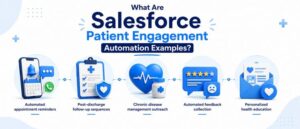
- Automated appointment reminders via SMS, email, and WhatsApp — reducing no-show rates with personalized, timely outreach aligned to patient communication preferences.
- Post-discharge follow-up sequences triggering at 24 hours, 72 hours, and 7 days after discharge — checking on medication adherence, flagging concerning responses, and routing high-risk patients to care coordinators automatically.
- Chronic disease management outreach for conditions like diabetes or hypertension — proactive check-ins tied to care plan milestones, with escalation logic when patients miss interactions.
- Automated feedback collection — post-visit CSAT surveys with negative responses routed immediately to patient relations teams.
- Personalized health education — condition-relevant content delivered based on diagnosis, care plan stage, and patient-stated preferences.
All flows run on Salesforce Flow and Marketing Cloud automation, with Health Cloud data ensuring every outreach is clinically relevant. This is coordinated, always-on engagement that traditional CRMs and standalone EHR portals simply cannot replicate — and it’s one of the clearest differentiators of Salesforce for healthcare at scale.
What Is the Salesforce Health Cloud Implementation Checklist?
A good Salesforce Health Cloud implementation checklist makes the difference between a successful deployment and a stalled one after 90 days. The following is a list of must-have items:
Pre-Implementation: Identify patient use cases and objectives, such as patient engagement, care coordination, or EHR integration. Audit data sources, scope migration, perform a BAA, and choose a Salesforce-certified partner who has proven experience in the healthcare industry.
Technical Setup: Set up Health Cloud data objects, add Salesforce Shield (if needed), implement role-based access and audit trails, and integrate EHRs through FHIR APIs or MuleSoft.
Workflow Configuration: Create care plan templates, set up automation workflows for referrals and outreach, configure Agentforce agents, and integrate omnichannel communication – email, SMS, and patient portal.
Testing and Launch: Conduct UAT in collaboration with all clinical and operational users; validate HIPAA compliance for all data flows; provide a 6-8-week training period for users; implement in phases, not all at once.
Post-Launch: Continuously track usage on usage dashboards, analyze care plan completion and engagement metrics, and adjust automation flows as per feedback from the care team.
Salesforce for Healthcare: The 2026 Verdict
Salesforce for healthcare in 2026 is not just a CRM; it’s an AI-powered operational platform that’s revolutionizing patient engagement, treatment delays, clinician burnout due to administrative burdens, and care coordination. Not only the HIPAA-compliant Health Cloud architecture, but Agentforce agents who schedule appointments, make referrals, and verify benefits 24/7, have made it one of the most comprehensive healthcare tech investments on the market. As your organization considers the integration of Salesforce into your existing process or the expansion of your Salesforce implementation, AnavClouds Software Solutions, a Salesforce Silver Partner, adds the experience and depth of the healthcare domain.
Frequently Asked Questions
1. What is Salesforce for healthcare used for?
Salesforce for healthcare – a complete solution for managing patient relationships, automating care coordination, connecting with EHRs, conducting patient engagement campaigns, and deploying AI agents for scheduling, benefits verification, and prior authorization.
2. Is Salesforce Health Cloud HIPAA compliant in 2026?
Yes, if implemented within a governed HIPAA compliance program, including roles and privileges, audit trails, and Platform Encryption.
3. How long does a Salesforce Health Cloud implementation take?
Typically, it takes 12–18 weeks to implement most mid-market solutions. Smaller organisations can go live in 6-8 weeks, and enterprise deployments can take 20-30 weeks depending on the size of the integration.
4. Can Salesforce integrate with Epic EHR?
Yes. With the help of the FHIR R4 APIs and MuleSoft and other connectors, Salesforce can be connected to Epic to allow for bidirectional patient data sync, care plan coordination, and a single patient view within both platforms.
Search Posts
Popular Posts
Author profile: Saransh Maurya, Content Writer at AnavClouds Software Solutions
Saransh
Maurya
About the author
Saransh Maurya is a dynamic and results-driven professional with a passion for innovation and problem-solving. Known for his analytical mindset and attention to detail, he excels at delivering high-quality solutions that drive business growth and operational efficiency. With strong communication skills and a collaborative approach, Saransh effectively bridges ideas and execution, contributing to successful projects and meaningful outcomes across diverse domains.
Recent Posts