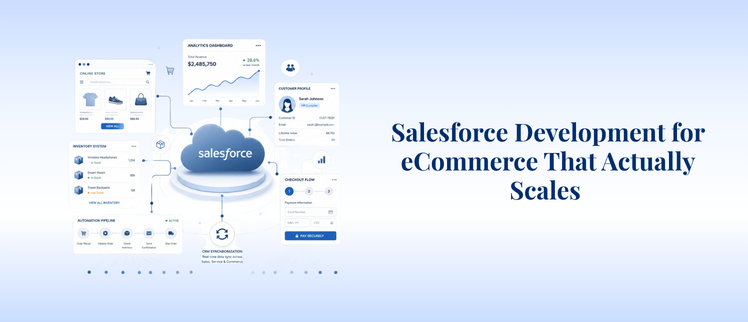
Salesforce Development for eCommerce That Actually Scales
The way of e-commerce has changed. Now, shoppers aren’t just browsing one path from discovery to purchase; they bounce between Instagram, your website, marketplace listing, and a customer service chat, and perhaps more than one in a single afternoon. It takes more than a working storefront to maintain such activity. Requires a connected ecosystem that can manage data, personalization, and scale. That’s what Salesforce development for eCommerce can achieve. With CRM, commSalesforce Development for eCommerce | Scale & Growerce, marketing, and service all in one, Salesforce provides eCommerce brands with the platforms and infrastructure they need to become the leaders, not just the followers, of the game — and today’s businesses are the ones taking the lead.
The Market Is Massive — and So Is the Pressure
It is important to understand the setting before getting into capabilities. Digital commerce is expected to account for 20.5% of global retail sales, and the global market will reach a total of $6.42 trillion. This level of scale creates stiff competition, diverse channels, and consumer expectations of seamless experience, whether offline or online. Salesforce development for eCommerce addresses these pain points directly — providing brands with a single intelligent platform to manage the full commercial experience from the initial click to post-purchase loyalty.
What Salesforce Development for eCommerce Actually Covers
So, when one comes across the term Salesforce development for eCommerce, he or she is not talking about a single product or one feature. They’re talking about a collection of linked capabilities that are customized, integrated, and configured to work the way a particular business does.
At its core, a well-executed Salesforce development for eCommerce engagement typically covers:
- Salesforce Commerce Cloud is the solution for creating and managing a storefront.
- Workflow, pricing logic, and automation with custom Salesforce development.
- eCommerce CRM solutions to have a 360-degree view of customers
- Yet, it is important to have Salesforce integration, as well as with Shopify or Magento.
- Set up Salesforce Marketing Cloud automated journeys and personalized campaigns.
- Salesforce B2B commerce setup for account-based sales.
- Salesforce automation for eCommerce across orders, inventory, and support
These layers on each are additional capabilities. The more collaborators, the stronger the competitive position.
Salesforce Commerce Cloud: The Storefront Built for Scale
Most serious implementations of Salesforce development for eCommerce begin with Salesforce Commerce Cloud — and for good reason. It is not just a storefront builder. It is a headless-ready, AI-powered platform designed for both B2C and Salesforce B2B commerce environments.
Headless Architecture Means Faster Iteration
Salesforce Commerce Cloud separates the frontend presentation layer from the backend commerce logic. This matters because teams can update layouts, product pages, and promotional content without touching core infrastructure. For high-growth brands, that means faster time-to-market and far fewer development bottlenecks between an idea and its execution.
Einstein AI Personalizes the Storefront in Real Time
Embedded Einstein AI analyzes individual shopper behavior and adapts to what each customer sees. If someone consistently browses athletic footwear, the homepage and search results reorder accordingly — automatically. Salesforce development for eCommerce configures these personalization layers to scale across hundreds of thousands of customers without requiring manual effort for each segment.
Salesforce B2B Commerce Has Its Own Infrastructure
Salesforce B2B commerce addresses what standard storefronts simply cannot — account-based pricing, contract management, custom catalogs, and streamlined reorder flows. Manufacturers, distributors, and wholesale operations depend on Salesforce development for eCommerce to configure these capabilities around their specific buyer relationships and procurement workflows.
eCommerce CRM Solutions: Turning Customer Data Into Decisions
The deeper power of Salesforce development for eCommerce is not the storefront itself. It is what happens when commerce data connects to CRM data. Salesforce eCommerce solutions make this connection clean, real-time, and actionable.
A Unified Customer Record Across Every Channel
When a shopper contacts support, the agent should already know what was ordered, what was returned, and what email landed in the inbox last week. E-commerce CRM Salesforce integration makes that possible. Every touchpoint — website, app, in-store, social — feeds into one customer record, giving the entire organization a shared view of each buyer.
Sales Cloud for B2B Account Visibility
For B2B brands, Salesforce development for eCommerce extends naturally into Sales Cloud. Account managers can access full purchase histories, flag upsell opportunities, and manage contracts without switching platforms. This removes the lag between what sales know and what the customer actually experiences.
Service Cloud for the Moments That Define Loyalty
Returns, shipping delays, and missing items — these post-purchase interactions matter more than most brands realize. Salesforce development for eCommerce connects Service Cloud to live order data, so agents can resolve issues faster. Fewer escalations. Higher satisfaction scores. Customers who feel heard are customers who come back.
Salesforce Marketing Cloud: Automation That Feels Human
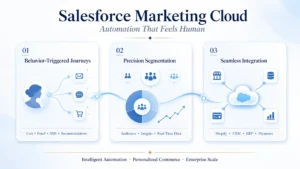
Reaching the right person with the right message at the right moment sounds straightforward. Executing across millions of customers is a different challenge entirely — one that Salesforce Marketing Cloud handles at scale.
Behavior-Triggered Journeys
Salesforce automation for eCommerce powers event-driven communication flows that feel personal because they are based on actual behavior. An abandoned cart triggers a personalized email within minutes — showing the exact items left behind, not a generic prompt. A loyal customer who has not purchased in 90 days enters a re-engagement flow with an offer built around their history.
Precision Segmentation from Real Commerce Data
Salesforce Marketing Cloud connects transactional, behavioral, and demographic data into segmentation models that go far beyond basic filters. Salesforce consulting for eCommerce teams uses this to build audiences like customers who bought winter outerwear in the last 60 days, or high-AOV shoppers in specific geographies who have never used a discount code. Every segment gets communications built on what they have actually done — not what the brand assumes about them.
Salesforce Integration with Shopify and Existing Platforms
Not every brand is ready for a full platform migration. Many operate on Shopify, WooCommerce, or Magento and want to add Salesforce intelligence on top. Salesforce integration with Shopify is one of the most common implementations in this area — and a clear example of how Salesforce development services deliver value without forcing a complete rebuild.
What a Connected Salesforce + Shopify Stack Looks Like
- Orders from Shopify sync into Salesforce in real time
- Customer profiles in CRM include full Shopify purchase history
- Service Cloud agents see live order data from Shopify without leaving Salesforce
- Marketing Cloud triggers activations based on Shopify purchase events
- Revenue reporting consolidates across both platforms inside Salesforce dashboards
Salesforce development for eCommerce in this context handles the middleware, the data mapping, and the ongoing sync — so both platforms stay accurate and aligned, even as transaction volumes grow.
Custom Salesforce Development: Where the Real Differentiation Happens
Standard Salesforce configurations work well for standard needs. But competitive brands go further. Custom Salesforce development is where implementations move from functional to genuinely differentiating — built around how a specific business operates, not how a generic template expects it to.
Custom Checkout and Payment Logic
Subscription billing, installment options, territory-based pricing, and regional tax rules all require custom Salesforce development to implement correctly. Salesforce development for eCommerce at this level reduces cart abandonment by making the checkout experience match exactly what the brand promises — clean, trustworthy, and frictionless.
Custom Analytics Built for Business Decisions
Salesforce includes strong native reporting, but Salesforce development for e-Commerce can extend this significantly. Custom dashboards can surface category-level revenue trends, customer lifetime value by acquisition channel, fulfillment performance by warehouse, or return rates by product line — whichever metrics drive decisions in that business.
Workflow Automation Tailored to Operations
Salesforce automation for eCommerce reaches its full potential when it mirrors the way a business actually runs. Custom flows can handle inventory alerts, reorder triggers, fraud detection flags, loyalty milestone notifications, and internal approvals — all without manual intervention and consistent with existing operational logic.
Salesforce B2B Commerce: A Deeper Look at the Business Buyer Experience
Salesforce development for eCommerce for B2B businesses is worthy of special attention as the needs vary significantly from retail eCommerce.
Key capabilities that Salesforce B2B commerce enables include:
- Account-based pricing — negotiated rates tied to specific accounts, not public-facing price lists
- Custom catalogs — buyers only see the products relevant to their agreements
- Reorder management — procurement teams can restock efficiently without starting from scratch
- Approval workflows — purchase orders above the defined thresholds route automatically for authorization
- ERP and backend integration — Salesforce connects to SAP, Oracle, and legacy systems so inventory and billing stay synchronized
These are non-negotiable improvements for distributors, manufacturers, and B2B wholesale brands. These are key conditions. These configurations are built in Salesforce development for eCommerce B2B environments to fit the current procurement process — not the reverse.
Why You Should Hire Salesforce Developers for eCommerce — Not Just Admins
It isn’t just a matter of Salesforce configuration; it’s a matter of building on Salesforce. By outsourcing Salesforce Developers for e-commerce, you are getting professionals who know and use Apex, Lightning Web Components, REST APIs, and the entire Salesforce Development Lifecycle.
What Developers Build That Admins Cannot
- Custom integration between Salesforce and third-party systems.A custom integration in Salesforce to third-party systems.
- Features that cannot be found in the regular out-of-the-box solution.
- Robust architecture with high throughput to process a lot of transactions.
- A detailed security and data governance model.A comprehensive security and data governance model.
- When platform native functionality is lacking, use AppExchange apps.
Salesforce development services in the eCommerce space are a blend of technical execution and strategic thinking. The best Salesforce development for eCommerce partners evaluates the state of the existing system, determines where the business has the greatest need, and then creates implementations that scale with the business and do not need to be rebuilt every few years.
Salesforce Solutions for eCommerce: Choosing the Right Implementation Path
Every e-commerce enterprise has its own distinct requirements for Salesforce development for e-commerce. The right solution requires the existing tech stack, business model, and the greatest operational gaps.
Here is a simple way to think about it:
Starting Fresh
Salesforce Commerce Cloud is the foundation platform, with Salesforce Cloud, Service Cloud, and Marketing Cloud from the beginning. At this level, a Salesforce development for eCommerce is a full build-out, often involving custom development as well as native configuration.
Augmenting an existing platform
Add Salesforce integration to Shopify or another platform, and add CRM, service, and marketing to an existing platform. A more common path to accessing Salesforce eCommerce solutions without replacing existing solutions — and with lower disruption.
Scaling a B2B Operation
Salesforce B2B commerce connected to Sales Cloud, integration with ERP tools, or custom approval & pricing processes. Here, Salesforce development for e-commerce is geared toward account management complexities and procurement efficiency.
This is where eCommerce experts come in through Salesforce consulting services to aid brands in making this judgment before embarking on an approach to ensure Salesforce development services are in line with their specific business needs.
Conclusion
eCommerce brands that win are the ones that treat their technology as a growth engine, not just infrastructure. Salesforce development for eCommerce brings commerce, CRM, marketing, and service together into a single intelligent platform, one that learns from customer behavior, automates the right responses, and scales without losing the personal touch that drives loyalty. Whether you are launching a new storefront with Salesforce Commerce Cloud, integrating Salesforce with an existing platform, or building out B2B commerce workflows, the investment pays back in faster decisions, stronger retention, and measurable revenue growth. AnavClouds Software Solutions is a certified Salesforce partner that specializes in Salesforce development for eCommerce, helping brands of every size turn implementation into a competitive advantage.
Frequently Asked Questions
What is Salesforce development for eCommerce?
It involves customizing, building, and connecting Salesforce tools like Commerce Cloud, CRM, Marketing Cloud, and Service Cloud to drive eCommerce, customer management, automation, and personalized shopping experiences from end to end.
Can Salesforce work with my existing e-commerce platform, like Shopify?
Yes. By connecting Shopify with Salesforce, brands can access CRM-grade intelligence without having to move all orders, customers, and marketing triggers to Salesforce.
What is the difference between Salesforce B2B and B2C commerce?
Salesforce B2B commerce provides all the tools required to configure pricing models, create custom catalogs, implement approval workflows, and support more complicated procurement scenarios. B2C commerce is all about customisable storefronts, mass consumer transactions, and AI-driven product discovery on a scale that was previously unheard of.
How do I choose the right Salesforce development services for eCommerce?
Search for qualified eCommerce Salesforce partners who have actual eCommerce implementation experience, Salesforce cross-cloud knowledge, and proven industry and business model-specific Salesforce custom development.
Search Posts
Popular Posts
Author profile: Saransh Maurya, Content Writer at AnavClouds Software Solutions
Saransh
Maurya
About the author
Saransh Maurya is a dynamic and results-driven professional with a passion for innovation and problem-solving. Known for his analytical mindset and attention to detail, he excels at delivering high-quality solutions that drive business growth and operational efficiency. With strong communication skills and a collaborative approach, Saransh effectively bridges ideas and execution, contributing to successful projects and meaningful outcomes across diverse domains.
Recent Posts