Digital Labor: Transforming Business Automation Today
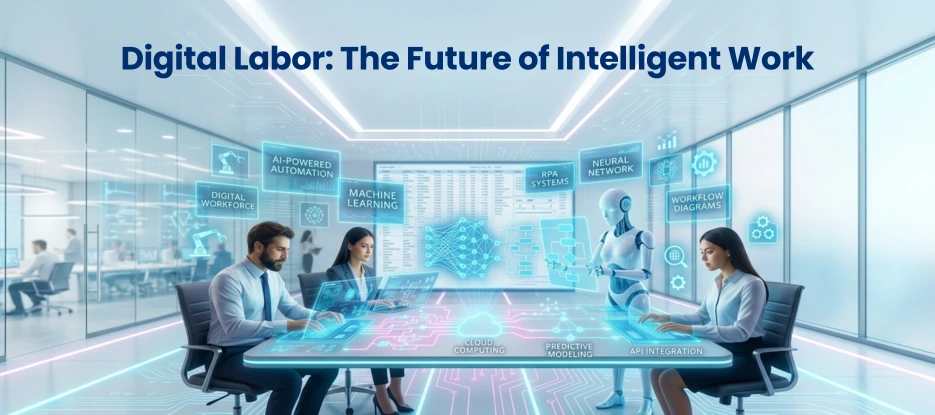
The idea of a workforce that never sleeps, never makes mistakes, and continuously learns to optimize business processes is imaginable. That is the strength of digital labor. Digital labor is a combination of AI, ML, and intelligent automation to carry out repetitive and complex jobs more precisely and quickly than ever. Those companies using digital labor AI have the opportunity to increase their productivity, cut operations costs, and create a digital workforce that will complement human employees. Digital labor makes smarter decisions, quicker execution, and scales of workflows previously controlled by humans; automating financial workflows to better customer service. This transformation is possible through Salesforce’s digital labor platform that facilitates it, which is easy to measure.
Unlocking the Power of Digital Labor for Modern Businesses
By integrating smart software with AI and ML functionality, digital labor is changing the manner in which organizations operate. These higher systems are virtual robots that mimic human activities, including simple, routine procedures, as well as sophisticated decision-making activities. Incorporating a digital workforce into the working processes will help businesses attain operational efficiency and minimize mistakes, as well as boost productivity in respective departments.
To answer the question, what is digital labor? It is an automation, AI, and cognitive computing strategic combination aimed at supporting human employees. In contrast to conventional automation, digital labor has the ability to respond to real-time information, learn, and make decisions. This enables businesses to scale up without the need to add additional headcounts, streamline resources, and provide quicker outcomes.
Going digital in labor not only simplifies the process of making things run smoothly but also gives the employees the power to concentrate on more valuable activities. Starting with the automated management of customer inquiries with the help of AI agents, to the automation of more complicated financial or HR operations, digital labor allows companies to develop a digital workforce that would result in increased efficiency. Besides, digital labor AI fusion guarantees smarter, quicker, and more precise operations, which will allow companies to remain competitive in a rapidly growing digital environment.
How Digital Labor AI Revolutionizes Business Operations
The emergence of digital labor AI is transforming the way business works in the modern world, as it can be intelligently automated within all departments. Digital labor includes both AI and ML functions to interpret information, decide, and act without human interference, unlike traditional automation. Through AI agents, businesses are able to automate processes, minimize errors by human beings, and improve productivity.
Streamlining Financial and Administrative Tasks
Automation of financial and administrative processes is one of the most influential applications of digital labor AI. Activities like invoice processing, financial record management, and payroll handling can now be done very fast and with precision. Less manual intervention of the business results in fewer errors and enables employees to concentrate on strategic initiatives, which increases efficiency in the business.
Enhancing Customer Engagement
Digital labor-driven AI agents can also track the interactions with customers in real time, produce actionable information, and act proactively to service requests. This enables organizations to provide faster and more customized customer experiences and to be consistent across various channels. Digital labor AI can help companies operate support tickets, monitor customer behavior, streamline service processes, and enhance satisfaction and loyalty.
Optimizing Supply Chain and Operations
Digital labor-led predictive analytics empower businesses to predict demand, optimize inventory, and be efficient in their logistics. Organizations can use AI-driven tools to have real-time insights that can assist in critical supply chain decisions, minimize downtime, and increase operational agility. Digital labor serves as a digital labour force, which continuously surveys and streamlines work processes, establishing a competitive edge in the dynamic markets.
Automating HR and Internal Workflows
Digital labor also helps human resources departments to remain automated in onboarding, employee inquiries, and standard HR practices. Repetitive HR activities can be managed by AI agents, so HR professionals can get free time to work on talent development and strategic planning. Such digital labor integration guarantees rapid response, improved adherence, and workplace productivity.
Creating a Complementary Digital Workforce
Digital labor AI is only useful in that it does not substitute human talent but enhances it. Companies that adopt such technologies are creating a digital workforce that collaborates with employees and improves decision-making, efficiency, and accuracy in operations. In the long term, this will develop an intelligent ecosystem in which human innovativeness and AI accuracy work together to promote progress and progress.
Core Technologies Powering Digital Labor for Business Success
Digital labor relies on many technologies that can be influential in terms of intelligent automation and AI-based processes. A combination of these parts can enable businesses to develop a digital workforce that is able to enhance productivity, cut costs, and trigger innovation.
AI and Machine Learning
The core of digital labor AI is the technologies of AI and ML, which also offer cognitive functions that enable agents to learn, adapt, and make informed choices. Such smart machines can process complex data, identify patterns, and optimize processes without necessarily requiring human oversight. Combining AI and ML, companies can be certain that their digital staff is making continuous steps forward throughout the years and providing more intelligent, quicker, and more precise outcomes.
Robotic Process Automation
One of the underlying principles of digital labor is Robotic Process Automation (RPA), which is a rule-based repetitive job that can be performed at a speed and precision never seen before. Processing the invoices as well as financial operations in the CRM systems, RPA lowers the number of human errors and relieves the employees for more valuable tasks. Together with AI agents, RPA will form part of an effective digital workforce, allowing companies to increase their operations smoothly.
Natural Language Processing
The chatbots, virtual assistants, and conversational AI agents are driven by Natural Language Processing (NLP), and communication between people and digital labor is easy and natural. Through NLP, organizations may offer customized customer service, respond to employees’ inquiries, and efficiently automate the workflows of the service. A combination of NLP and AI-based tools means that the interaction is real-time, the response is quicker, and the customer and employee satisfaction will increase.
Analytics and Decision Intelligence
To make informed decisions, modern businesses are dependent on data, and analytics and decision intelligence are the essential elements of digital labor. AI-based tools can handle large amounts of data, trends, and actionable insights, which allow for making smarter decisions in operations. When integrated with platforms like Salesforce’s Digital Labor Platform and Salesforce Data Cloud, organizations can harness these insights to enhance efficiency, predict outcomes, and optimize processes across departments.
Building a Robust Digital Workforce
These technologies create a digital labor ecosystem that supplements human employees, leads to innovation, and enhances the performance of operations. Companies replacing their workforces with such solutions, such as Salesforce Agentforce and Salesforce AI services, can develop a scalable and smart digital labor force that can perform repetitive tasks, make decisions, and promote strategic expansion.
Transform Your Business: Key Benefits of Digital Labor
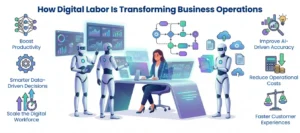
The use of digital labor has ceased to be a choice for progressive organizations. With the introduction of AI-based automation, businesses can develop a digital workforce that will improve efficiency, initiate change, and increase overall business performance. The strongest advantages of a switch to digital labor solutions are the following:
Enhanced Productivity Through Intelligent Automation
Among the benefits of digital labor AI, one can highlight the possibility to cope with monotonous, time-consuming tasks accurately and quickly. Human employees also can work on strategic and high-value activities by automating routine work undertakings. With the help of AI agents, businesses will be able to optimize their activities in the spheres of finance, human resources, and customer service, enabling them to complete tasks more quickly and achieve higher organizational productivity.
Significant Operational Cost Savings
Digital labor AI implementation saves time by eliminating human work and decreasing the mistakes made during key business operations. This brings in a huge saving on the operational cost in the long run. Tasks like data entry, invoice processing, and report generation can be automated, saving organizations on reliance on human work and enabling resource allocation to be done more effectively and less overhead to be incurred.
Scalability Without Workforce Expansion
One of the main benefits of a digital workforce is that it allows the company to expand the business not in direct proportion to the number of new employees. The AI systems of agents and digital labor will be able to deal with increased tasks under high demands, which will guarantee business continuity. Using the capabilities provided by Salesforce’s Digital Labor Platform, businesses can gain a wide range of capabilities in the shortest time possible without compromising quality and performance.
Improved Accuracy and Reduced Errors
AI-based applications reduce human mistakes in complicated processes and data manipulation. Digital labor guarantees accuracy, uniformity, and adherence, whether it is handling financial transactions or thousands of data points. Through the implementation of AI agents, organizations can minimize expensive errors, enhance the accuracy of reporting, and observe high standards in the process of operations.
Enhanced Customer Experience Through Real-Time Responsiveness
The digital labor position increases the efficiency and quality of interaction with customers. Chatbots, virtual assistants, and Salesforce agentforce solutions are AI-driven, fast, and data-driven responses that contribute to improving service delivery. Using digital labor AI, companies can solve customer problems more quickly, predict their desires and needs, and provide personalized experiences, which leads to greater satisfaction and loyalty.
Seamless Integration With Salesforce and AI Solutions
Those organizations that will implement Salesforce AI services, Salesforce Data Cloud, and Salesforce development services will be able to realize the power of digital labor to the fullest. These tools will incorporate the AI into the workflows, which will make the decisions smarter, improve analytics, and create a scaled digital workforce. The outcome is a unified system, comprised of human workers and AI agents collaborating to develop growth and innovation.
Overcoming Challenges in Implementing Digital Labor
Even though there are transformative advantages of digital labor, organizations have to overcome some hurdles to make digital labor adoption successful. When companies have awareness of these challenges and strategize in advance, a digital workforce can be established successfully, making use of the digital labor AI and AI-driven tools without any inconveniences.
Integration Complexity: Aligning AI With Existing Systems
Integration complexity is one of the major issues of digital labor. The introduction of AI agents and automated workflows into existing IT systems may not work seamlessly, particularly in companies that have old software. Businesses should strategize to integrate Salesforce AI services and Salesforce development services, or any other AI and ML services to the existing processes without interference with business. Effective alignment of the system will guarantee the harmonious integration of the digital workforce with the human employees.
Addressing Skill Gaps for the Digital Workforce
The digital labor must be successfully adopted because of the skills of employees that are required to use and cooperate with AI agents. Skills gaps are common in many organizations and may slow down the implementation and make them less efficient. Training on digital labor AI, automation tools, and analytics platforms will allow employees to make effective use of such technologies, which will result in a workforce that complements the digital workforce but does not replace it.
Ensuring Data Privacy and Security
One of the main factors that should be taken into account in the implementation of digital labor solutions is data privacy and security. The systems that are created by AI have access to sensitive business data, customer records, and financial information. To avoid breaches, organizations need to put in place effective governance controls, data storage, and compliance mechanisms. Solutions, such as Salesforce Data Cloud, are highly secure and are therefore capable of guaranteeing the safety of digital labor as well as preserving trust and regulation.
Change Management: Driving Adoption Across Teams
Digitization presents a lot of change management in terms of the workforce. Workers can oppose the introduction of new AI-based tools or processes out of fear of being disorganized or not understanding their roles. Communication, training, and executive support should be clear to enable smooth adoption. Organizations can maximize the use of the Salesforce Digital Labor Platform by dealing with cultural and operational changes, which will result in successful digital labor deployment.
Mitigating Challenges for Maximum ROI
The success of dealing with these challenges enables organizations to get the maximum ROI because of digital labor adoption. Through proper planning of integration, employee training, data protection, and change management, the business will be able to establish an effective and scalable digital workforce. This makes sure that the AI agents and digital labor AI solutions provide quantifiable productivity, accuracy, and customer satisfaction advantages.
Conclusion
Digital labor is no longer a theory; it is a viable solution to automation in modern business. Using AI agents, AI-driven applications, and Salesforce AI, firms can simplify operations, enhance precision, and provide superior customer experiences. The challenges of integration, skill, and security are taken care of so that the transition to a digital workforce is successful. In the case of organizations that need expert advice, AnavClouds Software Solutions offers extensive Salesforce development and AI integration services to enable businesses to adopt scalable and intelligent digital labor solutions, providing real growth and efficiency.
Search Posts
Popular Posts
Author profile: Saransh Maurya, Content Writer at AnavClouds Software Solutions
Saransh
Maurya
About the author
Saransh Maurya is a dynamic and results-driven professional with a passion for innovation and problem-solving. Known for his analytical mindset and attention to detail, he excels at delivering high-quality solutions that drive business growth and operational efficiency. With strong communication skills and a collaborative approach, Saransh effectively bridges ideas and execution, contributing to successful projects and meaningful outcomes across diverse domains.
Recent Posts