Salesforce for Startups: When to Adopt It in 2026
Start-ups don’t go out of business due to lack of ambition. They are unsuccessful because they lose sight of the people who were meant to be customers. It’s not because startup founders like enterprise software; it’s because there’s an easier and better way to solve the problem when a business begins closing real deals: start using Salesforce for startups. This guide explains Salesforce for startups for 2026: When to use Salesforce, what Salesforce Foundations gives you for free, the real Salesforce startup pricing, and where a lot of startup teams go wrong. If you need to decide, here’s all you need to know before you sign up.
What Is Salesforce for Startups, and Why Does It Matter Now?
Salesforce for startups means using Salesforce’s CRM, service, and marketing tools scaled to a small founding team rather than an enterprise deployment. It’s the same question every growing business faces — who are their customers, what’s the status of each deal, and what’s the next step — just answered with a founding team of 5 instead of 5,000.
The need to resolve this is growing fast. According to Fortune Business Insights, the global CRM market is expected to grow from $101.41 billion in 2024 to $262.74 billion by 2032, a 12.6% CAGR. That’s not just enterprise spending; it’s how common it has become that even three-person teams are running on structured customer data, rather than their memory. These days, investors are looking for pipeline visibility in due diligence. Early customers are looking for speedy, knowledgeable customer service. It’s no wonder Salesforce for startups has its seat at the table, rather than in the “someday” stack.
Salesforce vs Spreadsheets for Startups: When Do Spreadsheets Stop Working?
Every startup starts on spreadsheets, and honestly, that’s fine for the first few months. The Salesforce vs spreadsheets startup debate isn’t about spreadsheets being “bad”; it’s about them not scaling past a certain point of complexity.
Here’s where the cracks usually show up first:
- Leads go cold because no one owns follow-up once a founder gets busy
- Deal history lives in someone’s memory, not in a system anyone else can access
- Support requests get lost in email threads with no ticket trail
- Reporting takes hours because data lives in five different tabs, updated inconsistently
- New hires can’t ramp fast because there’s no single source of customer truth
A spreadsheet has no automation, no reminders, and no way to see the full customer journey in one view. Once a startup is juggling more than a handful of active deals or support conversations at once, the Salesforce vs spreadsheets startup comparison tips firmly in Salesforce’s favor, mainly because manual tracking starts costing more in missed revenue than a CRM would ever cost in subscription fees.
When Should a Startup Adopt Salesforce?
Knowing when to adopt Salesforce is really about spotting specific triggers, not hitting an arbitrary headcount or revenue number. Consider making the move when:
- You’ve closed a funding round, and investors expect pipeline reporting
- More than one person touches the sales or support process, and handoffs are getting messy
- You’re losing deals to follow-up gaps, not product or pricing issues
- Customer data lives in disconnected tools, a form here, a spreadsheet there, a Slack channel somewhere else
- You’re preparing to scale outreach and need repeatable, trackable workflows
Waiting too long to adopt Salesforce for startups usually means a painful, rushed migration later, once bad data habits are already baked into the team. Moving early, even on a free tier, means good habits form before the stakes get higher.
How Does Salesforce Foundations Help Startups Get Started for Free?
Salesforce Foundations is Salesforce’s free CRM suite for small teams, covering core sales, service, and marketing functionality without any upfront cost. It’s built for companies that need real structure before they’re ready to pay for enterprise software.
Salesforce Foundations for startups typically includes:
- Contact and account management to centralize customer records
- Basic sales pipeline tracking for deals and opportunities
- Simple case/ticket management for early customer support
- Email tools for outreach and follow-up
- Access to the broader Salesforce ecosystem, including Agentforce, so teams can explore AI-assisted workflows without an upfront investment
The real value of Salesforce Foundations isn’t just the free price tag; it’s that startups can build habits and data structures inside the same platform they’ll eventually scale into. There’s no “starter tool” to abandon and no messy migration later. That continuity is a big reason Salesforce for startups works better as a long-term bet than cheaper, disconnected alternatives.
What Does Salesforce Startup Pricing Look Like in 2026?
Understanding Salesforce startup pricing matters because the entry point is far more accessible than most founders expect; Salesforce isn’t the enterprise-only tool it used to be.
Here’s the general 2026 breakdown, per user, per month, billed annually unless noted:
| Tier | Approx. Price | Best For |
| Foundations / Free Suite | $0 | Very early teams, first CRM setup |
| Starter Suite | ~$25 | Small teams needing sales + service + marketing basics |
| Pro Suite | ~$100 | Growing teams needing automation and customization |
| Enterprise | ~$175 | Mid-market teams needing advanced workflows |
(Pricing is illustrative and changes periodically; always confirm current rates on Salesforce’s official pricing page before budgeting.)
For most early-stage companies, Salesforce startup pricing starts free and only scales up as the team and complexity grow, which means there’s no financial reason to delay adopting Salesforce for startups until “later,” when the migration will be harder and more expensive.
What Makes Salesforce the Best CRM for Startups?
Plenty of tools call themselves the best CRM for startups. Salesforce’s advantage isn’t a single feature; it’s the combination of accessibility now and headroom later.
- It scales without a rebuild. Startups that outgrow lightweight CRMs often face a full data migration. Salesforce for startups avoids that because the same platform supports a two-person team and a two-thousand-person enterprise.
- The ecosystem is enormous: backed by extensive Salesforce AppExchange services, so startups rarely have to build custom connectors for common tools.
- AI is built in, not bolted on. Agentforce and Einstein features are available even on lower tiers, giving early teams a taste of automation without enterprise pricing.
- It’s backed by real implementation expertise. Because Salesforce is so widely adopted, startups can find experienced partners for setup, customization, and ongoing support, something niche CRMs can’t offer at the same scale.
For founders comparing tools, the best CRM for startups isn’t necessarily the cheapest or simplest one; it’s the one that won’t force a switch six months after it starts working.
How Can Salesforce Development Services Help Startups Get More From Salesforce?
While Salesforce will get you started, most startups will eventually want something more custom, be it a custom object, an integration with their product database, or an automated workflow that best fits how they operate in sales. They’re where Salesforce development services come in.
This often starts with clean Salesforce data migration from spreadsheets or another CRM, so startups don’t carry bad habits into their new system. A development partner can help startups:
- Customize objects and fields to match their specific sales or service process
- Build integrations between Salesforce and product, billing, or support tools
- Automate repetitive workflows using Flow Builder or Apex
- Set up Agentforce agents for lead qualification, support triage, or internal reporting
- Migrate cleanly from spreadsheets or another CRM without losing historical data
A full-time Salesforce admin on payroll isn’t always necessary for startups. With a team of experts providing Salesforce development services, early teams can get the configuration correct the first time, which reduces technical debt incurred from a hasty DIY approach. In a platform as vital as Salesforce for startups, laying the groundwork early is important to avoid rework later.
What Are Common Mistakes Startups Make When Adopting Salesforce?
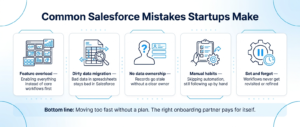
Even good tools get undermined by bad setup habits. Watch out for:
- Turning on every feature at once instead of starting with core sales and service workflows
- Skipping data cleanup before migrating from spreadsheets, which just moves bad data into a new system
- Not assigning clear data ownership, so records go stale within weeks
- Ignoring built-in automation and continuing to do manual follow-ups out of habit
- Treating Salesforce as “set it and forget it” instead of reviewing and refining workflows quarterly
Most of these mistakes come from moving too fast without a plan, which is exactly where a short onboarding project with the right partner pays for itself.
How Do You Get Started With Salesforce for Startups?
Getting started with Salesforce for startups doesn’t require a big-bang rollout. A practical sequence looks like this:
- Start on Salesforce Foundations to test core workflows at zero cost
- Map your actual sales and support process before configuring anything
- Migrate clean data, not everything you’ve ever collected
- Automate one workflow at a time, starting with your highest-friction process
- Upgrade tiers only when you hit a real limitation, not preemptively
This staged approach keeps Salesforce for startups affordable and low-risk while still building toward a system that can support real growth.
Final Thoughts
Choosing Salesforce for startups isn’t about buying enterprise software before you’re ready; it’s about avoiding the cost of disorganized customer data while you’re still small enough to fix it easily. Between Salesforce Foundations’ free tier, transparent Salesforce startup pricing, and a platform that scales without forcing a migration later, the barrier to entry has never been lower. The real decision isn’t if a startup should adopt Salesforce; it’s when, and how well the setup is done from day one. If you’re ready to move from spreadsheets to a system that actually supports growth, AnavClouds Software Solutions can help you implement, customize, and scale Salesforce the right way from the start.
Frequently Asked Questions
Is Salesforce good for startups, or is it too complex?
With Salesforce for startups, the beginning can be easy: Foundations and Starter Suite focus on the core Salesforce CRM features and don’t get bogged down in enterprise-level features to overwhelm small teams on day one.
How much does Salesforce cost for a small startup?
Salesforce startup pricing starts at $0 with Foundations, the free CRM suite for small teams. Paid plans begin around $25 per user per month with Starter Suite, rising to roughly $100 for Pro Suite and $175 for Enterprise as automation, customization, and team size grow.
When should a startup switch from spreadsheets to Salesforce?
Switch when any of these show up:
- Follow-ups get missed because no one owns them
- Deal history lives in one person’s head, not a shared system
- Reporting takes hours because data lives in scattered tabs
These are clear signs spreadsheets can no longer support your sales process.
Do startups need a developer to set up Salesforce?
Not initially; Foundations works out of the box. As needs grow, Salesforce development services help with customization, integrations, and automation beyond default features.
Search Posts
Popular Posts
Author profile: Saransh Maurya, Content Writer at AnavClouds Software Solutions
Saransh
Maurya
About the author
Saransh Maurya is a dynamic and results-driven professional with a passion for innovation and problem-solving. Known for his analytical mindset and attention to detail, he excels at delivering high-quality solutions that drive business growth and operational efficiency. With strong communication skills and a collaborative approach, Saransh effectively bridges ideas and execution, contributing to successful projects and meaningful outcomes across diverse domains.
Recent Posts