Salesforce Integration Cost 2027: Budget, Tools & Timeline
Salesforce integration cost in 2027 will be influenced by various factors, such as the systems to be integrated, data complexity, API capacity, delivery method, and support requirements. The cost of a simple automation will likely just require an inexpensive subscription, whereas the cost of a complex ERP connection can be considerable with a hefty development and platform fee. This Salesforce Integration Guide covers Salesforce API integration pricing, MuleSoft cost vs custom integration trade-offs, security changes, and Salesforce integration project timeline. It helps you to compare published platform benchmarks, so you can determine what costs will be known, what costs you need to get quotes on, and what you need to get in budget to make it through go-live.
What Determines Salesforce Integration Cost in 2027?
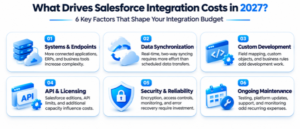
Different quotes can be given to two businesses in the same CRM. Salesforce integration cost is not only based on the number of applications that are integrated, but also on the entire workflow.
The Three Layers of Integration Spending
Your journey through Salesforce licensing and API entitlements is your first step. Include middleware subscriptions, connectors, or the infrastructure for custom code. Now count discovery, development, testing, and maintenance. Forcing that third layer might make Salesforce integration cost cheaper than it actually will be to the business.
Why Connectivity Keeps Growing
Based on Salesforce’s 2026 Connectivity Benchmark, 957 applications per enterprise would be connected, with an average of just 27% of those applications connected. New software and AI agents generate new requirements to share data; each one deserves a business case before it adds to Salesforce integration cost.
Which Factors Have the Biggest Impact on Salesforce Integration Cost?
Identify the relationships and business processes before the invitation for a proposal. Most differences in Salesforce integration cost among more or less similar-looking projects are due to these drivers.
Technical Requirements
- Systems and endpoints: One accounting link is simpler than syncing several ERPs, service tools, and warehouses.
- Data movement: Nightly exports are easier than two-way, near-real-time sync.
- Custom logic: Field transformations, custom objects, and conflict resolution add effort.
- Reliability: Retry queues, alerts, and recovery procedures matter for operational workflows.
Security and Ownership
Encryption, access controls, or audit trails might be necessary for security reviews. Salesforce Shield pricing may be conditional on meeting certain Salesforce spend thresholds – please check commercial terms. To manage Salesforce integration cost, you need to make a decision about who will be responsible for managing the integration after it is launched and include this as part of the initial estimate.
What Does Salesforce API Integration Pricing Include?
Salesforce API integration pricing is not a universal per-call fee. This is influenced by aspects such as the edition, licenses, API allocations, optional capacity, and efficiency in implementing requests, which can impact Salesforce integration costs.
Licensing and API Entitlements
API access is available in Enterprise Edition and will differ per daily allocation based on your license count. Salesforce documents an allowance with additions to do license, so check what your actual limit is in Setup. A Web Services API add-on ($25 per user/mo) is required for Pro Suite, and additional capacity is sold separately. Also, double-check with Salesforce before committing to a 2027 budget, because Salesforce API integration pricing differs by organization.
Request Design That Saves Capacity
The impact of record grouping on consumption. sObject Collections are able to contain up to 200 records to be written per request and up to 2,000 records to be read per request. Beyond approximately 2,000 records, Bulk API 2.0 is way more frequently a good option (usually not the only one). Trimming requests also come with Delta updates, sensible polling, and event-driven designs. Efficient design to reduce Salesforce integration cost and conserve capacity.
Authentication Changes for 2027 Projects
Starting in Spring ’26, Salesforce only allows new legacy Connected Apps to be created and recommends using External Client Apps for new integrations. Connected Apps continue to function as they do now, but teams are required to identify existing Apps and develop plans for migration. Plan for authentication rework in Salesforce API integration pricing—especially when using Salesforce to replace an old integration.
How Do Integration Platforms Affect Salesforce Integration Cost?
Middleware centralizes connections, transformations, and monitoring, which can reduce custom development. Subscriptions and usage charges, however, add recurring Salesforce integration cost.
Published Platform Price Signals for Salesforce Integration Cost
| Platform | Typical use | Public pricing signal |
| MuleSoft Anypoint | Enterprise integration and API governance | Vendr median about $68,695 a year; not a list price |
| Workato | Workflow automation | Vendr median about $64,772 a year; quotes vary |
| Boomi | Managed connectors and workflows | Pay-as-you-go from $99 monthly, plus usage |
| Zapier | Simple task-based automation | Paid plans from about $20 monthly; check limits |
These figures come from information reviewed in late 2026 and reflect different plans and usage levels. Implementation, onboarding, and support can cost extra, so confirm every price again in 2027. A subscription is only one slice of Salesforce integration cost.
MuleSoft Cost vs Custom Integration
The MuleSoft cost vs custom integration decision depends on how many workflows must be governed. MuleSoft offers reusable connectors, API management, and monitoring. Custom code avoids a middleware license but still creates development, hosting, security, and support duties. Neither is automatically cheaper.
For one stable connection, lightweight custom work may fit. Several business-critical systems can justify a managed platform. Evaluate MuleSoft cost vs custom integration over three years, including change requests, outages, and staff turnover, so Salesforce integration cost compares fairly across options.
When Is Middleware Cheaper Than Point-to-Point Integration?
As more applications and dependencies proliferate, the middleware vs point-to-point cost changes. Though direct connections are straightforward at first, particularly when there is a point of control by one team, the more links you have, the more Salesforce integration costs.
How Connections Scale
A fully connected point-to-point network would require three links between three systems, fifteen between ten systems, and 45 between ten and twenty. In the real world, you need not put in all the links; these are merely examples. Middleware unifies integrations and eliminates repeated transformations, and introduces subscription costs and platform dependency.
How to Compare the Options
Compare middleware vs point-to-point cost based on expectations of changes, expected data volumes, monitoring requirements, and in-house expertise. There are some common patterns of work that direct code can suit. When APIs are being reused across numerous teams, or teams require shared governance, that’s when middleware can become attractive. There is no single break-even year when it comes to Salesforce integration costs; look at 3-year scenarios and review the cost estimate of the middleware vs point-to-point cost estimates whenever adding a system.
Why Can Salesforce ERP Integration Cost Be Higher?
Salesforce ERP integration cost is higher due to its transactions, financial management, and multi-department data ownership. If the contact update fails, it’s an inconvenience. An incorrectly synced invoice can cause a delay in payment.
ERP Complexity Drivers
The project can be Salesforce to SAP, Oracle, NetSuite, or Dynamics. What applies to customer information, catalogs, prices, and order statuses must be determined by the teams. Scope is expanded with customized ERP setups, taxes, currencies, and approval rules. High investment in finance and ops testing makes up an additional part of Salesforce ERP integration cost.
Budgeting Without Invented Price Ranges
Don’t let vendors use the development and support costs to determine price. Make sure to determine error recovery, retry rules, and audit requirements first. A fixed scope discovery phase is better than a generic industry average for Salesforce ERP integration cost. Factor in source-data cleaning when estimating Salesforce integration cost.
What Is a Realistic Salesforce Integration Project Timeline?
Approvals and data quality are as important to a Salesforce integration project timeline as coding. A standard connector will require a shorter time to go live, ERP programs will require longer design and financial testing, and both affect Salesforce integration cost.
Five Delivery Phases
- Discovery: Identify systems, owners, goals, risks, and source-of-truth rules.
- Design: Define mappings, data flows, authentication, monitoring, and failure handling.
- Build: Configure connectors or develop and document custom code.
- Testing: Validate normal cases, duplicates, permissions, high volumes, and recovery.
- Go-live: Deploy carefully, monitor failures, and provide hypercare.
What Commonly Delays Delivery
Late access approvals, inconsistencies in fields, lack of clarity on who accesses the data and incomplete test data disrupt the Salesforce integration project timeline. Allow time for representative sandbox testing, and check your Edition’s sandbox entitlements. The important points of a great Salesforce integration project schedule are checkpoints, acceptance criteria, and contingency time, not a set number of weeks for each project.
What Additional Costs Appear After Launch?
Salesforce integration cost continues beyond implementation. Monitoring, API usage, changing requirements, and security reviews all shape the lifetime bill.
Maintenance and Platform Updates
Salesforce makes three releases for each season. Winter ’27 is already here in production, and more ’27 releases are upcoming. Plan for regression testing of key automations and validate integrations via preview sandboxes before each upgrade. Ensure that various connectors are updated, credentials are rotated, and alert ownership is included in support agreements.
Data Quality and Security
When data is initially shared between applications, duplicates, missing values, and inconsistent identifiers emerge. Even if the connector is functioning, it takes time to correct them. To safeguard Salesforce integration cost forecasts, limit unused connections, prevent double subscriptions, and correlate API usage with entitlements.
How Will AI Agents Affect Integration Budgets in 2027?
Workflow is a new type of integration and a new line on your budget with agent-enabled workflows. One interaction can be performed by an agent to retrieve customer context, request an update, and initiate an outside action.
New Work Agents Create
These activities have impacts on the Salesforce integration cost in terms of authentication, authorization, and observability. There may also be a spike in API usage as data is accessed often. Not all agents require a connector; many existing APIs can be used.
Controls Worth Budgeting For
Determine what agents can read or modify, what actions need to be approved by a human, and how errors are stored. Don’t think of agent activity as a hard cost; think of it as a cost that can be measured as a part of the Salesforce integration.
Where Should You Start? A Salesforce API Integration Guide
A Salesforce integration practice guide should not only give a list of tools, but make decisions too. Before connecting everything, document one of the workflows and what makes it successful.
First-Week Planning Checklist
- Inventory connected applications, data owners, and dependencies.
- Classify workflows as batch, near-real-time, or event-driven.
- Validate licenses, API usage, security controls and sandbox availability.
- Test a representative dataset, including duplicate and problem records.
- Compare subscriptions, implementation effort, and support duties.
- Agree on monitoring, recovery expectations, and success measures.
This Salesforce API integration guide is a journey toward small, testable decisions that reveal high-dollar assumptions early. Assume Salesforce integration cost before asking the vendors for detailed proposals.
When Salesforce Development Services Help
Architecture, connector evaluation, custom builds, and maintenance are all areas where Salesforce development services can help where in-house resources are limited. Analyze them based on how technical it is, how they handle security and compliance, how they handle testing, and how much they know about it, rather than on how much they cost per hour.
How Can You Keep Salesforce Integration Cost Under Control?
Control is based on a few repeatable habits. The clarity of ownership and realistic contingencies facilitate forecasting even in the event of changes in requirements.
Habits That Keep Spend Predictable
Go with minimal workflow that produces a concrete result. Reuse connectors where possible, reduce unnecessary API calls, and regularly review their usage. Differentiate implementation costs from continuing support. On the same 3-year assumptions, compare the platform, custom, and middleware vs point-to-point cost options, and retire workflows that aren’t in use before renewing subscriptions to help manage Salesforce integration costs.
What Is the Best Next Step for Your 2027 Budget?
The great thing about a Salesforce Integration Guide is that, more than just a vendor comparison, you’ll have a working budget framework. Consider Salesforce integration costs as a life-cycle cost: Document all systems, estimate the amount of data movement, determine security requirements, and document support requirements. Request scoped proposals, which break out implementation costs from recurrent costs. AnavClouds Software Solutions offers Salesforce consulting, integration, development, and managed services to help businesses plan, build, and maintain connected workflows. It is important to have clear ownership, as well as early testing, so that the cost of Salesforce integration doesn’t creep up after launch.
Search Posts
Popular Posts
Author profile: Saransh Maurya, Content Writer at AnavClouds Software Solutions
Saransh
Maurya
About the author
Saransh Maurya is a dynamic and results-driven professional with a passion for innovation and problem-solving. Known for his analytical mindset and attention to detail, he excels at delivering high-quality solutions that drive business growth and operational efficiency. With strong communication skills and a collaborative approach, Saransh effectively bridges ideas and execution, contributing to successful projects and meaningful outcomes across diverse domains.
Recent Posts