Salesforce Data Migration Cost 2027: What Teams Really Pay
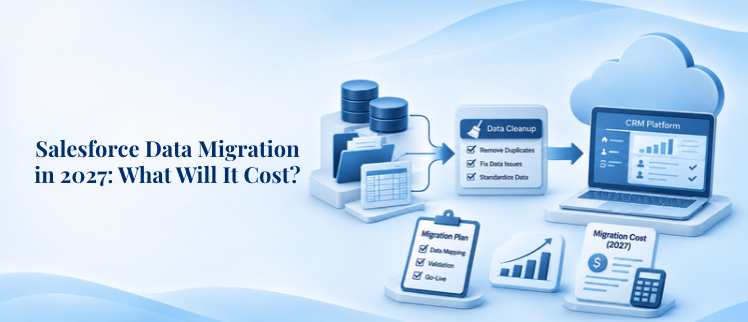
According to the latest Salesforce price guide from the vendor, the cost of Salesforce data migration begins at a few hundred dollars for a list upload and can climb up to $60,000 once several systems, dirty records, and integrations are in play. The greater change for 2027 is the reasons behind companies relocating. By 2026, organisations will be canceling 60% of their AI initiatives without AI-ready data. Nearly every quote is still based on scope, data quality, and integrations. This guide will take you through the various scenarios, tools, and hidden fees involved in Salesforce data migration and help you create a Salesforce migration project budget that passes the finance review.
What Affects Salesforce Data Migration Cost the Most?
A handful of drivers set almost every quote.
Record Volume and Source System
Volume matters, but less than people expect. Loading 200,000 tidy rows from a modern CRM is routine. Loading 20,000 rows from a 15-year-old system with no unique IDs is a project. That’s why the cost to migrate data to Salesforce can differ wildly between companies of the same size.
Data Quality and Custom Objects
Duplicates, three different date formats, and half-empty fields all need fixing before anything loads. Custom objects add design work, because data that doesn’t fit leads, accounts, contacts, or opportunities needs a new home. Attachments, call notes, and connected systems each add mapping and retesting. All of it adds hours, and hours decide Salesforce data migration cost.
What Has Changed for Salesforce Data Migration Cost in 2027?
Three developments have changed the budget conversation.
AI Readiness Is Now a Migration Driver
Many migrations now start because a company wants Agentforce to work. MarTech reported that KeyBanc research ties slower-than-expected Agentforce adoption partly to data readiness, since agents need clean, connected records. That moves the data cleansing cost Salesforce teams used to defer into core scope. Budget for duplicate rules, field-level validation, and permission checks before go-live, because that work now sits inside Salesforce data migration cost.
Authentication Retirements Add to Salesforce Data Migration Cost
Salesforce turned off new connected app creation by default in Spring ‘26, and Winter ‘27 retires the OAuth username-password flow for connected apps. The Platform SOAP API login() call for API versions 31.0 through 64.0 is scheduled to sunset in Summer ‘27. Data Loader jobs, middleware, and scripts that rely on those methods need to move to External Client Apps, a task many teams hand to Salesforce development services. Enforcement dates have shifted before, so check Salesforce’s current release notes, and include the work in your Salesforce migration project estimate from day one.
New Editions Raise the License Baseline
On September 3, 2026, Salesforce replaced Enterprise with Core at $195 per user per month, up from $175. Unlimited became Advanced at $395, up from $350. Salesforce says existing legacy pricing is unchanged, so new buyers should plan the cost to migrate data to Salesforce, and everything around it, against the higher baseline.
How Much Does Salesforce Data Migration Cost in 2027?
Published CRM data migration pricing varies because vendors define “migration” differently. One quote covers only the load. Another bundles mapping, cleanup, testing, and cut-over. Check the scope before you compare any Salesforce data migration cost figure.
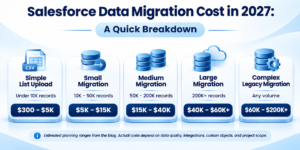
Typical Salesforce Data Migration Cost Ranges
| Scenario | Typical volume | Estimated range |
| Simple list upload | Under 10K clean records | $300 to $5,000 |
| Small migration | 10K to 50K records | $5,000 to $15,000 |
| Medium migration | 50K to 200K records, mixed quality | $15,000 to $40,000 |
| Large migration | 200K+ records | $40,000 to $60,000+ |
| Complex legacy migration | Any volume | $60,000 to $200,000+ |
These ranges come from recent vendor guides and haven’t been repriced for 2027, so treat them as a planning floor, not quotes. Like most CRM data migration pricing, they cover moving data only, so your total Salesforce data migration cost rises once configuration and integrations join the scope.
Comparing CRM Data Migration Pricing
Ask three things. Will it be a flat fee or per-hour? What’s excluded? Extra trial loads: who pays for what? If the number of questions asked is abnormally low, it’s likely because their scope is quite limited – and if they’re telling you this in writing, there’s no harm in being the one who asks the questions that will cost them more.
What Is the Cost to Migrate Data to Salesforce From Each Source System?
The cost to migrate data to Salesforce depends on where your records live right now.
Spreadsheets, HubSpot, Zoho, and Pipedrive
- Spreadsheets and CSV files: Least expensive, but no unique IDs; one company could appear five different ways.
- HubSpot, Zoho, or Pipedrive: Companies map to accounts and deals map to opportunities, except for custom objects and additional pipelines, which require a decision.
Dynamics, Legacy Databases, and Other Salesforce Orgs
- Microsoft Dynamics: Higher, thanks to business units, security roles, and plug-ins.
- Legacy or custom databases: Highest. To make the effort double or triple, you need to map and validate the relationships.
- Another Salesforce org: Tricky after a merger, because record types, sharing rules, and automation conflict.
The source system represents just one of the many factors that can impact Salesforce data migration cost by tens of thousands of dollars.
Why Does Data Cleansing Add So Much to Salesforce Data Migration Cost?
What Cleanup Includes
The data cleansing cost Salesforce buyers face ranges from about $1,000 for a tidy spreadsheet to $30,000 or more for a heavily duplicated CRM. Typical tasks include:
- Reduplicating accounts and contacts
- Standardizing date, phone, and address formats
- Turning free-text fields into pick lists
- Reassigning records owned by people who left, and deciding what to archive
Keeping Cleanup Under Control
One industry guide says problems found mid-migration cost about three times more to fix than problems caught early. So profile your data first. Write down your matching rules, and have a person review uncertain duplicates instead of letting a script merge them. That keeps data cleansing costs predictable for Salesforce teams, and it shields your overall Salesforce data migration cost from late surprises.
What Do Salesforce Data Migration Tools Cost?
Salesforce data migration tools cost less than most buyers expect, because the core options are free.
Free Tools That Keep Salesforce Data Migration Cost Down
- Data Import Wizard: When it comes to simple mappings in supported objects, Salesforce recommends it for fewer than 50,000 records.
- Data Loader: Free desktop application to load data with the Bulk API for larger loads. See if your authentication method is still supported.
- Dataloader.io: Free up to 10K records per month. One recent guide estimates that paid plans go up to about $299 per user per month at Enterprise level.
Paid ETL and AI-Assisted Platforms
At this tier, Salesforce data migration tools cost more, as there are platforms with custom pricing, which depend on volume and connectors. More recent mapping capabilities with AI can reduce field-based manual analysis but require human oversight of the results. If you’re not one of those, Salesforce data migration tools are inexpensive. People get the real money as the mapping, cleansing rules, and the reconciliation push the invoice. Salesforce data migration tools cost is much lesser for using tools as compared to scope.
How Does Salesforce Implementation Cost Affect the Total?
Migration is part of a larger project. Also included in Salesforce implementation cost are training, automation, integrations, configuration, and go-live support.
The 1.5 to 3 Times Rule
Many guides list implementation as 1.5 to 3 times the annual license fee. Adopt 20 users of Core at $195 per user-month. That’s $46,800 a year in licenses, so services land between $70,200 and $140,400. Ensure that Salesforce implementation cost isn’t swallowed up by Salesforce data migration cost.
Rebuilding Old Automations
Since December 31, 2025, Salesforce no longer supports Workflow Rules and Process Builder. Existing automation typically require to be rebuilt in Flow and this development activity will be part of your Salesforce implementation cost plan.
What Hidden Costs Can Push Salesforce Data Migration Cost Higher?
Final invoices rarely match the first quote.
One-Time Extras
- Integration rework: Simple connections run about $5,000 to $15,000, medium ones $15,000 to $50,000, and ERP integrations can top $60,000. Adding legacy logins to External Client Apps is on top of that.
- Training: Often $500 to $5,000 per user.
Recurring Costs
- Sandboxes: $5,000 to $15,000 per year can be added for full sandbox environments.
- Post-launch admin: $2000-$8000 per month for support or hire someone.
- Licenses: $195/USER/MONTH (the Core rate) for new buyers, as opposed to $175/USER/MONTH.
Together, these extras commonly add 20 to 40% to Salesforce data migration cost.
How Do You Build a Salesforce Migration Project Estimate?
Here is the 6-step approach to a reliable Salesforce migration project estimate:
- Inventory every source: Systems, objects, and record counts.
- Profile data quality: Count duplicates, gaps, and broken relationships.
- Set a history cut-off: Decide how many years of activity to load.
- List integrations and automation: Record all it will need to restructure/repoint.
- Request line-item quotes: Mapping, cleansing, trial loads, reconciliation, cut-over, and hypercare quotes should be separate.
- Add contingency: Hold back 20 to 40% for surprises.
Do it this way, and you won’t have an estimate for your Salesforce migration project that falls apart once you get real data.
Questions to Ask a Partner
Good questions expose hidden work faster than any CRM data migration pricing sheet.
- What does the quote mean? Don’t accept a general estimate.
- What about cleaning up? Ask Salesforce partners about whether they do charge for reduplication as part of their data cleansing quote.
- What kind of tools do they use? Verify if Salesforce data migration tools add to services.
- Is authentication change included? Who makes the integrations in External Client Apps?
How Can You Reduce Salesforce Data Migration Cost?
- Do not move things around; archive them: If nobody is using old records, it is just a risk to move them somewhere new.
- Clean at the source: Duplicate fixes prior to handover reduce the cost of data cleansing to Salesforce teams through mid-project fixes.
- Early hiring: When development services are acquired from Salesforce, they help eliminate rework and save money.
- For small jobs, use free tools: The following native wizard keeps the cost of migrating data to Salesforce low.
Scope it tightly, and Salesforce data migration cost stays under control.
When Should You Hire Salesforce Development Services?
You can handle fewer than 5,000 clean records on your own. Past that, risk climbs fast: broken relationships, lost activity history, failed integrations.
What a Partner Adds
Professional Salesforce development services bring a few things a DIY load lacks:
- Mapping experience across legacy and modern CRMs
- Apex, Flow, and API skills for rebuilding automation and integrations
- Custom object design, so migrated data has a proper home
- Reconciliation checks that prove nothing went missing
A partner often costs less overall because mistakes caught early are cheap. Mistakes caught after go-live aren’t, and they can push Salesforce data migration cost well past the original quote.
So, What Should You Do Next?
The right Salesforce data migration cost is the one that you can stand up and defend. Be honest about your sources; Price the cleanup first; Have separate budgets for Salesforce implementation costs and licenses. While free tools work well for smaller projects, specialist Salesforce development services are better for multi-system projects. As a Salesforce Silver Consulting Partner, AnavClouds Software Solutions provides clean and migrate data without any unpleasant surprises. To obtain a clear Salesforce data migration cost for your own project, let us know what your sources and timeline are, and we will transform them into a realistic and itemized estimate.
What Do People Ask Most About Salesforce Data Migration?
How much does Salesforce data migration cost?
The price of Salesforce data migration can vary from $300 for simple uploads of lists to $60,000 and above for multi-system projects. Your quote is determined by source system, data quality, custom objects, and integrations.
How long does a Salesforce data migration take?
It can take several weeks for a clean single-source migration. Projects with many data sources that have poor data quality, files, and back history can take several months, depending on the speed at which sign-off occurs and the number of trial loads that are needed.
Can I migrate data to Salesforce for free?
Yes, when there are only a few small and clean data sets. Salesforce data migration is close to no cost, as its Data Import Wizard and Data Loader are free. If it’s something that is complex or has duplicates or integrations, you will likely need an expert paid for this type of relationship.
What does Salesforce data migration cost include?
A complete quote includes profiling, field mapping, cleansing, sandbox trial loads, reconciliation, cut-over, and post-go-live support. Integrations, automation rebuilds, and training can be additional fees, so ensure there are no exclusions!
Search Posts
Popular Posts
Author profile: Saransh Maurya, Content Writer at AnavClouds Software Solutions
Saransh
Maurya
About the author
Saransh Maurya is a dynamic and results-driven professional with a passion for innovation and problem-solving. Known for his analytical mindset and attention to detail, he excels at delivering high-quality solutions that drive business growth and operational efficiency. With strong communication skills and a collaborative approach, Saransh effectively bridges ideas and execution, contributing to successful projects and meaningful outcomes across diverse domains.
Recent Posts