
Salesforce Implementation Timeline: How Long Does It Really Take?
One of the questions that likely crosses your mind when you have been analyzing Salesforce is how long will it actually take? It is a reasonable question, and it has no one answer. The Salesforce implementation timeline relies on the level of your business, the extent of your rollout, the complexity of your systems, and the preparedness of your team before commencing the project. Some businesses are launched within a few weeks. Others require between six and twelve months. And both may be totally proper. This guide will take you through what determines how much time you have to spend on your Salesforce implementation, how a realistic phase-by-phase implementation process would look, and how to accelerate the process without jeopardizing quality.
Why There’s No One-Size-Fits-All Salesforce Implementation Timeline
Over 150,000 organizations in the world, ranging in size from 10-person startups to large enterprises, use Salesforce. Salesforce has dominated the global CRM market, setting a record of more than 21% of the market compared to the four nearest competitors as per the IDC 2025 Worldwide Semiannual Software Tracker. Such reach in a wide array of industries implies that the Salesforce implementation timeline would appear quite different, based on who is undertaking the implementation and its purpose.
Here’s a general benchmark for Salesforce CRM implementation time by business size:
These are starting points, not guarantees. Let’s look at what actually drives the numbers.
Factors That Shape Your Salesforce Implementation Duration
Scope and Cloud Selection
Opportunity and complexity are added to each new Salesforce cloud. The Salesforce implementation timeline for rolling out Sales Cloud in a small team is significantly different than the implementation timeline of rolling out Sales Cloud, Service Cloud, and Marketing Cloud in multiple departments.
A staged implementation- begins with the essential functionality and extends as needed is frequently the most intelligent method to reduce the original Salesforce implementation time as you proceed to a full implementation.
Level of Customization
Salesforce provides potent out-of-the-box features. The larger the construction of a system that surpasses the defaults, the larger the Salesforce implementation process will become:
- Light customization (fields, layouts, basic reports): a few days to a couple of weeks.
- Medium customization (custom objects, approval of workflows, automation): a few weeks.
- Extensive customization (Apex code, Lightning Web Components, complex logic): months.
One of the most efficient methods of managing your Salesforce implementation timeline is to maintain customization lean during Phase 1.
Data Migration Complexity
Salesforce implementation timeline is silently expanded with data migration. Well-structured data that is clean migrates fast. The records found in legacy CRMs, spreadsheets, and unrelated tools will need to be cleaned extensively before anything can be transferred. Bad data also hurts user confidence after launch – inaccurate pipeline data or duplicate contacts eating up adoption quickly. Begin the data audit in the course of discovery, not in migration week.
Integration Requirements
Should Salesforce require connecting with your ERP, billing system, marketing tools, or support platform, those connections are time-consuming to establish and test. Normal integrations (Outlook, Slack, DocuSign) are generally quick. Legacy or proprietary systems for API integrations are not. All of them contribute to the general Salesforce implementation timeline.
Internal Team Preparedness and Change Management
A perfectly set Salesforce org will fail to work well unless its users are prepared. Team preparedness, the presence of an internal project owner, coordinated leadership, and trained end users directly influence the Salesforce implementation time, as well as the quality of the post-implementation adoption.
Partner Expertise
Having an accredited Salesforce implementation partner would make the project much faster. Seasoned partners have proven methodologies, pre-built templates, and the accumulated knowledge of how to avoid the most frequent traps before they become delays – and before they contribute weeks to your Salesforce implementation process.
The Salesforce Implementation Process: Phase by Phase
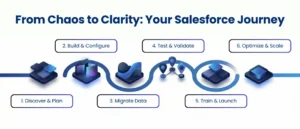
A well-structured Salesforce implementation process typically follows six core phases. What changes between projects is the depth and duration of each one.
Phase 1: Discovery and Planning (2 – 6 Weeks)
This is the most important — and most underestimated — part of the Salesforce implementation process. A solid discovery defines:
- Business goals and measurable success criteria
- Core workflows Salesforce will support or replace
- User roles, access requirements, and org hierarchy
- Data sources, current quality, and migration approach
- Integration requirements with existing systems
Every hour invested in discovery typically saves several hours during configuration. Rushing this phase is one of the most common reasons a Salesforce implementation timeline extends later.
Phase 2: Configuration and Development (4 – 16 Weeks)
This is where the actual Salesforce implementation process takes shape — building the org in a sandbox environment before anything touches live data. Activities include:
- Setting up user roles, profiles, and security settings
- Building custom objects, fields, page layouts, and automation
- Developing integrations and any required custom code
- Configuring dashboards, reports, and forecasting views
For standard implementations, this phase moves quickly. For enterprise-level builds, it’s usually the longest part of the Salesforce implementation timeline.
Phase 3: Data Migration (2 – 6 Weeks, Often Overlaps Phase 2)
Data migration typically runs in parallel with configuration. The goal is to get records into Salesforce accurately and in the right structure. This involves field mapping, data cleansing, sandbox test loads, and a final cutover before go-live. Clean data makes this phase straightforward. Messy data makes it the biggest variable in the entire Salesforce implementation timeline.
Phase 4: Testing (1 – 3 Weeks)
Testing is non-negotiable. Skipping it almost always produces post-launch problems that take longer to fix than proper QA would have taken. A solid Salesforce implementation guide always includes:
- Unit testing: Individual features validated by admins and developers
- User Acceptance Testing (UAT): Real users test workflows in a staging environment
- Integration testing: Data flows correctly between Salesforce and connected systems
- Regression testing: Fixes don’t break existing functionality
Phase 5: Training and Go-Live (1 – 2 Weeks)
Role-specific training — built around how different teams will actually use the system — is far more effective than a generic one-time session. Go-live readiness should include a confirmed checklist, a support team on standby, and a hypercare plan for the first 1 – 2 weeks post-launch.
Phase 6: Post-Implementation Optimization (Ongoing)
The Salesforce implementation timeline officially ends at go-live. Real value-building begins afterward — through feedback loops, workflow refinements, and feature expansion as the business evolves.
Salesforce Implementation Timeline by Business Type
Salesforce Implementation for SMBs
Salesforce implementation for SMBs is generally faster and more contained, but that doesn’t mean it can be treated casually. Most small businesses benefit from a focused Sales Cloud rollout using primarily out-of-the-box functionality and minimal integrations. A realistic Salesforce implementation timeline for an SMB in this scenario is 4 – 8 weeks.
The biggest risk for smaller teams is underestimating how much internal involvement is needed. Even without a large IT team, someone needs to own the project day to day.
Mid-Market Businesses
Mid-size organizations typically deploy two to three clouds with moderate customization and multiple user groups. The Salesforce CRM implementation time for this segment generally falls between 2 and 4 months. Training becomes increasingly important here — different departments will use the platform in different ways.
Enterprise Organizations
Enterprise implementations are multi-cloud, multi-department, and often multi-region. Complex data migrations, deep integrations, extensive custom development, and phased rollouts push the Salesforce implementation timeline to 6 – 12 months or longer. When the scope justifies it, that timeline is the right one.
Common Salesforce Implementation Challenges to Watch For
Even well-planned projects hit obstacles. These are the most common Salesforce implementation challenges that extend timelines and how to handle them:
Scope creep — Feature requests keep expanding the project mid-build. The fix: a firm Phase 1 scope and a formal process for logging future enhancements.
Poor data quality — Dirty data is the most disruptive hidden cost in any Salesforce rollout. Start cleanup during discovery, not during migration week.
Lack of executive sponsorship — Without leadership reinforcing priorities, decisions to stall, and timelines stretch. Assign an executive sponsor and keep them actively involved.
Skipping training — A well-built org won’t deliver results if users don’t adopt it. Build enablement into the Salesforce implementation process from the start — not as a last-minute addition.
Compressed testing cycles — Rushing through QA almost always creates more post-launch work than the time saved was worth it. Protect your testing phases.
Salesforce Implementation Checklist: Before You Start
Run through this Salesforce Implementation Checklist before your project kicks off:
Business Readiness
- Goals and KPIs defined for the implementation
- Executive sponsor assigned and aligned
- Internal project owner designated with time committed to the project
Technical Readiness
- Current systems and integrations documented
- Data sources inventoried and quality assessed
- Salesforce edition and licenses confirmed
Process Readiness
- Core workflows documented for configuration
- User roles and reporting requirements confirmed
- Training plan outline agreed
Partner Readiness
- Certified Salesforce implementation services partner selected and onboarded
- Project plan, milestones, and communication rhythm confirmed
Salesforce Implementation Cost: What to Expect
The cost of implementation of Salesforce is in direct proportion to complexity. In the case of SMBs with a limited scope, total prices (licenses and a partner) are usually in the range of 10,000-50,000. Mid-market projects often range from $50,000 to $200,000. The cost of enterprise implementations may be over 500000, based on the scope and Salesforce development services needed.
The cost of making a mistake is, nevertheless, the more important number. Rework, lack of adoption, and delayed ROI will always be more expensive than investing appropriately in the Salesforce implementation process at the start.
How to Accelerate Your Salesforce Implementation Timeline the Right Way
There are legitimate ways to shorten the Salesforce implementation timeline without creating problems downstream:
- Use native Salesforce features first. Save custom development for when it’s genuinely necessary.
- Start data cleanup early. Don’t wait for migration week — begin auditing during discovery.
- Prioritize ruthlessly. Build the 20% of features that deliver 80% of the value first, and push the rest to Phase 2.
- Keep decision-makers available. Slow response times from stakeholders are one of the top causes of extended Salesforce implementation timelines.
- Work with experienced Salesforce development services. Certified partners bring templates and methodologies that save weeks without sacrificing quality.
Ready to Get Your Salesforce Implementation Right?
Every business Salesforce implementation timeline will vary, but the overall principles that will guarantee its success remain the same: well-laid-out scope, quality data, expert assistance, and well-defined change management. As a Salesforce Silver Consulting Partner, we have practical experience with industries and types of implementations at AnavClouds Software Solutions. Be it a clean sheet or a spin-up, we assist businesses transit the Salesforce implementation cycle effectively – and create something that will provide tangible, lasting worth. Get in touch to start with a discovery conversation.
FAQs
Q1. How long does Salesforce take to implement for a small business?
The Salesforce implementation plan of an SMB implementing a single cloud with little customization and clean data will take an average of 4 -8 weeks. This can be extended to 3 -4 months by more complex requirements or data quality concerns. Having a defined scope prior to the start of the project is the most important aspect.
Q2. What most commonly causes the Salesforce implementation timeline to go over schedule?
The best offenders are scope creep, bad data quality, and the inaccessibility of key internal stakeholders. All these can be prevented by ensuring good planning. The most effective means of keeping track is a clear scope, timely data clean-up, and time to allow decision-makers to operate under crucial time constraints.
Q3. Do I need a Salesforce partner, or can I implement it internally?
To implement a Sales Cloud with a simple rollout and minimum customization, an expert in-house Salesforce administrator will be able to handle the project. Certified Salesforce implementation services are highly recommended to anything more complex, such as multiple clouds, custom development, and major integrations. The price of an incompetent implementation is virtually always higher than the price of collaboration with a competent partner.
Q4. Is the Salesforce implementation really finished after go-live?
The final Salesforce implementation timeline is not the final project, but go-live. A full Salesforce implementation schedule takes into consideration even the post-launch stage – expect a 2 -4 week hypercare period right after implementation, and then continue with optimization as user feedback is received. Salesforce also has three big platform releases per year, each of which is worth considering, potentially, to adopt in your org.
Search Posts
Popular Posts
Author profile: Saransh Maurya, Content Writer at AnavClouds Software Solutions
Saransh
Maurya
About the author
Saransh Maurya is a dynamic and results-driven professional with a passion for innovation and problem-solving. Known for his analytical mindset and attention to detail, he excels at delivering high-quality solutions that drive business growth and operational efficiency. With strong communication skills and a collaborative approach, Saransh effectively bridges ideas and execution, contributing to successful projects and meaningful outcomes across diverse domains.
Recent Posts