Salesforce vs HubSpot: Why Growing Teams Choose Salesforce
Salesforce vs HubSpot is a matter of short- and long-term tools. While both are easy to get started with, Salesforce is a better option for businesses looking for a CRM they won’t outgrow, boasting extensive customization, proven automation, and AI agents in sales, service, and marketing. When it comes to growth, it’s definitely the platform that is designed for scale that has the edge in a fair Salesforce vs HubSpot discussion. In this guide, we’ll analyze the features of Salesforce vs HubSpot, pricing, AI solutions, the fit for mid-market and startups, as well as when a HubSpot to Salesforce migration is a viable option, to ensure you choose a platform that you’ll be able to sustain in three years, not just this quarter.
What Is the Real Difference Between Salesforce and HubSpot?
Salesforce vs HubSpot is a comparison of two tools that both deal with customer relationships, but from different approaches. HubSpot is a marketing solution and works best as a simple, shared database for smaller teams. With its roots in sales, Salesforce is the home of most serious growth plans because it’s the platform you can mold around virtually any business process.
HubSpot at a Glance
- Easy to set up and user-friendly.
- Free CRM tier (flexible paid upgrades to other tiers)
- This is the ideal option for small processes and teams.
Salesforce Briefly
- New flexible platform for Sales Cloud, Service Cloud, Marketing Cloud and beyond.
- Deep customization using Flow, Apex and Lightning Web Components.
- The relationships with large partners and the AppExchange marketplace.
It’s that platform depth that continues to drive momentum for Salesforce: In the quarter that ended July 31, 2026, its annual recurring revenue (ARR) for Agentforce and Data 360 grew by over 210%, reaching nearly $3.9 billion. HubSpot comes out ahead on simplicity; Salesforce comes out ahead on direction in the Salesforce vs HubSpot debate.
So the core of Salesforce vs HubSpot is simple. One is a platform you configure and grow into. The other is a product you may outgrow.
How Does the Salesforce vs HubSpot Features Comparison Stack Up?
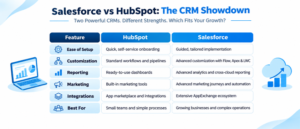
At the heart of Salesforce CRM, it is not far off from HubSpot’s core CRM features in any fair features comparison between the two platforms. Salesforce beats them in the customization, scale, and AI arena.
| Area | HubSpot | Salesforce |
| Setup | Days, often self-serve | Weeks, guided by an admin or partner and built to your process |
| Customization | Good, with tier caps on custom objects and pipelines | Near unlimited with Flow, Apex and Lightning Web Components |
| Reporting | Easy dashboards out of the box | Deeper analytics and cross-cloud reporting |
| Marketing | Native and strong | Marketing Cloud Account Engagement and Marketing Cloud for advanced journeys |
| Ecosystem | Smaller app marketplace | AppExchange with several times more apps |
| Best fit | Simple processes and small teams | Growing and enterprise teams with complex processes |
Where HubSpot Holds Its Own
On boarding and some alignment between marketing and sales. New reps, value for very simple processes, in days.
Where Salesforce Wins
Customization, data modelling and scaling. Salesforce has a leg up with the complex approval process, selling in multiple currencies, and industry clouds like Health Cloud and Financial Services Cloud; the advantage becomes even more pronounced as your business expands.
Ease of use tilts to HubSpot; flexibility, depth, and long-term value tilt to Salesforce when it comes to Salesforce vs HubSpot.
What Does Salesforce vs HubSpot Pricing Look Like in 2027?
The pricing of Salesforce vs HubSpot appears to be similar at the bottom end. HubSpot has a free CRM and an affordable Starter plan. Smaller teams can start out on the same platform that they’ll expand to with Salesforce’s Starter Suite, which is about $25 per user per month.
On the professional level, they both get around $100 per user/month. The list price difference between Sales Cloud and HubSpot Sales Hub Enterprise is not that significant: Sales Cloud costs a few extra dollars at $165 to $175 per user per month, while HubSpot Sales Hub Enterprise is closer to $150 per seat. It varies by published price depending on source, promotion/billing term; be sure to check on each vendor’s pricing page.
Plan in terms of three years. A more affordable licence can be more expensive if you hit its restrictions and then need to build a new one on a different platform; a platform that grows with you won’t cost you the second time.
Hidden Costs to Watch
- HubSpot: Contact-based pricing increases rapidly with the number of contacts in your database, and the cost of outgrowing HubSpot is paying for a migration in the future.
- Salesforce: Add-ons like Agentforce, Data Cloud, and marketing products are available for an extra cost, so make sure you scope them in at the beginning with your partner.
- Both: Admin time. It’s rewarded by Salesforce with a lot more control.
How Does HubSpot Enterprise vs Sales Cloud Compare for Large Teams?
The Salesforce vs HubSpot real battle begins with HubSpot Enterprise vs Sales Cloud. Custom objects, multiple pipelines, multiple team hierarchies, and predictive lead scoring are all features of HubSpot Enterprise. Sales Cloud Enterprise takes it one step further with territory management, record types, granular permission sets, sandboxes, and close integration with Revenue Cloud and CPQ.
A second Salesforce vs HubSpot comparison is that HubSpot doesn’t offer any tiers beyond Enterprise, whereas Salesforce offers Unlimited and AI-bundled editions for companies that have outgrown it. Sales Cloud provides much more space if you are running complex territories, several business units, or compliance rules. If your process is easy now, then you have a road map to when it’s not.
What Large Teams Should Test
- Perform a pilot with the actual pipeline stages and approvals
- Determine custom object limits and compare with the data model.
- Discuss with each team and region what they need to verify to get permission.
- Inquire from each vendor what is included and what is an add-on
Which CRM Is Better for Mid-Market Companies?
HubSpot vs Salesforce for Mid-Market Teams
When it comes to HubSpot vs Salesforce for mid-market buyers, it’s not typically a feature issue. It’s all about 3 years without Salesforce vs HubSpot. As a business grows, it will generally have to integrate business units, products, and integrations, and each of these will push the boundaries of a CRM.
In HubSpot vs Salesforce for the mid-market, alignment is also important when it comes to marketing. The tools natively built into HubSpot ensure campaign and sales follow-up are collected in a single location. That’s matched by Salesforce with Marketing Cloud Account Engagement or Marketing Cloud, which are combined with the same data model used by sales and service.
Choose HubSpot if:
- You have fewer than 100 users and a reasonably standard sales process.
- Marketing and sales need to have one view of the customer primarily
- You don’t have any admin or partner support in mind.
Choose Salesforce if:
- You have several channels of business or resellers.
- When it comes to deep integrations, you must make sure that you have deep ERP, CPQ, or compliance integrations.
- Reporting and permissions need to be well managed.
In most mid-market teams, the Salesforce vs HubSpot choice turns in favor of process complexity rather than staffing size, and that’s typically before the team starts to grow.
Should You Choose Salesforce or HubSpot for Startups?
For startups, the choice comes down to Salesforce or HubSpot, depending on how far in advance you plan. That’s a HubSpot win on day one. However, when you start on Salesforce, you don’t have to experience a painful migration when you’re growing the fastest.
If you’re selling to enterprise buyers, have a complex data model, or want to create your own workflows that you integrate into your product, Salesforce is the best fit. The Starter Suite makes it a cost-effective solution, and you can upgrade editions as you scale up.
Salesforce or HubSpot for Startups: A Quick Checklist
- Does your sales process keep evolving every month? HubSpot is a good place to begin.
- Do investors or enterprise buyers anticipate Salesforce features? Start on Salesforce.
- Are you in the process of building custom apps or integrations that will require a deep integration? Start on Salesforce.
If you’re at the early stages of your team, a simple guideline to follow is to choose HubSpot if speed is your top priority, or Salesforce if you think your sales process will become more complicated in the next two years.
How Do HubSpot Breeze and Salesforce Agentforce Compare?
As of this writing, AI is a mandatory feature in every Salesforce vs HubSpot comparison. The HubSpot Breeze AI is available with paid versions, with usage restrictions included, and is restricted to writing, prospecting, and support assistance. Now Salesforce’s Agentforce extends to more: agents that work across sales and service, and data workflows, and supported by Data 360.
The real Salesforce-HubSpot comparison: HubSpot’s AI is an aid to a basic platform. Agentforce is a new operating layer for businesses that are eager to reimagine their workflows with agents.
A warning: Agents are only as good as their data. If records are in disarray, either platform will take care of it. Clean data, turn on AI.
What to Ask Before You Buy AI
- What agents are covered, and which ones will be an additional charge?
- Are there any limits to use?
- Does the data originate from where, and who controls the data?
When Does a HubSpot to Salesforce Migration Make Sense?
A HubSpot-to-Salesforce conversion typically comes because of growth and not because of dissatisfaction. Often teams begin moving when they reach one of these walls.
Signs You’ve Outgrown HubSpot
- Limitations imposed by custom objects or pipeline, preventing new business models of operation.
- More complex workflows than HubSpot provides.
- Compliance, audit trail, or data residency requirements
- Integrations with ERP/billing systems (if complex).
- A sales team that is large enough that admin control is important.
How to Plan the Move
It takes planning to make a clean move. Validate, map HubSpot objects and associations to Salesforce objects, deduplicate before loading, migrate in increments, and test with live users. The most common areas that get overlooked are related to marketing history and email engagement/attachments. Allow a couple of weeks of parallel running, so that sales teams can become accustomed to the new system.
That’s when the Salesforce vs HubSpot debate is no longer theoretical but becomes a project plan.
Why Do Growing Teams Need Salesforce Development Services?
Salesforce provides flexibility, and flexibility requires building. Salesforce development services include custom Apex, custom Lightning Web Components, Flow automation, third-party integrations, data migration, and AppExchange apps. A proper partner will transform the platform’s capabilities into a process rather than a bunch of unused functions.
Find a partner who asks what they will be using before discussing tools, provides references, and provides support after go-live.
This is the price you pay for the benefit in Salesforce vs HubSpot. HubSpot helps you get on your feet quicker. Built to the right, Salesforce takes you so much further. Budget for Salesforce development services and for continued support – don’t wait for them to be available.
How Do You Make the Final Call?
Run through this checklist before you sign anything on Salesforce vs HubSpot:
- Team size and growth: For startups with less than 25 users and a typical process, they can begin on HubSpot with Salesforce or HubSpot. Do you plan to send 100 people? Start on Salesforce.
- Process complexity: HubSpot Enterprise offers more than a single product or multiple territories, or an approval chain, while Sales Cloud does not.
- Admin capacity: HubSpot vs Salesforce for mid-market: No admin would require partner support, while the other would provide you with much more control.
- Budget view: Compare Salesforce vs HubSpot pricing over three years, not just licence price.
- Support model: Check response times, onboarding help, and who fixes things after launch.
- Exit plan: Moving later costs time and money, so choose the platform you won’t need to leave.
Applied honestly, this Salesforce vs HubSpot checklist settles most decisions in one meeting.
Final Verdict
When it comes to simple processes and small teams, HubSpot is a great option, but Salesforce is a better long-term investment. It provides you with depth, control, a massive ecosystem, an AI roadmap that’s rapidly evolving, and a platform that expands as your business expands. Whether you are considering switching or migrating from HubSpot to Salesforce or are looking for Salesforce development services to unlock its potential, AnavClouds Software Solutions can help you achieve your goals. We are a Salesforce Silver Consulting Partner and provide implementation, integration, and support. Discuss your process with our team, and we’ll design a recommendation that is tailored to you.
FAQs
What Is the Main Difference Between Salesforce and HubSpot?
Salesforce is a platform that is very flexible and comes with a built-in solution for complicated sales cycles and long-term scalability. Today, HubSpot is a simpler all-in-one CRM for simpler needs, easier setup, and smaller teams.
Which Is Cheaper, Salesforce or HubSpot?
HubSpot can usually be more affordable on the first day. As you grow, the costs of outgrowing a CRM and migrating are generally higher, making Salesforce a worthwhile investment when it comes to pricing.
Is HubSpot or Salesforce Better for Small Businesses?
Simple needs have a faster launch time with HubSpot. When it comes to complex processes, quick scaling, or lots of customization, Salesforce is preferred over HubSpot, and in terms of size, the Starter Suite is for smaller teams.
Can You Migrate From HubSpot to Salesforce?
Yes. Contacts, companies, deals, activities, and history are moved to Salesforce via a HubSpot to Salesforce migration with import tools, APIs, or a partner. Schedule data cleanup, object mapping, testing, and user training.
Search Posts
Popular Posts
Author profile: Saransh Maurya, Content Writer at AnavClouds Software Solutions
Saransh
Maurya
About the author
Saransh Maurya is a dynamic and results-driven professional with a passion for innovation and problem-solving. Known for his analytical mindset and attention to detail, he excels at delivering high-quality solutions that drive business growth and operational efficiency. With strong communication skills and a collaborative approach, Saransh effectively bridges ideas and execution, contributing to successful projects and meaningful outcomes across diverse domains.
Recent Posts