Salesforce Net Zero Cloud: Track Emissions & Meet ESG Goals
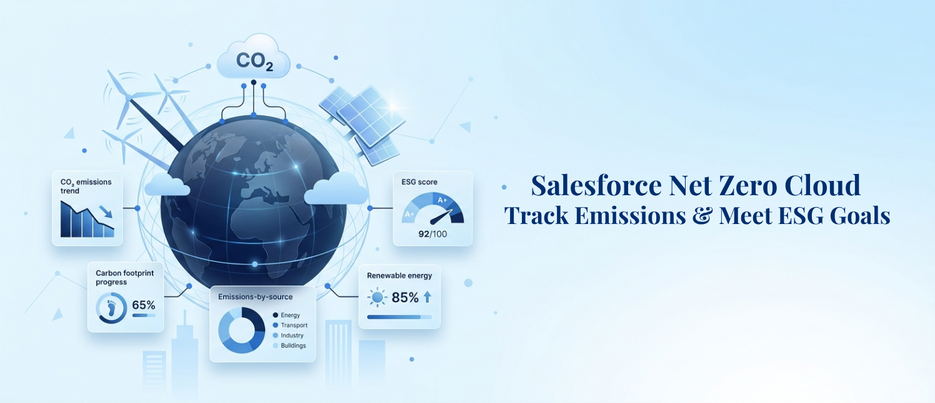
Sustainability reporting has moved from a corporate goodwill gesture to a legal obligation. Businesses worldwide are now expected to track emissions, disclose ESG data, and demonstrate real progress toward net zero, and many are realizing that spreadsheets simply can’t keep up. Salesforce Net Zero Cloud is a purpose-built platform designed to help organizations manage their carbon footprint, automate ESG reporting, and stay ahead of tightening regulatory frameworks like the EU’s CSRD. As a leading ESG reporting software solution built natively on Salesforce, it brings together carbon tracking, supplier engagement, and AI-powered analytics in one place. This blog covers what Net Zero Cloud does, how it works, who it benefits, and what implementation looks like, along with why it has become one of the most critical tools in the modern sustainability tech stack.
What Is Salesforce Net Zero Cloud, and What Problem Does It Solve?
Before anything else, it helps to understand what Net Zero Cloud actually is, and what it isn’t.
Net Zero Cloud is a sustainability management platform, sometimes referred to as the Salesforce sustainability cloud, built natively on the Salesforce ecosystem. It was originally developed in-house by Salesforce to manage their own carbon accounting needs, went through several iterations on a limited-access basis, and was eventually released to the general market. That origin story matters: this isn’t a bolted-on feature or a partner integration; it’s a product that Salesforce tested on itself before handing it to customers.
Salesforce Net Zero Cloud is essentially a single platform for environmental data. It aggregates data from throughout an organisation – energy usage in buildings, data centre consumption, corporate travel, waste production, and supply chain emissions – and creates structured, auditable insights from the raw data.
The issue it addresses is a common challenge for most sustainability teams: carbon data is cluttered, is spread out across departments and vendors, and is elusive to validate. Salesforce Net Zero Cloud tackles this by bringing together the data in one place, for easy access internally to make decisions or externally to report on. It is an ESG reporting software platform that avoids the use of disjointed spreadsheets and provides a reporting platform built from the start to take on audit-ready sustainability management.
How Does Salesforce Net Zero Cloud Actually Work?
Understanding the mechanics behind the platform helps businesses evaluate whether it fits their needs.
Net Zero Cloud organizes emissions data around the three scopes defined by the GHG Protocol:
- Scope 1, Direct emissions from sources your organization owns or controls, such as gas boilers and company vehicles
- Scope 2, Indirect emissions from purchased energy, such as grid electricity
- Scope 3, All other indirect emissions across your value chain, including suppliers, logistics, and the products and services you procure
The platform comes pre-populated with globally recognized emissions factors, removing a significant data entry burden from sustainability teams. These factors determine how energy consumption, fuel use, and other activities are converted into tonnes of CO₂ equivalent (tCO2e), the standard unit in carbon accounting Salesforce teams rely on for accurate, comparable reporting.
Data Gap Filling and AI Intelligence
One of Salesforce Net Zero Cloud’s most practical features is its Data Gap Filling Log. Carbon datasets are rarely perfect; missing entries, inconsistent records, and estimated figures are the norm. Net Zero Cloud uses Einstein AI to flag inconsistencies, estimate missing values using predictive models, and clearly distinguish between actual and estimated data points. This capability is standard practice in carbon accounting Salesforce-style, but having it automated and flagged within the platform saves significant manual effort and reduces the risk of audit failures.
Building Energy Intensity
For organizations managing large property portfolios, Salesforce Net Zero Cloud includes a building energy intensity module. Rather than comparing buildings against each other, which ignores differences in age, use, and location, it benchmarks each building against its own potential for improvement. A listed heritage building and a new-build office can’t be judged by the same baseline. This feature makes comparisons meaningful and actionable.
Targets, Dashboards, and Tableau Integration
Net Zero Cloud comes with Tableau built in, enabling rich data visualizations out of the box. Organizations can set emissions reduction targets and track actual performance against them in real time. This turns Salesforce Net Zero Cloud from a passive reporting tool into a live management instrument.
Supplier Scorecard for Scope 3 Transparency
Supply chain emissions are often the hardest to capture and verify. The Supplier Scorecard within Salesforce Net Zero Cloud allows businesses to collect, normalize, and track carbon data across their supplier network, a capability that is becoming increasingly critical as Scope 3 disclosures move from voluntary to mandatory under frameworks like CSRD and CDP.
Why Is ESG Reporting Now a Business Priority, Not Just a Compliance Exercise?
In 2025, the ESG software market was worth USD 1.2 billion and is expected to increase at a CAGR of 20.1% to reach USD 5.2 billion by 2033, reflecting the corporate world’s commitment to the technology for sustainability.
That growth isn’t taking place in isolation. An important impetus is regulatory pressure. The EU’s Corporate Sustainability Reporting Directive (CSRD) has introduced the need for thousands of firms to make detailed, auditable ESG disclosures, based on the European Sustainability Reporting Standards (ESRS). Across the UK, Salesforce ESG compliance is growing in significance as businesses are increasingly being compelled to make structured, verifiable sustainability disclosures because of the government’s Sustainability Disclosure Requirements (SDR) and the upcoming UK Sustainability Reporting Standards (UK SRS). The frameworks – such as GRI, TCFD, CDP and SASB – have evolved into a ground-truth standard for investors, regulators and other large procurement teams around the world.
Businesses already on Salesforce are especially attracted to the Salesforce sustainability cloud, as it doesn’t need to replace existing infrastructure. It coexists with the Sales Cloud and Service Cloud and other Salesforce products, and pulls in operational data that already resides in the org. And for those who are implementing Salesforce Net Zero Cloud as their ESG reporting software of record, the advantages are even more apparent: one platform, one dataset, and one audit trail.
What Are the Key Features That Make Salesforce Net Zero Cloud Stand Out?
Rather than a flat feature list, it’s worth understanding what these capabilities mean in day-to-day operations.
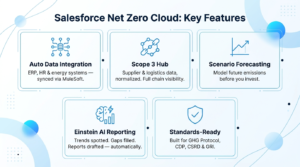
Automated Data Collection and Integration
Using tools like MuleSoft, Net Zero Cloud integrates with existing systems across an organization, energy management platforms, ERP systems, HR tools, and logistics databases, eliminating manual data entry and the errors that come with it. This automated data collection is one of the most significant productivity gains organizations report after Net Zero Cloud implementation.
Scope 3 Emissions Hub
Scope 3 is where most organizations struggle the most. Net Zero Cloud includes a dedicated Scope 3 Emissions Hub that enables data collection from suppliers, logistics partners, and other external stakeholders. The hub normalizes incoming data and helps organizations assess climate risk across the full B2B supply chain context.
Scenario Simulation and Forecasting
The platform includes advanced analytics that model future emissions based on strategic decisions, switching suppliers, investing in renewable energy, and upgrading machinery. This turns Salesforce Net Zero Cloud from a backward-looking compliance tool into a forward-looking planning platform.
Einstein AI for ESG Reporting
By leveraging Einstein, Salesforce Net Zero Cloud automatically analyzes historical emissions data, highlights trends and anomalies, intelligently fills missing data, and recommends high-emission areas for action. It also enables AI-powered report drafting, which cuts down on manual work and helps to create a disclosure-ready report. It’s a valuable time saver for sustainability teams that are working with multiple frameworks.
Audit-Ready Reporting Aligned with Global Standards
Net Zero Cloud is a top ESG reporting software solution, providing reports in line with the GHG Protocol, CDP, CSRD, and GRI. These are not “exported” structures, but “structured” outputs that are designed to comply with the needs of auditors, regulators, and institutional investors.
Which Industries Benefit Most from Salesforce Net Zero Cloud?
Net Zero Cloud is not industry-specific but is particularly relevant to those industries that have a high emissions profile and are exposed to regulation.
Manufacturing and Heavy Industry
Emissions tracking on production lines, furnaces, and fuel combustion in real-time, Scope 1 & 2. Manufacturing companies can use carbon accounting Salesforce functionality to determine which processes use the most energy, and then are able to adhere to carbon standards such as ISO 14001 and the EU Emissions Trading System.
Retail and Consumer Goods
Supply chain emissions (Scope 3) dominate this sector. Salesforce Net Zero Cloud’s supplier engagement tools help retailers hold vendors accountable and build toward a transparent, low-carbon value chain, increasingly a mandatory expectation from large retail partners like Amazon and Carrefour.
Banking and Financial Services
ESG scoring of clients and investment portfolios is now standard practice. Net Zero Cloud helps financial institutions integrate ESG data into credit processes, comply with the EU Taxonomy Regulation, and build investor confidence through transparent, framework-aligned reporting.
Real Estate and Hospitality
Managing building energy use, tracking Scope 2 emissions, and supporting LEED or BREEAM certifications. For commercial real estate, the building energy intensity module within Net Zero Cloud is particularly valuable.
Technology and IT Services
Data center emissions, responsible procurement and/or ESG reporting as a sales differentiator in B2B sales. The Salesforce sustainability cloud is a legitimate platform for tech companies to show enterprise customers and partners that they are environmentally responsible.
The key element in each of these scenarios is the same: Salesforce Net Zero Cloud provides an automated, centralized, audit-ready process where traditionally, it would be manual, fragmented, and prone to error.
What Does Net Zero Cloud Implementation Look Like in Practice?
Net Zero Cloud implementation is not a one-day deployment. It requires a structured approach that accounts for an organization’s data landscape, reporting obligations, and team readiness.
A well-structured Net Zero Cloud implementation typically follows these phases:
ESG Maturity and Gap Assessment
Before configuration begins, organizations need a clear picture of what emissions data they currently have, where it lives, and what’s missing. This shapes the entire integration and configuration approach.
Data Source Mapping and System Integration
Working with a Salesforce development services partner, the platform is connected to existing systems — ERP, energy management tools, travel platforms, and supplier databases — through a structured Salesforce data migration process that maps legacy records into Net Zero Cloud’s data model.
Configuration and Custom Emission Factors
Every organization has a unique carbon footprint. Salesforce Net Zero Cloud allows custom emission factors and objects to be added alongside the pre-populated global standards. A good Salesforce development services partner will configure these to match your specific operational footprint, whether that’s refrigerant-heavy industrial processes or a complex multi-site property portfolio.
Dashboard Setup and Target Definition
Tableau dashboards are configured to surface the metrics that matter most: Scope 1/2/3 breakdowns, progress against reduction targets, building performance comparisons, and supplier scorecard data.
Testing, Training, and Go-Live
Before go-live, the system is validated against real data to confirm accuracy. Teams across sustainability, finance, and operations are trained with clear ownership assigned for ongoing data management.
Ongoing Optimization and Regulatory Alignment
Salesforce Net Zero Cloud continues to evolve as regulations change. Post-implementation support ensures the org stays current with new reporting requirements and new platform features.
The right Salesforce development services partner makes a significant difference here. Look for one that combines deep Salesforce technical expertise with genuine knowledge of ESG frameworks and regulatory requirements, not just certifications.
How Does Salesforce Net Zero Cloud Support ESG Compliance in the UK?
For UK-based organizations, the regulatory environment is tightening quickly. Salesforce ESG compliance UK requirements are being shaped by the government’s SDR framework, the incoming UK SRS, and increasing investor expectations for standardized, verifiable sustainability disclosures.
Salesforce Net Zero Cloud addresses Salesforce ESG compliance UK needs through several specific capabilities:
- Alignment with GHG Protocol, CDP, and GRI frameworks that underpin both UK and EU reporting requirements
- Full audit-trail functionality that supports the verification demands of UK SDR
- AI-assisted report drafting that reduces the workload for sustainability teams navigating multiple disclosure frameworks simultaneously
- Supplier engagement tools that support the supply chain due diligence obligations now expected under CSRD and equivalent UK frameworks
For UK businesses already using Salesforce, the path to compliance through the Salesforce sustainability cloud is significantly shorter; existing operational data is already in the org, so there is no need to build a parallel data infrastructure from scratch. It’s one of the reasons Salesforce ESG compliance UK conversations increasingly start with Salesforce Net Zero Cloud as the logical first step.
Conclusion
Sustainability is no longer a long-term aspiration; it is an immediate operational and regulatory requirement. Salesforce Net Zero Cloud gives organizations the tools to move beyond intention and into measurable action: accurate emissions tracking, automated ESG reporting, supplier engagement, and AI-powered analytics, all within the Salesforce ecosystem they already know. Whether you’re navigating CSRD, responding to investor ESG expectations, or building an internal sustainability program for the first time, Salesforce Net Zero Cloud provides a credible, scalable, and audit-ready foundation. At AnavClouds Software Solutions, we help businesses implement and optimize Salesforce Net Zero Cloud to match their specific reporting obligations, regulatory requirements, and sustainability goals, so the platform delivers value from day one.
FAQs
What is Net Zero Cloud used for?
Salesforce Net Zero Cloud is used to track carbon emissions across Scope 1, 2, and 3, automate ESG disclosures, manage supplier sustainability data, and support compliance with frameworks including CSRD, CDP, and GRI.
Is Net Zero Cloud only suitable for large enterprises?
No. While large organizations with complex emissions profiles benefit significantly from Salesforce Net Zero Cloud, the platform is scalable. It can be configured for mid-sized businesses across a range of industries and reporting requirements.
How does Net Zero Cloud handle Scope 3 emissions?
Salesforce Net Zero Cloud includes a dedicated Scope 3 Emissions Hub that collects and normalizes supplier and partner data, integrating it into the organization’s overall carbon footprint reporting and audit trail.
Can Net Zero Cloud integrate with other Salesforce products?
Yes. Salesforce Net Zero Cloud is built natively on the Salesforce platform. It integrates directly with Sales Cloud, Service Cloud, and other Salesforce products, using shared data infrastructure to avoid duplication and improve reporting accuracy.
Search Posts
Popular Posts
Author profile: Saransh Maurya, Content Writer at AnavClouds Software Solutions
Saransh
Maurya
About the author
Saransh Maurya is a dynamic and results-driven professional with a passion for innovation and problem-solving. Known for his analytical mindset and attention to detail, he excels at delivering high-quality solutions that drive business growth and operational efficiency. With strong communication skills and a collaborative approach, Saransh effectively bridges ideas and execution, contributing to successful projects and meaningful outcomes across diverse domains.
Recent Posts