Gaurav AnavClouds Software Solutions +1 917 266 9985 info@anavcloudsoftwares.com
AI agents
AI Agents & Agentic Workflows

Imagine a Salesforce workflow that makes decisions, solves issues, and optimizes procedures in real time—all while thinking, adapting, and acting independently. This is the capability of AI agents & agentic workflows. With this, businesses can turn repetitive tasks into automated operations by integrating autonomous AI agents. This enables them to stay ahead in the competitive ecosystem by improving productivity and making data-driven decisions. Organizations can easily realize the potential of these intelligent workflows and provide improved user experiences. These results can be achieved with the help of an experienced Salesforce development service providers.  

In this blog, we will take a look at how these intelligent AI integrations in Salesforce automation can help businesses streamline their operations and improve productivity. 

Core Pillars of Agentic Workflows 

AI agents & agentic workflows in Salesforce automation are built on three essential pillars. Workflows are made possible by these pillars to operate independently, adjust wisely, and produce outcomes that complement corporate objectives. Let’s examine each’s role in more intelligent Salesforce automation solutions. 

AI Agents – The Driving Force of Automation

The foundation of agentic processes is AI agents. They make decisions on their own, engage with data, assess their surroundings, and carry out activities without assistance from humans. They can react to goals, context, and real-time inputs because of their flexibility. Through the integration of AI agents into Salesforce workflow automation, companies can develop dynamic processes that remain intelligent, adaptable, and effective. 

Prompt Engineering – Guiding Intelligent Responses

Accuracy and relevance are ensured via prompt engineering in autonomous AI agents. Businesses can direct AI activity and customize answers to meet particular objectives by using structured inputs. Prompt engineering improves workflow precision in Salesforce automation solutions, guaranteeing AI agents maintain efficiency while aligning with company goals. 

Large Language Models (LLMs) – Powering Generative Intelligence

AI Agents & Agentic workflows rely on Large Language Models (LLMs) as their intelligence engine. Natural language processing is used by LLMs, which have been pre-trained on large datasets, to comprehend queries, decipher context, and produce insightful results. LLMs enable autonomous AI agents to produce incredibly precise and context-driven results, whether they are creating content, evaluating customer interactions, or helping with Salesforce AI integration. 

Smarter Workflows Start Here – Automate with AI Agents Today.


Exploring the Different Types of AI Agents in Salesforce Workflows 

Because of their versatility, AI agents & agentic workflows allow Salesforce automation solutions to manage a variety of jobs, from straightforward, instantaneous actions to intricate problem-solving and teamwork procedures. The most popular kinds of AI agents utilized in agentic workflows are examined in further detail below. 

Autonomous AI Agents – Independent Decision-Makers

Autonomous AI bots make decisions on their own without assistance from humans. These agents evaluate data, adjust to novel situations, and enhance workflow efficiency by utilizing sophisticated machine learning models and algorithms. Examples of Salesforce workflow automation include automated systems that carry out procedures without human supervision and AI chatbots that handle customer requests. 

Reactive AI Agents – Immediate Responders

Reactive AI agents prioritize immediate inputs over long-term planning and react instantly to changes in their environment. They perform exceptionally well in jobs requiring quick adjustments to changing circumstances. Salesforce’s recommendation engines, for example, dynamically modify product or content recommendations in response to user behavior, demonstrating the effectiveness of AI agents in reactive workflows. 

Proactive AI Agents – Anticipating Future Needs

In order to improve results, proactive AI agents anticipate patterns and take preventative measures. These agents streamline processes before problems occur by anticipating possible obstacles and formulating plans of action. One real-world example of proactive AI agents boosting productivity is predictive maintenance systems in businesses, which examine data from machinery to avoid malfunctions. 

Collaborative AI Agents – Team Players for Complex Workflows

In order to address interdependent problems, collaborative AI agents cooperate by exchanging information and organizing tasks. These agents interact, assign tasks, and improve workflow efficiency as a group in multi-agent systems. Intelligent supply chain systems that optimize distribution and inventory, as well as robotic swarms in warehouse management, are two examples. 

Understanding the Two Faces of AI Agents in Salesforce Workflows 

AI Agents & Agentic Workflows in Salesforce can be classified into two primary modalities, each designed to meet different operational needs and enhance user experiences.

Back-End AI Agents – The Hidden Workhorses

Without interacting directly with users, back-end AI agents operate in the background, automating procedures, making judgments, and streamlining workflows. These “headless” systems, which handle complicated operations with little assistance from humans, are essential to Salesforce automation solutions. 

AI agents that automatically optimize supply chain operations, classify and route customer support queries, or expedite manual procedures like proposal identification are a few examples. Businesses can increase operational accuracy and efficiency by utilizing back-end AI agents. 

Front-End AI Agents – Interactive Partners

Front-end AI agents interact with users directly, providing interactive or conversational interfaces that make everyday chores easier.  By offering practical support and real-time guidance, these agentic AI systems in Salesforce AI integration boost user productivity. 

Examples include chatbots that communicate with consumers, AI assistants who guide sales teams through CRMs, and embedded agents in Salesforce systems that provide recommendations and contextual information.  Front-end AI agents produce actionable results while improving workflows’ usability. 

In order to maximize Salesforce workflow automation, back-end and front-end AI agents work together to show off the adaptability of AI agents & agentic workflows, supporting both engaging user experiences and automated processes with ease. 
Salesforce workflow automation

Single-Agent vs. Multi-Agent AI Systems in Salesforce Workflows 

It is necessary to differentiate between single-agent and multi-agent systems to comprehend AI agents & agentic workflows. Depending on the intricacy and extent of the activities, either strategy can be used, and each offers distinct benefits in Salesforce automation solutions. 

Single-Agent Systems – Focused and Specialized 

A single-agent system is made to handle particular tasks within a predetermined scope on its own. These autonomous AI agents are perfect for processes that don’t require a lot of decision-making. 

A single-agent AI system might, for instance, use several recommendation models to assess circumstances and provide a user with customized recommendations. By integrating these AI agents with Salesforce workflow automation, businesses can accomplish targeted, accurate, and efficient job management. 

Multi-Agent Systems – Collaborative Intelligence 

When a single AI agent is unable to do the entire range of necessary functions, multi-agent systems are perfect.  In these configurations, several specialized AI agents collaborate to resolve challenging issues and coordinate their activities in order to accomplish a common objective. 

Examples include handling extremely complicated procedures or browsing various material categories with specific prompts. Multi-agent AI systems can increase efficiency, simplify troubleshooting, and boost modularity in Salesforce automation.  This is best demonstrated by the example of a self-driving automobile, where distinct agents manage navigation, object detection, and decision-making while working together to guarantee seamless operations. 

Businesses can improve autonomous and collaborative capabilities in Salesforce automation solutions by optimizing AI agents & agentic workflows through the use of single-agent or multi-agent frameworks. 

Essential Capabilities of AI Agents & Agentic Workflows for Salesforce Automation 

AI Agents & Agentic Workflows bring intelligence and efficiency to Salesforce automation solutions through a set of core capabilities. These functions empower workflows to be adaptive, autonomous, and highly effective. 

Perception and Data Gathering – Understanding the Environment

In order to make wise decisions, AI agents constantly gather and examine facts from their environment. They track circumstances and derive useful insights through the use of sensors, APIs, and real-time data feeds. For instance, agentic workflows can react proactively when temperature, pressure, or movement is tracked by IoT-enabled industrial automation systems. 

Decision-Making and Reasoning – Intelligent Insights for Action

AI agents & agentic workflows use learned experiences and predetermined goals to analyze collected data and decide on the best course of action. This feature drives fraud detection systems in Salesforce automation solutions, where AI agents spot questionable transaction patterns and effectively reduce risks. 

Task Execution and Problem-Solving – Automating Complex Workflows

AI bots are capable of carrying out activities and solving challenging issues on their own. They guarantee seamless operations, optimize workflows, and streamline procedures. Examples include intelligent workforce scheduling solutions that adapt to changing circumstances without the need for human interaction or AI-powered order fulfillment in e-commerce. 

Communication and Collaboration – Coordinating for Maximum Efficiency

To improve workflow performance, AI agents cooperate with linked systems, other AI agents, and human users. By exchanging ideas and coordinating activities, they increase productivity. AI supply chain management, which guarantees smooth real-time coordination between manufacturers, distributors, and suppliers, is a prime example. 

Important Benefits of AI Agents & Agentic Flows in Salesforce Automation 

AI agents & agentic workflows introduce revolutionary advantages to organizations leveraging Salesforce automation solutions. From enhanced efficiency to enabling wiser decision-making, these workflows introduce measurable value to the processes. 

Enhanced Productivity Through Automation

By automating repetitive tasks, agentic processes reduce errors, expedite corporate processes, and eliminate flaws. For example, chatbots for customer service are examples of artificial intelligence agents that autonomously complete routine tasks, allowing employees to focus on strategic, high-value work. 

Adaptable and Expandable Processes

Agentic workflows scale and develop effectively as the business expands. By adjusting inventory levels, AI agents used by Salesforce automation can enhance demand-based forecasts. This keeps the procedures adaptable and handy as per the developments in the market. 

Data-Driven Decision Making

These strategies enable businesses to make informed decisions. These Salesforce automation solutions use dynamic pricing to identify market trends and vary product prices to increase profitability and responsiveness as per the customer behaviour. 

Improved Coordination of Multiple Agents

Cooperative AI bots may carry out complex, interconnected tasks. Multi-agent logistics or supply chain management systems optimize workflow efficiency by coordinating distribution, inventory, and deliveries. 

Improved User Experiences

Agentic processes increase user happiness and personalize interactions. By creating personalized recommendations, optimizing content, or personalizing customer journeys, AI agents in Salesforce may increase engagement and improve the user experience in general. 

Conclusion 

Businesses’ approach to automating Salesforce workflows is being redefined by AI agents & agentic workflows. Organizations may increase productivity, scalability, and user experiences by integrating intelligent decision-making, collaborative systems, and autonomous AI agents.  Businesses may streamline processes, cut down on manual labor, and make more informed decisions by utilizing these capabilities. Join up with AnavClouds, your reliable Salesforce AI integration partner, to fully utilize the potential of Salesforce automation solutions under the guidance of an expert. 


Frequently Asked Questions 

What’s the difference between AI agents and agentic workflows? 

AI agents are like individual problem-solvers — they can handle specific tasks on their own. Agentic workflows, on the other hand, bring multiple agents together to work as a team. When combined, these agents can manage bigger, more complex goals from start to finish, making workflows smarter and more efficient. 

How is agentic AI different from agentive AI? 

Agentive AI remains dependent on humans for decision-making and oversight, so it’s appropriate for industries where regulations and rules are very rigid. Agentic AI can be more autonomous — making quicker, big-batch decisions without direct human interaction. It’s ideal for companies that require automation at scale, such as customer service or financial trading. 

How does workflow automation compare to AI agents? 

Automation of workflow is wonderful for easy, repetitive steps — such as sending reminders or copying files. AI workflows go one step beyond, processing more dynamic, data-based processes. AI agents go even further, learning on the fly, adjusting to new situations, and solving problems more flexibly. 

How do agentic workflows differ from non-agentic workflows? 

Agentic workflows run on autonomy — they can think, adapt, and act without waiting for human instructions. A good example would be self-driving cars that make decisions on the go. Non-agentic workflows, on the other hand, always need explicit instructions and can only operate within fixed rules. 
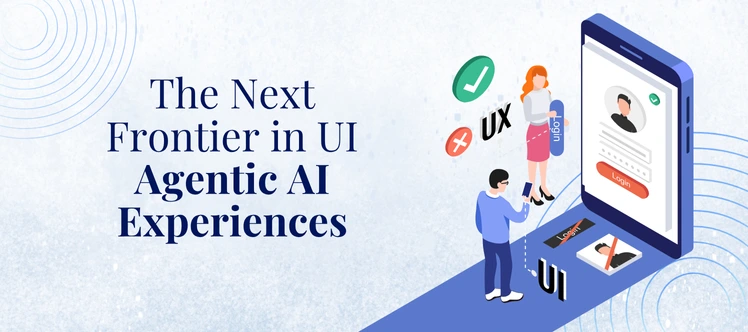
Agentic AI Experiences

The way we connect with technology is radically changing. We’re transitioning from the era of traditional apps and interfaces to one in which AI agents are at the heart of every user experience. Intelligent agents are rapidly replacing displays, clicks, and manual chores with conversational, context-aware automation, whether at work or at home. 

This shift heralds the advent of the agentic AI user experience—a concept in which the interface is not something you see but something that knows you. Instead of traversing complex tools, users just express their goal, and AI agents manage the implementation behind the scenes, coordinating across data, platforms, and workflows. 

In this blog, we will look at how AI-powered user experiences are replacing apps as the major way people interact with digital systems, what this implies for enterprise software, and how businesses should prepare for the new era in which AI is the new UI. 

Meet AI Agents: The Brains Behind Modern Digital Experiences 

Do you believe AI is solely about chatbots? Think again. The best online experiences of the day are driven by invisible smart systems called AI agents. These intelligent systems are not something that is in the future but are already contributing to daily experiences in the background. From making customer requests simple to handling intricate operations, Enterprise agentic AI user experience are becoming the stars in delivering frictionless, simple, and personalized services. 

Then, what is an AI agent, anyway? 

An AI agent literally means a smart computer program that can sense its surroundings, make decisions, and act to satisfy a list of objectives. Imagine having a quiet assistant, which is always watching and responding to information, whether through voice query, typed query, or real-time API stream. 

Here’s how they work: 

  • Perceive: They receive input through APIs, user commands, or data streams.
  • Decide: They use rule-based logic or machine learning algorithms to make informed choices.
  • Act: They take real-world actions, like updating systems, sending alerts, or placing orders.

This transition from manual to machine-driven decision-making underpins the developing agentic AI user experience. Tasks that formerly required human attention, such as checking order statuses or managing inventory, are now managed automatically. This provides consumers with greater mental space to focus on strategic thinking, creativity, and invention. 

Discover how the agentic AI user experience is transforming business workflows and making apps a thing of the past.


Rethinking Usability in the Age of AI Agents: From Screens to Intelligent Conversations 

People’s interactions with technology are changing in a quiet revolution as agentic AI user experience becoming more complex and contextually aware. With their buttons, dashboards, and drop-down menus, traditional user interfaces are beginning to seem antiquated. AI-powered user experiences that are dynamic, conversational, and highly customized are replacing them. 

The user’s intent now takes precedence over the user interface in this evolving world. 

This is the essence of the agentic AI user experience: effortless, natural, and intuitive. You no longer interact with tools—you interact with intelligent outcomes. 

Here’s how the shift is already unfolding: 

  • Invisible Interfaces: The best UI becomes no UI. Users engage through natural language, voice, or even gestures, without touching a screen.
  • Proactive AI Agents: Enterprise agentic AI user experience don’t wait for instructions. They suggest, remind, and even act in advance, based on patterns and context.
  • Hyper-Personalization: Interfaces adapt to each user’s role, behavior, and needs—no more one-size-fits-all dashboards.
  • Cross-Platform Intelligence: agentic AI user experience move fluidly across systems and apps, delivering a unified, seamless experience.

This isn’t just UX evolution—it’s a full reimagination. AI is the new UI, and it’s built around people, not processes. 

In the coming years, digital interaction won’t revolve around how users navigate systems—it’ll be about how effortlessly Enterprise AI Agents navigate for them. This shift unlocks not just productivity but an entirely new standard for digital simplicity and user satisfaction. 

Agentic AI User Experience: The Future Beyond Apps and Interfaces 

We’re at the edge of a massive transformation—one where apps no longer sit at the center of digital interaction. Instead, agentic AI user experience are emerging as a new layer of human-technology interaction. In the future, users will not need to browse complex software or switch between platforms to complete tasks. Instead, they’ll merely explain their requirements, and an AI-powered agent will handle the rest—quickly, smartly, and independently. 

This isn’t just a UI upgrade. It’s a complete redesign of how people interact with software. And it’s ushering in what many are calling the agentic AI user experience—an environment where software becomes invisible and intelligence becomes the interface. 

Why Apps Are Fading—and Agents Are Rising 

For years, software design revolved around the app. Need to manage sales? Use your CRM app. Want to analyze data? Open the BI dashboard. Employees spent hours navigating between the many departments’ systems, searching for information, processing assignments, and piecing together insights by hand. 

Take this example: if a user asks an AI agent to “Prepare a briefing for my 3 PM client meeting,” it will instantly retrieve CRM data, read past messages, analyze relevant metrics, and create a summary—all without the user ever opening an app. 

That is AI’s power as the new user interface. The agent becomes the interface, and apps shift into the background as secure, structured sources of logic, data, and automation. This isn’t about replacing software; it’s about making technology operate for users rather than through them. 

This also solves the well-known “swivel chair” problem, in which employees waste time switching between computers to do simple tasks. agentic AI user experience simplify these efforts by accepting suggestions in a single environment (such as Slack or Teams) and operating behind the scenes across platforms—retrieving information, making choices, and even performing activities without human participation. 

What Agent-Driven Interfaces Actually Look Like 

So, how does this transformation manifest in real life? Consider a sales representative as an example. Instead of logging onto numerous platforms to prepare for a meeting, an AI agent implanted in their workstation takes over. It enters the CRM, reviews recent emails, analyzes customer data, and generates specific talking points—all proactively. 

Similarly, agentic AI user experience may handle all aspects of a customer service inquiry. When a user makes a request, the agent ecosystem goes into action. It diagnoses the problem, retrieves pertinent order or contract data, recommends next steps, and can even connect directly with the consumer if necessary. Instead of doing each activity manually, the support representative oversees or approves it. 

In short, the agentic AI user experience is one where human intent drives the action, and AI handles the execution—quietly, efficiently, and in real time. 

The Multi-Agent Architecture Powering the Future

To provide this level of intelligence and automation, enterprises are implementing a multi-tiered AI agent paradigm. However, to leverage these multi-agent Salesforce development services can greatly help. This architecture contains three types of agents, each with unique tasks that interact flawlessly together:

Primary Agents (User-facing)

They are leveraged by the users, who interact with them in many applications of the communication technology like Slack, Microsoft Teams, and mobile apps. They bring conversation to life, making it natural and responsive. They attempt to understand the intent of the user and trigger the appropriate workflow.

Orchestration Agents

Orchestration agents run in the background to schedule tasks between different systems and departments. They’re tasked with sending commands, placing orders for requests, and scheduling actions depending on context, urgency, and logic. This function is sometimes done by a master agent.

Specialized Agents

These are the doers. They establish direct connections to APIs from CRMs, ERPs, customer platforms, and other systems. They collect data, process it, validate inputs, and perform real actions, such as filing for a refund, sending a quote, or updating a record. 

Such agents exist together to support a modular, API-oriented platform that can be integrated into current enterprise systems without needing to reshape the underlying applications. This allows enterprises to integrate and scale AI-based processes incrementally with little disruption. 

Designing for Intelligence, Not Interfaces 

Designing for Intelligence

This agent-first approach turns the traditional software design on its head. Instead of focusing on how a user will navigate displays, designers and developers must now consider how their system will provide the appropriate data, APIs, and logic for an AI agent to use efficiently. 

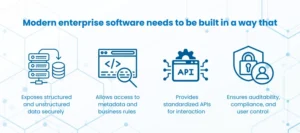
Modern enterprise software needs to be built in a way that: 

  • Exposes structured and unstructured data securely
  • Allows access to metadata and business rules
  • Provides standardized APIs for interaction
  • Ensures auditability, compliance, and user control

Agents can only be as effective as the systems they’re built upon. That’s why companies must rethink not just their UI, but their entire digital foundation, enabling agents to interpret and act on data across departments and workflows. 

Why a Unified Platform Is Key to AI Agent Success 

For agentic AI user experience to operate efficiently and deliver enterprise-grade performance, they need more than intelligence—they need a deeply unified platform. 

This platform must bring together three critical components: 

  • Centralized data foundation – All business data, structured and unstructured, must be accessible and interoperable.
  • Workflow integration – Agents must understand how processes operate across departments, from HR to finance to support.
  • AI execution layer – The ability to act intelligently, securely, and contextually, without breaking compliance or trust.

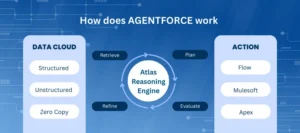
Salesforce has already established the norm with its combination of Agentforce, Data Cloud, and Customer 360. With MuleSoft, agents may interface with third-party systems, enabling full business interoperability. This means that agents do more than just automate jobs; they orchestrate complete business results across several platforms. 

Conclusion 

The future of user interaction isn’t app-based, but agent-based. As agentic AI user experience become increasingly autonomous, proactive, and integrated deeply into workplace systems, they’re revolutionizing the very fabric of how people work and interact with technology. The emergence of agentic AI user experiences is more than a technological leap; it’s a shift toward more human-centric, outcome-oriented digital engagement. 

Success in this new world belongs to companies that build for intelligence, not interfaces. Organizations can minimize friction, enhance productivity, and create smooth, intuitive experiences that feel effortless to users by implementing a unified, API-first design and leveraging the power of Enterprise AI Agents. 

At AnavClouds Software Solutions, we assist forward-thinking enterprises in leading this change by developing, integrating, and optimizing AI agent ecosystems that are tailored to your objectives. If you’re ready to see how AI as the new UI can benefit your business, we’re here to help. 

Agentic AI

Running a small business often means wearing too many hats—managing sales, supporting customers, marketing your brand, and juggling operations. What if an intelligent system could handle these tasks for you, without needing constant supervision? That’s where Agentic AI comes in. 

Unlike traditional automation tools or even generative AI, Agentic AI systems are designed to act with purpose. They understand goals, plan strategies, take initiative, and adapt in real-time. Whether it’s crafting emails, resolving customer issues, or optimizing financial workflows, AI agents powered by Agentic AI function like reliable team members, making smart decisions and delivering results. 

In this guide, we’ll explore how Agentic AI for small business is changing the way companies operate. You’ll also learn how it differs from generative and agentive AI, how it works behind the scenes, and how tools like Agentforce and AI, backed by expert Salesforce Consultant’s are helping small teams achieve big outcomes. 

How Can Agentic AI Transform Small Businesses? 

Agentic AI is a significant advancement in how small firms can function more efficiently and intelligently; it’s not simply another catchphrase. Fundamentally, it gives AI agents the ability to behave independently, making choices, establishing objectives, adjusting, and even reasoning—all with little to no assistance from humans. These intelligent AI systems are made to work in unison with people, giving corporate operations a new degree of speed and flexibility. 

Consider it an intelligent overlay that complements your current technologies, particularly your CRM programs like Salesforce. This layer, which is frequently referred to as the agentic AI layer, has deep integration with the systems you now use to hold marketing, sales, and service data. What makes it powerful is how it takes action on your behalf. Instead of just storing customer info, it interprets it and acts on it. 

Let’s say you’re using Salesforce AI  tools like Agentforce can learn from human behavior and apply that knowledge to help manage complex business scenarios in real-time. Unlike traditional automation or rule-based chatbots, AI agents don’t just respond—they adapt. They personalize responses, predict needs, and even solve problems based on customer history and context. 

What Sets Agentic AI Apart from Generative and Agentive AI? 

Generative AI is renowned for its ability to generate material, such as emails, graphics, and code, only in reaction to human user input. It is reactive rather than proactive. Generative AI can produce creative results or answers to questions, despite its lack of initiative. It just doesn’t do anything without a prompt. This makes it helpful for content development or brainstorming, but its utility is constrained by its need for ongoing human input. 

By automating simple chores and making recommendations, agentive AI makes a modest advancement. It still requires human clearance before doing anything, even if it suggests calendar actions, email responses, or predictive insights. A recommendation system might, for instance, write a response, but it won’t send it; you will need to choose what to do next. Workflows are streamlined by this semi-autonomous behavior, but the user still makes the final decisions. 

On the other hand, agentic AI offers a new degree of freedom and intelligence. These AI systems, such as Agentforce, may both produce material and operate independently toward a predetermined objective, in contrast to generative or agentive systems. It is highly contextual, proactive, and flexible. Without any human input, an AI agent could compose an email, schedule it for the best time, examine engagement data, and improve subsequent messages. This AI is a potent ally for small businesses because of its intelligent autonomy, particularly when it is included in platforms like Salesforce AI with the help of professional Salesforce Development Services. 

Empower Your Business with Agentic AI—Build Smarter Workflows with AnavClouds.


How Does Agentic AI Actually Work? 

Automation, machine learning, and natural language processing (NLP) are the three primary technologies that AI uses to make wise decisions and act on its own. When combined, they enable AI bots to function independently, learn from mistakes, and complete jobs without constant supervision. 

  • Machine learning helps the system get better over time. It examines data, searches for patterns, and becomes better with every interaction, just like people do. 
  • The AI can comprehend spoken or written language thanks to NLP.  This enables the AI to naturally carry on a conversation, follow directions, and answer inquiries. 
  • The AI can act independently thanks to automation technologies. The technology completes tasks without waiting for approval, whether it’s sending an email or making changes to a marketing campaign. 

What sets agentic AI systems apart is how they connect these pieces. Say your goal is to improve customer engagement. A traditional tool might give suggestions. But an AI, like Agentforce, figures out what needs to be done, takes action, and adjusts based on results. It works like a self-managing assistant, especially powerful when used through platforms like Salesforce AI and supported by expert Salesforce Development Services. 

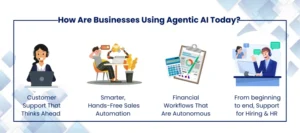
How Are Businesses Using Agentic AI Today? 

Agentic AI uses

AI isn’t just a futuristic idea—it’s already helping real businesses solve real problems. Whether it’s sales, customer service, finance, or HR, smart AI agents are quietly taking over repetitive tasks and handling them with more intelligence and speed. Here’s how agentic AI systems are being used across different areas of a business:

Customer Support That Thinks Ahead

Forget basic chatbots that follow scripts. With this AI, businesses can now use AI agents that analyze a customer’s history, predict their needs, and resolve issues instantly—without bouncing the customer to five different departments. These systems don’t just respond—they act with context, improving support quality and response time. When paired with Salesforce AI, the results are even more impressive.

Smarter, Hands-Free Sales Automation

Imagine your sales process running on autopilot. Agentic AI for small business can research new leads, tailor email outreach, schedule meetings, and even tweak presentations based on how prospects interact with your content. It’s not just automation—it’s initiative. Backed by the right Salesforce Development Services, these systems can plug directly into your CRM and optimize your sales funnel without constant oversight.

Financial Workflows That Are Autonomous

These AI systems are analyzing transactions, identifying anomalous activity, creating reports, and monitoring compliance in finance departments—all while gaining knowledge from historical data. These AI agents improve daily tasks and lessen the workload associated with regular financial inspections.

From beginning to end, Support for Hiring and HR

These AI streamlines the hiring process, which can be time-consuming. AI agents are capable of handling every step of the hiring process, from organizing interviews and reviewing resumes to creating personalized onboarding materials for every new employee. Companies minimize manual bottlenecks, save time, and enhance the applicant experience. 

Conclusion 

Agentic AI is a significant change in the way small businesses may think, act, and expand; it’s not just another tech fad. These AI systems are doing more than just helping; they are actively influencing results, from automating customer service and sales to making real-time decisions in HR and finance. 

Small businesses can include AI agents in their everyday operations and begin to see results right away by utilizing platforms like Salesforce AI and collaborating with the best Salesforce Development Services. The goal is to empower your team with proactive, intelligent systems that reduce workloads and increase your success, not to replace individuals. 

Do you want to integrate AI into your Salesforce setup? Collaborate with AnavClouds Software Solutions, a reputable Salesforce consulting firm, to create scalable, intelligent solutions for your company.