Salesforce vs Custom Development: The Best Choice for SMBs
For fast-growing SMBs, choosing the right CRM platform can directly influence revenue, customer retention, and long-term scalability. That’s why the debate around Salesforce vs Custom Development is no longer just a technical decision — it’s a business growth decision. While Salesforce delivers a proven, cloud-based platform with automation and AI capabilities out of the box, custom CRM development for SMBs offers total flexibility for businesses with unique operational models. The real challenge? Identifying which path aligns better with your current agility needs, future expansion plans, and ownership expectations.
In this blog, we’ll compare both approaches across critical decision factors like implementation speed, scalability, data ownership, cost structure, customization depth, and AI future-readiness, helping you determine which CRM path truly supports your growth stage and ambition.
What Is Custom CRM Development for SMBs?
In Salesforce vs Custom Development, custom CRM development is the concept of creating a fully customised CRM development, the process of creating a CRM that is fully customised to fit a specific process, data flow, and long-term growth objectives of a business. Rather than extending the pre-existing system,s such as Salesforce, companies establish a CRM that reflects their operational culture. SMBs prefer this method because they require full control over the features, scalability, UI/UX, integrations, and data ownership that might not be fully offered by off-the-shelf platforms.
Key Advantages of Custom CRM Development for SMBs
Although the Salesforce vs Custom Development argument usually boils down to flexibility vs speed, custom CRM development offers long-term ownership, greater adaptability, and no platform dependency, which is better suited to SMBs with multifaceted or changing business models.
100% Tailored to Your Business Processes
Unlike Salesforce, where you adapt to its framework, custom development gives you a CRM that is built around your existing workflows — not the other way around. Every module, approval logic, and UI element is purpose-built, resulting in higher adoption and zero operational compromise.
Maximizes Efficiency and Team Productivity
SMB-specific CRM programming automates common activities such as lead assignment, follow-ups, contract approvals, and reporting in, it does just as your business functions. This eliminates the pressured changes and makes decisions quicker based on real-time and business-specific data.
Seamless Scalability and Future-Readiness
The comparison between Salesforce vs Custom Development, the custom development carries the day, in terms of long-term platform freedom. Your CRM keeps up with your business, as you can add new features, modules, and workflows as your business grows, or you can even add industry-specific functionality without being restricted by pre-built platform limitations.
Full Control Over Data Security and Compliance
If you compare Salesforce vs custom development, having a custom CRM solutions allow SMBs to decide exactly how and where their customer data is stored, with compliance frameworks built natively around their industry standards. For businesses in finance, real estate, healthcare, or legal sectors, this offers a level of security and ownership that managed platforms cannot always match.
What Is Salesforce and Why Is It Relied on by SMBs?
Salesforce is a cloud-based CRM system that is trusted all over the world and helps SMBs in simplifying their sales, marketing, and customer service processes with one integrated system. Businesses need to deal with siloed tools less because they can centralize customer data, automate lead nurturing, monitor pipeline health in real time, and improve customer engagement easily. Between Salesforce vs custom development, Salesforce provides SMBs with the power to run their businesses more effectively, make sales faster, and provide customers with highly personalized experiences, without having to maintain a massive infrastructure or extensive IT resources.
Why SMBs Prefer Salesforce Over Custom Development
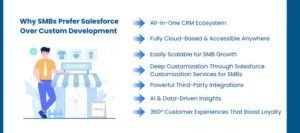
In the Salesforce vs Custom Development comparison, Salesforce is an all-inclusive and deployable CRM ecosystem enabling growing businesses to use the same platform to handle all phases of the customer lifecycle – such as marketing, sales, onboarding, and post-sales support – in the same environment. It serves as a single truth-bearer, allowing SMBs to free themselves of fragmented tools and open the doors to greater efficiency, quicker decision-making, and better customer visibility.
All-in-One CRM Ecosystem
In the Salesforce vs custom development debate, Salesforce prevails in the discussion with its full package of sales, marketing, service, and analytics, all interlinked. SMBs do not need to put up with disconnected tools anymore or have to perform complex integrations by hand, which creates less operational friction and allows data to be synchronized between teams seamlessly.
Fully Cloud-Based and Accessible Anywhere
The Salesforce platform is a 100% cloud-based solution that allows real-time access on any device, unlike the traditional systems under Salesforce custom development services. It is best suited to SMBs that have a hybrid or remote workforce and no need to maintain any IT infrastructure to access customer data on the fly.
Easily Scalable for SMB Growth
Salesforce SMB growth is future-proof and enables expansion in size to 500 plus users, with ease. The features, modules, and workflow can be upgraded in real-time, without the system rebuilds or project delays common to the custom CRM development by SMBs.
Deep Customization Through Salesforce Customization Services for SMBs
With future-ready Salesforce Development Services, the SMBs can model the CRM to suit their precise workflows, approval processes, and reporting frameworks. In contrast to inflexible traditional systems, Salesforce customization services to SMBs mean that the platform changes to fit your process, rather than the opposite.
Powerful Third-Party Integrations
Salesforce enables strong third-party integrations with ERP, accounting solutions, messaging applications, and Salesforce Marketing Automation systems – providing a complete, digital infrastructure. This will eradicate data silos, minimize redundant work, and facilitate cross-business unit collaboration.
AI and Data-Driven Insights
Salesforce Einstein offers AI automation and predictive analytics to enable SMBs to prioritize leads and personalize engagement, and predict revenue. This provides a competitive advantage in the Salesforce vs custom development environment – internal AI engineers are not required.
360° Customer Experiences That Boost Loyalty
Salesforce gathers all customer touchpoints: email, web, chat, WhatsApp, and puts them in one place. This allows the SMBs to provide hyper-personalized experiences, faster response, and long-term retention, which is an essential rationale why they prefer Salesforce to custom development to the SMBs.
Salesforce vs Custom Development: A Comparative Analysis
When SMBs evaluate Salesforce vs Custom Development, the decision often comes down to flexibility, cost, scalability, and long-term ROI. Both approaches have strong advantages — but their impact on growth, agility, and total ownership varies significantly based on business vision, IT readiness, and expansion plans. Below is a strategic breakdown to help SMBs make an informed choice.
Out-of-the-Box vs. Fully Tailored Solutions
Salesforce offers a ready-to-use CRM framework, allowing SMBs to start quickly with pre-built features for sales, support, and Salesforce Marketing Automation. It’s ideal for businesses that want speed and stability from day one.
On the other hand, Custom CRM development for SMBs gives complete freedom to build workflows, dashboards, and data architectures from scratch. This is highly beneficial for businesses with unique industry requirements — but requires more time and technical ownership.
Implementation Time and Speed of Deployment
Salesforce vs Custom Development for SMBs is a clear win for Salesforce when speed matters. Salesforce can be deployed within weeks thanks to pre-configured modules and Salesforce Development Services offered by partners.
In contrast, custom development demands extensive planning, testing, and iteration, making deployment significantly longer — well-suited only for SMBs that can afford longer go-to-market timelines for total control and ownership.
Cost Structure and Long-Term Investment
Salesforce operates on a subscription-based model, making the initial cost lower and predictable — especially with support from Salesforce customization services for SMBs.
However, custom development involves a higher upfront investment, including UI design, architecture, integrations, and security. While expensive initially, it may offer long-term savings if businesses want complete IP ownership and no recurring license costs.
Flexibility and Future Scalability
When comparing Salesforce vs custom development, Salesforce is highly scalable and allows SMBs to upgrade users, add modules, and expand capabilities without rebuilding the system. This makes Salesforce for SMB growth a low-risk option.
Meanwhile, custom-built platforms offer absolute flexibility, but scalability depends largely on how well the solution is engineered during the foundation stage — requiring strong technical leadership and future-proof architecture.
Integration Capabilities and Ecosystem Connectivity
Salesforce dominates here, offering thousands of effortless integrations with tools like WhatsApp, Slack, ERPs, and marketing platforms — thanks to Salesforce custom development services and AppExchange marketplace.
With custom CRM development, integrations must be built manually, resulting in higher cost, dependency on developers, and potential delays — especially as the tech stack evolves.
Maintenance, Security & Ongoing Updates
Salesforce automatically manages platform updates, security patches, and compliance — allowing SMBs to focus on business instead of IT maintenance. Salesforce vs Custom Development strongly favors Salesforce here for non-technical teams.
Custom CRM solutions, however, require continuous maintenance, dedicated security handling, and manual upgrades — which can become costly unless the SMB has long-term in-house engineering capabilities.
Training, Adoption & Skill Dependency
While comparing Salesforce vs custom development, Salesforce offers a low learning curve with Trailhead, certifications, and platform familiarity — making onboarding easier, especially when supported by the role of Salesforce Development Partners.
Whereas custom development, however, requires technical expertise, making training heavily dependent on documentation quality and internal development teams, which can delay adoption if not managed strategically.
Conclusion
The question Salesforce vs Custom Development is not about which one is better, but which one fits better into the stage and ambition of your SMB. When speed, scalability, AI-enhanced automation, and low IT maintenance are the most important, Salesforce is the smarter and less-risky option, with the help of expert Salesforce customization services in the case of SMBs. Nevertheless, when your business model requires total control, distinctive architecture, and extended IP ownership, a brief CRM development of SMBs can still be a strong rival.
We also provide you with the chance to consider both alternatives, both with the openness of a book at AnavClouds Software Solutions, as you decide between Salesforce and need to design a CRM to precisely match your business needs, to get your business booming at the point of CRM investment.
FAQs
Does Salesforce outperform a custom-built CRM with SMBs?
Salesforce fits best with SMBs, which require quicker implementation, built-in automation, and scalability without extensive technical engagements. Nonetheless, companies whose processes are fairly unique or those whose long-term ownership ambition is a concern might find it more appropriate to develop their own CRM.
Comparison Salesforce vs custom CRM: How many days to implementation?
The implementation of Salesforce can be completed in weeks, particularly with the assistance of certified partners. Depending on the complexity, integrations and trials, and errors, custom CRM development might take several months.
Is Salesforce or a custom CRM more cost-effective?
Salesforce adheres to the subscription-based pricing scheme, which is economical in the short run. Custom CRM has a greater initial cost but can prove less expensive in the long term to businesses that desire complete control and no recurring licensing charges.
Are they both AI and automation-friendly?
Yes, Salesforce offers AI and automation as an in-the-box feature, such as Einstein AI. AI and automation may also be supported using custom CRMs, although they take more development effort and technical knowledge.
Search Posts
Popular Posts
Author profile: Saransh Maurya, Content Writer at AnavClouds Software Solutions
Saransh
Maurya
About the author
Saransh Maurya is a dynamic and results-driven professional with a passion for innovation and problem-solving. Known for his analytical mindset and attention to detail, he excels at delivering high-quality solutions that drive business growth and operational efficiency. With strong communication skills and a collaborative approach, Saransh effectively bridges ideas and execution, contributing to successful projects and meaningful outcomes across diverse domains.
Recent Posts