Offshore Salesforce Development Compliance: 2027 Playbook
Offshore Salesforce development compliance means making sure every offshore team that builds, customizes, or supports your Salesforce org follows the laws and security standards that apply to your data. In 2027, for healthcare, finance, and other regulated industries, that comes down to four things: GDPR-compliant data transfers, a signed Business Associate Agreement (BAA) for health data, independent security attestations such as SOC 2, and strict access controls inside Salesforce. Get these right and offshore delivery stays fast, affordable, and audit-ready. This guide explains each requirement, the main security risks, and how to choose an implementation partner who can prove compliance instead of just promising it.
What Is Offshore Salesforce Development Compliance and Why Does It Matter?
Offshore delivery is attractive for good reasons: wider talent pools, round-the-clock progress, and lower cost per sprint. The catch is that your obligations do not shrink when the developers sit in another country. You stay accountable for customer data, wherever the keyboard is.
What Does Compliance Actually Cover?
It covers who can see production data, where that data travels, how code moves between environments, and what evidence you can show an auditor. Strong offshore Salesforce development compliance treats the vendor as an extension of your own security team.
Why Is the Pressure Higher in 2027?
Breach costs keep climbing. Cost of a Data Breach Report 2026 puts the global average at $4.99 million, up 12% on the year before, with healthcare the costliest sector at $6.64 million per incident. AI agents built on Salesforce, such as Agentforce, can act on many records at once, so one loose permission now exposes more. That is why offshore Salesforce development compliance now sits on the boardroom agenda, not just IT’s.
What Are the Biggest Offshore Salesforce Security Risks?
Many problems do not come from clever hacking. They come from ordinary gaps that nobody owned. Each of these risks is a compliance failure as much as a security one, which is why offshore Salesforce development compliance starts with fixing them.
Excess Access to Production Data
Developers often get System Administrator profiles because it is faster. Offshore teams rarely need live customer records to build a flow or an Apex class. Give them sandboxes, least-privilege permission sets, and no standing access to production.
Unmasked Sandboxes
A full-copy sandbox holds real customer data unless you mask it. Salesforce Data Mask exists for exactly this reason. Skipping it quietly turns a test environment into a second, weaker production org.
Subcontractors and Unapproved Tools
Your vendor may use freelancers, personal laptops, or AI coding assistants you never approved. Ask for a full subprocessor list and ban pasting customer data into public tools.
How Do Compliance Rules Differ Across Industries?
One offshore model rarely fits every sector. The core controls stay similar, but the regulations that apply, and the evidence auditors expect, change with your industry. Map your obligations before you write the statement of work.
Healthcare and Life Sciences
HIPAA leads the list, along with any contract terms from payers. Health Cloud projects should treat PHI in notes, attachments, and integrations as in scope, not just standard fields.
Financial Services and Retail
Financial firms deal with GLBA, SOX controls, and in the EU, the Digital Operational Resilience Act, which puts third-party ICT risk under close watch. Retail and payments teams must also meet PCI DSS for card data, plus privacy laws such as GDPR and CCPA.
How Do You Keep Offshore Development GDPR Compliant?
GDPR does not ban offshore work. It regulates how personal data of people in the EU and UK moves and who processes it. Getting offshore development GDPR compliant is mostly contracts and discipline, and it forms the legal backbone of offshore Salesforce development compliance for any company with European customers.
Transfer Mechanisms That Hold Up
Where the destination country lacks an EU adequacy decision, use Standard Contractual Clauses and complete a transfer impact assessment. Better still, keep EU data in a European Hyperforce region and let offshore engineers work on masked data only.
Processor Contracts and Data Minimization
Article 28 requires a written data processing agreement covering instructions, confidentiality, subprocessors, breach notice, and deletion. Add data minimization: if a task works without personal data, do it without personal data. Fines can reach €20 million or 4% of global turnover, so shortcuts are expensive.
What Does HIPAA-Compliant Salesforce Development Require From an Offshore Team?
Healthcare is where mistakes cost the most, so expectations are tighter. HIPAA-compliant Salesforce development is possible with an offshore team, but you must show that protected health information (PHI) stays protected at every step. Some payer and state Medicaid contracts also restrict offshore access to PHI, so read your agreements first. This is the toughest part of offshore Salesforce development compliance in Health Cloud projects.
When Is a BAA With Offshore Vendor Teams Required?
Any time the vendor can create, receive, maintain, or transmit PHI on your behalf. Your BAA with offshore vendor staff should define permitted uses, safeguards, breach reporting timelines, and flow-down terms for subcontractors. Salesforce signs a BAA for its covered services, but that agreement does not cover your implementation partner.
Technical Safeguards Inside Salesforce
Use Salesforce Shield for Platform Encryption, Event Monitoring, and Field Audit Trail. Turn on multi-factor authentication, restrict logins by IP range or VPN, log every access to PHI, and keep PHI out of free-text fields and debug logs.
Why Does a SOC 2 Salesforce Partner Strengthen Offshore Salesforce Development Compliance?
A promise of security is easy to write. An independent audit is harder to fake. A SOC 2 report tests whether a vendor’s controls are well designed and, in a Type II report, whether they worked consistently over several months.
What Should You Ask to See?
Request the latest SOC 2 Type II report, confirm its scope covers the delivery center doing your work, and read the exceptions section. Ask about ISO 27001, background checks, and security training records too. A report that is two years old or covers only the head office is a warning sign.
Does Certification Replace Your Own Oversight?
No. A SOC 2 Salesforce partner lowers risk, but you still own the outcome. Keep your own access reviews, code reviews, and audit rights in the contract.
Why Is Salesforce a Strong Platform for Regulated Offshore Projects?
Compliance gets easier when the platform does part of the work. Salesforce was built with enterprise controls in mind, so regulated teams start with a solid foundation for offshore Salesforce development compliance and offshore partners can focus on configuration instead of reinventing security.
Built-In Controls Worth Using
Hyperforce lets you pick the region where data lives. Shield adds encryption, monitoring, and audit trails. Permission Set Groups, field-level security, and mandatory multi-factor authentication limit what any user, onshore or offshore, can reach. Used well, these controls let you give offshore teams exactly the access they need and nothing more.
Why Experienced Salesforce Partners Matter
Platform tools only protect you when they are configured correctly. A partner who works with Salesforce every day knows which settings quietly break compliance, such as overly broad sharing rules or unencrypted fields. Strong Salesforce development services pair platform expertise with security discipline.
How to Choose a Salesforce Implementation Partner for Regulated Industries?
When you are thinking about how to choose a Salesforce implementation partner, price and speed dominate most proposals. For regulated work, evidence should come first. Treat offshore Salesforce development compliance as a hard filter, then rank everything else after it.
A Practical Partner Checklist
Use this list when comparing vendors side by side.
- Salesforce credentials: certified developers, partner tier status, and delivery experience in Health Cloud or Financial Services Cloud
- Proof: SOC 2 Type II, ISO 27001, and references from regulated clients
- Contracts: DPA, BAA, subprocessor list, audit rights, and a fixed breach notification window
- Delivery: named team, documented CI/CD pipeline, peer reviews, and no direct changes in production
- Support: an onshore project lead and overlapping working hours
Red Flags to Walk Away From
Vague answers about where data is stored, refusal to share audit reports, no named subprocessors, or a pitch that never mentions compliance. Quality Salesforce development services should include security design in the statement of work, not as a paid extra. If a vendor treats offshore Salesforce development compliance as negotiable, move on.
What Does Offshore Salesforce Development Compliance Look Like in Daily Delivery?
Policies mean little until they change how work happens on a Tuesday afternoon. A mature offshore model blends onshore ownership with controlled offshore execution.
Onshore Governance, Offshore Execution
Keep architecture decisions, data ownership, and approvals with an onshore lead. Offshore engineers build against masked sandboxes and release through a CI/CD pipeline with mandatory review. That split keeps offshore Salesforce development compliance auditable without slowing sprints.
Evidence to Collect Every Quarter
Gather access reviews, change logs, training records, and penetration test summaries. Auditors increasingly ask for proof of current practice, not last year’s policy. Keeping this ready turns offshore Salesforce development compliance into a routine habit instead of an annual scramble.
How Will AI and Agentforce Change Offshore Compliance in 2027?
AI agents are moving from pilots into daily operations, and that changes the risk picture. An agent can read, summarize, and update customer records faster than any human, which makes its permissions, prompts, and logs part of your compliance scope.
Governing Agent Access and Data
Give each agent its own scoped permissions, just as you would a new hire. Use the Einstein Trust Layer settings for data masking and zero data retention where available, and review which objects and fields every agent can touch.
Setting Rules for Offshore AI Tools
Your contract should state which AI coding assistants offshore developers may use, what data they may never paste into them, and how generated code is reviewed. Treat AI-written code like any other contribution: it needs a human reviewer before it ships.
How Can You Build an Offshore Compliance Roadmap?
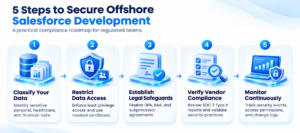
A roadmap keeps offshore Salesforce development compliance practical. You do not need to fix everything at once, but you do need a clear order.
- Classify your data. List which objects and fields hold personal, health, or financial data.
- Cut access. Remove standing admin rights and move offshore work to masked sandboxes.
- Sign the paperwork. Put the DPA, BAA, and subprocessor terms in place before work starts.
- Verify the vendor. Review SOC 2 Type II reports and test their security answers with a short pilot.
- Monitor continuously. Turn on Event Monitoring and review access and change logs every quarter.
What Are the Most Common Questions About Offshore Salesforce Development Compliance?
What Is Offshore Salesforce Development Compliance?
It is the practice of making sure offshore Salesforce teams follow data protection laws and security standards, including GDPR, HIPAA, and SOC 2, whenever they access or handle your Salesforce data.
Is Offshore Salesforce Development Allowed Under GDPR?
Yes, if personal data transfers use valid safeguards such as Standard Contractual Clauses, a data processing agreement is signed, and the vendor only accesses the minimum data needed for the task.
Do I Need a BAA With an Offshore Salesforce Vendor?
Yes, if the vendor can access protected health information. HIPAA requires a signed Business Associate Agreement with the vendor, and the vendor must pass the same obligations to any subcontractors.
What Should I Check Before Hiring an Offshore Salesforce Partner?
Check for a current SOC 2 Type II report, signed data processing and business associate agreements, a named subprocessor list, least-privilege access practices, and verifiable references from regulated clients.
What Should You Do Next?
Offshore teams can deliver excellent Salesforce work, and regulated companies do not have to choose between speed and safety. The path is clear: restrict access, mask data, sign the right agreements, ask for independent audit proof, and keep decisions with an onshore owner. Done well, offshore Salesforce development compliance becomes a competitive advantage instead of a burden. AnavClouds Software Solutions helps businesses plan, build, and support secure Salesforce solutions with onshore and offshore delivery, compliance built into every project, and a response time under five hours. Ready to review your current setup? Talk to our team about offshore Salesforce development compliance today.
Search Posts
Popular Posts
Author profile: Saransh Maurya, Content Writer at AnavClouds Software Solutions
Saransh
Maurya
About the author
Saransh Maurya is a dynamic and results-driven professional with a passion for innovation and problem-solving. Known for his analytical mindset and attention to detail, he excels at delivering high-quality solutions that drive business growth and operational efficiency. With strong communication skills and a collaborative approach, Saransh effectively bridges ideas and execution, contributing to successful projects and meaningful outcomes across diverse domains.
Recent Posts