Gaurav AnavClouds Software Solutions +1 917 266 9985 info@anavcloudsoftwares.com
admin – Page 13
Salesforce Commerce Cloud

Have you ever wondered how some of the world’s leading eCommerce companies are able to create super-fast websites, completely custom shopping experiences, and seamless checkouts without skipping a beat? Spoiler alert: They’re only doing this because they are not doing it alone.  

Salesforce Commerce Cloud: the dominant platform responsible for some of the world’s best digital storefronts. Whether you’re selling to businesses or consumers, SFCC covers everything you need courtesy of AI-led insights, cross-channel flexibility, and automation. It’s not just about selling more—for eCommerce giants, it’s all about selling smarter. 

In this helpful guide, we’ll break down the B2B & B2C editions, walk through the top features and benefits of Salesforce Commerce Cloud available to you. We’ll also share the reasons why choosing Commerce Cloud by Salesforce may be the best business decision you’ve made. 

What Is Commerce Cloud by Salesforce? 

Salesforce Commerce Cloud is a comprehensive cloud accessible eCommerce platform that enables brands and organizations to deliver connected and personalized experiences. It allows for customer engagement across all digital touchpoints on desktop, mobile app, and social. Being an online Software-as-a-Service (SaaS) solution, organizations and brands can scale their digital storefront management while optimizing customer effectiveness and touchpoints. 

Commerce Cloud by Salesforce lays the foundation of the platform, followed by the acquisition of Demandware in 2016. Essentially developing Salesforce B2C Commerce Cloud, then CloudCraze in 2018, developing B2B options as Salesforce B2B Commerce Cloud. 

Today’s innovations have brought both together in a fundamental modern technology, enabling an end-to-end digital commerce enterprise solution. With built-in AI personalized options, sophisticated search, and flexible pricing tools for B2B and B2C Commerce Cloud by Salesforce. It is a suite of technology and tools to help brands sustain a competitive landscape for e-commerce change. 

Understanding Salesforce B2B Commerce Cloud and B2C: 

Salesforce b2b & b2c commerce cloud

Commerce Cloud by Salesforce comes in two tailored solutions to support different business models: 

Salesforce B2B Commerce Cloud 

Built specifically for business-to-business transactions, this edition is ideal for companies that buy or sell in bulk or manage wholesale operations. It offers: 

  • Transparent pricing models
  • AI-powered order management  
  • Intelligent search and product recommendations  
  • Direct access to business buyers  

These features can significantly enhance profitability, with reports suggesting potential revenue growth of up to $3.6 million within 3 years. 

Salesforce B2C Commerce Cloud 

Perfect for direct-to-consumer brands, the B2C edition helps retailers deliver engaging, personalized experiences at scale. Powered by Salesforce Einstein, the platform leverages AI to: 

  • Personalize product recommendations  
  • Drive smarter marketing campaigns
  • Integrate with social platforms  
  • Offer ready-made store templates  

Whether your customers shop via mobile or desktop, B2C Commerce ensures you meet them where they are—boosting both sales and brand loyalty. 

7 Features of Salesforce Commerce Cloud 

Salesforce Commerce Cloud offers a comprehensive toolkit to help businesses deliver frictionless and scalable eCommerce experiences. Below are seven standout features that set it apart. 

Omnichannel Commerce

With Commerce Cloud by Salesforce, merchants can sell through a variety of channels aside from the web, whether it’s mobile apps, social media, or even a physical retail storefront. This means the same shopper can get a consistent experience regardless of the platform. A robust set of unified customer data across these channels enables businesses to interact with users using relevant offers, content, and experiences. This leads to improving satisfaction and conversion rates.  

Unified Commerce

With every B2B and B2C solution in the Salesforce fold, companies can have a more unified experience from a single system. When departments and channels are integrated within the same environment, teams and employees can collaborate more efficiently with less hindrance. Commerce Cloud by Salesforce allows retailers can track inventory, price, product information, and customer interactions from one console, leading to a more collaborative organization and a more centralized experience for the customer. 

AI-Driven Personalization

Salesforce has incorporated the Einstein AI-enabled engine within its platform, changing the way people view and communicate with customers. The Einstein AI works on reading user habits and preferences, and generates hyper-personalized recommendations, reorders products based on sorts, and creates dynamic content. Recently, Salesforce also introduced Agentforce, AI Agents to take automation a step further and manage customer support, merchandising decisions, sales forecasting, and more. These invaluable features both increase engagement and ultimately sales within your digital storefront. However, to leverage them, hiring Salesforce development services is necessary. 

Order Management System (OMS)

The Commerce Cloud by Salesforce offers an Order Management System that allows complete visibility and control over the order life cycle. From the initial order placement to final delivery or return, each step is monitored and optimized. Companies can automate mundane tasks such as return label creation and shipping notifications, saving time and minimizing errors. The OMS also integrates seamlessly with leading payment gateways, inventory databases, and shipping carriers, enabling faster fulfillment and improved customer service. 

Inventory and Content Management System (CMS)

One of the top features of Salesforce Commerce Cloud is the Content Management System (CMS). With Commerce Cloud by Salesforce, companies can track inventory in multiple stores or warehouses in real time. This prevents overselling and stockout, with the capacity to show accurate product availability across channels. The built-in CMS allows companies to respond to product description changes, images, prices, and promotion banners without technical expertise. This allows companies to respond to seasonality and market trends. 

Commerce Portals

Another benefit of Salesforce Commerce Cloud is that it provides role-configurable commerce portals—buyers, suppliers, and internal business organizations. This improves the B2B experience with features such as bulk ordering, contract pricing, reordering facility, and approval workflow. In the case of B2C, they can be applied to loyalty programs, account management, and facilitate personalized promotions. All the portals are responsive and device-independent. 

Seamless Integration with Salesforce Ecosystem

One of the best things about Commerce Cloud by Salesforce is its intrinsic linking with other Salesforce products like Sales Cloud, Service Cloud, and Marketing Cloud. With this unification, a unified view of customers can be obtained, enabling more efficient marketing campaigns, support in return, and more insightful sales. Salesforce Development Services enable you to further extend and customize these integrations as per your business needs, further strengthening the ecosystem. 

Top Benefits of Salesforce Commerce Cloud 

Commerce Cloud by Salesforce offers far more than just an online storefront. It’s a powerful ecosystem designed to elevate every part of your eCommerce strategy—from customer engagement to backend operations. Here are the key benefits that make it stand out: 

Intelligent, AI-Driven Data Analysis

Salesforce Commerce Cloud uses the might of Einstein AI to provide actionable insights in real time. It informs you of buying behavior, uncovers product affinities, and optimizes your merchandising with data, rather than assumptions. Integrated tools such as Einstein AI for better insights obviate third-party integrations. With this data in your hand, personalization is a breeze. 

Personalized Shopping Experience

One of the greatest benefits of Salesforce Commerce Cloud is that consumers have a more seamless and intuitive shopping experience. Whether they shop online via mobile, desktop, or in-store. With features like predictive sorting, smart product suggestions, and advanced search, every interaction is personalized. Click-and-collect functionality also bridges the digital-physical divide and enhances conversions. And with faster browsing, shoppers linger longer and buy more. 

Improved Marketing Efficiency

Commerce Cloud by Salesforce unites your merchandising and marketing in a single, centralized location. Retailers can customize promotions by region, customer segment, or product category—all from a single interface. Campaigns are simpler to deploy and better tied to sales objectives. The platform even allows A/B testing to hone your messaging and optimize performance over time. 

Accelerated Time-to-Market

Pre-built integrations and drag-and-drop features in Salesforce Commerce Cloud enable brands to incorporate new capabilities quickly. Whether opening up a new store or launching a holiday promotion, it’s all accomplished seamlessly. That means less time spent in development and more time spent with customers and driving revenue. 

Global Scalability and Localization

Managing several storefronts by countries and languages is easy with Commerce Cloud by Salesforce. You can manage various currencies, tax configurations, catalogs, and content without any inconsistency in maintaining a brand’s identity. With this, companies can localize experience without having individual infrastructures, which is critical for global eCommerce success. 

Single Platform for B2B and B2C

Whether you sell to consumers or businesses, SFCC accommodates both models within a single environment. This simplifies tech stack complexity and provides a single customer view across all channels. Companies can simplify operations and provide consistent branding without having to manage multiple systems. 

Reliable, Scalable Cloud Infrastructure

Based on a scalable, cloud-native architecture, Commerce Cloud by Salesforce delivers consistent availability, rapid performance, and secure transactions at scale. It autoscales during peak traffic periods, such as holiday shopping or new product releases, thereby eliminating the risk of service unavailability. Customers also have the advantage of frequent updates and enhancements, without having to upgrade manually. 

Conclusion 

Whether you’re an enterprise B2B giant or a high-growth D2C brand, Salesforce Commerce Cloud provides everything you need. It helps you to do everything you can to build smarter, faster, and more customer-centric digital experiences. From AI-driven personalization and order management simplification to unified commerce capability that facilitates global scale, SFCC is a platform for business growth. 

With ongoing changes in customer expectations, having a future-ready and adaptive eCommerce solution has gone from being a choice to a prerequisite. Leveraging Commerce Cloud by Salesforce allows companies to fulfill requirements while shaping future possibilities. If you are keen on revolutionizing your digital commerce experience with best-in-class insight and customized solutions, AnavClouds Software Solutions is here to help you out. Book a free demo today and let us bring your vision to life. 


FAQs 

What is the difference between Salesforce B2B and B2C Commerce Cloud? 

Salesforce B2B Commerce Cloud is specifically designed for business-to-business transactions, with capabilities such as bulk ordering, contract pricing, and account-specific catalogs. B2C Commerce Cloud, by contrast, is centered on consumer-facing experiences with personalized recommendations, social media integration, and pre-built templates. 

Can Salesforce Commerce Cloud integrate with other Salesforce products?

Yes, Commerce Cloud can easily integrate with Salesforce products such as Sales Cloud, Marketing Cloud, and Service Cloud to give a 360-degree customer view and an integrated business environment. 

Does Salesforce Commerce Cloud support omnichannel selling? 

Yes, it supports omnichannel commerce, enabling businesses to offer consistent customer experiences across websites, mobile apps, social media, and physical stores. 

What is Einstein AI in Salesforce Commerce Cloud? 

Einstein AI is Salesforce’s artificial intelligence engine that powers personalization, smart recommendations, product sorting, merchandising automation, and customer behavior analysis within Commerce Cloud. 

What are the key benefits of Salesforce Commerce Cloud? 

Some of the major benefits include AI-driven personalization, unified customer experiences, robust order and inventory management, scalability, and seamless integration with the Salesforce ecosystem. 

salesforce for retail

Retail businesses are experiencing a rapid change with increased customer expectations and demand for digitalization. This has increased the competition in the industry, and to remain on top, retailers need smart and data-driven solutions to maximize operations and improve customer experience. Salesforce for retail or Commerce Cloud is a complete one-stop solution and an advanced CRM platform that simplifies operations, customer relationships, and inventory management. Salesforce for retail industry leverages the latest technologies to create customized experiences, increase efficiency, and promote business growth. In this blog, we will look at how Salesforce Commerce Cloud is enhancing the retail sector and why it is a must-have for businesses today. 

What is Salesforce for Retail? 

Salesforce CRM for retail is a cloud-based platform that allows combining online and offline shopping experiences. The platform provides AI-powered capabilities for retailers to handle customer data, inventory, and communication across multiple locations. Moreover, Salesforce CRM for retail also provides a 360-degree view of customers and the performance of sales channels. With this, businesses can create streamlined data-driven decisions and provide enhanced and personalized experiences.  

These capabilities of Salesforce CRM for retail are obtained because of Salesforce Commerce Cloud. A powerful solution that allows businesses to extend operations, streamline strategies, and maximize customer satisfaction. A unified view of sales across multiple channels, including online and offline platforms, allows seamless retail management and customer engagement. This results in improved ROI, customer relations, and increased sales. 

Key Benefits of Salesforce for Retail Industry 

Integrated View of the Customer

Retailers are struggling to understand customer behavior across different channels. The Salesforce CRM for retail collects data from different sources, such as social media, sites, and purchase history, and combines it in an integrated customer profile. Using Salesforce Customer 360, companies have the tools to create an end-to-end view of customers, targeted offers, personalized offers, and improved service. 

AI-Driven Customized Marketing

Salesforce Einstein AI allows predicting customer needs, their purchasing behavior, and market trends. Retailers can execute transactional one-to-one marketing campaigns using Salesforce Marketing Cloud with the ability to reach the right customer, at the right time, with the right message. 

With AI-powered intelligence, retail organizations can automate social marketing, email marketing, and even product recommendations and build customer loyalty, conversion rate, and engagement. 

Consolidated Inventory Management

Retailers have always experienced challenges with managing inventory and visibility. Salesforce CRM for retail provides real-time stock level visibility that allows organizations to manage their inventory, streamline their supply chain, or remove stock-outs and shortages. Furthermore, Salesforce for retail provides more sophisticated predictive features like anticipating variances in consumer demand, waste, and overhead. This equates to reduced cost constraints when doing business. 

Exceptional Customer Service

Customer service excellence is a retailing brand differentiator. Salesforce CRM for retail provides a support system fueled by artificial intelligence that efficiently handles questions, complaints, and service requests. Automated case management, chatbots, and self-service portals drive maximum customer support for instant resolution and heightened satisfaction. 

Data-Driven Decision Making

Salesforce CRM for retail provides retailers with curated dashboards and live reporting. Organizations can assess customer behavior, engaging marketing, and sales metrics to determine strategic growth and sustainability. Using a data-backed process, retailers can manage trends, evolve strategies, and maximize total business for long-term future growth.

Omnichannel Strategy for a Seamless Experience

Modern retailers must offer a unified experience across physical locations, eCommerce sites, mobile apps, and social media. Salesforce Commerce Cloud combines all these channels so that companies can process orders, marketing campaigns, and customer interactions from one place. Salesforce CRM for retail gives a unified and engaging shopping experience, whether offline or online. 

How Salesforce Commerce Cloud Empowers Retailers 

Scalability for Business Growth

Retailers need to be scalable and responsive to handle high traffic, heavy inventory, and traffic bursts. Salesforce for retail responds automatically to traffic bursts by improving site performance, payment security, and shopping experiences. Retailers can scale their business seamlessly without downtime. 

Advanced Marketing and SEO Tools

Salesforce CRM for retail enables merchants to provide pre-emptive marketing functionality that allows customers to easily find their favorite products. Salesforce development services can deploy AI solutions for search, targeted promotions, and search engine optimization, with higher order values and improved conversion rates. Through automation, Salesforce CRM for retail also enhances this strategy for merchants looking to utilize social media, email marketing, and more capabilities to drive engagement.  

Omnichannel Fulfillment Strategies

Salesforce CRM for retail provides simplified customer information, sales, and orders for merchants through various channels. Hence, companies can do up-selling and cross-selling while targeting promotions based on customer behavior and past purchase information. 

Additionally, they are using predictive analytics that involve AI technology to simplify inventory distribution and strategies to fulfill orders without risk of issues or delays. 

Premier Customer Support Services

Salesforce Commerce Cloud supports 24/7 customer service options through integration with Salesforce AI agents. This helps in streamlining support through chatbots, automated case management, and proactive recommendations for service. For example, merchants can proactively address customer concerns and improve response times while building rapport with their audience. 

Mobile-First Shopping Experiences

Mobile traffic is constantly increasing because of flexibility, and because of this, mobile-optimized shopping has become a leading priority for retailers. Salesforce development services can help with mobile-optimized experiences, predictive search, and easier social media connectivity for a better experience. Moreover, Salesforce CRM for retail provides AI-powered recommendations to enhance user interactions and sales conversions. 

Integration with the Salesforce Ecosystem

Salesforce CRM for retail can easily integrate with Salesforce Customer 360, enabling businesses to connect sales, marketing, and analytics services. Integration can help retailers automate business processes and gain higher profitability. 

Essential Features of Salesforce for Retail Industry 

Salesforce for Retail Industry

Storefront Reference Architecture 

Salesforce for retail allows businesses to develop highly customizable and visually appealing e-commerce websites. Pre-built templates, third-party integrations, and in-built AI tools assist brands in developing a personalized web presence without any trade-offs on performance. The flexibility of the platform allows businesses to develop mobile-optimized experiences, thus enabling the user to experience seamless shopping across channels. It also facilitates frequent updates and rapid deployments to minimize new enhancements and feature delivery. 

Limitless Aisle Experience 

Salesforce CRM for retail brings together every shopping channel, where customers and store staff can view personalized recommendations, purchase history, and inventory. Even customers can maintain wish lists and view online available promotions on their own, which provides them with a better in-store shopping experience. The omnichannel feature enables retailers to ship from anywhere, which can be either from a warehouse, another store, or a supplier, and provide customers with more options while they shop. Salesforce Commerce Cloud bridges the offline and online channels gap, by which companies can offer better customer satisfaction and generate more sales. 

Content Management System (CMS) 

Brands can quickly design, schedule, and publish tailored pages using Salesforce CMS without the need for developer support. The drag-and-drop functionality makes it easy to manage websites, providing a smooth and interactive customer experience. The intuitive design capabilities enable brands to create dynamic and tailored content based on marketing campaigns and holiday promotions. Brands can also use AI-driven insights to personalize content placement to drive engagement and conversion rates. 

Order Management Advanced 

Salesforce CRM for retail reduces order processing complexity, payment operations, and monitoring inventory. Business owners can process fulfillment operations effectively, reducing error rates and optimizing delivery frequency. The order is directed by the system to the most ideal fulfillment center based on location, inventory levels, and delivery routes. Companies can set up auto-reminders and real-time tracking for consumers and internal organizations, ensuring a transparent and quality order fulfillment system. 

Predictive AI Analytics 

Salesforce Einstein AI eliminates the necessity of manual analysis by incorporating insights into customer preference, sales patterns, and business performance. Companies can utilize AI-recommended plans to refine strategies and improve efficacy. The predictive aspect is capable of predicting demand fluctuations, price optimization, and real-time personalization of consumer experience. Through AI-based forecasting, companies are capable of driving market trends and making effective data-driven decisions, resulting in long-term growth. 

Conclusion 

Salesforce for retail is a great solution for businesses that helps streamline operations, customer experiences, and long-term business growth. Salesforce CRM for retail provides AI capabilities, omnichannel, and data-driven insights empowered by Salesforce Commerce Cloud. With its ability to unite sales, marketing, inventory, and customer service, the platform enables businesses to create seamless, personalized, and streamlined retail experiences. However, to fully leverage the platform, hiring a certified Salesforce development company is a good idea. AnavClouds Software Solution is an experienced partner who can help you with customized Salesforce solutions, reinventing how businesses interact with customers. Book a demo now and learn more! 


FAQs 

How does Salesforce help the retail industry?

Salesforce offers capabilities to customize customer experiences, track inventory in real-time, and integrate sales channels. Retailers have improved insights, automated operations, and enhanced customer satisfaction through Salesforce CRM and Commerce Cloud. 

Is Salesforce Commerce Cloud good for B2B businesses? 

Yes, there are customized solutions for manufacturers and wholesalers with Salesforce B2B Commerce Cloud. It supports customized catalogs, contract pricing, self-service portals, and automated ordering for a hassle-free B2B experience. 

Why should retailers choose Salesforce CRM? 

Retailers should adopt Salesforce CRM due to its capability for bringing customer data together, personalizing marketing, and enhancing service delivery. It tracks behavior across channels and delivers insights that inform better decisions. 

What is omnichannel retail with Salesforce? 

Omnichannel retail on Salesforce implies handling in-store, online, mobile, and social media sales on one platform. It provides consistent customer experiences and seamless order fulfillment across all channels. 

What is Salesforce Commerce Cloud? 

Salesforce Commerce Cloud i a cloud-based eCommerce solution that enables businesses to handle online and offline sales. It caters to B2B and B2C models with AI-driven tools, omnichannel functionality, and seamless customer experiences. 

Salesforce Education Cloud

The education industry is changing fast, with institutions looking for more intelligent means of running operations, improving student experience, and increasing engagement. Salesforce implementation for education offers a single platform that unifies data, streamlines administrative tasks, and provides personalized student interactions. This allows institutions to simplify admissions, monitor student progress, and build strong alumni relationships using Salesforce Education Cloud. 

This blog will delve into the major advantages of implementing Salesforce for education organizations, key considerations, and a step-by-step implementation guide. 

Benefits of Salesforce Implementation for Education 

Salesforce Education Cloud features

Increased Student Engagement

Salesforce’s CRM capability enables institutions to develop tailored engagement plans. Institutions can track the progress of students, spot failing students at an early stage, and deliver tailored support for their success. Salesforce Marketing Cloud for higher education enables personalized messaging by student preference, increasing levels of retention and satisfaction.

Increased Operational Efficiency

Salesforce automates administrative work such as admissions, enrollments, grades, and alumni management. Through automation, the workload is less manual and teachers and administrators are left with spare time to spend on giving quality education. With Salesforce for education, they are not being burdened with repetitive administrative work.

Data-Driven Decision Making

Institutions are provided with access to advanced analytics and reporting capacity via the Salesforce Education Cloud functionality. Administrators and teachers are enabled to monitor trends, measure program success, and make data-driven, informed decisions that result in student and institutional success.

Smooth Integration with Existing Systems

Salesforce education can be effortlessly integrated with Learning Management Systems (LMS), Student Information Systems (SIS), finance systems, and marketing automation systems. Integration provides easy digital configuration with less data silo and more accessibility.

Customization and Scalability

Salesforce for education offers flexibility that allows institutions to customize workflows, automate processes, and expand solutions as your needs expand. From a small private school to a multi-campus university, Salesforce for education evolves with your changing needs. 

Organizations That Can Benefit from Salesforce Implementation

Colleges and Universities

Salesforce implementation for education allows universities to manage the full student lifecycle, including admissions and enrollments as well as alumni relationships. With Education Cloud in Salesforce, institutions can deliver targeted student support and automate communication. Salesforce Marketing Cloud for higher education extends alumni relations and fundraising activities, fueling successful campaigns and more meaningful connections with donors. 

K-12 Schools

For K-12 education, Salesforce for education provides instant access to student records and grade books, enhancing communication. Performance tracking features of Salesforce for education organizations enable schools to monitor student progress, determine learning gaps, and implement proactive measures. 

Vocational & Technical Institutions

Vocational and technical schools can use Salesforce for education to track careers and skills, matching students with job opportunities based on their aspirations and skills. Salesforce implementation for education can also be used by schools to handle partnerships with industry leaders. This helps in providing apprenticeships and job placements to make students career-ready.

Corporate Training Programs

Salesforce for education sector automates employee learning and development through the monitoring of training progress and certifications. It also automates regulatory compliance and certificate tracking to ensure employees become compliant with industry requirements using automated tools, minimizing administrative effort, and improving training efficiency. 

Key Considerations When Choosing Salesforce CRM for Education 

Integration Capabilities

When selecting Salesforce implementation for education, ensure that the platform has good integration with your existing systems, including LMS, SIS, and financial systems. Salesforce for education offers robust integration capabilities for seamless data exchange between various systems, providing a single view of student data and improving operational efficiency.

Customization & Flexibility

Salesforce for education implementation provides high levels of customization to suit your institution’s particular requirements. For student management, alumni management, or fundraising, Salesforce Education Cloud features provide adaptable tools that can be customized and are scalable.

Implementation & Maintenance Ease

Remember how easy it is to implement and maintain Salesforce CRM within your organization. Downtime is prevented through a seamless deployment process, and by the continuous support of Salesforce, your platform is updated and running without gaps.

User Experience & ROI

User experience plays a vital role in adoption and use. Having a simple user interface guarantees instant adoption by the staff and faculty. Also, the ROI can be quantified by increasing student engagement, retention, and administrative efficiency. Salesforce Marketing Cloud for higher education can help enhance these factors through targeted communication.

Customer Support & Training

Salesforce for education offers extensive customer support and training resources to help your team make the most out of the platform. Select a package that includes these services to ensure on-time support and ongoing training, so your team can maximize the potential of Salesforce Education Cloud features. 

Steps to Implement Salesforce for Educational Institutions 

Step 1: Planning & Strategy Development 

The first step towards implementing Salesforce for education sector is deciding the major objectives of the institution. These could be increased student engagement, automation of administrative workflow, or better alumni connectivity. Having precise goals ensures they meet the purpose of the institution’s mission. Post-setting goals, form a project team with members from IT, faculty, and administration to ensure the project serves the needs of all departments. 

Step 2: Data Preparation & Migration 

Sanitize and audit the existing data before importing it into Salesforce Marketing Cloud so that it is accurate and complete. Mapping data fields is necessary so that no delay is caused and all the analytics and reports for the education cloud in Salesforce. Accurate information and not causing delay enable decision-makers to make the right decisions is necessary. 

Step 3: Customization & Integration 

Salesforce for education offers high degrees of customization. Organizations can customize dashboards, reports, and workflows to fit their business processes. In addition, integrating Salesforce CRM with other systems such as LMS, SIS, and Salesforce Marketing Cloud for higher education offers seamless data transfer between systems, further enhancing overall efficiency 

Step 4: Training & Adoption 

To achieve successful implementation, offer in-depth training to administrators, faculty, and students to use Salesforce Education Cloud. The training should emphasize functions that automate common tasks. Deal with resistance by showing how Salesforce for education improves administrative functions and increases the student experience. 

Step 5: Testing & Deployment 

Before deployment, pilot test to determine areas of weakness. Testing within a contained environment reveals bugs or loopholes in the system. After testing, deploy Salesforce implementation for education workflows in phases to reduce disruptions and enable gradual adjustment within the institution. 

Step 6: Continuous Evaluation & Optimization 

Following deployment, monitor performance continuously and collect user feedback. System function should be reviewed regularly to guarantee that the faculty, students, and administrators are served as expected. Workflows can be optimized or new features incorporated over time to stay updated with upcoming trends and changes in the institution. 

Overcoming Challenges in Salesforce Implementation 

User Adoption

Gaining user adoption is one of the most important Salesforce implementation challenges. Institutions must invest in programs to train faculty, staff, and students to teach everyone how to use Salesforce Education Cloud. Highlighting the value of the platform, such as increased student engagement and administrative efficiency, wins over faculty and staff.

Data Integration & Quality Management

Integration of data from multiple systems can be challenging. To facilitate seamless integration into Salesforce CRM for education, institutions must perform a detailed data audit and cleanup before migration. Enforcing rigorous quality control processes—like frequent checks and validation rules—ensures data integrity so that correct data informs student lifecycle management.

Balancing Customization & Standardization

Over-customization can make updates more difficult in the future. Institutions must prioritize essential customizations that provide definite advantages while keeping best practices for updates in mind. This middle ground preserves the flexibility without sacrificing ease of maintenance or making scalability more difficult.

Ensuring System Scalability

As educational institutions expand, it’s essential to make sure that the implementation of Salesforce for education organizations can expand with changing requirements. Institutions should plan for expansion by choosing features and customizations that can scale as the student population, programs, and administrative processes change. 

Overcoming Resistance to Change

Change resistance in adopting new systems is common. To avoid this barrier, educating all parties about the long-term benefits of Salesforce Education Cloud and how it supports student engagement and operations is critical. Constant support and involving staff in the process can ease the transition. 

Conclusion 

Salesforce Implementation for Education is a great way to accelerate student engagement, automate processes, and drive data-driven decisions. From colleges and K-12 institutions to corporate training initiatives, Salesforce for education sector provides scalability and flexibility, making it the go-to solution for education today. With the right implementation planning and training, educational institutions can drive a more streamlined and student-centric learning environment. With the assistance of Salesforce development services you can streamline the process of implementation. A certified Salesforce partner like AnavClouds Software Solutions can enhance the whole process and help you achieve the full potential of the Education Cloud. Book a demo now and learn more! 


FAQs 

How can Salesforce improve student engagement? 

Salesforce enables institutions to track student progress, identify at-risk students, and deliver personalized communication. The Salesforce Marketing Cloud for higher education helps create targeted campaigns based on student preferences, increasing retention and satisfaction. 

Is Salesforce customizable for different educational institutions? 

Yes, Salesforce is highly customizable. Institutions can adjust workflows, dashboards, and reporting features to fit their unique needs, from K-12 schools to universities and vocational training centers. 

What are the benefits of Salesforce Marketing Cloud for higher education? 

The Salesforce Marketing Cloud helps institutions create personalized, automated marketing campaigns that improve communication with students, alumni, and prospective donors. This leads to better engagement, higher retention rates, and increased fundraising success. 

What challenges might I face with Salesforce implementation? 

Challenges include ensuring user adoption, managing data quality during integration, balancing customization with system updates, and overcoming resistance to change. However, with proper planning and support, these obstacles can be minimized. 

How does Salesforce support alumni relations and fundraising? 

Salesforce helps manage alumni data, track donations, and foster long-term relationships. With Salesforce Education Cloud, institutions can automate fundraising campaigns, segment alumni for targeted outreach, and build personalized engagement strategies. 

SFMC Consultants

In today’s digital world, companies are trying to craft seamless, individualized experiences for their clients at various touchpoints. Salesforce Marketing Cloud (SFMC) is the most extensive platform to implement, and organizations have seen an ROI of nearly 300% a research has shown. That is where Salesforce-certified marketing cloud consultants fit into the picture. With SFMC’s comprehensive experience and capabilities, businesses can tap into the platform optimally, automate marketing efficiently, and enhance customer interactions. 

Lacking the expertise, Salesforce Marketing Cloud complexities can lead to wasted features, inefficient campaign management, and missed personalization opportunities. In this blog, we will talk about the necessity of Salesforce Marketing Cloud Consultants, their role in SFMC success, and how businesses can choose the correct consultant. 

What is Salesforce Marketing Cloud? 

Salesforce Marketing Cloud is a robust automation platform that helps companies plan, personalize, and maximize customer engagement. It can be easily integrated by a certified Salesforce implementation partner and effectively utilized. Salesforce development services deploy Marketing CRM software to collect customer data in one place and provide a single view of all the data. This helps companies engage them and maximize every opportunity and provide maximum engagement, customer satisfaction, and effective marketing performance. 

With the power of Salesforce Marketing Cloud, you can automate email, social, SMS, mobile app, and web marketing campaigns and deliver personalized messages. You can handle all the marketing campaigns in a simple way, drive customer engagement, and expand marketing capabilities. 

Salesforce Marketing Cloud Features 

The Salesforce marketing cloud suite offers organizations a modern set of technical capabilities and features that can help design, execute, and analyze customer interactions effectively: 
 

  • Journey Builder: Automates customer journeys through multiple connected touchpoints, giving highly personalized experiences based on what customers do. 
 
  • Email Studio: Facilitates creation and management of email marketing efforts using dynamic content and automated and segmented messaging. 
 
  • Mobile Studio: Connects with customers via SMS, push messages, or group messaging to allow digital communication to get transferred seamlessly to mobile. 
 
  • Social Studio: Facilitating management and monitoring social media interactions allows organizations to track conversations, observe trends, and create brand presence. 
 
  • Advertising Studio: Refine advertising campaigns to most effectively target through connected customer data open up possibilities for advertising. 
 
  • Web Studio: Create and refresh web content, like custom landing pages and microsites, to create digital interaction. 
 
  • Interaction Studio: Realize interactions are happening in real-time with customers to create one-to-one experiences and personalization. 
 
  • Datorama: Provides analytics and insight that leverages AI based on data to measure your campaign’s performance and make data-supportive marketing decisions. 
 
  • Loyalty Management: Designing custom customer loyalty programs can create repeat business and foster brand loyalty.   

Why You Should Hire Certified Salesforce Marketing Cloud Consultants 

The strength of Salesforce Marketing Cloud (SFMC) lies in its deep set of tools that allow organizations to implement data-driven, targeted marketing campaigns. Professional implementation and optimization are, however, necessary to properly leverage. SFMC consultants fill this gap by providing robust expertise, allowing organizations to unlock the full potential of the platform for growth and success. 

Smooth Implementation & User-Customization

Every business has individual marketing needs, and a Salesforce-certified marketing cloud consultant can optimize the platform for your particular requirements. Contrary to an out-of-the-box solution, your business objectives and customer activities are known to a consultant, enabling them to tailor an SFMC configuration just for you. Their experience assists in: 

  • Configuring the platform for optimum functionality. 
  • Configuring third-party app integrations, online store websites, and CRM apps. 
  • Embracing automation procedures to automate marketing processes, enhancing efficiency and engagement. 
  • Guiding away from potential pitfalls that will result in misconfigurations and inefficiencies. 

With SFMC consultants located in USA and other regions, companies can enjoy smooth migration, reduced downtime, and optimized efficiency from the very beginning. 

Maximizing SFMC’s Advanced Features

Marketing automation is one of the best Salesforce marketing cloud features, but businesses often fail to leverage it fully. A Salesforce marketing cloud consultant unlocks the true potential of: 

  • Journey Builder – Design automated, multi-channel campaigns based on customer behavior. 
  • Email Studio – Streamline email marketing campaigns for greater engagement and conversions. 
  • Mobile Studio – Utilize push messages and SMS marketing to maximize customer reach. 
  • Social Studio – Centralize social media marketing and customer interaction in one place. 
  • Interaction Studio – Leverage AI-powered analytics to tailor interactions using real-time insights. 

Through collaborations with seasoned Salesforce consulting companies, businesses can ensure that these features are being utilized effectively to drive better marketing results. 

Strategic Marketing Automation & Personalization

Today’s consumers expect very personalized experiences. Salesforce-approved marketing cloud consultants specialize in delivering data-driven, AI-driven marketing automation that helps businesses to: 

  • Create segmented, dynamic customer lists for hyper-personalized campaigns. 
  • Participate in triggered messaging that is customer activity-triggered in real-time. 
  • Leverage AMPscript & SQL query for generating customized content for different groups of audiences. 
  • Synchronize a cross-channel approach across email, SMS, social media, and web marketing. 

Depending on the capability of AI-based intelligence and automation, SFMC consultants empower organizations to propel greater customer engagement, customer retention, and conversions. 

Faster ROI and Reduced Deployment Time

One of the strongest benefits of engaging Salesforce partners is accelerating time-to-value with the implementation of Marketing Cloud. Rather than taking months to navigate intricate configurations, companies enjoy: 

  • Rapid and organized SFMC deployment with minimal disruption. 
  • Effective campaign execution, resulting in quicker customer engagement and outcomes. 
  • Streamlined workflow, removing inefficiencies and maximizing marketing performance. 
  • Ongoing improvements, delivering improved ROI over time. 

By tapping into the expertise and knowledge of Salesforce partners, businesses can observe real benefits, which makes their marketing efforts more effective overall. 

Data Management, Compliance & Security

Data privacy is an imperative issue in today’s marketing. Salesforce consulting companies make sure businesses are in adherence to industry policies like: 

  • GDPR (General Data Protection Regulation) 
  • CCPA (California Consumer Privacy Act) 
  • HIPAA (Health Insurance Portability and Accountability Act) 

They help with: 

  • Installing strong data security measures to safeguard customer data. 
  • Setting preference centers to enable users to manage consent and subscription preferences. 
  • Compliance with industry policies through the right audit trails and governance framework. 

By putting data security and privacy at the forefront, businesses can establish trust and preserve a good reputation among customers and regulatory agencies. 

Performance Tracking & Continuous Optimization

Success in marketing is a continuous process. Salesforce-certified marketing cloud consultants offer ongoing monitoring and optimization through the use of sophisticated analytics tools like: 

  • Datorama dashboards for end-to-end performance insights. 
  • A/B testing to determine the best content, subject lines, and delivery times. 
  • Real-time monitoring of customer interactions to optimize campaign strategies. 
  • Optimization of email deliverability, click-through rates, and conversions. 

Through SFMC’s constant performance analysis and data-driven decisions, companies can achieve the best in marketing and keep one step ahead of their competition. 

Omnichannel Marketing & AI Integration

Customers deal with brands across numerous touchpoints, so utilizing omnichannel marketing is thus very important. SFMC consultants help organizations to create an integrated marketing approach by: 

  • Convergence of email, SMS, push, and social media for seamless customer engagement. 
  • Implementing AI-driven recommendations to personalize content and drive engagement. 
  • Applying chatbots and predictive analytics to enhance customer service and sales.  

Combined with omnichannel capabilities, AI enables companies to provide a unified and engaging experience that inspires customer loyalty and conversions. 

Ongoing Training & Knowledge Transfer

To maintain long-term success, Salesforce marketing cloud consultants don’t merely deploy the integration and walk away. They enable companies with: 

  • Hands-on training specific to in-house marketing teams. 
  • Extensive documentation for quick reference and best practices. 
  • Knowledge transfer sessions and workshops make sure teams can operate SFMC on their own. 

Through regular education and support, consultants enable businesses to make the most of the platform for years to come. 

How to Choose the Right Salesforce Marketing Cloud Consultant 

Salesforce Marketing Cloud features

Hiring an SFMC consultant is mandatory for your organization if you want to unlock the full potential of the Salesforce Marketing Cloud. With a certified and experienced Salesforce partner, you can experience hassle-free implementation, robust platform capabilities, and ongoing fine-tuning for the long term. Some crucial considerations while choosing a consulting partner are presented below.

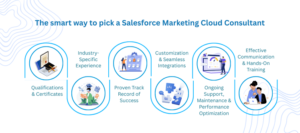
Qualifications and Certificates

A Salesforce-approved marketing cloud consultant should include skills and practical knowledge of Salesforce marketing cloud capabilities. Certifications authenticate their expertise to allow them to implement sophisticated installations and offer strategic advice specific to your business needs.

Industry-Specific Experience

Each industry poses different marketing issues and customer actions. An industry-experienced SFMC consultant knows how to customize the Salesforce Marketing Cloud to best support your business goals. Salesforce consulting companies with industry expertise can design extremely effective, well-targeted marketing automation solutions.

Proven Track Record of Success

Select a Salesforce consulting partner with a history of successful SFMC implementations. Request case studies, reviews, and client testimonials to guarantee that they are experts. A certified Salesforce consultant with a strong portfolio can help your business avoid common mistakes and accelerate time-to-value.

Customization & Seamless Integrations

A Salesforce professional consultant should be able to customize the Salesforce Marketing Cloud according to your particular business needs. They should be experienced in integrating SFMC with CRM, ERP, data analytics software, and third-party tools to deliver a smooth and efficient marketing platform.

Ongoing Support, Maintenance & Performance Optimization

The proper Salesforce partners ensure ongoing support post-implementation. SFMC necessitates constant performance monitoring, optimization, and debugging. A Salesforce-certified marketing cloud consultant must ensure post-implementation support, fine-tune marketing plans, maximize automation, and streamline customer interaction.

Effective Communication & Hands-On Training

Other than execution, a good consultant ensures your internal team is trained well enough to manage Salesforce Marketing Cloud. Look for consultants providing comprehensive training, workshops, and detailed documentation, enabling your marketing team to explore SFMC features confidently. 

Conclusion 

Salesforce Marketing Cloud is a potent resource, but with no expert knowledge, companies have difficulty tapping its full potential. Salesforce-certified marketing cloud consultants have the expertise, experience, and strategic vision necessary to unlock the potential of SFMC, spur personalized customer relationships, and create measurable business expansion. 

Investing in an appropriate SFMC consultant guarantees successful implementation, tactical marketing automation, and lasting success. To make the most of your marketing automation and enhance customer experience, collaboration with an SFMC consultant is the formula for success. 


FAQs 

What does a Salesforce Marketing Cloud consultant do?  

A Salesforce Marketing Cloud consultant assists companies in managing, optimizing, and leveraging their SFMC platform. They build integrated automation workflows, personalize customer interactions, connect third-party apps, and translate SFMC’s capabilities into a seamless omnichannel experience. Their expertise helps companies maximize SFMC’s capabilities for customer engagement and their return on investment (ROI). 

Is it necessary to hire certified Salesforce consultant for Marketing Cloud? 

A Salesforce-certified Marketing Cloud consultant has the depth of knowledge to ensure businesses take full advantage of everything SFMC has to offer. They work with companies on smooth implementations, data security, ongoing optimization, developing a strategic plan for automating customer journeys, and campaign personalizations – all of which enhance marketing efforts and ultimately the customer experience. 

How does AI work in Salesforce Marketing Cloud? 

AI, powered by Einstein AI, works in SFMC to help businesses analyze their data and make predictions about customer behavior. It also helps with automating decision-making. AI enables companies to provide AI-driven recommendations, personalize content delivery, improve customer sentiment analysis, and analyze sophisticated use cases to help engagement and improve marketing ROI. 

What is Journey Builder in Salesforce Marketing Cloud? 

Journey Builder is automation tool that enables companies to design and execute highly personalized, integrated cross-channel customer journeys. Journey Builder automates marketing experiences and interactions based on customer behavior so the right message gets delivered on the right channels at the right time. 

How does SFMC integrate with CRM? 

SFMC integrates with Salesforce CRM for data to provide businesses with a unified view of customer data for marketing execution and targeted marketing. Salesforce allows businesses to sync data in real-time so using SFMC for automated lead nurturing and to personalize cross-platform customer journeys across marketing and sales interactions. 

IT Staff Augmentation

Organizations are challenged with the need to seek innovative ways of fulfilling their demands and needs. Consequently, it has experienced a growing need for skilled IT experts. IT staff augmentation will become a strategic means for organizations wishing to use talent to grow efficiently by 2025. With the effect of technological growth and shifting workforce trends, organizations are opting for IT staff augmentation services to achieve a competitive edge. In this blog, we will examine some of the most prominent trends that are defining the future of staff augmentation. 

Emerging Trends in IT Staff Augmentation 

IT staff augmentation services

Rise of Hybrid and Remote Work

The transition to workspaces that integrate hybrid and remote workspaces has been gaining traction for years and today is a prevalent trend among IT staff augmentation. Most companies are reevaluating the conventional office setup and are considering work arrangements that offer flexibility for the employees to work from home or on-site depending on needs. Such as Salesforce development services, HR professionals, etc. 

All the big tech players have switched to hybrid models, and many have adopted a full remote model. This is beneficial for businesses as it enhances their talent pool and reduces overhead expenses. Remote employees are now being supplied by staff augmentation consulting services who fit into the in-house team so seamlessly, and location-independent work is becoming the trendy norm. 

AI-Based Recruitment Strategies 

Artificial intelligence (AI) is revolutionizing IT staff augmentation recruitment processes. Traditional recruitment processes are being replaced by AI-based platforms that screen, shortlist, and hire candidates automatically. Organizations now use AI-based tools to screen resumes, analyze candidate qualifications, and suggest professionals for positions. 

Agents who use AI are now able to do first-level interviews, screen candidates, and even handle onboarding. It not only quickens the recruitment process but also eliminates recruiting bias. IT staff augmentation services are increasingly counting on AI-powered solutions to streamline processes and enable companies to connect with the right talent faster than ever. 

Greater Demand for Specialized Skill Sets 

As technology is constantly advancing, businesses now require exceptional skill sets to handle complex problems. The demand for niche skills in multiple domains like cloud computing, AI, data science, and more is on the rise. Organizations are looking forward to Staff augmentation consulting services to overcome skill gaps without long-term commitments of full-time staff. This enables businesses to employ experts who are skilled in new technology and are updated with the latest innovations in their field. 

Focus on Soft Skills 

Technical skill set is no longer a necessity as businesses are increasingly demanding soft skills such as communication, adaptability, and collaboration. 84% of managers and employees believe that soft skills are important for workplace success. 

IT staff augmentation consultants now screen candidates not just for technical knowledge. They now look for their potential to work as part of a team, their capacity to function under pressure, and their ability to get along with existing teams. It reflects the emphasis given to well-rounded professionals in the technology sector. 

The Future of IT Staff Augmentation 

Global Talent Acquisition 

The development of remote working has opened a gateway to worldwide talent scouting. Companies no longer have any spatial constraints in employing IT professionals. Instead, they are looking to offshore development services to find talented developers from the rest of the world. 

The trend is cost-saving without sacrificing the quality of development. Offshore staff augmentation services provide a cost-effective model for companies that require outsourcing operations without sacrificing expertise. 

Compliance and Data Security 

Since companies are increasing their IT workforce all over the globe, compliance and data protection are now the key. They must ensure that their outsourced workers are complying with regulations like GDPR, HIPAA, and other guidelines. 

To counter threats, organizations are adopting strict security measures such as non-disclosure agreements, access controls, data encryption, and cybersecurity. IT staff augmentation services stress compliance training and having their experts well-equipped with compliance requirements. 

Outcome-Based Engagement Models 

A shift towards outcome-based engagement models is transforming IT staff augmentation. Unlike the traditional hourly or fixed-cost models, these models are performance metric- and deliverable-based. Firms establish key performance indicators (KPIs) and desired outcomes to encourage accountability and effectiveness. 

This approach syncs staff augmentation consulting services with business goals, with cost predictability and flexibility. Companies have lower risks and increased productivity, as payment is based on output rather than time. 

Integration of Augmented Teams with In-House Staff 

It is essential to successfully merge outside augmented staff with internal teams to enable smooth coordination. Organizations are embracing agile methods, collaborative tools in the cloud, and systematic onboarding to facilitate outside professionals to synchronize with internal processes. 

Clear role definitions, regular check-ins, and cultural alignment initiatives help foster collaboration. By leveraging communication tools and project management software, businesses enhance transparency and coordination between in-house and augmented teams. 

Predictions for the Future of IT Staff Augmentation 

Identity and Credential Verification with Blockchain Technology 

The impact of blockchain technology will revolutionize the processes related to the verification process in staff augmentation. Due to characteristics of immutability and transparency, blockchain technology can be an efficient vehicle for verifying the identity, credentials, and skill sets of candidates. IT staff augmentation services are utilizing blockchain-powered solutions in conjunction with other technologies to safeguard against fraudulent activity and verify authenticity. This innovative use of technology builds trust between the organization and the augmented professional and optimizes the hiring process. 

Heightened Demand for Cybersecurity Professionals 

Due to cyber threats becoming more sophisticated, the demand for professionals who work in cybersecurity has reached all-time highs. Organizations of all sizes are leveraging the expertise of cybersecurity professionals to invest heavily in protecting sensitive data and breaches. Demand for IT staff augmentation services is surging for roles ranging from professional ethical hackers to security engineers and chief information security officers (CISOs).  

Adoption of AR and VR in Training IT Staff 

Augmented reality (AR) and virtual reality (VR) are powerful technologies being adopted for training IT staff. These technologies create simulated environments for coding, troubleshooting scenarios, and collaborative exercises. Staff augmentation service organizations are utilizing AR as a vehicle for skill enhancement, building confidence in onboarding, and developing IT professionals for critical thinking and handling complexity.  

Strategic Roles for Augmented Teams 

The evolution of IT staff augmentation has progressed beyond just technical work. More companies are leveraging augmented workers in strategic roles focused on product innovation, digital change, and business decision-making.  

Using specialized talent externally for consulting and market research allows businesses to gain a fresh viewpoint as well as market industry thinking. This also demonstrates the increasing trust in staff augmentation consulting services for strategic long-term business.  

Why is Your Company Choosing IT Staff Augmentation?  

As businesses evolve as a response to changing market conditions, IT staff augmentation fills the void for workforce needs. Here’s why clients are adopting staff augmentation services to increase their workforce:  

  • Cost-Effective Increased Workforce: IT staff augmentation services allow businesses to increase their workforce based on project timelines, and the workforce has a limited obligation beyond the project end date, which would be more financially beneficial than a full-time hire.  
  • Access to Diverse Market Talent: Companies can hire niche expertise from diverse talent markets without the restrictions of geographical locations.  
  • Flexibility and Agility: Companies have turnaround time with IT professionals staff augmentation resources, bringing the right IT expertise to meet deadlines and changing companies’ needs.  
  • Higher Productivity: Adding in augmented teams not only allows organizations to make workflow and efficiencies more efficient but overall productivity increases.  
  • Reduced Risk Hiring Process: Recruiting staff augmentation consulting services manage the recruitment process for you, with the confidence that likely qualified candidates are presented with the proper skill sets and fit for both technical and soft skills.  

Conclusion 

Staffing solutions are experiencing a revolutionary change with advances in technology, shifting workforce, and shifting business requirements. The emergence of remote work, AI-driven hiring, global talent pools, and compliance solutions are augmenting the industry. Companies are banking on IT staff augmentation services for greater flexibility and expertise. Keeping pace with upcoming trends is crucial and adopting innovations such as blockchain verification, AR/VR training, and strategic talent integration can offer new opportunities. Furthermore, to tap into the appropriate skills AnavClouds Software Solutions can assist you by offering reliable staff augmentation solutions to fuel lasting growth in 2025 and beyond. Schedule a call and discover more about how we can assist you. 


FAQs 

What is IT Staff Augmentation, and how does it work? 

IT staff augmentation is an open-ended hiring methodology that enables corporations to augment their workforce on a short-term basis by hiring off-site IT experts for particular projects. Staff augmentation consulting agencies can be hired by organizations to employ experienced professionals without maintaining them long-term on permanent payrolls. 

How is IT staff augmentation different from outsourcing? 

IT staff augmentation entails the hiring of outside experts who work in tandem with your internal team, promoting smooth integration. Outsourcing, on the other hand, entails the assignment of complete projects or functions to a third-party provider, with minimal direct control by the client. 

What are the main advantages of IT staff augmentation? 

Some of the main advantages of IT staff augmentation are: 

  • Cost savings over full-time employment 
  • Access to worldwide talent and specialized expertise 
  • Flexibility to scale teams up or down at will.  
  • Quicker recruitment process versus traditional hiring 
  • Lower risk in ensuring hires with pre-vetted professionals 

How long does staff augmentation hiring of IT professionals take? 

Recruitment is relatively fast in comparison to conventional hiring with the assistance of IT staff augmentation. Depending on the expertise and requirements for the job, businesses can appoint specialists within weeks or days. 

Why Do Companies Prefer IT Staff Augmentation? 

Companies such as IT staff augmentation benefit from its cost-effectiveness, flexibility, and access to expert talent. It enables firms to expand quickly, reduce the risk of recruitment, and speed up project delivery without long-term commitments. 

salesforce for real estate

The real estate market is dynamic and competitive, where professionals have to multitask, from client relationship management to property listing and closing a deal. Having the right technology can make a lot difference in streamlining multiple aspects. CRM tool like Salesforce for real estate is a leading solution that can automate multiple tasks. No matter if you are a small or large company Salesforce CRM for real estate organizations can streamline the processes and enhance client satisfaction. In this blog, we will take a look at how Salesforce CRM for real estate businesses is changing the industry and why it is essential for professionals. 

What is Salesforce CRM for Real Estate? 

Salesforce CRM for real estate is a robust resolution that can be customized according to the business needs. It enables professionals working in the industry to streamline workflows and tasks like lead management, client interactions, listings, and sales process can be managed seamlessly. However, unlike industry-specific tools or solutions, Salesforce does not offer any dedicated real estate cloud, but its customization options allow businesses to build tailored solution. The platform can easily be integrated with third party applications, automation tools, and AI driven insights. Moreover, hiring a certified Salesforce development partner is necessary to implement the solution seamlessly.  

Benefits of Salesforce for Real Estate 

Salesforce for real estate agents

Salesforce CRM solution offers a powerful suite of tools designed to meet the specific needs of real estate businesses. Beyond just managing clients or other data benefits of Salesforce CRM for real estate include more, fulfilling every aspect of business from lead generation to closing deals. Here are the key advantages of Salesforce real estate CRM. 

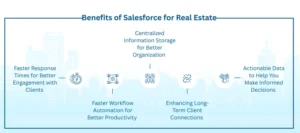
Faster Response Times for Better Engagement with Clients 

Good communication is essential to closing the deal in real estate, and faster communication can make all the difference. Salesforce CRM for real estate allows agents to respond quickly to any inquiry because the platform allows cloud-based access from any device. Agents get live updates from clients and can respond to messages without delays, as they will no longer have to coordinate manually. Automated response features also help professionals personalize their responses while acknowledging inquiries and providing a little more assurance that the client is valued and informed. 

Faster Workflow Automation for Better Productivity 

In real estate industry their are multiple daily repetitive tasks such as managing documents, tracking contracts, and client follow-ups. Salesforce CRM for real estate automates these task so that agents can focus on high value activities. Moreover, with the help of Salesforce for real estate managing follow-ups, sending reminders, and tracking important dates is much easier, with this agents can also focus on what’s important. 

Centralized Information Storage for Better Organization 

It can be overwhelming and challenging to manage leads from several different sources without any formal structure. Salesforce CRM for real estate provides you with one widely-understood and secure database to store all of your client and property data.  Agents can access, update, and share that data in real-time to manage clients and property efficiently. The platform integrates and updates databases so agents can synchronize and keep updated listing information posted as they access trending information in their market. 

Enhancing Long-Term Client Connections 

Creating and nurturing strong client connections is imperative for continued success in the real estate industry. Salesforce for real estate allows for continued involvement with clients and prospects by automating periodic communications and personalized updates. Through ongoing engagement with past clients, agents are more likely to obtain repeat business and referrals, developing loyal customers. Real estate CRM Salesforce can enhance client relationships which impacts business success. 

Actionable Data to Help You Make Informed Decisions 

To run a successful real estate business it requires tracking your performance and re-evaluating your strategy. With Salesforce CRM for real estate, you get access to real time analytics and reporting features that can provide enhanced insights into multiple business aspects. With access to sales trends, client engagement, and marketing efforts you can analyze the effectiveness of your Salesforce solution. This allows you to strategize accordingly, and reallocate time and more for maximized growth and profitability. 

Key Features of Salesforce Real Estate CRM 

The real estate industry is growing with increasing competition and businesses needs to run all process simultaneously including lead generation, client management, property listing etc. Salesforce CRM for real estate is a leading solution that offers enhanced tools to help professionals improve operations, streamline productivity, and improve client relationships. Below are some of the key features of Salesforce CRM for real estate organization.

Advanced Lead Generation and Management

Real estate professionals are only successful if they can generate, follow up on, and convert leads on time. Salesforce CRM for real estate enables professionals to simplify their lead management plan by bringing all lead information into one place to track it. All the information like contact information, property specifications, and interactions can all be placed within the Salesforce CRM for real estate. 

  • Automated Lead Capture: Salesforce for real estate enables realtors to design personalized lead capture forms to capture leads from channels, including their website, social media, and marketing efforts. Personalized lead capture forms automatically capture the information required for a lead in the real estate Salesforce CRM system reducing manual workload. 
  • Lead Scoring and Prioritization: Salesforce CRM for real estate provides a feature that enables agents to categorize and prioritize leads This includes engagement, budget, and property criteria. enabling agents to nurture the highest potential leads with a higher conversion rate. 
  • Smart Lead Assignment: Salesforce CRM for real estate assigns leads to the agents according to pre-defined criteria, like location, skill level, or presence reducing response time and enhancing the chances of closing.  
  • Follow-Up Automation: The system enables the agents to automatically schedule follow-up emails, reminders, and alerts so that no lead is missed. 

Centralized Property Listing and Management

Effective management of multiple property listings is the bread and butter of real estate agents. Salesforce for property management facilitates a simplified process through integration with Multiple Listing Services (MLS) and third-party products, gathering all listings in one location. 

  • Effortless MLS Integration: Real estate agents can integrate their Salesforce CRM for real estate with MLS databases to update property data instantly, reducing the hassle of manual updating. 
  • Advanced Filtering and Search: Salesforce can be likened to comparing similar properties by using configurable filters that enable them to search for listings instantly by input fields such as location, price, and amenities. 
  • Automated Updates in Listing: Agents can provide instant updates of property details, availability, and price, providing real-time information to potential buyers. 
  • Performance Analytics: Salesforce CRM for real estate gives agents listing-level performance data to allow agents to view trends, monitor inquiries on properties, and manage marketing to offer additional exposure. 

Full Contact and Client Relationship Management

Client contact building and maintenance are the secrets to long-term real estate success. Salesforce CRM for real estate offers a powerful contact management system that holds all client contact details, personal preferences, and transactional history in a single database. 

  • Centralized Client Database: Agents can record and store client contact information, communications history, and interest in property in one integrated system, allowing it to become an easier task to track interaction. 
  • Personalized Client Interaction: Salesforce for real estate enables agents to segment clients by budget, property searches, and preferences, allowing for focused and tailored communication. 
  • Automated Reminders and Follow-Ups: The system automatically schedules reminders for follow-ups, property visits, or signing contracts, so agents never miss a vital client meeting. 
  • Client Journey Monitoring: With Salesforce for real estate agents, they can monitor the client’s journey from inquiry to close, gaining insight into their behavior and preferences to optimize engagement. 

Automation of Sales and Marketing for Increased Efficiency 

Real estate agents who aspire to maximize exposure and conversion levels need marketing and sales automation as must-haves. Salesforce CRM for real estate features the automation of marketing campaigns as well as streamlining sales.  

  • Email and SMS Marketing Automation: Agents may pre-build targeted email and SMS campaigns with personalized messages so that prospects will receive targeted recommendations for properties as well as updates. 
  • Lead Nurturing Campaigns: Agents may nurture leads with Salesforce’s drip email campaigns, sending timely and relevant content and building engagement and trust. 
  • Social Media Integration: Salesforce CRM for real estate is connected to social media sites, and agents can track engagement and activate marketing campaigns within the CRM. 
  • Sales Pipeline Management: The software enables agents to track deals, negotiate, and close deals efficiently by getting visibility into all the stages of the sales pipeline. 

Enhanced Client Communication and Follow-Up

Timely and effective communication is also vital in building trust with the customers. Salesforce for real estate enables managing customer communications across multiple channels by agents. 

  • Automated Communication Workflows: Agents can send automated reminders, property updates, and follow-ups via email, SMS, or chat. 
  • Pre-Designed Email Templates: Salesforce real estate CRM provides pre-designed email templates through which agents can send professional and consistent emails within seconds. 
  • Call Logging and Interaction Tracking: All client interactions, whether over the phone, via e-mail, or through a meeting, are logged in Salesforce CRM so agents can monitor contact and respond in turn. 
  • AI-Driven Chatbots: Salesforce AI-driven chatbots can answer first-time questions, schedule appointments, provide property information, and make it available 24/7 to potential clients. 

Task and Calendar Management to Remain Organized

Real estate agents are confronted with a plethora of appointments, viewings, and negotiations daily. Salesforce CRM for real estate organization makes task management and scheduling easier, keeping agents organized. 

  • Automated Task Creation: The system can create tasks in response to customer interactions, including setting up appointments following a property viewing. 
  • Integrated Calendar Syncing: To avoid scheduling conflicts, agents can link their Salesforce calendar to Outlook or Google Calendar. 
  • Intelligent Alerts and Reminders: Automated reminders guarantee that agents never overlook crucial customer calls, deadlines, or meetings. 
  • Team Collaboration: By using the Salesforce CRM for real estate to assign tasks, monitor progress, and exchange critical updates, managers and team members may increase team productivity. 

Data-Informed Decision Making with Analytics and Reporting

Salesforce’s extensive reporting and analytics capabilities enable real estate professionals to make informed business decisions. 

  • Customizable Dashboards: Agents can create their own dashboards to track key performance indicators (KPIs) like as lead conversion rates, property sales, and the success of marketing campaigns. 
  • Real-Time Insights: By providing real-time data on customer interactions, sales patterns, and agent productivity, the platform supports data-driven decision-making. 
  • Market Trend Analysis: Agents can study market trends, real estate demand, and price fluctuations to enhance their strategies and keep a competitive edge. 
  • Forecasting Tools: Salesforce CRM for real estate helps agents plan and allocate resources more effectively by helping them predict future trends in sales and revenue.  

Easy Integration with Property Management Systems

Real estate agents dealing with property management find it easier to integrate the Salesforce platform with property management systems, making it easier to operate and increase efficiency. 

  • Property Real-Time Updates: Real-time updates in property information, rental terms, or tenants can be exhibited on integrated sites. 
  • Efficient Maintenance Tracking: Agents can track maintenance requests, arrange repairs, and manage service providers via the CRM. 
  • Rental and Lease Simplification: Seamless lease monitoring, rent reception, and communications with tenants can be facilitated with integration. 
  • Data Synchronization: Maintains client and property data up to date on all systems, eliminating redundancy and discrepancies. 

Conclusion 

In the rapidly moving real estate business today, being a step ahead takes more than old-school selling skills—it takes clever technology that enhances all functions of your business. Salesforce provides real estate agents with a centralized, automated, and data-driven process for managing clients, tracking properties, and marketing. Whether you are looking to deploy or refine Salesforce for your real estate business, AnavClouds Software Solutions can assist. As a certified Salesforce consulting partner, we offer tailored solutions that unlock your CRM’s full potential. Schedule a demo today and learn how we can optimize Salesforce for real estate business with innovative solutions. 


FAQs 

How do I organize my real estate CRM? 

To structure your real estate CRM, you must prioritize your leads, establish automation for follow-ups, sync data, and utilize dashboards to monitor primary metrics. You can centralize all the details, automate workflow, and enable streamlined communication using Salesforce CRM for real estate to work more efficiently. 

What is the best CRM for real estate? 

Selecting the most suitable CRM for your real estate company is based on your requirements. Salesforce CRM for real estate is unique due to its customization features, automation, AI-powered insights, and smooth integrations it offers. With the assistance of property management software, the CRM solution is perfect for real estate agents. 

Do brokers and realtors need a CRM? 

Yes, realtors and brokers require a CRM system to handle leads, monitor customer interactions, follow-up automatically, and streamline the sales process. An effective real estate CRM Salesforce makes you more efficient, strengthens your customer relationships, and grows your sales. 

How do I choose the right CRM for realtors? 

Considerations such as customization features, automation, usability, mobile usability, and property management system integration need to be considered while selecting a CRM for realtors. Salesforce CRM provides all these attributes making it a suitable option for real estate businesses. 

How much is Salesforce for real estate? 

The pricing of Salesforce varies depending on the business needs. As the platform can be customized completely the price relies on various factors such as the number of users and integration requirements. It is wise to take advice from Salesforce professionals for a better understanding and pricing estimates according to your business requirements. 

How is a CRM used in real estate? 

It is applied to several areas such as lead management, property tracking, client interactions, workflow automation, and performance metrics. Salesforce real estate CRM supports agents in making data-driven decisions for improved results. 

Salesforce is a robust CRM solution that drives business growth, automates business processes, and improves customer relationships. However, businesses have their own needs based on the processes and workflows which may require customized solutions to fulfill them. Salesforce customization and configuration are robust solutions that can help streamline the process. But it may require knowing these solutions and how they differ which will enable you to make the correct decisions that suit business needs and technical expertise. 

What is Salesforce Customization? 

Customization of Salesforce is particularly the process of modifying the platform through custom code. Through this new functionalities can be introduced along with improving existing features and tailoring the system to meet specific business needs. Moreover, Salesforce development is the best choice for businesses that need advanced automation, workflows, or integration beyond Salesforce. 

Furthermore, customizing Salesforce needs the technical skills and expertise of a Salesforce development services provider who holds expertise in multiple integrations and software. With this businesses can leverage the functionality of the platform and streamline their workflows. Customizing Salesforce can easily develop tailored user interfaces specific to business needs. 

Key Areas of Customizing Salesforce  

Salesforce customization is the process of altering various aspects of the Salesforce platform to suit business processes and operations. Some key areas that can be customized within Salesforce are: 

  • Custom Objects & Fields: Businesses can configure standard or new data to meet their specific business workflows to help manage their data more systematically.  
  • Workflow Rules: Repetitive tasks can be automated based on specific criteria, improving efficiency, while reducing manual and non-automated actions.  
  • Custom Reports & Dashboards: Organizations can develop complex data across their area of interest with informed reports and dashboards related to their identified KPIs.   
  • Apex Classes & Triggers: Custom code can automate complex business processes to give a well-defined user experience.  
  • Lightning Components: New and reusable UI functions can improve the interface and usability of the organization.  
  • Custom UI: Salesforce CRM solutions can be modified to give a better specific brand identity to create a better user experience.  
  • Third-Party Integrations: Organizations can connect Salesforce integration to third-party tools (ERP, eCommerce / sales) to improve and streamline the data that is exchanged.  

What is Configuration of Salesforce? 

Salesforce configuration is a process of modifying the features that are native to the platform, without changing the code. Configuration leverages declarative tools, or point-and-click functionality, which allows administrators and business users with no coding experience to make adjustments. Configuration is best suited to businesses that want to quickly improve Salesforce without incurring the expense of custom development.  

Key Areas of Configuring Salesforce  

Businesses can configure multiple elements of Salesforce to make the platform fit their organization including:  

  • User Set-Up and Roles: Businesses will set up user permissions, access levels, and hierarchies to maintain data security and efficiency. 
  • Security Settings: The configuration can offer control of data visibility, field-level security, and log-in access. 
  • UI Customization: Configuring page layouts, list view, or navigation helps to improve the user experience and allows users to access their data faster. 
  • Workflow Automation: Businesses can configure workflow rules to automate tasks such as email notifications, field updates, or approval processes. 
  • Email Settings: Businesses can configure reusable email templates, so one department uses standardized communication and another uses a similar communication format. 
  • Integration Settings: Businesses can leverage third-party applications without a large amount of coding to enhance overall system functions. 

Customization vs. Configuration: Which One Should You Choose? 

Whether customization or configuration, Salesforce CRM implementation should be applied depending on several factors such as business objectives, investment costs, etc. Here’s what to do when implementing a Salesforce solution: 

When to Use Customization of Salesforce 

  • Your company needs features beyond Salesforce’s native features. 
  • You need advanced automation and custom workflows to enable automation. 
  • Smooth integration with other applications is necessary. 
  • You have a committed development team and the capability to fund regular maintenance. 

When to Use Configuration of Salesforce 

  • The platform’s out-of-the-box functions are sufficient to meet your company’s needs. 
  • You need a cheap and fast solution that does not involve coding. 
  • Your organization lacks in-house developers and prefers to minimize reliance on custom code. 
  • You wish to be upwardly compatible with Salesforce’s standard updates and best practices. 

Key Differences Between Customization & Configuration 

Differences Between Customization & Configuration

Degree of Personalization

Customizing Salesforce can enable businesses to tailor anything within their CRM to suit specific needs. A business, for example, can develop a custom pricing formula or a departmental-level user interface that cannot be created using Salesforce functions otherwise. 

Configuration does allow for customization, in the sense that it can only do so much with the tools that Salesforce has built in. Customizing Salesforce is flexible, but still can’t necessarily be an organization’s precise need for a feature. 

Complexity of Implementation

Customizing Salesforce requires a software development skillset with thorough testing and ensuring multiple deployment cycles. The Salesforce development service often works in a sandbox and deploys changes with tools like Salesforce CLI for production.  

Configuration, on the other hand, is less complex and can be done directly in production. A Salesforce administrator can easily make configuration changes with a limited technical background and no testing in a sandbox.  

Time Commitment

Salesforce customization can take longer and requires planning, development, testing, deployment, and maintenance. A development project can take weeks or months.  

Configuration, on the other hand, is faster than customization because it involves utilizing existing tools. Changes can be implemented in real time, making it a good choice for a quick change. 

Maintenance & Upgradability

The maintenance of customized solutions depends on code quality and complexity. Since Salesforce rolls out updates a couple of times a year, businesses may need to update their custom code to maintain compatibility. 

Configuration, on the other hand, requires minimal maintenance. Since it relies on Salesforce’s native features, most updates automatically align with existing configurations, reducing the need for manual intervention. 

Expertise Requirement

Custom Salesforce development requires advanced technical skills, including knowledge of Apex, JavaScript, SOQL, and Salesforce DX. As a result, businesses need to hire dedicated Salesforce developer or development team. 

Configuration, however, can be handled by Salesforce administrators. A basic understanding of Process Builder, Flow Builder, and Custom Report Types is sufficient to implement configurations. 

Cost Factors

Customization of Salesforce may be an expensive approach due to the expense of development, extended project life, and maintenance. Businesses must spend on debugging, testing, and system integration. 

Conversely, configuration is cheaper since it does not involve custom development. Organizations can utilize in-house administrators to perform necessary adjustments at a cost savings to them in the long term. 

Risk Factors

Customizing Salesforce entails altering the initial code, and this comes with a greater risk of unforeseen outcomes. It may cause system collapse or interference with ongoing processes when executed inappropriately. 

Configuration is safer as it does not alter the core code. However, over-configuring the system with numerous modifications will make it confusing and reduce system stability. 

Conclusion 

Customizing Salesforce and configuration are both top priorities when it comes to leveraging Salesforce for business success. If your business requires advanced automation and custom functionality, tailoring the platform is necessary for optimal usage. But if you need rapid changes with built-in tools, configuring Salesforce is an affordable and scalable solution.  

However, having a balanced strategy usually works best, if you require small changes configure the platform and reserve customizing Salesforce when necessary. Also, hiring experienced Salesforce consultants and development services like AnavClouds Software Solutions can help you assess your needs. Schedule a call with us and learn more about implementing the right solution that fits your long-term business goals. 


FAQs 

When should I choose Salesforce customization over configuration? 

Customizing Salesforce should be chosen when you need advanced automation, complex workflows, or third-party integrations. It requires extensive expertise as the whole platform is tailored according to business needs. Moreover, if standard Salesforce features meet your needs, configuring the platform is a better and more cost-effective option. 

Does Salesforce configuration require coding knowledge? 

Salesforce configuration does not require coding knowledge. It uses declarative tools which can be managed by administrators and they can easily fix issues or change functionalities. 

Is customization or configuration better for integrating third-party applications? 

If you require simple integrations, configuration can easily connect Salesforce with third-party tools using built-in solutions. However, more complex integration requires advanced API and custom logic, and customization is required. 

What are the cost differences between Salesforce customization and configuration? 

Salesforce customization is more expensive due to development costs, testing, and continuous maintenance. However, the configuration is cheaper since it leverages built-in features without any custom development. 

Salesforce Manufacturing Cloud

The manufacturing sector is experiencing a massive revolution due to the implementation of digital technologies. This is improving business responsiveness and operational efficiency. Most importantly, the industry is concerned with streamlining supply chains, improving customer experiences, and enhancing productivity. Salesforce Manufacturing Cloud is one of the best solutions, designed for the sector. Manufacturing CRM not only streamlines the sales, operation, and manufacturing team processes, it also empowers businesses to make informed decisions.

Moreover, the platform also offers strong analytics, automations, and process visibility in real-time. This makes it easy for the businesses to make production planning simpler, improve collaboration, and drive long-term growth. In this guide, we are going to explain the major features of Salesforce CRM for the manufacturing industry. Apart from that, the advantages, implementation best practices, and how to unleash its value are explained here.

What is Salesforce Manufacturing Cloud

Manufacturing cloud by Salesforce provides different types of data in a single perspective to the organizations, i.e., manufacturing forecasts, customer interactions, sales contracts, etc. They can automate their business quite easily and become efficient. Moreover, CRM for the manufacturing industry is capable of addressing the complexities of the industry. 

Salesforce in manufacturing industry also integrates real-time data from different sources. Businesses can gain a complete overview of the supply chain, inventory management, and production. With this they can fulfill the customer needs efficiently, reduce waste, and minimize stockouts. Salesforce manufacturing CRM also offers AI-powered insights through which businesses can forecast demand more accurately, align sales agreements with production capabilities, and make proactive decisions. But to leverage it hiring Salesforce development services is a good way to keep the processes streamlined. 

Key Benefits of Salesforce CRM for Manufacturing Cloud

Manufacturing CRM

Increased Visibility Throughout the Supply Chain

One of the greatest benefits of Salesforce manufacturing cloud is its capability of delivering real-time visibility throughout the end-to-end supply chain. Businesses can monitor production schedules, customer demand, and inventory levels using a single dashboard. This ensures improved decision-making and resource management. Additionally, with accurate data in their hands, companies can better optimize the use of production planning without allowing too much inventory or supply shortages.

Enhanced Alignment of Sales and Operations

Manufacturing CRM aligns sales and operations on the same page by offering a unified platform. The Sales Agreement enables teams to make customer commitments, order quantity, and pricing computations in real-time. This helps in reducing risks and promoting facilitative communication across disciplines.

Enhanced Demand Forecasting

With analytics powered by AI, the Manufacturing cloud by Salesforce allows companies to predict demand. The Account-Based Forecasting capability helps manufacturers give personalized forecasts to customers, allowing production to match real market demands. This prevents underproduction and overproduction risks and provides improved control of inventory.

Smooth Collaboration with Distributors and Partners

Businesses usually depend a lot on a chain of suppliers, distributors, and other associates. The CRM for manufacturing industry allows for free collaboration through a shared source of information for everyone involved. Manufacturing cloud by Salesforce facilitates smooth coordination by providing businesses access to common data, thus improving efficiency and customer satisfaction.

Data-Driven Decision-Making

Manufacturing CRM uses real-time analytics and machine learning based on which enterprises can recognize trends, examine performance, and search for new prospects. Based on the data, manufacturers can optimize pricing methods further, reduce operating expenditures, and maximize profitability.

Core Features of Manufacturing Cloud by Salesforce

Sales Agreements

This is a robust feature provided by Salesforce CRM for manufacturing cloud, which allows manufacturers to create agreements in a more structured way. This helps in ensuring correct tracking of purchase, pricing, and order quantities. Moreover, alignment for sales and production strategies helps in reducing risks of mismatching data.

Account-Based Forecasting

Manufacturing Cloud by Salesforce provides custom forecasting capabilities at the account level, enabling the businesses to customize their production plan according to the needs of specific customers. This personalization enhances order fulfillment and fortifies relationships with customers.

Advanced Analytics and Reporting

Some powerful analytics and reporting features that the manufacturing cloud by Salesforce provides to manufacturers are to gain enhanced insights. They can easily access the demand patterns, sales performance, and operational efficiency. Businesses can create custom dashboards and reports to measure important performance metrics and act accordingly with the help of the manufacturing cloud by Salesforce.

Seamless ERP and System Integrations

Manufacturing Cloud by Salesforce can be integrated seamlessly with existing ERP and MES systems to ensure that data flows without any complications. This integration avoids silos, enhances activities, and improves business process.

Best Practices for Implementing Salesforce Manufacturing Cloud

Set Clear Goals and Objectives

There have to be objectives before the manufacturing cloud by Salesforce is implemented. With this, you can determine the most significant business problems and then define the desired results.

Engage Key Stakeholders Early

Including all the key stakeholders from different departments like sales, operations, IT, and finance will make sure that all the voices are heard. This engagement will implement the manufacturing CRM more easily, along with enhancing the adoption rate.

Offer Full Training

To make the manufacturing cloud by Salesforce fully utilized, proper training among all the employees should be achieved. Proper training among all the employees should be achieved for an optimal level of adoption of features and functionalities from the platform.

Start with a Pilot Project

Instead of implementing the manufacturing cloud by Salesforce directly, it is better to start with a small pilot project initially. Salesforce manufacturing cloud facilitates experimentation with functionalities and problems to take necessary steps in advance. This helps in understanding and then installing and using it completely.

Continuously Monitor and Optimize

Deploying the manufacturing cloud by Salesforce is not a one-time job. It needs to observe regularly, seek feedback, and adjust processes so that the platform is aligned with business requirements and evolving situations.

Overcoming Common Manufacturing CRM Implementation Challenges

Resistant to Change

Employees can resist introducing new technology, and to overcome this, businesses have to incorporate strong change management methods. This includes effective communication, reward systems, and training initiatives.

Data Migration Issues

Data migration from existing systems to Manufacturing Cloud by Salesforce can be challenging. Businesses have to employ data migration software and hire certified Salesforce consultants to ease the process.

Customization and Scalability

With increasing businesses, additional customizations might be required. Regular review and configurations ensure the platform adapts to shifting business needs.

Maximizing the ROI of Manufacturing Cloud by Salesforce

Continuous Process Improvement

Manufacturers should regularly check and streamline their operations to be able to utilize Salesforce Manufacturing Cloud to the full extent. Automating repetitive tasks and optimizing production scheduling can enhance efficiency by leaps and bounds.

Integration with Other Salesforce Products

Businesses can easily implement manufacturing CRM by Salesforce with other Salesforce solutions like Sales Cloud, Service Cloud, and Einstein AI. This offers one platform to understand customer relationships, service operations, and predictive intelligence.

Leveraging AI and Emerging Technologies

Adding AI-driven insights and machine learning will make decision-making and business efficiency even greater. Salesforce provides robust AI solutions and companies adopting these technologies will be ahead in the marketplace.

Conclusion

Salesforce manufacturing cloud is a robust solution that enables manufacturers to simplify operations, enhance collaboration, and drive business success. With instant insights, enhanced forecasting, and robust integrations, manufacturing cloud by Salesforce enables businesses to lead the way. By leveraging best practices, overcoming implementation challenges, and refining processes, businesses can maximize their value obtained from manufacturing CRM. Incorporating a powerful platform today can open new opportunities. If you are looking to implement manufacturing cloud by Salesforce, then a certified Salesforce implementation partner like AnavClouds Software Solutions can streamline the process. Schedule a call today and learn more!

FAQs

How can I implement Manufacturing Cloud by Salesforce for my business?

Implementing Salesforce manufacturing cloud is not an easy task, and to ensure a smooth process, it is best to work with an experienced and certified consulting partner. They can ensure a seamless process with minimal disruption along with proper training and support.

What are the challenges in implementing Salesforce Manufacturing CRM?

Some common challenges include resistance to change, data migration complexities, customization requirements, and user adoption. However, if you hire a certified Salesforce partner like AnavClouds Software Solutions, you can easily overcome these challenges.

What are the key features of Manufacturing Cloud by Salesforce?

Key features of the manufacturing cloud by Salesforce include sales agreements, account-based forecasting, advanced analytics, and seamless ERP integration. These features help businesses enhance decision making, optimize sales, enhance operations, and improve overall efficiency.

How does Manufacturing Cloud by Salesforce improve supply chain visibility?

With instant data integration and analytics, the Salesforce supply chain management provides end-to-end visibility into inventory, production, and customer needs. This helps businesses reduce waste, avoid stockouts, and optimize production planning.

Artificial intelligence (AI) has revolutionized the customer service and sales process of organizations. In Salesforce CRM, two artificial intelligence tools rule in the automation and decision-making functionalities, Salesforce Einstein AI and Agentforce. Both Salesforce solutions can automate features and enhance the customer experience. However, both these Salesforce tools can be utilized for varied purposes and can be applied to facilitate various business requirements. 

A study has shown that 75% of employees are enhancing their productivity by automating their tasks with the help of AI solutions. Choosing the right AI solution can bring a significant impact on business performance. Let’s compare Salesforce Agentforce vs Einstein AI so that you can make an informed choice based on your business needs. 

Salesforce’s Agentforce: The AI-Powered Workflow Optimizer 

Agentforce vs Einstein AI

Agentforce is an intelligent aide that automates mundane tasks and enables teams to concentrate on high-value activities. From lead assignment and support queries to follow-ups, Agentforce features eliminate hectic tasks and simplify processes. 

Key Advantages of Agentforce: 

  • Increases Productivity: Automates mundane and chaotic tasks to conserve time and effort. 
  • Streamlines Workflow Management: Lead routing, customer communication, and case assignment are easily accomplished. 
  • Easy to Set Up: This intelligent Salesforce automation is triggered without requiring any long AI training or configuration. 
  • Seamless Salesforce Integration: Runs within the Salesforce ecosystem to optimize workflow automation. 

Agentforce is perfect for businesses that need to plug-and-play an AI-based automation solution and automate procedures without any special skillset. Agentforce features help them reduce workload by automating follow-ups, data entry, and administrative procedures effortlessly so that you can focus on driving maximum customer interaction. 

Einstein AI: The Intelligent Strategist of Salesforce 

Einstein AI is completely different from Salesforce Agentforce, which automates tasks. It is all about giving intelligent insights. Einstein AI capabilities apply AI and ML techniques to predict trends, comprehend customer behavior, and offer data-driven suggestions. 

Key Advantages of Einstein AI: 

  • Predictive Analytics: With Einstein AI, it is easier to make informed decisions as it allows you to predict customer interactions and sales trends. 
  • AI-Based Recommendations: With advanced analytics, you get suggestions on sales, marketing, and customer service. 
  • Personalized Customer Engagement: Salesforce Einstein AI provides personalized customer interactions along with data-driven marketing campaigns and engagement plans. 
  • Advanced AI Learning: The platform can learn and advance on its own through engagements and interactions. 

Businesses looking to leverage data-backed insights, AI suggestions, or deeper knowledge about customer behavior are able to do so with the help of Einstein AI capabilities. The intelligent Salesforce solution uses real-time data to optimize marketing, lead conversion, and customer experience. However, to leverage the capabilities of these AI solutions and make the process of implementation easier it is better to hire Salesforce development services. 

Agentforce vs. Einstein AI: Key Differences and Business Impact 

AI has transformed sales and customer service, and Salesforce provides two strong AI solutions, Einstein AI and Salesforce Agentforce. Both Salesforce solutions offer greater efficiency and customer interaction and work in different ways, and are appropriate for different business needs. If they are well aware of their basic functions and features, it can help them choose the best AI solution. The following is a Salesforce AI comparison: 

Core Functionality 

Agentforce is an excellent program designed to automate workflows and minimize manual efforts. Repetitive tasks like assigning leads, routing customer queries, and follow-ups will be streamlined. This guarantees that the sales and support teams work efficiently and do not have to deal with administrative work.  

Moreover, Einstein AI is much more than automation. Einstein AI gives AI-powered insights for strategic decision-making. It can quickly scan customer data, forecast trends, and provide smart suggestions that can assist companies in driving the operations. Rather than following pre-defined work, Salesforce Einstein AI gives the power to make good, well-informed decisions based on data. 

Best Fit for Businesses 

Agentforce is perfect for businesses requiring seamless automation without delving too much into complex AI analytics. It optimizes workflows for companies that do not need any extensive training or technical experience to implement it.  

Einstein AI on the other hand, is better suited for businesses who rely on predictive analytics and AI-powered insights. Businesses can benefit from its advanced capabilities as they can seek to integrate data-driven strategies to enhance customer interactions, marketing, and sales processes.  

Automation Capabilities 

Agentforce features utilize rule-based automation for handling customer service and sales workflow. It follows predefined workflows and executes tasks effectively to provide smooth business operations with minimum human intervention.  

While Salesforce Einstein leverages advanced machine learning models that can easily adapt based on user behavior and existing data. Instead of following pre-defined rules, it can learn and evolve, which allows it for smarter automation. Moreover, this robust Salesforce AI solution aligns with the changing needs of the businesses. 

AI Intelligence Level

Salesforce Agentforce is process-based AI, meaning it follows a set of instructions and workflows to work on tasks. It automatically goes through the data and provides no recommendations as it is focused on executing tasks quickly and with accuracy.  

Einstein AI uses machine learning to analyze patterns, make forecasts of future trends, and recommend next-best actions. This advanced AI capability lets businesses stay ahead of customers’ needs by adjusting sales technique preparations and enhancing marketing personalization.  

Ease of Use & Setup 

One of the strongest selling points of Agentforce is ease of implementation. It doesn’t call for deep training as it integrates seamlessly within Salesforce. Businesses can use it instantly, without significant time invested into setup and configuration.  

Salesforce Einstein AI model on the other hand will require some level of AI training itself and a deeper configuration. But at the end of the day, time and resources are worthwhile with high level of insights and sophisticated automation created for long-term business growth.  

Decision-Making Support 

In terms of automating day-to-day activities, Agentforce is surely effective but provides no predictive insights for strategic decision making. It makes operations efficient, but does not provide any outlook for long-term planning or forecasting.  

Einstein AI capabilities render real-time insights and predictive analytics. Moreover, high-value leads can be forecasted based on sales trends, which allow businesses to make decisions based on data-based insights. This intelligence from AI  becomes a great boon to enhance business strategies, and gain a competitive advantage. 

Effect on Customer Experience 

Agentforce improves customer support efficiency by reducing manual work for support personnel. By automating ticket assignment, follow-ups, and regular engagement, it enhances response time and overall service quality. 

Einstein AI takes customer experience to an unparalleled level with personalized interactions. It predicts customer needs, provides customized solutions, and enables proactive interactions, resulting in increased customer satisfaction and loyalty. 

Sales Optimization 

For sales teams, Agentforce features simplify administrative work by automating task management, follow-ups, and lead distribution. It organizes teams and keeps them productive, with no lead or customer inquiry left behind. 

Einstein AI, however, provides more detailed sales performance data. It applies data trends, customer behavior, and past interactions to suggest how to increase conversion rates. With AI-powered recommendations, businesses can optimize their sales strategy and drive maximum revenue potential. 

Business Flexibility 

Salesforce Agentforce is most appropriate for sequential processes that can be automated but do not need AI-powered recommendations. Well-established processes of organizations can benefit from their optimized processes. 

Einstein AI is ideal for adaptive businesses that leverage data-driven insight. Businesses that constantly revise strategies in line with customer actions and market trends will find its predictive analytics extremely helpful. 

Salesforce Integration 

Both AI solutions are integrated into Salesforce but are applied for different functions. Agentforce is primarily used as an automation tool to ensure that workflows are seamless in different teams without additional steps. 

Einstein AI is infused across Sales Cloud, Service Cloud, and Marketing Cloud, offering AI-powered automation and insights at every turn. Extensive integration in this way helps businesses make decisions based on data across their customer journey. 

ROI & Performance Enhancements 

Agentforce brings about instant gains in efficiency through the removal of manual interventions. By automating the mundane, it saves time, boosts productivity, and enables employees to concentrate on high-value tasks. 

Salesforce Einstein AI offers a higher strategic ROI through improved lead conversion rates through predictive analytics. Studies have shown that businesses that use AI-based recommendations can see up to a 30% increase in lead conversions, and as such, Einstein AI is a worthwhile asset for businesses that want to drive their revenue growth to the highest levels. 

Making the Right Choice: Which AI Solution is Best for You? 

Choosing between Agentforce vs Einstein AI ultimately comes down to the target goals of your business. If your primary aim is to establish workflow automation with minimal setup, you can consider Agentforce as a good choice. It minimizes menial tasking and ensures that teams can work without distractions efficiently.  

However, if you are thinking of leveraging AI for strategic decisions, then Einstein AI capabilities will come to your rescue. With great insights, predictive analytics, and AI recommendations, you can implement your steps toward business growth.  

For some businesses that need to scale further and seek to optimize processes, a combination of both solutions could be the ultimate game-changer. With the integration of Agentforce features for automation and Einstein AI for intelligence, businesses can streamline their operations while enhancing decision making capabilities. 

Conclusion 

Using Artificial Intelligence has become a need for a business to survive in the competition of today’s fast-paced market. Both Salesforce’s Einstein AI and Agentforce bring unique strengths and can cater to different business needs. Whether you want smart automation or intelligent insights, Salesforce AI solutions can increase efficiency, benefit customer experiences, and improve performance.  

However, to know the exact AI tool necessary according to the business requirements, it is essential to deploy the correct solution. If you want to achieve maximum productivity, hiring a certified Salesforce partner like AnavClouds Software Solutions can help in implementing AI-powered solutions for your business. Schedule a call with us and see how to stay ahead of the competition. 


FAQs 

What is the difference between Einstein AI and Agentforce? 

Einstein AI provides the ability to deliver predictive analytics, AI-driven suggestions, and data-driven insight to enhance decision-making optimization. Agentforce features can, on the other hand, automate recurring tasks and streamline workflows for better efficiency. 

Which AI solution is better for workflow automation in Salesforce? 

Salesforce Agentforce is tailored for companies seeking to automate manual tasks like lead routing, assignment of customer support tickets, and follow-ups. It streamlines the processes with minimal training and configuration. 

Can Agentforce and Einstein AI be used together? 

Yes, the combination of Agentforce and Einstein AI can form a strong and capable AI-powered ecosystem in Salesforce. While Agentforce streamlines mundane tasks to enhance efficiency, Einstein AI offers data-driven insights for strategic business decisions. Companies can integrate both Salesforce solutions easily for efficient workflows and improved productivity and performance. 

Which is easy to set up and use, Agentforce or Einstein AI? 

Agentforce is simple to operate, you can plug-and-play with little installation and can instantly use it. It does not need extensive training of AI as well as complete configuration, rendering it readily usable for companies. 

Although Einstein AI is a complex setup since it employs machine learning to process data and provide insights. Companies have to set it up according to certain needs, and in certain situations, training AI may be required. 

hire dedicated Salesforce developer

Salesforce is a robust CRM solution that helps organizations boost efficiency and customer engagement, and to leverage its potential it is important to hire the right Salesforce developer. These certified developers can deploy, customize, or scale up your Salesforce solutions with ease. However, businesses can choose to hire Salesforce developer in-house, or they can outsource one. But choosing between the two options can be difficult for them as both have their advantages and challenges depending on the project requirement, budget, etc. In this blog, we are going to look at the pros and cons of hiring in-house vs. outsourcing Salesforce developers. 

5 Key Factors to Consider When Choosing a Salesforce Developer 

hire Salesforce developer

As both an in-house Salesforce development approach and an outsourced one have their advantages, it is better to decide while evalualting important factors like: 

Project complexity and scope 

A large and long-term Salesforce implementation require an in-house team so that project understanding and continuity exist with appropriate business alignment. Whereas, for a short term, specialized projects could outsource Salesforce development services. They can benefit from their experience as they can deliver solutions efficiently without any long-term commitments.  

Furthermore, another important aspect would be the level of customization needed. When the business comes in with evolving features and a need for constant updates, it’s best to hire Salesforce developer in-house. When the development services remain standard, outsourcing developers may be more cost-effective by hiring a specialized agency. 

Budget-based considerations 

Maintaining an in-house team can be expensive as it includes salaries, training, and benefits. Moreover, there are infrastructure costs, continuous certification, retention efforts, etc. On the other hand, outsourcing Salesforce developers is flexible, you will simply pay for the services in the hourly contracts, fixed pricing, or retainer models.  

While outsourcing may look cost-effective, the businesses should look at hidden factors, such as vendor management, and communication barriers, as they can add cost. Considering hiring a Salesforce expert in-house means drawing a pretty huge upfront investment. Recruitment, onboarding, and training costs add up to considerable amounts, whereas outsourcing those costs is eliminated and the business can use its resources more cost effectively. 

Required Expertise 

Some other areas include AI automation, API integration, and cloud solutions. In-house teams may have limited skills sets, while outsourcing allows businesses access to a pool of certified Salesforce developers with specialized expertise. If your business requires niche skills frequently, an external Salesforce development partner would be ideal in providing that expertise without too much hiring hassle.  

Furthermore, the Salesforce ecosystem keeps changing, and so does the knowledge base among developers. They have to stay updated with the latest releases and innovations. Outsourced Salesforce development services generally make investments further into continuous learning and certifications. They ensure that businesses will have all these cutting-edge solutions without any additional cost of training 

Security and compliance 

Industries are working with sensitive data and compliance with regulation such as GDPR, HIPAA, etc. is a top priority. While in-house Salesforce developers have direct control over data security measures, outsourcing requires proper consideration to choose Salesforce implementation services. It is necessary to ensure they follow best security practices and are compliant with industry standards. This risk can be mitigated by signing NDAs and working with ISO-certified partners 

Time sensitivity factor 

If businesses want development and deployment fast, outsourcing has the edge. Established service providers for Salesforce development have inherent techniques for rapid implementation. On the other hand, in-house teams will provide long-term efficiency, hence less need for external dependency to maintain projects once they are inducted.  

Outsourcing Salesforce Development: Pros & Cons 

Pros: 

  • Cost-Effective: Saves on the expense of recruitment, training, and infrastructure. Outsourcing spares the company’s fiscal resources from expenditures on hiring and maintaining an internal team. 
  • Access to Expertise: Work with extremely experienced Salesforce developers with expertise in various fields. Offshore teams typically have certified professionals with expertise in multiple industries, so they possess more diversified experience. 
  • Time Efficiency: Faster project completion through pre-defined workflows. Established Salesforce development service providers follow best practices, cutting down on development time and providing quicker turnaround. 
  • Scalability: Scalable to add or remove team members with ease based on project needs. Do you require one developer or a whole team? Outsourcing allows you to scale up or down according to your needs. 
  • Specialized Skills: Gain access to multi-cloud experts, AI automation, and integrations. Outsourcing developers partners tend to have expertise in newer technologies that are not within. 

Cons:  

  • Transparency Issues: Limited direct management of outsourced operations. Third parties require trust and contract clarity to permit smooth coordination. 
  • Communication Barriers: Language, time, and differences in culture might necessitate planned cooperative work. Planned communication procedures and time-based meetings can cover the gap. 
  • Security Risks: Granting third-party access to your CRM data comes with rigorous security protocols. Having vendors who are ISO-certified or GDPR-compliant will reduce risks. 

In-House Salesforce Development: Pros & Cons 

Pros: 

  • Business Alignment: The Salesforce developers will be closely collaborating with the internal teams so that the interactions are seamless. An internal team knows company goals and can easily adjust with changing business needs. 
  • Enhanced Data Security: Complete authority over data protection and compliance. Businesses dealing with sensitive customer information can impose strict security measures. 
  • Flexibility in Customization: Customization according to company-specific business needs can be facilitated at a faster rate independent of external influences. Internal developers assure that everything programmed is according to company-specific details. 
  • Improved Coordination: The team can communicate with ease and monitor projects seamlessly. In-house Salesforce developers share the same office and time zone, hence, can prevent delays in making some of the decisions. 
  • Long-Term Investment: The team builds design and development skills for the marketing model in the long term. Developers are developed, retained, and trained with time so that business continuity and an in-depth understanding of the system are assured. 

Cons: 

  • Higher Costs: The increasing operational expenses arising from salaries, benefits, and making investments into infrastructure, hiring full-time employees is a long-term commitment that requires financial forecasting. 
  • Difficulties Setting Talent Acquisition: Competing in the market for certified Salesforce professionals is involved, and these candidates can be rather scarce to increase their demand over time. 
  • Employee Turnover Risks: The high market demand for Salesforce development services means that there are new faces on the team, which can lead to disrupting projects. Substantial investment by companies in employee retention measures that can maintain stability in their teams. 

Hybrid Approach: The Best of Both Worlds 

The majority of businesses adopt a blend of both approaches, leveraging the benefits of in-house and outsourced Salesforce developers. They keep the central development in-house but outsource for the projects temporarily. 

Advantages of a Hybrid Approach: 

  • Cost Savings: Outsourcing the hiring of Salesforce developers can save overhead but maintain an in-house team for core functions. 
  • Access to World Talent: Leverage different expertise when required without any long-term obligation. 
  • Scalability & Flexibility: Fulfill the project requirements rapidly by handling internal and external resources. 
  • Enhanced security: It is easier to keep sensitive information in-house while outsourcing non-sensitive projects. 

Conclusion 

Selecting an in-house or outsourced Salesforce development services is based on your company’s objectives, finance, and scope of work. If you need continuous customization, data security, and long-term investment, having an in-house team could be the way forward. Yet, if flexibility, cost reduction, and exposure to diverse talent is your focus, outsourcing Salesforce developers is also a strategic choice. In addition, some companies find a hybrid approach fits better in terms of flexibility and scalability. 

Moreover, it is important to determine your needs and work with the right Salesforce developer to get the best out of your investment. AnavClouds Software Solutions is a certified Salesforce partner, with diverse expertise that is beneficial for your business. You can get customized solutions that fit your needs, along with a seamless implementation process. Schedule a call with us to learn more. 


FAQs 

Why should I hire a Salesforce developer? 

Hiring a Salesforce developer will allow you to customize, integrate, and optimize your CRM according to your company-specific needs. They can deliver smooth automation, improved workflows, and optimized customer interaction, making your Salesforce solution more effective.  

How does outsourcing differ from hiring internally?  

Internal hiring provides better stability and business fit, however, a higher cost. Outsourcing is cheap, but the freedom and talent pool with some skill set is bigger. To decide which is more suitable, determining the project needs, the budget, and the long-term goal is necessary. 

How much does it cost to hire a Salesforce expert?  

The cost of hiring Salesforce experts varies depending on experience, hiring mode, and proficiency areas. In-house developers need salaries, benefits, and to account for costs of training and infrastructure, while outsourcing is cost-effective. You could probably have flexible pricing models such as hourly, fixed-price, or retainer contracts. This can enable companies to optimize costs depending on the scope of the projects.  

Why is Salesforce development outsourcing more preferable?  

In cases where fast deployment, specific skill, or the ad-hoc type of project is not expected to fit into a company’s long-term development plan, outsourcing is a preferable option. Outsourced developers make it much easier to enhance development work without the need to hire them as full-time employees. Also, this is the best way possible for Salesforce integration, upgrades, or even customization.