Salesforce Implementation Partner vs DIY: Pick Wisely
Salesforce is one of the most powerful CRM platforms available today — but raw capability means nothing if the implementation goes sideways. And more often than businesses expect, it does. The Salesforce implementation partner vs DIY debate sits at the center of every rollout decision, yet most companies make the call based on upfront cost alone rather than the full picture. What does each path actually look like? What does it cost you in time, risk, and outcomes? This blog covers every angle of the Salesforce implementation partner vs DIY question — so you can walk into this decision with clarity, not assumptions.
The Real Reason Businesses Choose Salesforce DIY Implementation First
When companies first explore Salesforce implementation partner vs DIY, the in-house route wins on instinct. It looks cheaper, feels more controllable, and seems like something a capable internal team can figure out. Those instincts aren’t entirely wrong — they’re just incomplete.
Cost savings are the loudest argument for a Salesforce DIY implementation. Skipping external consulting fees looks like an easy win, especially for businesses watching budgets closely. If there’s already someone on the team who knows Salesforce — even as a power user — the assumption is that the gap between “knows the platform” and “can implement it properly” is smaller than it actually is.
Internal control is the second big pull. With DIY, you set the timeline, you own the decisions, and there’s no third party to coordinate around. For businesses with strong internal processes and a hands-on leadership style, this feels like a natural approach.
Both motivations are understandable. The problem isn’t the instinct to save money or maintain control — it’s that the Salesforce implementation partner vs DIY decision is rarely as simple as it appears on a spreadsheet. What looks like savings in week one often looks very different by month six.
Hidden Costs That Make Salesforce DIY Implementation Far More Expensive Than It Looks
This is where the Salesforce implementation partner vs DIY conversation gets real. A McKinsey and University of Oxford study covering more than 5,400 large IT projects found that, on average, these projects run 45% over budget and 7% over time — while delivering 56% less value than predicted.
Salesforce DIY implementation follows the same pattern, and the hidden costs show up in predictable places:
Time overruns hit hard and early
Internal teams are learning while building, which means every configuration decision takes longer; every mistake requires backtracking, and timelines that looked reasonable on paper stretch out significantly. A certified partner with structured Salesforce implementation services complete in weeks can take an internal team months.
Rework is where the real money goes
Poor data architecture, misconfigured automation, and workflow errors don’t always surface at go-live — they surface later. When fixing them means rebuilding sections of the org from scratch. This is one of the most consistent patterns in failed Salesforce DIY implementation projects and one of the strongest arguments in the Salesforce implementation partner vs DIY debate.
Missed features quietly drain ROI
Teams configure what they know and leave everything else on the table. Advanced automation, AI-powered insights, native reporting capabilities, and integration opportunities that could directly impact revenue go untouched — not because they aren’t available, but because nobody on the internal team knew to look for them.
Delayed ROI is the cumulative result
Every week of rework, every month of low adoption, and every missed feature pushes the return on your Salesforce investment further into the future. When you factor in the Salesforce implementation challenges that compound over time in DIY projects, the total cost of ownership rarely favors the in-house route.
The right way to approach the Salesforce implementation partner vs DIY cost comparison is over a 12 to 24-month window — not just the initial project invoice.
DIY vs Consultant Salesforce: The Scenarios Where Going In-House Actually Works
Fairness matters here. The Salesforce implementation partner vs DIY decision is not automatically resolved in favor of a partner for every business. There are specific scenarios where a Salesforce DIY implementation is a genuinely viable choice.
In-house implementation works when:
- Your organization is small — typically fewer than 20 users — with simple, stable sales processes that don’t require heavy customization
- You’re deploying a basic Sales Cloud setup with minimal third-party integrations and clean, well-structured existing data
- Your internal team already includes certified Salesforce admins or developers with hands-on implementation experience — not just platform users
- Your go-live timeline is flexible, meaning delays won’t have direct revenue or operational consequences
- The scope is genuinely contained and unlikely to expand once the project begins
Even under these conditions, having an external expert conduct an architecture review before go-live adds a valuable layer of assurance. But if these factors apply to your situation, a well-managed Salesforce DIY implementation can absolutely serve as a solid starting point.
The moment scope grows — more Salesforce clouds, messier data, tighter timelines, more users — the Salesforce implementation partner vs DIY math shifts decisively. What worked for a small team rarely scales without expert involvement.
When Salesforce Implementation Partner Benefits Outweigh Every DIY Advantage
For a significant portion of businesses evaluating Salesforce implementation partner vs DIY, the right answer is a partner — and not because DIY is impossible, but because the risk and complexity of the project make unguided implementation genuinely dangerous to the business.
You need certified Salesforce implementation services when:
- Your rollout spans multiple Salesforce clouds — combining Sales Cloud with Service Cloud, Marketing Cloud, Health Cloud, Financial Services Cloud, or Field Service Lightning introduces layers of complexity that require architectural expertise
- You’re dealing with complex or large-scale data migration — legacy CRM data, multiple source systems, duplicate records, and inconsistent field mapping are landmines that Salesforce implementation partners are trained to navigate
- You’re operating at enterprise scale — hundreds of users, multiple departments, custom development requirements, and integrations with external platforms like ERPs or data warehouses
- Compliance and governance are non-negotiable — healthcare, finance, and insurance organizations cannot afford misconfigured permissions, broken audit trails, or weak validation logic
- You need fast time-to-value — partners bring pre-built accelerators, proven delivery frameworks, and a Salesforce project implementation strategy that compresses timelines without cutting corners
The Salesforce implementation partner benefits in these scenarios go beyond delivery speed. They include risk containment, higher user adoption, cleaner data architecture, scalability built in from day one, and post-launch support that keeps the system evolving alongside your business. This is precisely why the Salesforce implementation partner vs DIY decision carries such long-term weight.
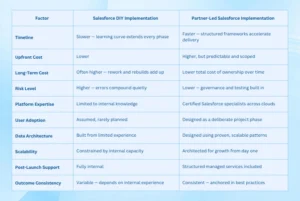
Salesforce Implementation Comparison: Every Factor, Side by Side
This Salesforce implementation comparison puts both approaches directly against each other across the dimensions that drive real business outcomes. Use this when making the Salesforce implementation partner vs DIY call:
Are You Actually Ready for Salesforce DIY Implementation? Run This Check First
Before locking in a Salesforce DIY implementation, businesses owe themselves an honest internal assessment. These questions cut through the optimism and surface what the Salesforce implementation partner vs DIY decision hinges on.
Do you have genuinely certified Salesforce professionals in-house?
Power users and certified implementers are not the same. Active certifications in Salesforce Administration, Development, or Architecture are the baseline for a credible DIY approach. Without them, Salesforce partner vs in-house implementation quickly becomes a false economy.
Is your data migration-ready?
Clean, well-structured, deduplicated data is a prerequisite for any smooth rollout. Messy legacy data is one of the top Salesforce implementation challenges across all project types — and in DIY implementations, there’s no expert safety net when migration goes wrong.
Does your team have real, dedicated bandwidth?
Salesforce CRM implementation is not a background task. Teams that try to implement while managing their day-to-day responsibilities consistently underperform on both fronts. Dedicated focus is not optional — it’s foundational.
Is your scope locked and genuinely simple?
Scope creep is one of the most common and painful patterns in Salesforce DIY implementation. What starts as “just Sales Cloud” often expands once internal stakeholders see what’s possible. Without experienced Salesforce development services guiding the boundaries, expansion becomes a serious delivery risk.
Can your business absorb the cost of failure?
This is the question most teams skip. If a delayed or failed implementation would materially impact revenue, operations, or customer relationships, that risk alone often resolves the Salesforce implementation partner vs DIY question in favor of a partner — regardless of team capability.
How to Choose the Right Salesforce Implementation Partner
Once you’ve decided a partner is a good choice, how do you choose a Salesforce implementation partner vs DIY? Who you choose to provide your Salesforce implementation services is as important as choosing to partner.
What to look for:
- Certified partner status – Salesforce Silver, Gold, and Platinum partner status is a sign of delivery excellence and a deep understanding of the platform. Partner tier is not everything, but it’s a quality indicator.
- Industry expertise – A partner that has implemented Salesforce CRM for companies in your industry knows the tricks, trade-offs, and industry-specific considerations that broad-based implementers don’t understand. This helps define your Salesforce project implementation plan.
- Thorough discovery process – Top partners work with your company to gain a deep understanding of your business before configuration. If they don’t or they rush it, say “thanks, but no thanks”.
- Clear delivery process – Ask how they manage scope, test before go-live, manage change requests, and report on progress. Weasel words mean weasel processes.
- Genuine client references – Case studies on websites are all well and good, but talking to real clients gives insight into what the client experience looks like when things go wrong.
- Post-deployment support – A good partner details the level of support after go-live: stabilization, tuning cycles, periodic training, and Salesforce development services to support future improvements.
- Response time standards – If it takes days to get a response during the sales process, it will take longer during delivery. If it is days now, it will be longer later.
Conclusion
The choice between a Salesforce implementation partner vs DIY is more important than you might think. It can shorten (or extend) your project, manage (or increase) your risk, drive (or hinder) your adoption, and ultimately, the value you get out of Salesforce. If you have a small, straightforward deployment and in-house certified resources, DIY may be right for you. For all other deployments, such as multi-clouds, complex migrations, enterprise deployments, and short timelines, partnering with a certified Salesforce partner is a lower-risk, higher-value proposition. AnavClouds Software Solutions offers a unique combination of Salesforce expertise and industry experience, paired with a customer-centric implementation approach, to get your Salesforce right, the first time.
FAQs
Is hiring a Salesforce implementation partner worth the cost?
Yes – particularly for large projects. They help to avoid risks, shorten time frames, and deliver higher adoption and ROI than Salesforce DIY implementation in projects of a similar size.
What are the biggest Salesforce implementation challenges in DIY projects?
Hurried discovery, poor data architecture, excessive customisation, inadequate user training, and adoption are the most common themes, and all are more difficult to control without the expertise of certified Salesforce implementation partners.
When does the Salesforce implementation partner vs DIY decision favor going in-house?
DIY is a good fit for small organizations, basic Sales Cloud configurations, good data, certified in-house resources, and time. Anything more complex than this tips the Salesforce implementation partner vs DIY scales in favor of a partner.
What happens after a Salesforce implementation partner completes the project?
Nearly all partners will offer post-implementation stabilization, optimization, training for Salesforce users, and Salesforce development to ensure the full commercial return on your Salesforce investment for years to come.
Search Posts
Popular Posts
Author profile: Saransh Maurya, Content Writer at AnavClouds Software Solutions
Saransh
Maurya
About the author
Saransh Maurya is a dynamic and results-driven professional with a passion for innovation and problem-solving. Known for his analytical mindset and attention to detail, he excels at delivering high-quality solutions that drive business growth and operational efficiency. With strong communication skills and a collaborative approach, Saransh effectively bridges ideas and execution, contributing to successful projects and meaningful outcomes across diverse domains.
Recent Posts