Salesforce Developer Cost: Smart Budget Guide 2026
Here’s something a lot of businesses figure out too late — the Salesforce license is the easy part. You pay, you get access, and then you realize the platform doesn’t quite do what you actually need to do. Not out of the box, anyway. That’s where developers come in. And that’s where the question nobody has a clean answer to shows up: What is the Salesforce developer cost going to be?
Honestly? It depends on more things than most people expect. The Salesforce developer cost changes based on who you hire, what you’re building, where your developer is located, and how clearly, you’ve defined the project’s scope before anything starts. This guide breaks all of that down, so there are no surprises when the invoice lands.
A Quick Look at Why This Market Is Growing
Before the numbers — a bit of context. IDC’s 2025 Worldwide Semiannual Software Tracker reported that Salesforce earned over $21.6 billion in CRM revenues in 2025, more than its four closest competitors combined. That tells you the platform isn’t going anywhere. If anything, demand for people who can build on it is higher now than it’s ever been, which matters because it directly affects the Salesforce developer cost you’ll be quoted.
So What Is the Salesforce Developer Cost, Really?
Two main variables control this more than anything else: experience and location.
Experience Level
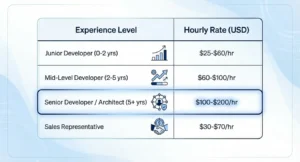
A junior developer can handle basic Salesforce customization — page layouts, simple flows, standard reports. Fine for small tasks. But put a junior on a complex integration project, and you’re setting yourself up for expensive rework down the line. Mid-level developers are what most companies actually need for day-to-day Salesforce development services. They work independently, understand multiple clouds, and don’t need hand-holding on standard builds. Senior developers and architects are the ones you bring in when things get complicated — multi-cloud setups, custom Apex development, platform architecture, enterprise-scale Salesforce integration services. The Salesforce developer hourly rate is higher at that level, but so is the confidence that it gets done right.
Geography
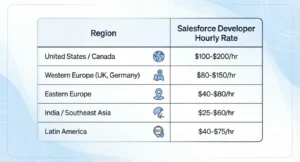
Geography is probably the single biggest lever you have on Salesforce developer cost. US-based talent is expensive — not because they’re necessarily better, but because the market demands it. A lot of companies are now running hybrid teams: an onshore consultant handles scoping and architecture, offshore developers handle the build. When it’s managed well, this approach cuts Salesforce developer cost significantly without sacrificing quality. Indian Salesforce consulting partners in particular tend to carry heavy certifications and solid delivery track records at much lower rates than Western alternatives.
Hiring Models: This Decision Matters More Than Most People Think
The engagement model shapes your Salesforce developer cost as much as the rate does. Here’s how each one plays out in practice.
Going the Freelance Route
For quick tasks — a flow update, a minor Salesforce customization, fixing a broken report — freelancers work fine. You hire Salesforce developer talent on demand, pay for hours, and move on. The Salesforce developer cost is low upfront, and there’s no long-term commitment. It’s also a useful way to test the market before committing a bigger Salesforce developer cost investment.
The problem shows up on anything bigger. Freelancers are hard to hold accountable. They disappear between tasks; documentation is rare, and if they’ve written messy code, you won’t find out until you bring in the next developer to build on it. For short-term, well-defined work, fine. For anything ongoing or complex — think twice about the real Salesforce developer cost here.
The Dedicated Salesforce Developer Model
This is the middle ground a lot of growth-stage companies land on. A dedicated Salesforce developer — sourced through an agency or staffing partner — works on your project consistently. It’s not as expensive as a full-time hire, and you get more continuity than you do with a freelancer.
Works well when you have a steady stream of Salesforce development services work, but not quite enough to justify a full-time employee. Works especially well when you have internal people who can direct the work but just don’t have the technical depth to build it themselves.
Hiring Remote
When you hire a remote Salesforce developer, geography stops being a constraint. You can find certified developers in time zones that work for you, at a Salesforce developer cost that’s often 40–60% lower than what you’d pay onshore. Many companies today actively choose to hire remote Salesforce developer talent specifically to stretch their budgets further without compromising certification or experience. The tools exist now — good async communication, solid project management platforms, video check-ins — to make remote collaboration genuinely smooth. What kills remote engagements isn’t the time zone; it’s the vague scope and poor communication practices. Sort that out first with a clear Salesforce onboarding checklist, and you’ll be fine.
Partnering with a Salesforce Consulting Firm
Working with certified Salesforce consulting services means you get a whole team packaged together — developer, architect, QA, and often a project manager. The Salesforce developer hourly rate through a partner firm looks higher than a freelancers on paper. The total Salesforce developer cost often ends lower because projects are scoped better, fewer mistakes happen, and you’re not paying to fix someone else’s mess three months later.
For anything involving Salesforce integration services, multi-cloud implementations, regulated industries, or serious CRM customization, certified Salesforce consultant partners are almost always the safer call. Check AppExchange reviews, ask about relevant industry experience, and make sure they’ve delivered similar projects before.
Full-Time In-House Hire
This only makes sense at scale. US salaries for Salesforce developers run $90,000–$140,000 annually; architects go $150,000–$180,000. Add benefits and recruiting costs, and the Salesforce developer cost here is significant. That said, if your business runs on Salesforce and the work is continuous, it pays off in institutional knowledge and speed over time.
What Actually Makes the Salesforce Developer Cost Go Up
The hourly rate is just the starting point. Here’s what really moves the final number:
Certifications
Developers who hold credentials like Platform Developer I & II, CPQ Specialist, or OmniStudio Developer charge more. The Salesforce developer cost is higher — and usually worth every dollar. They build things that hold up, follow best practices, and don’t leave technical debt behind them.
Complexity of The Build
Report tweaks and flow changes are cheap and fast. Custom Lightning Web Components, Apex triggers, complex automation, and custom data models take far more time. The more bespoke the Salesforce customization, the more the hours add up.
Integration Scope
Salesforce integration services tend to eat up budget fast. Connecting an ERP like SAP or Oracle, syncing billing data, and building middleware connections — this is specialized work that requires real API depth and thorough testing. Don’t budget it like it’s a configuration task.
State of Your Data
Bad data slows everything down. Companies with messy, duplicate-heavy legacy data routinely pay more in Salesforce developer costs during migration than companies that cleaned their data beforehand. A proper Salesforce onboarding checklist before migration begins saves real money.
Salesforce Loyalty Management
If Salesforce Loyalty Management is on your roadmap, account for it separately. It’s not a toggle-on feature — implementing loyalty tiers, points logic, member portals, and integration with Sales or Service Cloud requires real development effort. The Salesforce developer cost here can range from $15,000 for small programs to well over $75,000 for enterprise-grade setups.
Salesforce Developer Responsibilities in Scope
What exactly are you paying for? Development only? Or development plus QA, documentation, training, and post-launch support? The broader the Salesforce developer responsibilities you hand over, the higher the engagement cost — but also the less you need to manage internally.
Freelancers vs. Certified Partners — Where the Real Salesforce Developer Cost Lies
Freelancers quote $50/hr and it sounds great until the project goes sideways. No dedicated QA, hard to pin down when things break, and documentation that amounts to a few comments in the code. A project that starts at $8,000 can quietly balloon when you factor in rework, bug fixes, and the senior developer you eventually bring in to sort things out. The true Salesforce developer cost of a cheap freelance engagement is rarely what it looks like on day one — and by the time you realize that, you’ve already paid twice.
A certified Salesforce consulting partner charges more per hour. But they show up with a team, process, and accountability. Scope creep gets caught early. Testing is built in. When the project is done, you have documentation, clean code, and a system your team can use. For anything that matters to your business — Salesforce integration services, Salesforce Loyalty Management, CRM customization at any real depth — the math almost always favors the partner. Lower total Salesforce developer cost, better outcome.
A Few Things That Keep Salesforce Developer Cost in Check
Lock in your scope before work starts. Scope creeps are where budgets go to die. Every unclear requirement becomes a change request and changes requests cost money. The tighter the brief, the more predictable the Salesforce developer cost — and the fewer uncomfortable conversations you’ll have mid-project.
Clean data first, migrate second. Pre-migration cleanup is significantly cheaper than post-migration cleanup inside Salesforce. Don’t skip it. This one decision alone can meaningfully reduce your total Salesforce developer cost.
Phase the build. Build what matters now, validate it with real users, then expand. Businesses that try to build everything in Phase 1 almost always go over budget, under-deliver on adoption, and end up with a higher Salesforce developer cost than a phased approach would have required.
Match the model to the work. Retainer for ongoing support. Fixed price for scoped deliverables. Time-and-materials for exploratory projects. The wrong engagement model for the work type creates friction and, ultimately, a higher Salesforce developer cost than you signed up for.
Conclusion
Getting the Salesforce developer cost conversation right before a project starts is genuinely one of the most valuable things a business can do. Not because the numbers are simple — they’re not — but because understanding what drives Salesforce developer cost gives you real control over it. The companies that get the most out of Salesforce aren’t the ones with the biggest budgets. They’re the ones who planned well, chose the right engagement model, and worked with people who knew the platform.
If you’re working through any of this for the first time — whether it’s figuring out what a Salesforce integration services project should cost, what a dedicated Salesforce developer engagement looks like, or how to scope Salesforce customization for your team — AnavClouds Software Solutions is a Salesforce Silver Consulting Partner that works through exactly these questions with clients every day. Reach out and let’s have a real conversation about what your project needs.
FAQs
How much does it cost to hire a Salesforce developer in 2026?
Salesforce developer cost ranges from $25 to $300/hr based on experience and location. Full project costs span $5,000 for basic setups to $200,000+ for complex multi-cloud implementations.
What is the average Salesforce developer hourly rate?
The average Salesforce developer hourly rate sits between $40 and $150/hr globally. US-based developers charge $100–$200/hr; offshore talent typically ranges from $25–$80/hr.
What factors affect the cost of Salesforce development?
Key factors include experience level, certifications, project complexity, location, engagement model, scope of CRM customization, integration requirements, and data quality before migration.
Is it better to hire a dedicated Salesforce developer or work with a consulting partner?
For steady, ongoing work, a dedicated developer offers good value. For complex or first-time builds, a certified Salesforce consulting partner typically delivers better outcomes and lowers total cost.
Search Posts
Popular Posts
Author profile: Saransh Maurya, Content Writer at AnavClouds Software Solutions
Saransh
Maurya
About the author
Saransh Maurya is a dynamic and results-driven professional with a passion for innovation and problem-solving. Known for his analytical mindset and attention to detail, he excels at delivering high-quality solutions that drive business growth and operational efficiency. With strong communication skills and a collaborative approach, Saransh effectively bridges ideas and execution, contributing to successful projects and meaningful outcomes across diverse domains.
Recent Posts