Salesforce AppExchange Apps Selection Guide for 2026
Salesforce AppExchange is set to be a decisive business layer in Salesforce by 2026. The Salesforce AppExchange apps selection nowadays has a direct influence on scalability, performance, and long-term CRM success because of the availability of thousands of solutions. Selecting the incorrect apps will result in disjointed SF workflows, integration problems, and redundant expenses. The right ones will be faster to automate, easier to adopt, and provide quantifiable ROI.
A feature-based comparison is no longer sufficient for modern businesses. Salesforce AppExchange apps selection should be based on business goals, security level, integration system, and future expansion strategy. A structured, strategic approach helps organizations cut through marketplace noise and invest in solutions that genuinely strengthen their Salesforce ecosystem.
Strategic Framework for Salesforce AppExchange Apps Selection in 2026
Salesforce AppExchange apps selection needs to be highly organized, planned, and not made on the spur of the moment. As the complexity of apps and the needs of business change, companies need to test the tools in the latest versions with deeper features. A clear framework will make sure that Salesforce AppExchange apps selection is in line with business objectives, technology infrastructure, and scalability. This model helps businesses prevent integration risks, manage expenses, optimize Salesforce ROI, and establish a future-adjusted CRM atmosphere. These are the critical points that you should be keen on:
Align App Selection with Business Objectives
Salesforce AppExchange apps selection always starts with understanding business goals. Choosing applications based on features can easily lead to tool choices that appear to be strong but do not provide results. Companies have to determine their focus on sales efficiency or service optimization, marketing automation, or operational visibility. By having goals that are written, Salesforce AppExchange apps become narrowed, quantifiable, and result-oriented as opposed to being exploratory.
Other types of clear goals are used to show the relevance of vendors with regard to demos and trials. This saves on time during evaluation and unnecessary investments.
Map Existing SF Workflows and Process Gaps
Every Salesforce implementation is unique, which makes workflow analysis crucial. The Salesforce AppExchange apps selection is expected to complement rather than impact major processes. The businesses need to record the flow of leads, opportunities, cases, and campaigns within Salesforce. This clarity helps identify where automation, insights, or integrations are really required.
The best Salesforce AppExchange apps enhance workflow and maintain familiarity in operations. This improves user adoption and minimizes training in 2026 environments.
Ensure Native Salesforce Integration and Data Flow
The quality of the integration is a decisive factor in Salesforce AppExchange apps selection. The apps should be native to Salesforce and compatible with the Salesforce data model. These poorly-integrated applications generate data silos, reporting anomalies, and operational lags. Businesses must give importance to solutions that embrace Salesforce integration services to enable clean and real-time data synchronization.
With Salesforce becoming increasingly complex in 2026, it is important to have seamless integration to achieve scalability and the accuracy of analytics.
Validate Security, Compliance, and Data Governance
Modern CRM environments are non-negotiable when it comes to security concerns. Salesforce AppExchange apps selection should contain a comprehensive security assessment of the apps beyond AppExchange review badges. The businesses ought to evaluate the encryption standards, data accessibility, compliance certifications, and audit preparedness.
Applications that do not fulfil governance needs are a source of long-term risk. The selection of Salesforce AppExchange apps must always be in line with the internal security policies and regulatory requirements.
Analyze Ratings, Reviews, and Market Reputation
User feedback is a valuable insight into the real-life performance. Salesforce AppExchange apps selection should include analysis of reviews and adoption rates, as well as frequent problems. Moreover, past reviews might not indicate the existing capacities, particularly with the fast advancement of AppExchange Salesforce solutions.
Vendor credibility is as important as the functionality of the app. Shortlisting apps should be done by evaluating Salesforce knowledge, certification, and industry presence of the experts by businesses.
Test Usability Through Demos and Trials
The Salesforce AppExchange apps selection can only be effective with hands-on testing. Workflow impact, usability, and performance speed are disclosed in demos and trial environments. Apps should feel intuitive and align with user expectations across teams.
For validation, integration depth and vendor support quality can also be tested. The Salesforce AppExchange apps selection without a trial usually causes post-implementation problems.
Evaluate Scalability and Product Roadmaps
While choosing Salesforce AppExchange apps, keep the future expansion in mind. The apps must scale as more data and users are added, as well as the business models. In 2026, the use of AI-driven improvements and automation capabilities becomes the norm.
Businesses need to look into vendor roadmaps to make sure there is constant innovation and compatibility with Salesforce releases. Alignment in the long term safeguards CRM investments.
Analyze Total Cost of Ownership Carefully
Prices are a very important factor in Salesforce AppExchange apps selection. The cost of subscriptions is not an investment in itself. The businesses have to take into account the implementation effort, customization requirements, training, and support costs in the long run.
Certain applications cannot make full value without Salesforce development services. Also, some instances may require more effective ROI on custom CRM development for SMBs rather than the accumulation of paid tools.
Ensure Flexibility for Custom Salesforce Environments
The success of Salesforce is based on customization, and Salesforce AppExchange apps selection must be focused on tools that can support custom objects, automation, and integrations. Applications with low customization reduce technical debt and reduce innovation.
The solutions required by businesses investing in Salesforce development services must not replace other custom logic.
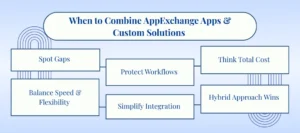
When to Combine AppExchange Apps with Custom Solutions
Off-the-shelf tools do not always work adequately to meet every business need. Whereas Salesforce AppExchange apps selection offers thousands of pre-built solutions, some of the operational requirements require a more specific solution. As of 2026, companies will have to consider when they can use AppExchange Salesforce apps and when they need to invest in custom app development. The balanced approach guarantees flexibility, scalability, and long-term CRM efficiency without redundancy.
Identify Use Cases Where AppExchange Apps Fall Short
Salesforce AppExchange applications are built to support general business contexts, yet they can have problems when dealing with highly specialized workflows. Salesforce AppExchange apps selection needs to take into consideration those processes that entail complicated logic, multi-step authorization, or industry-related compliance. Apps that involve too much configuration or workaround tend to generate operational friction. These scenarios indicate a need for custom CRM development for SMBs or enterprise-grade customization.
Evaluate the Impact on Existing SF Workflows
There are AppExchange Salesforce tools that demand modification in the current SF workflows. This is capable of interfering with processes and lowering the uptake by the users. Salesforce AppExchange apps selection should evaluate an app that would add value to the workflows or make the teams adjust unnecessarily. Custom solutions enable companies to maintain workflow continuity and introduce automation to Salesforce. Such a strategy would reduce resistance and enhance the durability.
Balance Speed of Deployment with Long-Term Flexibility
Salesforce AppExchange benefits include increased speed of deployment. Nevertheless, there should be no priority given to speed over flexibility. The choice of Salesforce AppExchange apps is supposed to take into consideration the potential development of the requirements. Custom Salesforce development services allow more control over future enhancements. Companies that expect to undergo change regularly are likely to use custom-made components with customized AppExchange solutions.
Consider Integration Complexity and Data Architecture
An important aspect in the decision to build or buy is integration depth. The AppExchange Apps provide little data model or integration customization. Salesforce integration services can be used to bridge such gaps, although there is a complex issue when there are several tools. There are custom solutions that can be created to fit perfectly with Salesforce architecture. The Salesforce AppExchange apps selection should prefer custom development in cases where consistency in integration is hard to control.
Analyze Cost Beyond App Subscription Pricing
The subscription charges hardly reflect the total investment. The choice of Salesforce AppExchange apps should include the cost of customization, maintenance, training, and support. Various applications may be more costly than a custom CRM development for SMBs, but when scalability over the long term is needed, usually provide greater ROI. Lifecycle expenses should never be left out in the cost analysis, but only in the initial pricing.
Create a Hybrid Salesforce Ecosystem for Maximum Value
A combination of the two approaches will be the most effective Salesforce strategies in 2026. The Salesforce AppExchange apps selection works best when it is used in conjunction with focused custom development. The AppExchange tools manage standard business functions, whereas custom solutions deal with the distinctive business requirements. This hybrid model is made available through Salesforce development services which makes the interaction between custom components and apps seamless. This equilibrium has the highest performance, flexibility, and growth potential.
Final Thoughts on Salesforce AppExchange Apps Selection in 2026
Salesforce AppExchange apps selection is a determining factor in the effectiveness with which Salesforce contributes to business growth in 2026. As automation, integrations, and data security become more and more complex, unstructured or feature-driven app decisions cannot be afforded by businesses anymore. Such a strategic approach will make sure that all apps will be used to support business goals, integrate well with SF processes, and increase in scale as needs grow.
Integrating the best Salesforce AppExchange apps along with the development of the applications when it is required, companies can eliminate the restrictions and create flexible CRM ecosystems. AnavClouds Software Solutions assists companies in streamlining the process of choosing Salesforce AppExchange applications by providing them with the services of Salesforce integration and Salesforce development. Having a profound experience in creating personalized CRM among SMBs and businesses, AnavClouds lets us make certain decisions and achieve performance growth, scalability, and ROI in the long-term.
FAQs
What is Salesforce AppExchange apps selection?
The process by which Salesforce AppExchange apps are evaluated and selected based on business intentions, business processes, and technical requirements is called the Salesforce AppExchange apps selection process. It will guarantee apps that do not interfere with the existing Salesforce processes.
How do I choose the best Salesforce AppExchange apps?
Salesforce AppExchange apps are selected as the best by assessing the business needs, compatibility with integrations, and security levels, as well as user acceptance. It is also useful to test apps with the help of demos or trials to make sure that everything works in reality.
Are Salesforce AppExchange apps suitable for all business needs?
Salesforce AppExchange applications are suitable for common business use cases and standard workflows. Yet, special or complicated requirements can be such that they need tailored Salesforce development services.
Can Salesforce AppExchange apps be combined with custom solutions?
Indeed, Salesforce AppExchange applications may be used with custom solutions to create versatile CRM platforms. This method balances the availability of ready-to-use functionality and customized business needs.
Search Posts
Popular Posts
Author profile: Saransh Maurya, Content Writer at AnavClouds Software Solutions
Saransh
Maurya
About the author
Saransh Maurya is a dynamic and results-driven professional with a passion for innovation and problem-solving. Known for his analytical mindset and attention to detail, he excels at delivering high-quality solutions that drive business growth and operational efficiency. With strong communication skills and a collaborative approach, Saransh effectively bridges ideas and execution, contributing to successful projects and meaningful outcomes across diverse domains.
Recent Posts