Salesforce vs Dynamics 365 vs HubSpot: The 2027 CRM Verdict
The choice between Salesforce vs Dynamics 365 vs HubSpot all boils down to scale, ecosystem, and budget. For businesses with complex and rapidly expanding needs that require extensive customization and AI agents, Salesforce serves as an ideal solution. Microsoft Dynamics 365 is for organisations that are currently running Microsoft 365 and Azure. HubSpot is ideal for small and mid-sized teams looking for speedy setup and minimal admin. Here’s a comparison of features, pricing, AI, and migration that will help you select the best enterprise CRM 2027 has to offer. Every section focuses on one query that a buyer may have and provides the most recent 2026 pricing and market information. Additionally, you’ll get insight into when it’s worth switching from Dynamics or HubSpot and what to consider before you do it.
What Is the Real Difference in Salesforce vs Dynamics 365 vs HubSpot?
Three Platforms, Three Philosophies
Consider it as three different philosophies. Salesforce is a platform that you can build on. Dynamics 365 is a CRM within the Microsoft (MS) stack. HubSpot is a product you turn on and begin to utilize. That’s where each Salesforce vs. Dynamics 365 vs. HubSpot argument begins.
The market is more towards the platform approach. Salesforce claimed the No. 1 spot on the global CRM applications market in 2025, with 20.0% market share, for the 13th straight year. That lead is accompanied by a big network of partners, a talent pool, and an app ecosystem.
Quick Platform Snapshot
Here’s the quick Salesforce vs Dynamics 365 vs HubSpot snapshot:
- Salesforce: Designed for large, multi-cloud companies. Deep customization, a huge ecosystem, and Agentforce for AI agents.
- Microsoft Dynamics 365: Designed for organizations that rely on Microsoft. Close integration with Teams, Outlook, Power BI, and Azure.
- HubSpot: Designed for small and mid-market teams. Quick setup, user-friendly interface, and a marketing-centric approach.
All of them are good options. However, as your processes become more complex, the platform that has the “room to grow” will typically be more budget-friendly in the long term if you wish to tap into the best enterprise CRM 2027 has to offer.
Which Is the Best Enterprise CRM 2027 Buyers Should Shortlist?
What Enterprise Buyers Weigh
Buyers of enterprises don’t just make decisions based on features. The top reasons for a Salesforce vs Dynamics 365 vs HubSpot shortlist are cost (including Dynamics pricing), scalability, integration level, AI maturity, and security and compliance.
Performance at Enterprise Scale
On those measures, Salesforce leads for large, regulated organizations. It supports multi-cloud deployments for sales, service, and marketing, industry clouds such as Health Cloud and Financial Services Cloud, and is not impacted by complex data models. In the Salesforce vs Microsoft Dynamics 365 comparison, Salesforce is certainly a nobody, but Dynamics is a strong competitor, particularly when it comes to the CRM for Microsoft shops. Salesforce vs HubSpot: HubSpot is a good choice up until a certain point, but at the point where territories, approval chains, and custom data structures start adding up, teams will outgrow it.
When you ask yourself which system you will not need to re-platform in three years when you are using it on a large scale, then it is obvious that Salesforce is the better choice. No feature list can match that question when narrowing the top contenders for enterprise CRM in 2027.
How Does Salesforce vs Microsoft Dynamics 365 Compare on Features?
They’re both enterprise platforms, and when it comes to Salesforce vs Dynamics 365 vs HubSpot, they’re both big-name players. Gaps are revealed in the details.
Customization and Scalability
With Salesforce’s metadata-driven platform, Lightning Web Components, and Flow, teams can quickly adapt the system without having to rebuild it. Powerful, but tightly coupled to Microsoft’s licensing model, with Dynamics 365 customizations done via Dataverse and Power Platform.
Ecosystem and Talent
AppExchange offers thousands of pre-designed apps for the Salesforce user base, and there’s a large number of admins, developers, and consultants to choose from. Finding experienced people is easier. Dynamics also has a solid partner ecosystem, but it’s more geared toward ERP-related activities.
Industry Depth
There’s also a Salesforce industry cloud for the healthcare industry, financial services, education, and so on. The industry accelerators and partner solutions are key to Dynamics 365.
The Short Verdict
The short version of Salesforce vs Microsoft Dynamics 365: Dynamics wins on Microsoft familiarity, while Salesforce wins on flexibility and ecosystem depth.
What Does Dynamics vs Salesforce Pricing Really Cost?
Current List Prices
List prices tell only half the story in Salesforce vs Dynamics 365 vs HubSpot cost comparisons. These figures are per user per month, billed annually, and checked in 2026:
- Dynamics 365 Sales: Professional – $65, Enterprise – $105, Premium – $150.
- Salesforce: Sales Cloud Starter Suite ($25), core Sales Cloud editions are about $165 to $195, advanced Sales Cloud is $240, and Agentforce is $280.
- HubSpot Sales Hub: Starter (approximately $15) to Professional (nearly $90) to Enterprise (nearly $150).
Hidden Costs to Watch
Dynamics vs Salesforce pricing is clearly in favor of Microsoft at the enterprise level. When you’re using Dynamics, the costs rise along with Power Platform add-ons, storage, Copilot licenses, and implementation. You incur additional HubSpot costs when you add contact levels and additional hubs. However, Salesforce charges for editions and add-ons, too, and the more expensive editions include more capability.
How to Compare Quotes
When you consider Salesforce vs Dynamics 365 vs HubSpot pricing, the smart choice is to take a look at the net rates that were quoted, not list prices, over three years. Prices may vary from vendor to vendor, so check the official price pages for up-to-date pricing information.
Is Salesforce vs HubSpot Really a Question of Scale?
Where HubSpot Shines
Mostly, yes. HubSpot provides a free tier of its CRM and an interface that most reps learn in a day. Marketing, sales, and service are in one system. That’s pretty tough to beat for a team of 15, with simple pipelines. The real power of HubSpot is rapid adoption, and the real power of Salesforce is control and depth.
Signs You’ve Outgrown HubSpot
The cracks appear later. Salesforce vs HubSpot starts to tilt when you spot these signs:
- Multiple business units or regions with different sales processes
- Complex quoting, pricing, or approval workflows
- Heavy reporting needs across custom objects
- Strict security, data residency, or compliance requirements
- Integrations with ERP, billing, and data warehouses
If you recognize any of those, you might be operating a business that’s as big as Salesforce on a smaller system like HubSpot. That’s when the Salesforce vs Dynamics 365 vs HubSpot choice becomes easier.
Which CRM for Microsoft Shops Makes the Most Sense?
Why Dynamics 365 Is the Default
For Microsoft shops, the default solution for CRM is indeed Dynamics 365, and it is not bad. Single sign-on, Outlook, Teams, and Power BI play nicely together, as they come pre-installed.
Can Salesforce Fit Microsoft-First Teams?
However, it’s not all about Microsoft. Salesforce native tools and integrations allow sales reps to remain in their apps of choice, including Outlook, Microsoft 365, Teams, and Azure. There are other Microsoft-dependent businesses that opt for Salesforce due to the fact that it is a CRM with a non-vendor-specific approach.
Questions to Ask Before Deciding
Ask three questions. If your CRM for Microsoft shops is tasked with handling processes that are not necessarily Microsoft’s forte, does it have the ability to do so? Need industry-specific functionality? Will you need to automate AI applications? If you answer yes to two of the following questions, it points toward Salesforce: If you say yes to two of the following questions, it’s a Salesforce vs Microsoft Dynamics 365 question in which Salesforce is the answer.
How Do Agentforce, Copilot, and Breeze Compare Across Salesforce vs Dynamics 365 vs HubSpot?
How the Three AI Tools Differ
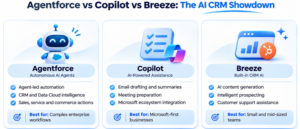
It’s impossible to overestimate how much a big part of any Salesforce vs Dynamics 365 vs HubSpot discussion is going to be about AI.
- Salesforce Agentforce: Autonomous agents, powered by your sales, service, and commerce data in Salesforce, and built on your CRM and Data Cloud data.
- Microsoft Copilot: Support integrated into the Dynamics 365 and Microsoft 365 environment, particularly beneficial for summarizing, email drafting, and meeting preparation.
- HubSpot Breeze: AI that is available everywhere on the platform- content, prospecting, and support- and that is easy to set up.
What It Means for 2027 Buyers
Copilot will aid people in working more quickly within Microsoft applications. Breeze is designed to assist small teams to do more with less. Agentforce is looking to make a larger leap: digital agents help with more than just recommendations. That distinction is crucial for businesses facing the decision between Salesforce vs Dynamics 365 vs HubSpot in 2027, as the quality of the data you have and the extent of the capabilities of your platform will impact the quality of AI output.
When Does Dynamics 365 to Salesforce Migration Make Sense?
Common Migration Triggers
A Dynamics 365 to Salesforce migration usually comes up when a company’s needs outgrow a Microsoft-centered setup. Common triggers include:
- There is a need for one platform that offers more automation for sales and service teams
- Customization has become a web of Dataverse flows and Power Automate flows
- Industry features or partner apps are more readily available on AppExchange
- Leaders desire an AI Roadmap based on common datasets
Typical Migration Steps
- Perform Inventory Audits: Audit entities, fields, flows, plugins, and integrations.
- Map: Align Dataverse tables with Salesforce objects and recreate automations in Flow.
- Clean: Eliminate duplicate and obsolete records before the move.
- Move and test: Import into a Sandbox, check and address missing data.
- Train and cut: Implement in stages, train users.
The Costliest Mistake
The most frequent Dynamics 365 to Salesforce migration error is missing the audit, which is the most costly error. The right solution, even in a Salesforce vs Dynamics 365 vs HubSpot comparison, can be a bust if it is not implemented correctly.
Is HubSpot to Salesforce Migration Worth the Effort?
Why Teams Leave HubSpot
Generally, yes for growing companies. This is typically when reporting, permissions, or process control can no longer keep pace with HubSpot to Salesforce migration. When it comes to evaluating Salesforce vs Dynamics 365 vs HubSpot, teams may decide that they’ve outgrown HubSpot.
What Moves and What Needs Care
Contacts, business, deals, tickets, activities, notes, and custom properties are all transferred. Association labels, lifecycle stages, workflows, forms, and marketing history must be paid attention to. Several teams use Sales Cloud in conjunction with Marketing Cloud or Account Engagement to ensure campaign data is linked to pipeline.
Slip-Ups to Avoid
Watch out for these common slip-ups:
- Mapping HubSpot properties to the wrong Salesforce field types
- Losing activity history because of association gaps
- Rebuilding workflows one-to-one instead of redesigning them
- Forgetting integrations that quietly depend on HubSpot IDs
Treat It as a Redesign
Regardless of the Salesforce vs Dynamics 365 vs HubSpot result, view HubSpot to Salesforce migration as an opportunity to streamline and not copy. Teams that change their process around during migration tend to do better than teams that copy all of the ‘old’ behaviors.
How Do You Choose Between Salesforce vs Dynamics 365 vs HubSpot?
Build Your Scorecard
Run a short, honest Salesforce vs Dynamics 365 vs HubSpot scorecard. Rate each platform from one to five on:
- Process complexity: Higher complexity favors Salesforce.
- Existing tech stack: Heavy Microsoft usage favors Dynamics but doesn’t rule out a Dynamics 365 to Salesforce migration.
- Team size and admin capacity: Salesforce is the better choice for teams without admin capacity, while HubSpot is better for small teams.
- Growth plans through 2027 and beyond: Fast growth favors the platform with the most headroom.
- AI ambitions: Agent-led automation favors Salesforce.
- Budget: When looking at Dynamics vs Salesforce pricing, focus on 3-year Net Cost, not List Cost.
Validate Before You Commit
If you do want to enter into a multi-year agreement, you should first run a paid pilot or proof of concept using actual data. When real users come into play, a Salesforce vs Dynamics 365 vs HubSpot shortlist changes. It’s okay to be a small team now and plan to migrate to Salesforce in the future, if you’re on HubSpot today.
What Should You Do Next?
Choosing between Salesforce vs Dynamics 365 vs HubSpot isn’t about picking the loudest brand. It’s about matching a platform to the way your business works today and the way it will work in 2027. HubSpot gets small teams moving fast. Dynamics 365 rewards Microsoft-first organizations. Salesforce gives growing and complex businesses the most room to scale, automate, and add AI agents. If you’re planning a switch, AnavClouds Software Solutions, a Salesforce Silver Consulting Partner, can help with Dynamics 365 to Salesforce migration, HubSpot to Salesforce migration, implementation, and integrations. Talk to our team today and get a clear, realistic migration plan before you commit.
Search Posts
Popular Posts
Author profile: Saransh Maurya, Content Writer at AnavClouds Software Solutions
Saransh
Maurya
About the author
Saransh Maurya is a dynamic and results-driven professional with a passion for innovation and problem-solving. Known for his analytical mindset and attention to detail, he excels at delivering high-quality solutions that drive business growth and operational efficiency. With strong communication skills and a collaborative approach, Saransh effectively bridges ideas and execution, contributing to successful projects and meaningful outcomes across diverse domains.
Recent Posts