
Agentforce Pricing: Where Every Credit and Dollar Goes
Agentforce pricing is based on three basic approaches in 2026 – Flex Credits, Per-Conversation billing, and Per-User licensing. Each Flex Credit is $500 for 100,000, or about $0.10 per standard agent action. Conferencing is priced at $2 per conversation, and per-user services start at $5 per month and go as high as $550 per month. It will vary based on the number of actions your agents take on each interaction, the number of employees that require access to it, and the amount of Data 360 usage that exists below it. This guide details the explanation of each model, the locations of hidden costs, and how to calculate the actual cost before committing. It can be considered a map in plain English on what Salesforce is charging, why the bill can get high, and where the best value savings typically lie.
What Do Salesforce Agentforce Statistics Say About Adoption and Spend?
It’s good to look at the indicators of market interest in this product before the line items. The most recent Salesforce Agentforce statistics reveal real cash is moving from hand to hand, which is the way to view each price listed below.
Revenue and Adoption Signals
The second quarter of fiscal 2027 saw sales of Agentforce ARR exceed $1.5 billion, an increase of over 240% compared to the previous year. That’s growth with buyers typically no longer testing, but rather handling real invoices – not demo budgets.
What the Numbers Mean for Buyers
It isn’t just a pilot stage idea anymore; Agentforce pricing is now a viable solution. It’s a real budget line, and since Salesforce has morphed it a few times since it was released, any number you come across should be double-checked before you sign on the dotted line. Don’t use Salesforce Agentforce statistics as a guarantee of savings, but rather a signal of maturity.
How Much Does Agentforce Cost in 2026?
There isn’t one price tag. Agentforce pricing is sold in layers, and most companies mix two of them, such as a seat-based plan for employees and a credit pool for customer-facing agents. If you’re asking how much Agentforce costs, the answer depends on which layers you pick.
Current List Prices at a Glance
Here’s the list-price picture today:
| Model | List price | Works best for |
| Salesforce Foundations | $0, with 100,000 Flex Credits (Enterprise Edition and above) | Testing early use cases |
| Flex Credits | $500 per 100,000 credits | Variable, action-based usage |
| Per conversation | $2 per conversation | Steady service volume (mainly existing customers) |
| Agentforce User License | $5 per user a month, credits bought separately | Giving every employee access |
| Add-ons | 125peruseramonth(150 for Industries) | Unlimited employee-facing use |
| Max / Agentforce 1 Editions | From $550 per user a month | Full-suite adopters |
Agentforce pricing differs by currency and region, so treat every number as a US list-price starting point rather than a quote.
A Quick Example for a Support Team
So how much does Agentforce cost for a real team? A support agent handling 5,000 conversations a month at three actions each lands near $1,500 at list price. Double the actions and the bill doubles with it. That’s the catch with Agentforce pricing: the unit cost looks tiny, but volume does the damage.
How Does Salesforce Flex Credits Pricing Work?
Salesforce Flex Credits pricing is the model Salesforce now leads with, and it’s the one most buyers meet first. You buy credits in packs, and the agent spends them as it works. Understanding this model is the foundation for judging every other Agentforce pricing option.
Credit Packs and Per-Action Rates
Credits sell in packs of 100,000 for $500, so each credit costs half a cent. They’re fungible, so one pool can cover actions, prompts, and voice interactions across teams.
- Standard or custom action: 20 credits, about $0.10
- Voice action: 30 credits, about $0.15
- Sandbox testing: 16 credits per standard action
- Help Agent resolution: 400 credits, or $2
That flexibility is why Agentforce pricing under this model suits companies still figuring out where agents will earn their keep.
Forecasting Credit Consumption
Forecasting Agentforce pricing on credits is tricky because one customer question rarely equals one action. Looking up a record, checking an order, and drafting a reply is already three. Retries and clarifying questions add more. Most real interactions use two to five actions, which puts a typical interaction at $0.20 to $0.50. Unused credits also generally don’t roll over, so overbuying isn’t a safe hedge.
Sample Monthly Bills
Here are three illustrative Agentforce pricing scenarios at list price:
- 1,000 interactions at 2 actions each: about $200 a month
- 5,000 interactions at 3 actions each: about $1,500 a month
- 20,000 interactions at 4 actions each: about $8,000 a month
These figures cover action charges only. Licenses, data usage, and build work come on top, which is why Agentforce pricing quotes and final invoices rarely match. Treat the numbers as a floor, not a forecast.
What Is the Agentforce Cost per Conversation?
The big number before the credit was the Agentforce cost per conversation, which remains important for many contracts. The easiest way to find out which billing model is best suited to your workload is by comparing it to per-action billing.
The Original $2 Model
The initial pricing model for Agentforce was straightforward: $2 per conversation, regardless of the agent’s activities within it. Customers railed against that flat charge, which led to the introduction of ‘Flex Credits’ by Salesforce, and the option is now largely used by existing customers. Please check the availability before making plans around it.
Break-Even Math Against Flex Credits
Divide $2 by $0.10, and you get 20 actions. If your average conversation uses fewer than 20 actions, Flex Credits cost less. Above that, the flat rate wins. The Agentforce cost per conversation stays fixed, while credit spend climbs with every extra step. Before settling on Agentforce pricing, pull a sample of real conversations and count the steps an agent would take in each. Ten transcripts will teach you more than any calculator.
Help Agent Resolutions
Salesforce’s own Help Agent bills $2 per resolution, and you pay only when the issue is actually resolved. It’s a useful reference point when you’re judging what an outcome-based price might look like for your own workflows.
How Do Per-User Licenses Change Agentforce Pricing?
Seat-based plans work differently from meters. Instead of paying for each action, you pay for each person, and that changes how Agentforce pricing behaves as usage grows.
License Types and Prices
- Agentforce User License ($5): employee access, but no credits included
- Add-ons ($125, or $150 for Industries): unmetered employee use on top of Sales, Service, or Field Service
- Max and Agentforce 1 Editions (from $550): the add-on plus a bundled credit pool
Bundled Credits in Editions
Here’s what trips people up. The $5 license includes nothing to spend, so every action still draws from credits you buy separately. The editions bundle credits at org level, roughly 2.5 to 2.75 million a year depending on which Salesforce page you read, so confirm the figure in your contract. It’s also worth asking whether a Flex Agreement lets you swap licenses for credits later.
Choosing Seats or Consumption
Seat-based Agentforce pricing suits employee assistants where usage is hard to predict, because a flat monthly fee removes the fear of a surprise invoice. Salesforce Flex Credits pricing suits customer-facing agents where you can count interactions.
How Does Agentforce vs Einstein Cost Compare?
Many buyers arrive here holding an Einstein contract. Salesforce has largely retired that branding, so the Agentforce vs Einstein cost question is about how the billing logic changed.
Billing Logic Differences
Einstein Copilot is now Agentforce, and the earlier Einstein add-ons were replaced by similarly named Agentforce ones.
- Einstein: predictive features bundled into editions or sold as per-user add-ons, so spend is steady and easy to budget
- Agentforce: agents that act, billed per action, per conversation, or per seat, so spend follows usage
Seat-based add-ons are predictable, but you pay whether people use them or not. Metered Agentforce pricing rewards efficient agents and punishes sloppy ones.
Renewal Overlap to Watch
Coming from an Einstein-era contract, expect Agentforce pricing to feel less like a subscription and more like a utility bill. Check renewals for overlap, because some buyers pay for a legacy add-on covering a feature their edition already includes. Neither approach wins by default, and a fair Agentforce vs Einstein cost comparison puts both numbers side by side.
How Does Data Cloud Credits Pricing Affect Your Agentforce Bill?
Agents are only as useful as the data they can reach, and that’s where Data Cloud, now branded Data 360, enters the picture. Data Cloud credits pricing is easy to overlook, yet it can move your total more than the agent itself.
Data 360 Credit Basics
Data Cloud credits pricing also starts at $500 per 100,000 credits, and Salesforce lets you move Flex Credits between Data 360 and Agentforce. Each operation, from ingestion to identity resolution to segmentation, burns credits at its own rate, and the heavy ones burn a lot.
Profile-Based Alternative
Profile-based pricing, reported at around $240 per 1,000 profiles a year for the entry tier, is the flat-rate option. Higher Agentforce editions also include a Data 360 credit allowance. Give Data 360 its own line in your Agentforce pricing worksheet, because teams that skip it usually discover the gap after launch.
What Does Agentforce Total Cost of Ownership Really Include?
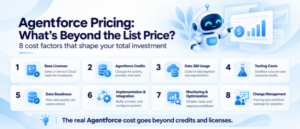
Agentforce total cost of ownership goes well beyond what the Agentforce pricing page shows. The list price covers the meter. It doesn’t cover everything that keeps the meter running well.
Direct Costs
- Base licenses: every human on the queue still needs a Sales or Service Cloud seat
- Credits: actions, prompts, and voice interactions
- Data 360 usage: ingestion, unification, and segmentation
- Testing: sandbox runs consume credits too
Hidden Costs After Launch
- Data readiness: agents reading messy data waste actions
- Implementation and integration: scoping, building, and connecting back-office systems, with costs that vary widely
- Monitoring and tuning: someone must review transcripts and fix loops
- Change management: training and workflow redesign
Planning Across 12 Months
A sound Agentforce total cost of ownership model covers twelve months, not twelve days. Pilots flatter Agentforce pricing because volume is low and everyone’s watching closely. Add a contingency for the unknowns, since early deployments almost always need extra tuning once real customers arrive.
How Can You Keep Agentforce Pricing Under Control?
Cost control starts before the contract and continues after launch. A few habits keep Agentforce pricing predictable without starving adoption.
Planning Before You Buy
- Start free: use Foundations credits to test one use case first
- Count actions first: map each workflow and estimate actions per interaction
- Match the model to the job: seats for employees, credits for customer-facing agents
Monitoring After Launch
- Watch consumption weekly: credit dashboards catch runaway loops early
- Tighten the agent: clear instructions and narrow topics cut wasted actions
- Buy credits in stages: since they don’t roll over, avoid large upfront bets
Review actual usage against forecast every month. After three months of real data, Agentforce pricing stops feeling unpredictable.
When Should You Hire Salesforce Agentforce Consultants?
Not every team needs outside help. One simple agent on clean data is manageable in-house, but the decision to hire Salesforce Agentforce consultants gets easier as complexity grows.
Signs You Need Outside Help
- Your data lives across several clouds or external systems
- You can’t forecast credit use with any confidence
- You’re negotiating add-ons against consumption in one contract
- You operate in a regulated industry with strict data rules
- A pilot worked, but scaling it keeps stalling
What a Good Consultant Delivers
Someone who has priced a dozen deployments will spot patterns you can’t see from one project. Before you hire Salesforce Agentforce consultants, ask for an Agentforce pricing model with assumptions you can challenge, not just a quote.
So, What Should You Take Away About Agentforce Pricing?
First, break up the meters, and Agentforce pricing will be easy. Actions are tracked by Flex Credits, outcomes are tracked by conversations, and people are tracked by licenses. Data 360 and the rest of the platform are additional layers. The savviest buyers take an educated guess on how many actions they can complete per interaction, run it on the free version, and factor in data work and tuning. Review the numbers every quarter, as Salesforce continues to change packaging/budgets allowances. The Agentforce pricing page is not the final answer, but a starting point; record your assumptions for the next review. A transparent usage plan, clean data, and honest cost math are much more beneficial to the budget.
FAQs
How much does one Agentforce action cost?
A standard Agentforce action requires 20 Flex Credits; at a list price of $500/100,000 credits, it is approximately $0.10 per use. Voice actions cost 30 credits ($0.15 apiece).
Is there a free way to try Agentforce?
Yes. Enterprise Edition and higher customers can use Salesforce Foundations for free, including 100,000 Flex Credits ($100,000 worth of access) to try out some early use cases before jumping into paid plans.
Are Flex Credits cheaper than the $2 conversation rate?
Usually, standard actions go for $0.10, and Flex Credits will go for less per conversation if it’s under 20 actions. The flat $2 rate, however, may be lower for longer, multi-step conversations.
What costs sit outside Agentforce credits?
The costs other than credits include user licenses, Data 360 consumption, implementation and integration efforts, sandbox testing, and continuous monitoring. These tend to determine the destiny of total spend, whether it remains within the forecast or moves into the red.
Search Posts
Popular Posts
Author profile: Saransh Maurya, Content Writer at AnavClouds Software Solutions
Saransh
Maurya
About the author
Saransh Maurya is a dynamic and results-driven professional with a passion for innovation and problem-solving. Known for his analytical mindset and attention to detail, he excels at delivering high-quality solutions that drive business growth and operational efficiency. With strong communication skills and a collaborative approach, Saransh effectively bridges ideas and execution, contributing to successful projects and meaningful outcomes across diverse domains.
Recent Posts