Gaurav AnavClouds Software Solutions +1 917 266 9985 info@anavcloudsoftwares.com
Salesforce CPQ
Salesforce CPQ

Salesforce CPQ is changing the way in which enterprises handle the quotes, prices, and approvals. It also makes the complicated sales processes simple and enhances accuracy and efficiency. Having added Einstein pricing guidance to Salesforce CPQ and Agentforce Automation, now companies can use intelligent automation to make smarter deals in less time. In the case of SMBs, the tools aid in error elimination, facilitate workflow, and increase revenue without having to work on them manually. This guide presents Salesforce CPQ to novices and describes how predictive pricing and automation are useful in improving business productivity. 

What is Salesforce CPQ? 

Functioning as a potent tool, Salesforce CPQ, or Configure, Price, Quote, is an automated tool that complies with quoting, pricing, and approving businesses. It minimizes mistakes, time savings, and uniform operations in revenue generation. Salesforce CPQ makes sales teams, large or small, more efficient and makes the decision-making process simpler by automating complicated sales processes. 

Key features of Salesforce CPQ include: 

  • Automated product configuration: Salesforce CPQ enables salespeople to rapidly build compatible products and services with each quote to avoid manual errors and to ensure each custom is built according to company guidelines. 
  • Pricing and discount policy: The site will automatically use the general price, quantity discounts, and promotional prices, which are always consistent and eliminate the issue of over- or under-pricing in any quote. 
  • Approval workflows: Quotes are automatically forwarded to the appropriate managers or teams for approvals to speed up the sales process or minimize bottlenecks in the decision-making process. 
  • Connection with Salesforce CRM: Salesforce CPQ is connected to Salesforce CRM through which it receives updated customer and account data in real-time, and the generated quote will be accurate and customized to each customer. 
  • Reporting and analytics: Sales teams can see the performance of quotes, price trends, and other revenue insights, and make decisions based on the data to optimize their sales strategy. 

Although Salesforce CPQ can still be used in the current implementation, agent-based businesses can consider Agentforce Automation and Revenue Cloud to scale their quoting, pricing, and workflow automation using AI. By utilizing Salesforce development services, it is possible to achieve smooth customization, integration, and performance. 

Boost sales efficiency with Salesforce CPQ and Agentforce Automation today!


Einstein Predictive Pricing: Making Smart Decisions 

Einstein pricing guidance for Salesforce CPQ allows companies to make smart and informed pricing choices that drive sales and expedite the deal-making process. Einstein pricing suggests the right pricing strategies in any quote to be provided by analyzing historical sales, market trends, and customer behavior. Using AI in Salesforce CPQ, price can become a competitive edge instead of manual work, which enables companies to drive smarter, faster results that are more profitable. 

Data-Driven Recommendations 

Through Salesforce CPQ, Einstein pricing is formed to examine past data, customer buying behaviors, and trends in the industry to suggest the best prices. This will make quotes profitable and competitive. The sales teams are confident in their pricing decisions, and this reduces the guesswork, and they sales teams are in line with the revenue goals of the company. The Einstein pricing guidance for Salesforce CPQ, allows companies to make good decisions on all dealings. 

Dynamic Discounting 

Discounts must be automatically altered in order to preserve profit margins, as well as to be competitive. Einstein pricing advice examines the context of the deal, the history of the customer, and the value of products to propose accurate levels of discounts. In Salesforce CPQ, teams will not run the risk of over-discounting or underpricing. Dynamic discounting enables SMBs and enterprises to balance profitability and competitive level, simplifying the process of managing revenues in the entire sales pipeline. 

Enhanced Deal Success 

Precise pricing results in expedited approvals and satisfaction among customers. With Einstein predictive pricing, Salesforce CPQ will allow sales representatives to present persuasive, data-driven quotes with quicker rates of closures. Through the insights of AI, teams will win matches, deepen relationships with clients, and boost overall sales. Predictive pricing guarantees that all quotes are set to be successful. 

Reduced Manual Errors 

Calculations that are made manually are subject to errors, time loss, or missed earnings. Salesforce CPQ is a solution that is used to automate price recommendations and enforce company rules and compliance criteria. This minimizes human error, maintains uniformity in quoting, and creates a sense of trust amongst internal teams and clients. The companies do not have to spend time on rectifying mistakes in pricing and can instead engage in strategic processes. 

Real-Time Insights 

Einstein pricing is actionable and offers a comprehensive understanding of the market in Salesforce CPQ, which allows sales teams to respond to market fluctuations. Decision-making involves the real-time disposition of data on teams quickly to evaluate product bundles, customer segments, or competitive scenarios. These insights enhance the accuracy of the forecast and predictability of revenue and make the businesses act proactively instead of reactively. 

Using Einstein pricing guidance for Salesforce CPQ makes the pricing process an error-prone manual affair to become a strategic business advantage and enable organizations to hasten the speed with which they close deals, defend their margins, as well as manage their sales processes in an efficient and efficient manner. 

Agentforce Automation: Streamlining CPQ Processes 

The Salesforce CPQ is automated by Agentforce Automation to automate repetitive sales functions and streamline a complicated workflow. It gives SMBs and businesses more power to act as they wish, minimize errors, and speed up dealings. Using AI-based automation and the Agentforce CPQ automation guide, companies can boost their productivity, increase their revenue performance, and provide a more streamlined sales process. 

Automated Quote Generation 

Salesforce CPQ is also capable of producing compliant and accurate quotes within seconds with Agentforce Automation. The sales teams do not have to spend hours calculating product prices manually or setting up product bundles. Through the Agentforce CPQ automation guide, a business guarantees that each quote is based on all the existing pricing regulations, discount policy, and product compatibility. This accelerates the process of sale, increases accuracy, and serves to make sales reps react quicker to customer needs. 

Approval Workflow Automation 

Sales are usually slowed down, and bottlenecks are created in manual approval processes. The quotes are automatically directed by Agentforce Automation and passed through the right managers, and they have to comply with the internal policies of prices and discounts. Such an efficient workflow speeds up approval, minimizes errors, and enhances efficiency. SMBs and enterprises will have the ability to finalize deals in less time, but with governance and compliance. 

CRM Integration 

The Salesforce CPQ, in conjunction with Agentforce Automation, will retrieve customer and product data in real-time by utilizing CRM. Such integration will also remove instances of data silos, duplications, and ensure that the quotes can be customized and precise to each client. Companies have more visibility through the sales channel, which allows them to make smart predictions and make decisions. 

Time and Resource Savings 

Salesforce automation for SMB enables the sales staff to concentrate on value-added activities such as the development of leads, relationships with clients, and growth opportunities because a lot of repetitive work is automated, and Salesforce can now focus on value-added activities. Such a change decreases the workload of the administration, increases the efficiency of teams, and enables businesses to expand operations without any additional human resources. 

Error Reduction and Compliance 

The automation will greatly minimize human mistakes in pricing, product configuration, and approvals. The Requirement Agentforce CPQ automation guide is used to ensure that all quotes adhere to the company standards and discounting policies. Businesses enjoy the predictability and reliability of their quotes, which would increase customer confidence and regulatory compliance. 

Real-World Impact 

Application of Salesforce CPQs powered by Agentforce Automation results in quantifiable business performance: the number of deals closed increases, the win rate decreases, the revenue grows, and the satisfaction levels of customers are elevated. Companies also enjoy an increased cohesion between the sales, finance, and operations teams, and thus, end revenue management is smooth. Using Salesforce development services to implement and customize the platform takes advantage of all the potential further. 

As Salesforce CPQ turns out to be more than just a quoting system with the help of Agentforce Automation, it is a strategic enabler of efficient, precise, and scalable sales operations. 

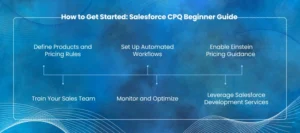
How to Get Started: Salesforce CPQ Beginner Guide 
Salesforce CPQ Beginner Guide

The first time of implementing Salesforce CPQ can be simple when it is done methodically. This Salesforce CPQ beginner guide assists enterprises and small businesses in successfully implementing CPQ and using Agentforce Automation and Einstein pricing advice to the best of their ability. The implementation and high adoption will be smooth when one follows these six steps.

Define Products and Pricing Rules

Start by determining every product and service that your business sells. Configure volumes, price breaks, promotions, and special discount models within Salesforce CPQ. These rules should be well defined to make sure that each quote is focused on business goals, minimization of errors, and to bring uniformity among the sales teams. Successful CPQ automation is based on an accurate definition of product and pricing.

Set Up Automated Workflows

Tom, generate automated workflows for approvals, quote generation, and pricing validation with the use of the Agentforce CPQ automation guide. An automated system will save on the effort of manual work and shorten the deal cycle, and ensure that internal pricing policies are adhered to. The Salesforce CPQ enables the sales team to work on strategic functions instead of manual operations due to smooth work processes.

Enable Einstein Pricing Guidance

Apply Einstein pricing guidance for Salesforce CPQ to streamline price and discount suggestions with the help of AI. Through historical data, customer behavior, as well as market trends, Einstein offers predictive pricing information. This enhances the accuracy of quotes, guards the profit margin, and increases the chances of sealing deals within a shorter time. Artificial intelligence-based pricing will keep Salesforce CPQ a strategic revenue tool.

Train Your Sales Team

Give thorough onboarding and training so that your group gets accustomed to Salesforce CPQ and Salesforce automation for SMB. Make them familiar with workflows, approval, AI suggestions, and reporting. Training leads to adoption, minimizes errors, and enables the employees to make maximum use of the capabilities of CPQ in order to sell more products.

Monitor and Optimize

Report and monitor quote performance, pricing effectiveness, and workflow efficiency on Salesforce CPQ reports and dashboards regularly. Data analysis to optimize pricing policy, pricing structure, and workflows. The constant feedback will make your CPQ system respond to new market conditions and business needs, thus enhancing the sales performance in the long term.

Leverage Salesforce Development Services

Professional Salesforce development services are required in case of more complex automation requirements, integrations, and other advanced customization requests. Salesforce CPQ can be customized to match specific business operations by experts and can also be linked with ERP or CRM systems and other automation with Agentforce Automation. Collaboration with experts provides a seamless implementation, significant adoption, and scalability. 

Based on this Salesforce CPQ beginner guide it deals with an efficient, reliable, and scalable implementation of CPQ. Automation and AI-driven insights can help businesses to speed up quoting, streamline pricing, minimize mistakes, and enhance revenue performance. 

Conclusion 

Salesforce CPQ, Einstein pricing direction, and Agentforce Automation enable companies to automate, enhance precision, and increase revenue. Intelligent automation and predictive insights can be used to help both SMBs and enterprises make smarter decisions in a shorter time. Professional Salesforce development services will provide the best implementation and customization, which will open the potential of Salesforce CPQ. Use of these tools will assist firms in remaining competitive in addition to realising a steady growth in an ever-more-complicated sales environment. 

Salesforce RLM vs. CPQ

Visualize a world where your sales process is seamless, your quotes are always precise, and your revenue management goes effortlessly from beginning to end. Yes, sounds too good to be true, but with Salesforce RLM and CPQ, it can become your reality. Both of these dynamic tools are revolutionizing the way companies handle everything from initial quotes to post-sale revenue management. But here’s the catch: though they’re both instrumental in your business development, they play different functions. So, how do you know which one or both is the ideal solution for your requirements? Let’s discuss the comparison between Salesforce RLM vs CPQ so you can make the right decision for your business.  

Streamlining Sales with Salesforce CPQ 

Sales teams today require more than velocity; they need precision. Salesforce CPQ (Configure, Price, Quote) provides an intelligent path to automate the quoting process and remove common sales issues. From right-pricing to quicker deal completions, the solution enables businesses to sell better. Moreover, to leverage this robust solution, having certified Salesforce implementation partners can be a good idea. 

Before the advent of tools such as CPQ, making quotes was a time-consuming, manual process. Sales representatives had to begin from scratch, balancing intricate pricing plans and specialized configurations. Errors were the norm, and delays frequently lost deals. 

All that changes with a Salesforce solution like CPQ. It automates critical aspects of the quoting cycle based on pre-defined rules, pricing logic, and templates. Sales reps can quickly create error-free, customized proposals, enabling businesses to respond faster and close more deals. It maintains consistency in pricing and discounting irrespective of how complicated the product or service is. 

Key Capabilities of Salesforce CPQ 

As a robust Salesforce solutions, CPQ extends beyond simple quoting. It provides clever capabilities meant to deliver efficiency, eliminate mistakes, and maximize opportunity revenue. Let’s see how Salesforce CPQ elevates every step of your sales process: 

Smart Product Configuration 

With CPQ, your sales reps don’t need to guess what works. The system guides them through valid product combinations, ensuring only compatible items are bundled together. It also highlights upselling and cross-selling opportunities to increase deal size without compromising accuracy. 

Automated Pricing and Discount Controls 

Forget the pricing chaos. Salesforce CRM solution brings structure by automating: 

  • Complex pricing logic  
  • Volume-based discounts  
  • Tiered pricing strategies  
  • Customer-specific price adjustments  

CPQ ensures that every quote follows your pricing policies, maintaining consistency across all sales channels. 

Professional Quote Creation 

Need branded, error-free proposals? CPQ handles it all. It generates personalized quotes with complete product details, accurate pricing, and custom terms, ready to send in minutes. The result? Polished quotes that build trust and move deals forward faster. 

End-to-End Deal Management 

CPQ isn’t just about pricing, it’s about full deal control. It tracks every negotiation stage, automates approvals, and ensures compliance with company policies. Managers can set up tiered approval levels to keep pricing under control while still enabling sales teams to move quickly. 

Where CPQ Ends, Salesforce RLM Begins 

While CPQ excels at automating the quoting and deal-closing process, that’s only half of your revenue operations. Most companies believe that after a deal is signed, the hard work is done. That’s where the complexity starts. 

Enter Salesforce RLM (Revenue Lifecycle Management), the answer to getting everything that happens after the check is signed right. CPQ gets you across the finish line; RLM makes sure that the revenue that comes with getting across the finish line is done accurately, effectively, and compliantly. Furthermore, hiring Salesforce development services can streamline the process of choosing the right solution. 

Salesforce RLM: Managing the Full Revenue Journey 

If you compare Salesforce RML vs CPQ, CPQ assists you in closing deals effectively, but the actual challenge tends to kick in post-sale. That’s where Salesforce CRM solutions like RLM come into the picture. It goes beyond quoting to drive each pivotal element of your revenue operations, enabling an end-to-end, hassle-free revenue process. 

For companies that count on recurring revenue, RLM is not an option, it’s a necessity. It provides financial accuracy, business efficiency, and predictable cash flow from a single, integrated platform. Whether you’re expanding your operations or streamlining compliance, RLM makes your post-sale process just as strong as your sales approach. It is better to consult Salesforce CRM Implementation partner for better outcomes. 

What RLM Does 

Salesforce Revenue Lifecycle Management (RLM) provides end-to-end revenue management that simplifies business operations post-sale. Let us take a look at the particular features that make RLM an essential resource for any business. 

Contract Lifecycle Management 

Manual contract management can be a slow and error-prone process. With RLM, you’ll automate the complete contract life cycle from creation to pricing approvals and renewals. You will never miss a renewal or miss out on revenue for expired contracts. For example, when a customer upgrades or downgrades their subscription, RLM automatically adjusts the contract terms and billing in real time. This keeps manual touch to a minimum while enhancing operational efficiency. 

Automated Billing & Subscription Management 

Billing errors frequently cause revenue leakage and lead to customer delays and dissatisfaction. RLM addresses such issues by streamlining the billing process through automation. It is compatible with different types of billing models, namely subscription-based, usage-based, and hybrid models. Invoices are created in real-time using RLM, thus allowing customers to be charged correctly and timely manner, thereby improving cash flow and decreasing revenue delays. 

Revenue Recognition & Compliance 

Revenue recognition is one of the most important aspects in financial reporting, especially for companies whose product has recurring charges or are delivered under subscriptions. RLM keeps pace with central finance regulations such as ASC 606 and IFRS 15. Revenue recognition automates, eliminating frequent mistakes occurring from manual workflows and diminishing dependencies on spreadsheets. It means improved accuracy on the financial side of the ledgers and a transparency increase for your reporting. 

Revenue Forecasting & Analytics 

Foresight of future revenue is necessary in strategic business decision-making. When comparing Salesforce RLM vs CPQ, RLM gives detailed forecasting and revenue analysis, and businesses can project forward, anticipate trends, and determine renewal rates. Visibility into current financial health enables CTOs, CFOs, and finance departments to plan, make informed decisions, and be able to plan for expansion. 

Why RLM Matters 

Salesforce Revenue Lifecycle Management (RLM) is vital in fostering financial stability and aiding long-term business growth. By automating revenue processes, RLM guarantees improved control and maximizes every stage of the revenue cycle. 

Revenue Predictability 

Unpredictable billing cycles, lost renewals, and unexpected customer churn are sources of instability in a firm’s revenue stream. RLM serves to reduce these challenges by streamlining renewals and organizing billing cycles, leading to smoother and more predictable cash flow. Through real-time visibility of future revenue streams, companies can plan for cash flow better and get ahead of financial uncertainty, building a stable ground for growth. 

Better Customer Retention 

Customer retention is equally important as winning new customers, yet most companies ignore it. A manual process of renewal may result in customer dissatisfaction and loss. RLM Salesforce solution automates reminders, approvals, and adjustments, which keeps customers active and makes renewals easy. Thus, companies can enhance their customer retention rates, establish stronger relationships, and generate more opportunities for upselling extra services, which leads to long-term success. 

Seamless Finance Operations 

Revenue management crosses multiple teams, including sales, finance, and customer success. RLM is a centralized platform that bridges gaps among these teams and makes it seamless to work together. Centralizing and automating financial processes like contract management, billing, and reporting, RLM eliminates manual reconciliation, hence making it efficient and less error-prone. With RLM, teams can be confident that their financial processes are automated, transparent, and accurate. 

Regulatory Compliance 

Adherence to revenue recognition requirements such as ASC 606 and IFRS 15 is critical for timely and accurate reporting and penalty prevention. Manual maintenance of revenue causes errors and auditing risks. Salesforce CRM solution like RLM achieves compliance by streamlining revenue recognition procedures and conformity to industry practices. It also produces audit-ready reports, so compliance is much simpler and less likely to involve errors that create legal troubles or ruined reputations. This keeps financial statements accurate and earns investor and stakeholder trust. 

Deciding Which Solution (or Both) to Implement 

Salesforce solution

Selecting Salesforce RLM vs CPQ, or whether to deploy both, will largely be a function of your company’s revenue model, industry requirements, and particular pain points. While certain companies will have only a need for CPQ to automate their sales processes, others will find value in RLM to support intricate revenue configurations. The following is a division of when to select each solution, or when an integrated solution may be best for your organization. 

When CPQ Is the Right Choice 

CPQ is perfect for businesses that view transactional selling or need sales quote creation processes to be automated. It is perfect if you are experiencing issues such as delayed quote creation, pricing errors, or extended approvals. Approval, discount, and price can be automated using CPQ, saving admin time. Your reps will be able to close deals instantly and spend more time on customer interactions, thus boosting productivity as well as profitability. 

When RLM Is Essential 

RLM is essential for companies that subscribe to recurring revenue or subscription-based business models. Are you grappling with revenue leakage due to manual contract management and incorrect billing? RLM possesses the characteristics you require to automate renewal cycles, invoicing cycles, and comply with financial regulations. It is ideal for companies that must keep up with stringent financial regulations like ASC 606 and IFRS 15. With RLM, companies can better predict revenue and enjoy a seamless, unbroken revenue stream in the long term. 

When You Need Both CPQ & RLM 

If you take a look at the advantages, differences, and other aspects of Salesforce RLM vs CPQ. The combination of both is great for companies with transactional and subscription-based businesses. With this combination, you can automate pricing and quoting, contract management, and revenue recognition. With the combined solution, you will have smooth integration between sales, finance, and customer success teams. It also provides more visibility into your revenue cycle so that your business can scale more effectively with fewer errors and revenue leakage. 

Making the Right Decision 

When choosing between Salesforce RLM vs CPQ, consider the following:  

  • Do you require quicker and more precise sales quoting? If so, Salesforce CPQ is for you.  
  • Are you having issues with contract management and billing for recurring revenue? If so, RLM is what you require.  
  • For businesses wishing to automate the entire revenue cycle from sales right through to renewals. Possessing both CPQ and RLM ensures seamless business processes, limits revenue leakage, and sets your business up for long-term success. 

Conclusion 

Whether you choose CPQ to streamline your sales process or RLM to optimize your revenue lifecycle, both are transformational for businesses looking to boost efficiency and grow. Which one is for you is based on your business model and goals. At AnavClouds Software Solutions, we have the knowledge to guide businesses through these decisions and execute the best Salesforce solutions for their specific needs. Are you ready to elevate your sales and revenue management to the next level? Contact us today to learn how our Salesforce capabilities can help your business! 


FAQs 

What distinguishes Salesforce RLM vs CPQ? 

CPQ automates quoting, pricing, and approval, and makes the selling process efficient, but ensures proper pricing and faster closure of contracts. RLM, on the other hand, handles contract renewal, billing, revenue recognition, and regulatory requirements, including the whole revenue process post-sale. 

How does CPQ differ from RLM? 

Salesforce CPQ automates price quotes, approval processes, and pricing, which lead to easy-to-use sales processes, right-pricing, and faster closure of contracts. RLM, however, deals with the entire revenue life cycle after a sale, which comprises contract renewal, billing, recognition of revenues, and compliance. 

For recurring revenue businesses, what is the best choice? 

Salesforce RLM is critical to companies that earn recurring revenue. RLM manages revenue projections, contract renewals, and subscription-based billing, with revenue streams secure and in line with financial accounting standards such as ASC 606. 

If I already have an effective billing system, do I still need Salesforce CPQ? 

CPQ is an excellent option if you have a robust billing system but struggle with inconsistent pricing or delayed, erroneous quoting. It speeds up and improves the accuracy of your sales cycle by automating pricing, quoting, and approval operations. 

What financial compliance benefits may RLM offer? 

RLM helps organizations comply with revenue recognition standards like ASC 606 and IFRS 15 by automating revenue recognition and generating audit-ready reports. It reduces the risk of fines and audit issues by ensuring that your business is always in compliance with industry regulations.