Gaurav AnavClouds Software Solutions +1 917 266 9985 info@anavcloudsoftwares.com
Salesforce artificial intelligence
Salesforce Trends in AI, Automation & Data

The pace of evolution within Salesforce is unprecedented, and the CRM platforms will be very intelligent, autonomous, and data-driven by the year 2026. Salesforce will exploit Salesforce AI agents, Salesforce workflow automation, and Salesforce intelligent automation to optimize business operations, decrease the amount of manual work, and improve decision-making. The Salesforce 2026 trends will indeed reshape the way organizations operate sales, service, and marketing processes. Those companies that embrace such tools early enough will experience insights faster, more efficient operations, and more favorable customer experiences. These trends are now a requirement rather than an option, especially when businesses aim at achieving sustainable development, competitiveness, and businesses that ensure operations remain sustainable. 

Key Salesforce 2026 Trends 

The Salesforce 2026 trends indicate the trend towards the increasing CRM platforms being smarter, more autonomous, and more data-driven. To enhance the speed and quality of execution and decision-making, Salesforce is integrating artificial intelligence throughout the workflows. The companies that will match these trends will be more efficient in their work and react to the market changes more quickly. 

Stay ahead with Salesforce trends and boost efficiency with AI and automation.


Agentic AI and Salesforce AI Agents 

Behavioral signals and the history of previously engaged leads will be managed by Salesforce AI agents. With Salesforce artificial intelligence, the agents can rank the opportunities before human involvement. This enhances better conversion and lessens the response delays. 

Customer interaction in digital platforms will also be done by Salesforce AI agents. They will provide customized answers with reference to real-time and historical information. This guarantees customer uniform experiences on scale. 

With the Salesforce 2026 trends, the workflow updates will be provided by AI agents. They will delegate tasks, refresh records, and dynamically cause actions. This saves on manual labor and operational tension. 

Salesforce Autonomous Workflows 

Traditional rule-based automation is going to be substituted with Salesforce autonomous workflows. Such workflows will analyze conditions not based on fixed triggers but based on AI. Manual approvals will not be necessary to move processes on. 

Salesforce workflow will automate processes and adjust execution paths according to the changes in live data. This flexibility guarantees that processes are efficient when there is a fluctuation in business. Independent working processes decrease sales, service, and operational delays. 

In Salesforce 2026 trends, autonomous workflows will process entire process lifecycles. They will manage approvals, escalations, as well as data synchronizations. There will be a reduction in the turnaround time and level of errors in businesses. 

Salesforce Intelligent Automation 

Salesforce intelligent automation involves AI reasoning together with workflow orchestration. This gives automation an opportunity to execute complex decision-driven tasks. Businesses can automate more than repetitive moves. 

Using Salesforce intelligent automation, processes adjust automatically depending on the volume of transactions. Automation is also consistent even when there is high demand. This makes it stable in its operations in case of growth. 

Salesforce artificial intelligence increases the accuracy of automation via continuous learning. Systems enhance execution excellence with time. This brings about long-term efficiency and uniformity among the departments. 

Unified Data with Salesforce Data Cloud 

Salesforce Data Cloud will centralize customer data in various systems on a real-time basis. This forms one correct view of the customer. The Salesforce 2026 trends revolve around unified data. 

Salesforce artificial intelligence applies Data Cloud to produce predictive knowledge. These are insights that inform sales strategies, service actions, as well as marketing decisions. Companies obtain real-time intelligence. 

Salesforce Agentforce statistics have shown that AI agents are dependent on the Data Cloud to understand the context. Correct data can be used to do smart automation and customization. This eliminates the mistakes that are occasioned by incomplete information. 

Cost-Effective Salesforce Solutions for SMBs 

Salesforce is increasing accessibility to smaller organizations. Salesforce SMB solutions are cost-effective and enable highly advanced CRM adoption with not too high investments. AI and automation can be effectively used by SMBs. 

Salesforce workflow automation assists small groups in minimizing manual undertakings. Automation enhances output without the need to expand the number of staff. This promotes long-term business development. 

Salesforce development services will help SMBs to develop solutions strategically. Businesses can introduce only the necessary features. This guarantees flexibility and control of the budget. 

Hyper-Automation Driving Business Growth 

One of the most important Salesforce 2026 trends is hyper-automation. It incorporates AI agents, workflows, analytics, and data into a single system. This gets rid of operational silos. 

Salesforce autonomous workflows accelerate the decision-to-action processes. Corporations are quicker to react to client demands and business shifts. This enhances general agility. 

The use of Salesforce intelligent automation increases consistency in customer experience. Predictive analytics facilitates a proactive approach to engagement. Hyper-automation leads to quantitative business improvement. 

Why Salesforce 2026 Trends Matter for Business Growth 
Salesforce 2026 Trends

Salesforce 2026 trends should be understood in a bid to grow businesses sustainably. These trends reinvent the manner in which organizations make revenue, retain customers, and operate effectively, extending their operations. Salesforce is transforming into an intelligent growth platform as opposed to being a transactional CRM. Early adaptability and operational resilience over the long term are enjoyed by businesses that adapt early. 

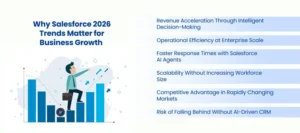
Revenue Acceleration Through Intelligent Decision-Making 

The Salesforce artificial intelligence facilitates decision-making in sales operations that is fast and insight-based. With the assistance of AI, teams can detect high-value opportunities more accurately. Predictive analytics enhances the transparency of pipelines and reliability in forecasting. Companies that are aligned with Salesforce 2026 trends transform data insights into revenue more quickly than others. 

The Salesforce AI agents facilitate decision-making by prioritizing deals and recommending actions to be taken next. This minimizes guesses and enhances sales stability. Income teams obtain transparency and trust at any point. 

Operational Efficiency at Enterprise Scale 

With Salesforce 2026 trends, the consistency of processes within the different departments and regions can be guaranteed. Automatic processes stop redundant manual operations and minimize mistakes in operations. The processes do not change with the growing volumes of data and contacts with customers. 

Salesforce workflow automation is capable of large-scale execution without putting any operational pressure. This performance reduces operational expenses but does not affect performance. Companies enhance profits but do not compromise on service delivery. 

Faster Response Times with Salesforce AI Agents 

The response speed among sales and service functions is significantly enhanced by Salesforce AI agents. These agents do follow-ups, inquisitions, and the execution of tasks independently. The customers are responded to immediately without having to wait when humans are available. 

Salesforce artificial intelligence makes sure that the Salesforce agents operate based on real-time context and history. Better interaction enhances satisfaction and confidence amongst customers. This sensitivity enhances customer retention in the long term. 

Scalability Without Increasing Workforce Size 

The Salesforce 2026 trends allow companies to increase their operations effectively. Salesforce autonomous workflow deals with approvals, updates, and escalation independently. Growth is no longer a matter of manual interventions through teams. 

Salesforce autonomous workflows has allowed the company to handle additional workload without commensurate recruiting. Companies increase capacity and manage the costs of operations. Scalability is made foreseeable and controllable. 

Competitive Advantage in Rapidly Changing Markets 

Markets require speed, individualization, and precision. Firms that embrace Salesforce 2026 trends are quick to meet customer behavior change. Artificial intelligence-based systems react immediately to changes in data and patterns of engagement. 

Companies that use manual processes find it difficult to stay in line. Intelligent automation in Salesforce allows fast optimization and experimentation. First mover benefits allow an early adopter a sustainable competitive advantage. 

Risk of Falling Behind Without AI-Driven CRM 

Those organizations that do not focus on Salesforce 2026 trends are increasingly becoming inefficient. Delays in decision-making affect the customer experience and revenue potential. Paper-based operations raise the risks of operation and delays. 

The Salesforce artificial intelligence provides speed and accuracy to competitors. Late adoption makes transformation complex in the long run. The businesses will lose their relevancy in more and more automated markets. 

Affordable and Scalable Salesforce Solutions Empowering SMB Growth in 2026 

Salesforce is now much more affordable to small and medium-sized companies. By 2026, cost-effective Salesforce solutions for SMB will allow enterprise-level automation without breaking budgets. Large businesses are no longer able to monopolize on advanced CRM capabilities, which can now be acquired by SMBs. Salesforce is trying to establish itself as an enabler of growth and not a cost-addition. 

Enterprise-Grade Capabilities Without Enterprise Costs 

Salesforce artificial intelligence does not require significant investments in small businesses. The Salesforce AI agents assist with sales, service, and operations. These features assist SMBs in competing with bigger institutions in smarter automation. 

Workflow Automation Designed for Lean Teams 

Salesforce workflow automation decreases the use of manual processes. Automation is done for approvals, follow-ups, and data updates. The lean teams can work at an increased pace with reduced resources. 

Modular Adoption Supporting Business Growth Stages 

Cost-effective Salesforce solutions for SMB allow modular implementation. Companies can begin with the core features and grow as time goes by. The development of Salesforce assists in aligning CRM capabilities with changing business requirements. 

Customization Through Salesforce Development Services 

The development services of Salesforce allow customized workflows and integrations. The SMBs do not have to complicate the system since they do not have to include features that are not necessary. Customization will guarantee improved ROI and flexibility in the long run. 

Predictable Costs and Sustainable ROI 

Sales force automation minimizes the operational costs in the long term. Scalable licensing and automation provide businesses with reliable expenses. This will contribute to sustainable development without a financial burden. 

How Salesforce Development Services Enable Future-Ready Businesses 

The Salesforce 2026 trends are changing the way business operations and growth are taking place. The use of intelligent automation, autonomous workflows, and AI agents can be effectively applied with the help of expert Salesforce development services. However, when the CRM capabilities are integrated with the business objectives, the companies guarantee future-ready, scalable, and data-driven operations. 

  • The Salesforce 2026 trends will demand custom implementations beyond the standard CRM setups. 
  • Salesforce development services program, Salesforce AI agents in accordance with actual business processes. 
  • Proper development will guarantee that Salesforce’s artificial intelligence provides correct, reliable results. 
  • Salesforce Autonomous workflows help to execute end-to-end processes automatically without the need for a manual. 
  • Workflow automation at Salesforce does not raise the number of people working on the system. 
  • The Salesforce Data Cloud integrations help to consolidate data into real-time insights and AI-powered actions. 
  • Salesforce smart automation enhances uniformity, effectiveness, and operational management. 
  • Professional Salesforce development solutions maximize the Salesforce automation investment. 

Conclusion 

The Salesforce 2026 trends show that business success in the future is powered by AI, intelligent automation, and single data systems. Firms that embrace Salesforce AI agents, Salesforce autonomous workflows, and Salesforce workflow automation will make and execute decisions more quickly, operate on par, and deliver better customer experiences. These innovations are accessible to small and medium businesses by using cost-effective Salesforce solutions designed to meet their SMB needs, as well as Salesforce development services designed to meet their growth needs. Today, it is possible to prepare and move into a smarter, more automated 2026. Collaborate with AnavClouds Software Solutions to realize such trends effectively, achieve the best ROI, and get the full potential of Salesforce in your business. 
Salesforce AI Implementation

Consider a CRM that not only keeps track of your client information but also acts, thinks, and anticipates, turning every interaction into a chance for improvement. That is the Salesforce AI implementation’s power. AI is now a game-changer for companies wanting to work smarter, not harder. Gone are the days when it was only a futuristic idea. Automating repetitive operations, seeing hidden trends, and providing individualized experiences at scale are all made possible by utilizing Salesforce’s artificial intelligence. This brief article explores how to use robust Salesforce AI technologies and a tried-and-true Salesforce AI adoption strategy to transform your workflows. 

What is Salesforce AI Implementation? 

Implementing Salesforce AI is a strategic move towards smarter, faster, and more personalized customer relationships, not just adding AI to your CRM. Essentially, the process is about leveraging Salesforce AI frameworks to enhance every customer touchpoint along the customer journey, automate work, and build predictive insights. 

Salesforce Einstein, the core of Salesforce artificial intelligence, is a robust set of intelligent tools that act on data. Einstein applies machine learning, natural language processing, and predictive analytics to help teams make faster, smarter decisions in marketing, sales, or customer service. 

Let’s examine what makes Salesforce AI implementation so effective: 

AI Agents: Automation’s Intelligence

AI agents are self-governing, intelligent machines that perform tasks using real-time data and large language models (LLMs). They offer contextual understanding, multi-step reasoning, and proactive execution capabilities. By enabling low-code customisation and automating intricate processes and client interactions. These Salesforce AI agents can increase operational effectiveness and foster high levels of engagement. 

Automation Driven by AI: Doing Away with Duplicate Tasks

Difficult chores like data input, email answers, and lead routing are handled by automation through Salesforce AI implementation. Every interaction teaches it something new, and it keeps becoming better. This increases team productivity, speeds up business procedures, and frees up your employees to concentrate on strategic decision-making rather than day-to-day tasks. 

Einstein Copilot: AI Assistant for Conversation

Einstein Copilot is a virtual assistant with AI tools capabilities that is integrated into Salesforce apps. Users may easily create case summaries, email drafts, and marketing strategies thanks to its understanding of natural language and voice commands. Across departments, this conversational interface provides a more intuitive user experience and increases productivity. 

Einstein Studio: Create Personalized AI Models Without Writing Any Code

Business people with no prior coding knowledge can create and implement AI models using Einstein Studio. It runs inside Salesforce Data Cloud and facilitates connectivity with Azure and OpenAI. It speeds up Salesforce AI implementation by enabling non-technical people to develop powerful AI models, from batch processing to creating prompts. 

MuleSoft AI Connect: Integrating Information Throughout Systems

MuleSoft AI Connect facilitates smooth data flow by connecting Salesforce with external platforms. It guarantees AI models have real-time access to data, which improves the intelligence and responsiveness of your workflows. It facilitates data-driven decision-making and connected corporate processes through the management of APIs and synchronization systems. 

Data Graphs: An Integrated Database

Data Graphs, which are powered by Salesforce Data Cloud, combine unstructured and structured data. With precise, up-to-date data, this unified data platform powers AI models and automation tools. It makes it possible for there to be just one source of truth, which promotes greater business insights and more informed judgments. 

AI-Powered Virtual Assistants and Chatbots: Round-the-Clock Intelligent Assistance

Salesforce’s AI-powered chatbots interact with clients at any time by using contextual memory and natural language processing (NLP). These bots lower expenses, manage service calls effectively, and fix problems more quickly. They increase client happiness by providing prompt, reliable, and beneficial assistance. 

Einstein for Developers: Integrating AI into the Development Process

Throughout the development process, Einstein for Developers provides helpful tools. It greatly lowers errors through the use of natural language code generation, autocomplete, bug detection, and unit tests. This increases the productivity of Salesforce development services and results in deployments that are quicker and of greater quality. 

Smarter Salesforce AI Adoption: A Strategic Framework That Works 

Salesforce AI implementation provides insightful data, but only when used carefully. This framework describes the necessary actions to introduce AI in a way that steers clear of typical pitfalls and produces quantifiable results. 

Evaluate AI Readiness: Systems, Skills & Data 

Determine whether your company is actually prepared for AI before launching into implementation. Verify that your data is comprehensive, clean, and organized correctly. Make sure everyone on your team is aware of the function, potential, and constraints of AI. Examine whether AI workloads can be supported by your Salesforce infrastructure. This readiness check helps you avoid being caught off guard in the middle of your project by highlighting technical shortcomings and informing your plan. 

Define High-Impact AI Use Cases 

Begin by listing every possible area in which AI could benefit your company. Give priority to use cases with little complexity and quick return on investment. Prioritize resolving pressing business issues, particularly in divisions like marketing, sales, and customer support. Select examples that strike a balance between immediate gains and future expansion prospects. In this manner, you allocate resources where they will have the biggest impact right away. 

Design a Scalable AI Architecture 

Plan how Salesforce AI implementation will fit into your current Salesforce environment. Define the data sources, workflows, and system integrations required. Map out how different parts of the architecture will work together securely. Consider scalability and flexibility to accommodate future changes. A well-thought-out Salesforce implementation strategy ensures seamless integration and minimizes disruptions down the line. 

Train, Test & Fine-Tune Your Models 

To teach AI models from real-world instances, use your company’s data. Verify the forecasts by contrasting them with the actual results. Models should be improved and retested to make sure performance meets business requirements. Your model’s results will be more dependable the more accurate it is. Gaining trust and generating useful outcomes from your AI systems depends on this stage. 

Launch with a Controlled Rollout 

Implement the AI features within your Salesforce system step-by-step. Carefully integrate them into your existing setup and test thoroughly at each stage. Train your teams on how to use the new Salesforce AI frameworks effectively. Start small, then gradually expand functionality. This phased approach reduces risk and ensures a smooth transition to AI-powered operations. 

Test in Real Time: Pilot Groups & Feedback 

Roll out your AI solution to a small group of users first. Observe how they interact with it and gather feedback. Identify areas for improvement and make adjustments based on real usage, not assumptions. This real-time testing helps optimize the system before full deployment. Continuous feedback loops drive lasting success and ongoing refinement. 

Expand with Confidence: Scale & Sustain 

Once the pilot proves successful, expand Salesforce AI implementation usage across departments. Monitor system performance closely and resolve any scaling issues early. Keep evaluating whether the AI tools are delivering value and making a measurable impact. Stay ready to evolve with new data, user feedback, and feature updates. Scaling smartly ensures long-term success and sustainability. 

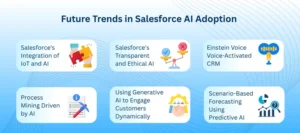
Future Trends in Salesforce AI Adoption 

Future of Salesforce AI

The Salesforce AI deployment landscape is still changing quickly as 2025 approaches. Businesses that make strategic investments in Salesforce AI adoption will maintain their agility and competitiveness through predictive analytics and dynamic customer experiences. What lies ahead is as follows: 

Using Generative AI to Engage Customers Dynamically

Salesforce’s artificial intelligence is revolutionizing personalization. Intelligent chat responses, hyper-personalized emails, and content catered to specific client demands are being created with tools like Einstein GPT. This cutting-edge Salesforce AI solution improves customer satisfaction and loyalty by revolutionizing how companies interact with their customers. 

Scenario-Based Forecasting Using Predictive AI

Salesforce AI is making scenario-based forecasting possible in addition to sales prediction. Salesforce development services are currently concentrated on creating models that predict consumer preferences, market trends, and competition movements using historical data and behavioral patterns, giving firms a competitive advantage. 

Process Mining Driven by AI

Intelligent process mining is now a part of the Salesforce AI application to improve workflow efficiency. AI tools find bottlenecks and provide fixes by examining CRM data. Faster service delivery and more efficient operations are advantageous to businesses and are essential elements of a successful Salesforce implementation strategy. 

Einstein Voice Voice-Activated CRM

With voice-activated features, Salesforce artificial intelligence is growing increasingly intuitive. Users can utilize natural language instructions to communicate with the CRM with Einstein Voice. This tool streamlines daily tasks and increases field productivity, from creating reports to updating records. 

Salesforce’s Integration of IoT and AI

Smarter customer experiences are being produced by the combination of Salesforce AI implementation and IoT. Companies may now anticipate maintenance problems, provide proactive support, and streamline operations by analyzing real-time data from linked equipment. The use of Salesforce AI in the future is on the rise. 

Salesforce’s Transparent and Ethical AI

Transparency is essential as AI gets more and more integrated into CRM. These days, Salesforce AI is being developed with tools that describe the decision-making process. Enhancing user trust is a primary goal of any Salesforce deployment plan, and this ethical approach supports global compliance, including the CCPA and GDPR. 

Conclusion 

More than just technology is needed to successfully deploy Salesforce AI; a well-defined Salesforce implementation services that is in line with user readiness and business objectives is also necessary. From evaluating preparedness and ranking use cases to expanding and maintaining AI projects, companies may optimize their investment and achieve more intelligent results by taking a methodical approach. Future-proofing your Salesforce CRM will require embracing breakthroughs like generative AI, predictive analytics, and ethical transparency as AI develops further.  

This process can be accelerated by collaborating with knowledgeable Salesforce development services like AnavClouds Software Solutions. These implementation partners will guarantee that your Salesforce AI implementation solutions provide quantifiable results and a sustainable competitive edge. Book a free consultation today and learn more! 


FAQs 

What is Salesforce AI, and how can it support my business? 

Salesforce AI leverages advanced technology to automatically carry out tasks, forecast customer behavior, and personalize communications, enabling your business to operate more effectively to promote positive customer experiences. 

Can I personalize Salesforce AI for my business? 

Yes, Salesforce provides tools like Einstein Studio for training and personalizing AI models for whatever purposes you need, even with no coding experience. This helps create personalized AI solutions to support your specific business challenges and goals to enhance efficacy.  

Does Salesforce AI integrate with other business systems? 

Yes, using tools like MuleSoft AI Connect, Salesforce AI integrates with external systems to facilitate seamless data movement and continuous real-time connection. This improves accuracy and integration across your business. 

Is Salesforce AI suitable for small businesses? 

Yes, Salesforce AI scales to the size of your business. Small businesses can improve efficiency and predictive accuracy, and automation can work for you without a maximum upfront cost for support, which enables smaller organizations to compete faster with large businesses.   

How often should I update Salesforce AI models? 

Models should be periodically reviewed and updated with new data and user experiences to ensure accuracy and relevancy. Continuous updates ensure that AI is accurately performing as business needs change to improve operations.