Gaurav AnavClouds Software Solutions +1 917 266 9985 info@anavcloudsoftwares.com
hire salesforce developer
Custom Salesforce Development

Any business is entitled to a CRM that functions in a manner that it requires. Custom Salesforce development takes the default Salesforce CRM and turns it into a robust, customized solution that fits your workflow, automates processes, and surfaces actionable insights. With the help of the role of Salesforce developers, organizations will be able to facilitate operations, improve customer relations, and achieve sustainable growth. Individualized dashboards to flawless system integrations, specialized Salesforce solutions empower opportunities that are not merely achievable with off-the-shelf platforms. We will discuss how custom Salesforce development can help streamline operations to become a big part of businesses. 

What is Custom Salesforce Development?  

The Custom Salesforce development is about how to make Salesforce CRM to suit your business requirements. Utilizing Salesforce development services, companies can optimize customer relationship management, collaborate more efficiently, and generally be more effective. 

Custom Salesforce solutions can be used with cloud-based technology to reach customers, partners, and clients in a seamless manner. They can help you to monitor and examine how you are interacting with your customers, automate your routine activities, and concentrate on what is actually making your business go. 

This has obvious advantages of Salesforce custom development: rather than managing with features you do not even need and/or reducing your operations to workflows, you have the flexibility of customizing Salesforce to your specific operations. This guarantees that your business develops stably with complete control of your CRM environment. 

Custom Salesforce development for smoother operations


Key Areas for Salesforce Custom Development 

When you hire Salesforce developers, they can transform your Salesforce CRM into a highly tailored platform that fits your business processes perfectly. The following are the key areas that Salesforce custom development can really impact: 

  • Custom Objects: Store and process data according to your business requirements. 
  • Custom Fields: Add the necessary data and use other fields that fit in your unique processes. 
  • Custom Workflow Rules: Custom workflow rules are used to automate routine business activities through rules that are defined based on their conditions in order to save time and minimize errors. 
  • Custom Validation Rules: This ensures that incoming data is up to the expected standards before it is stored to be accurate and consistent. 
  • Custom Reports & Dashboards: Get valuable analytics by using custom reports and dashboards to make smarter decisions. 
  • Visualforce Pages: A Visualforce Page is a special-purpose user interface created by developers to meet specific business needs. 
  • Lightning Components: Develop reusable elements of the dynamic and modern web applications on Salesforce. 
  • Apex Classes and Triggers: Custom code also allows complex business processes to be automated and enables extending. 
  • Third-Party Integrations: Integrate Salesforce with ERP, eCommerce, and other tools needed. 
  • Designed User Interfaces: Customize themes and layouts to match your brand. 
  • Custom Email Templates: Visualforce Design visually appealing email templates (branding). 
  • Custom Community Portals: Strengthen teamwork by creating collaboration portals with partners, customers, or employees. 
  • Event Management Tools: Simplify event activities using check-in, scheduling, and tracking capabilities. 
  • Better Views and Layouts: Ease of use through improved list views and page layouts to access key information easily. 

These Salesforce development areas will enable your business to fully exploit the strength of CRM without making workflows complex and difficult to use. 

Essential Components in Salesforce Custom Development 

The major elements of Salesforce development are important to businesses that want to make the most out of their CRM. When you contract developers to do a custom Salesforce development, they apply these tools to create customization, automation, and optimization of your Salesforce CRM efficiently: 

Apex 

The Salesforce proprietary programming language is called Apex. It is automated by certified Salesforce developers in order to automate business processes, process certain business rules, and develop scaling apps that can expand with your organization. Apex is used to ensure a seamless transaction and operations on the Salesforce platform. 

Visualforce 

Visualforce is a dedicated markup language to create interface customization in Salesforce. It is also integrated with the Lightning platform, which enables developers to build dynamic pages that interoperate with your Salesforce data, just like HTML with Salesforce. Visualforce Standard controllers are used to perform simple database operations effectively. 

Lightning Components 

Lightning Components allow developers to develop contemporary and performance-oriented user interfaces in Salesforce applications, Experience Builder websites, and the Lightning Experience. Lightning Web Components (LWC) is a developer technology that enables programmers to build web-based applications using common web technologies, such as HTML, CSS, and JavaScript. 

Salesforce Object Query Language (SOQL) 

SOQL enables developers and users to search through Salesforce data to retrieve information. It eases data searches, report-making, and filtering of records, and is an essential resource in tailored Salesforce development. 

Salesforce APIs 

The Salesforce APIs (REST, SOAP) offer the guidelines and instruments to unite external applications with Salesforce. These APIs enable developers to access, update, and automate Salesforce data, integrating your CRM with ERP systems, eCommerce platforms, and other important applications. 

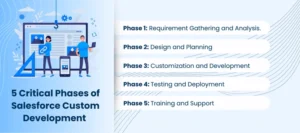
5 Critical Phases of Salesforce Custom Development 
Phases of Salesforce Custom

A systematized approach to Salesforce development is necessary to make sure that your Salesforce CRM perfectly fits your business objectives. When you contract Salesforce developers, they consider the following main steps to develop successful custom Salesforce development: 

Phase 1: Requirement Gathering and Analysis

The process starts by gathering and evaluating all the business requirements. It is an important step towards you knowing your processes, goals, and expectations. Through involvement of the stakeholders, the developers can determine the critical functions, challenges, and opportunities, which will lead to a customized solution that will result in a successful Salesforce implementation. 

Phase 2: Design and Planning 

The developers and designers then come up with detailed blueprints depending on the requirements collected. This involves data models, workflows, UI layouts, and the choice of the appropriate tools, including Apex to use as a backend logic and Lightning Components as a user interface. Effective planning facilitates the alignment of the end Salesforce solution to the business. 

Phase 3: Customization and Development 

The development team now starts to write code and assemble your custom Salesforce development solution using blueprints. The stage is associated with developing unique applications, automation, and linking third-party systems through Salesforce APIs and tailoring options to optimize workflows and give users a better experience. 

Phase 4: Testing and Deployment 

Once developed, extensive testing of the project is undertaken, in terms of unit testing and user acceptance testing (UAT), to ascertain the proper functioning of workflows, data, and integrations. The deployment is done in a controlled manner, typically through Change Sets or DevOps tools, to facilitate a smooth transition with minimum impact to the business operations. 

Phase 5: Training and Support 

The last stage is dedicated to user empowerment. On-the-job training, documentation, and constant Salesforce consulting will guarantee that your company will be able to utilize the system. Ongoing support and maintenance assistance resolve problems promptly and make updates as your company changes to ensure your Salesforce CRM is streamlined to succeed over time. 

Key Advantages of Salesforce Custom Development 

By collaborating with the appropriate Salesforce development services, you can be sure that your CRM will be adjusted to the objectives of your business and will provide tangible outcomes. In the case of custom Salesforce development, the skills of the developers lead to each and every step, from strategy to implementation, unlocking the complete strength of Salesforce CRM. Custom Salesforce development has the following benefits to your organization: 

Customized Products to meet Special Business Requirements 

No business functions alike, and Salesforce custom development can give your CRM the exact match to your goals. Store shelf solutions can be lacking in essential nuances, whereas custom development will provide: 

  • Custom Workflows: Workflow Automation Workflows that resemble your business processes. 
  • Customized Dashboards: Get the metrics that are most important to your teams to make more decisions. 
  • Business-Specific Solutions: Customize Salesforce to fit the specific demands of companies in specific industries such as healthcare, retail, finance, or manufacturing. 

These custom-built solutions make them more productive, less manual, and more customer-oriented. 

Scalability to Support Business Growth 

Your CRM must increase in tandem with your organization. Custom Salesforce solutions empower: 

  • Execution of New Features: Integrate third-party tools, plug-ins, or applications seamlessly. 
  • Dealing with Greater Data Velocity: Optimally scale your system to handle larger datasets without reducing its performance. 
  • Future-proof operations: Construct a scalable design that can adapt to new technologies and market demands. 

Improved User Adoption and Experience 

The user-based CRM leads to increased adoption and ROI. Custom development enhances usability with: 

  • Streamlined Interfaces: User-role-specific interfaces. 
  • Robotic Processes: Have the free teams do away with monotonous activities so that they can concentrate on strategic work. 
  • Easy to Use: Smoother operations to access tools and data more quickly. 

Intuitive connection with the existing systems 

Tailored Salesforce development guarantees seamless access to your business ecosystem: 

  • ERP Systems: Combine financial and operational data to have a single insight. 
  • Marketing Tools: Connect apps such as HubSpot or MailChimp to do comprehensive campaigns. 
  • E-Commerce Platforms: Track customer experiences across the board by integrating CRM and online stores. 

Advanced Analytics and Insights 

Custom Salesforce development will make data-driven decisions easier: 

  • AI and ML Integration: Make predictions and anticipate customer trends. 
  • Custom Reports: Create insights about individual metrics. 
  • Real-Time KPI Tracking: See the performance and take initiative. 

Better Security and Compliance 

Secure confidential information and remain within regulatory provisions: 

  • Role-based access: Multi-Factor authentication and custom Security Protocols. 
  • Regulatory Compliance: Meet GDPR, HIPAA, or CCPA standards. 
  • Audit Trails: Keep a record of system activities to ensure accountability and transparency. 

Efficiency in the Long Run 

The cost of custom development is initially expensive, but it saves money in the long term by: 

  • Optimization of Resources: Concentrate on value-adding activities and reduce unnecessary activities. 
  • Minimizing Downtime: Develop a high-quality system to avoid breakdowns. 
  • Maximize ROI: Improve productivity, efficiency, and customer satisfaction in the long term. 

Through Salesforce custom development, companies acquire an efficient, secure, and scalable CRM system, which expands to their requirements whilst ensuring measurable value. 

Conclusion 

Custom Salesforce development is the beginning of unlocking the full potential of Salesforce CRM. Through collaborating with certified Salesforce developers and Salesforce implementation partners such as AnavClouds Software Solutions, the businesses will enjoy custom workflows, advanced analytics, better security, and scalable solutions that will expand as their needs grow. AnavClouds Software Solutions will help you achieve the desired result of your CRM and achieve long-term business success, whether it is a goal of increasing efficiency, enhancing user adoption, or integrating multiple systems. 


Frequently Asked Questions 

Is Salesforce truly customizable to my business needs? 

Absolutely! The custom Salesforce development makes it possible to do whatever you desire with your CRM, whether it is by workflows or dashboards, and align it to your business. This will guarantee you a system that works in your favour and not vice versa. 

How quickly can I see results after hiring Salesforce developers? 

The appropriate Salesforce development services will allow you to begin realizing the benefits of efficiency, automation, and enhanced insights in a few weeks of implementation. Furthermore, all modifications can be made to make the most of your team from the first day. 

Will custom Salesforce development help my team actually use the CRM more effectively? 

Yes! Salesforce has customized interfaces, streamlined navigation, and automated functionality, making it easy to operate to increase adoption and ensure your staff remains productive. This will make sure that your employees will not take so much time to learn the system, but instead, they will focus on attaining business objectives. 

Does Salesforce integrate with the rest of the tools that my business utilizes? 

Definitely. Salesforce development can be extensively customized to integrate with ERP systems, marketing platforms, and e-commerce applications, and so forth, to disperse data and make smarter decisions. Having all things linked, your business will have a 360-degree perspective of operation and customer relationships. 

Salesforce CRM Developement

Every successful CRM is driven by experience, strategy, and execution in addition to excellent software. The role of Salesforce developers is to help with that. There has never been a greater need for qualified experts who can customize the platform to meet certain objectives, as more and more companies use Salesforce for CRM transformation. 

However, what precisely do Salesforce developers do? These experts are the backbone of Salesforce CRM development, managing everything from customization to ensuring seamless integrations. Whether you are just starting or want to scale, understanding the CRM goal can help you maximize the ROI. 

We’ll cover everything in this blog, including hiring advice, the necessary skills, what you look for before investing in Salesforce, and why specialized Salesforce development services are crucial for sustained success. 

Key Considerations Before You Hire Salesforce Developer 

Choosing Salesforce is a significant decision that needs careful preparation. Before beginning Salesforce CRM development, it’s critical to comprehend the variables that may affect your success. Here are some things to think about if you want to investigate bespoke Salesforce solutions or understand the role of Salesforce developers:

Understand the True Cost of Licensing

Salesforce provides a range of subscription packages designed to meet various company requirements. The features, degree of access, and size of your business will all influence your decision. The price can vary greatly, particularly if you need unique setups or intend to integrate complex features. Mapping these expenses early on in the Salesforce installation process is crucial.

Include Customizations and Integrations

Unconventional Salesforce is powerful, but customization is what sets it aglow. Certain integrations with third-party apps or systems are often required by companies, which can add complexity and cost. Experienced Salesforce developers ensures the proper setup and seamless integration, no matter your intent for small adjustments or large-scale Salesforce application development.

Take into Account Staff Development and Ongoing Assistance

A CRM is only as good as the users who use it. A substantial return can be obtained by spending money on user training, internal assistance, or using programs like Salesforce Trailhead. Hiring a Salesforce developer or utilizing expert Salesforce development services can also maximize onboarding and ongoing support.

Focus on Maintaining and Upgrading

Since Salesforce is always changing, your platform must also. Performance improvements, security patches, and regular updates  

are necessary. Maintaining current Salesforce CRM development and managed services ensures that your system is modern, safe, and scalable as your company grows.

Assess the Requirement for AppExchange Add-Ons and Tools

There are dozens of third-party products in Salesforce’s ecosystem that can enhance your CRM. These add-ons, which include analytics tools and productivity boosters, are pricey. Simply choose the features that best suit your needs, then consider how a Salesforce developer could alter them to suit your needs. 

How the Role of Salesforce Developers Can Help in CRM Success

Role of Salesforce Developers 

Relying on outdated CRM systems is no longer sufficient in today’s fast-paced digital environment. Businesses need advanced automation, specific connectors, and secure APIs to stay ahead. Salesforce developers can help with that. Hiring a Salesforce developer from reputable Salesforce development services gives you access to specialized skills that will improve productivity, efficiency, and long-term outcomes. 

The role of Salesforce developer can be a game-changer for your organization:

Reduced Costs, Increased Output

It is often cheaper to employ full-time Salesforce developers than to contract independent contractors or outsourcing teams. Dedicated developers reduce the cost of doing business with a consistent focus and streamlined workflow. They can come up with faster, smarter solutions that support your goal due to their skill in Salesforce CRM development.

Deep Knowledge of Salesforce Ecosystem

Developing a Salesforce application calls for extensive technical knowledge and practical experience. Salesforce developers contribute domain-specific knowledge that guarantees improved performance, greater security standards, and customized outcomes across all business operations, from creating automation rules to personalizing dashboards and reporting.

Strategic Input That Drives Growth

Your CRM should grow with your company. As your company expands, a skilled Salesforce developer helps you make strategic adjustments to your CRM system, improving business logic, automating procedures, and encouraging more astute decision-making. Their observations assist in coordinating your CRM with actual company goals, rather than only technological requirements.

Building Tailored Solutions for the AppExchange

Your company may occasionally require a unique solution that isn’t available now. Building customized apps and even releasing them on AppExchange are areas of expertise for Salesforce developers. These niche-specific bespoke Salesforce solutions provide you with a competitive edge and speed up the launch of new items.

Easy Integration with External Resources

Salesforce experts understand how to install third-party applications like MuleSoft, Slack, and Google Suite to expand the capabilities of your CRM. Whether you’re automating marketing workflows, syncing data, or providing data security measures. This includes encryption and access control, professional programming allows you to integrate everything seamlessly and compliantly. 

Essential Skills to Consider Before Hiring a Salesforce Developer 

Selecting the best Salesforce developer is crucial to the success of your CRM process. You are either considering a bespoke Salesforce solution or a complete Salesforce CRM development project, and the skill set of your developer can either save or ruin the process. Apart from having technical acumen, your best candidate will have a mix of creativity, problem-solving skills, and familiarity with the platform. 

The following are the role of Salesforce developers that are necessary to understand:

Depth of knowledge in the Salesforce platform

An experienced Salesforce developer understands declarative elements like process builders and workflows, and the core modules they will be working with. Having this general knowledge, they can establish whether or not they can use base components or create a custom Salesforce application based on their specific needs.

Apex Programming Knowledge

Salesforce employs Apex as its primary programming language. When creating intricate business logic and automations, your developer needs to know how to write scalable and maintainable Apex code. It is challenging to proceed beyond the basics without this skill.

Understanding the Components of the Lightning Web (LWC)

Lightning Web Components power modern, intuitive interfaces. To provide clients with engaging and responsive experiences, developers should be proficient in HTML, JavaScript, and CSS. Proficiency in LWC improves speed and usefulness on all devices.

Strong Data Management Capabilities

Salesforce developers have to be careful when handling massive amounts of business data, from data imports to de-duplication and reporting. Proficiency in data organization, cleaning, migration, and security is essential, particularly for expanding companies that depend significantly on precise insights.

Integration Expertise

Integrating Salesforce with applications like Outlook, Slack, or MuleSoft requires a high level of technical know-how. An expert developer understands middleware, APIs, and how to create seamless cross-platform communication. These connections are essential to the development of a unified ecosystem.

Testing and Debugging Skills

Every new feature or update must undergo extensive testing. Before going live, a skilled Salesforce developer should be able to identify faults, decipher errors, and test features in sandbox settings. This guarantees quality control and safeguards your live data.

Understanding Version Control Systems

When multiple developers are working together on a project, version control is useful. Thanks to modern technologies, developers can easily track changes, roll back to earlier versions, and create new functionality. This is particularly useful for agile Salesforce development services.

Security-First Mentality

Data security should not be compromised. Role structures, sharing policies, and field-level security are all things that a Salesforce developer should be familiar with. They need to understand how to avoid vulnerabilities and adhere to best practices to secure sensitive consumer data.

Documentation and Communication Skills

Without great documentation, great development is futile. A trustworthy Salesforce developer creates detailed notes and technical documentation to support team members, onboard new developers, and preserve clarity over the project’s duration.

Adaptability and Constant Learning

The Salesforce environment is in a continuous state of evolution. Top developers engage with the Trailhead community, remain current with each release, and try out new ways to increase efficiency. Long-term success is assured by an openness to learning. 

How to Choose the Best Salesforce Developer: A Useful Manual for Companies 

Choosing the right Salesforce developer can have a big impact on how well your Salesforce CRM development goes. Whether you need someone for a long-term Salesforce application development project or a short-term modification project, choosing the ideal professional requires more than just assessing technical skills. 

You can choose a Salesforce developer who is in line with your business goals by following this wise advice:

Make relevant experience and certifications a top priority

Assess the latest qualifications held by Salesforce professionals, like Salesforce Certified Administrator or Salesforce Certified Platform Developer, before hiring them. These qualifications ensure their technical prowess and dedication towards the platform. Moreover, in case you require complex connections or bespoke Salesforce solutions, search for relevant experience with working on projects like your own.

Search for Problem-Solving and Analytical Skills

Instead of just writing code, a skilled Salesforce developer tackles actual business issues. Select a person with the ability to assess problems and create workable, expandable solutions. You may be certain that you’re collaborating with experts who are knowledgeable about resolving particular CRM issues if you choose a firm that offers proficient Salesforce development services.

Assess Collaboration and Team Fit

Some departments and stakeholders are commonly engaged in Salesforce projects. Your developer needs to be able to collaborate with people from different teams and make a substantial contribution throughout the planning, execution, and deployment phases. Working as a team guarantees that your business needs are met by custom Salesforce solutions.

Test Communication Skills

As crucial as technical skill is, the ability to collaborate with technical and non-technical teams alike. Ensure your Salesforce developer can articulate needs, describe ideas, and guide others through tough ideas.

Think About Culture and Team Fit

As technical skills are important, so is cultural alignment. When hiring a Salesforce developer, consider how well the person aligns with your company’s values. It is easier to collaborate, and the installation of Salesforce goes more smoothly when there is a strong cultural fit. 

Conclusion 

Salesforce developers play the key role in converting your CRM from a generic platform to a customized corporate growth engine. Their capability to design custom Salesforce solutions, integrate, and conform to your company’s requirements ensures that your investment not only generates money but also turns into a source of competitive strength. 

No matter whether you aim to enhance user experience, streamline processes, or bring in third-party technology, the proper Salesforce developer is what matters. 

Are you looking for Salesforce developers who will comprehend your vision and do more than expected? 

Join forces with AnavClouds Software Solutions, a Salesforce Consulting Partner with certification. 

Our specialty is end-to-end Salesforce development services, which include application development, integration, and customisation, and are intended to help you succeed with CRM more quickly. 


FAQs 

What is a Salesforce developer?

A Salesforce developer designs and implements tools and functionalities on the Salesforce platform. They code to build solutions that allow companies to manage their data, automate, and improve how teams work together. They test and also keep the tools up and running to make sure everything works as expected. 

Who typically employs Salesforce developers?

There are many kinds of companies that hire Salesforce developers. Healthcare, financial, retail, and educational businesses often need experts to collaborate with them in order to optimize Salesforce. Any business that uses Salesforce to deal with customers or automate functions may need a developer to customize the system. 

How does a Salesforce admin differ from a developer?

A Salesforce admin does the initial setup and regular upkeep of the system, like adding users or making reports. A Salesforce developer, on the other hand, writes code to develop custom functionality or integrate Salesforce with other tools. Admins deal with more native tools, whereas developers deal with code and deeper customizations.

Is it hard to become a Salesforce developer?

It will be a while to figure out how to be a Salesforce developer, but it is not as difficult as long as you are dedicated. You don’t have to be a coding expert to begin with. With training, practice, and free resources such as Salesforce Trailhead, you can develop the skills piece by piece.

hire dedicated Salesforce developer

Salesforce is a robust CRM solution that helps organizations boost efficiency and customer engagement, and to leverage its potential it is important to hire the right Salesforce developer. These certified developers can deploy, customize, or scale up your Salesforce solutions with ease. However, businesses can choose to hire Salesforce developer in-house, or they can outsource one. But choosing between the two options can be difficult for them as both have their advantages and challenges depending on the project requirement, budget, etc. In this blog, we are going to look at the pros and cons of hiring in-house vs. outsourcing Salesforce developers. 

5 Key Factors to Consider When Choosing a Salesforce Developer 

hire Salesforce developer

As both an in-house Salesforce development approach and an outsourced one have their advantages, it is better to decide while evalualting important factors like: 

Project complexity and scope 

A large and long-term Salesforce implementation require an in-house team so that project understanding and continuity exist with appropriate business alignment. Whereas, for a short term, specialized projects could outsource Salesforce development services. They can benefit from their experience as they can deliver solutions efficiently without any long-term commitments.  

Furthermore, another important aspect would be the level of customization needed. When the business comes in with evolving features and a need for constant updates, it’s best to hire Salesforce developer in-house. When the development services remain standard, outsourcing developers may be more cost-effective by hiring a specialized agency. 

Budget-based considerations 

Maintaining an in-house team can be expensive as it includes salaries, training, and benefits. Moreover, there are infrastructure costs, continuous certification, retention efforts, etc. On the other hand, outsourcing Salesforce developers is flexible, you will simply pay for the services in the hourly contracts, fixed pricing, or retainer models.  

While outsourcing may look cost-effective, the businesses should look at hidden factors, such as vendor management, and communication barriers, as they can add cost. Considering hiring a Salesforce expert in-house means drawing a pretty huge upfront investment. Recruitment, onboarding, and training costs add up to considerable amounts, whereas outsourcing those costs is eliminated and the business can use its resources more cost effectively. 

Required Expertise 

Some other areas include AI automation, API integration, and cloud solutions. In-house teams may have limited skills sets, while outsourcing allows businesses access to a pool of certified Salesforce developers with specialized expertise. If your business requires niche skills frequently, an external Salesforce development partner would be ideal in providing that expertise without too much hiring hassle.  

Furthermore, the Salesforce ecosystem keeps changing, and so does the knowledge base among developers. They have to stay updated with the latest releases and innovations. Outsourced Salesforce development services generally make investments further into continuous learning and certifications. They ensure that businesses will have all these cutting-edge solutions without any additional cost of training 

Security and compliance 

Industries are working with sensitive data and compliance with regulation such as GDPR, HIPAA, etc. is a top priority. While in-house Salesforce developers have direct control over data security measures, outsourcing requires proper consideration to choose Salesforce implementation services. It is necessary to ensure they follow best security practices and are compliant with industry standards. This risk can be mitigated by signing NDAs and working with ISO-certified partners 

Time sensitivity factor 

If businesses want development and deployment fast, outsourcing has the edge. Established service providers for Salesforce development have inherent techniques for rapid implementation. On the other hand, in-house teams will provide long-term efficiency, hence less need for external dependency to maintain projects once they are inducted.  

Outsourcing Salesforce Development: Pros & Cons 

Pros: 

  • Cost-Effective: Saves on the expense of recruitment, training, and infrastructure. Outsourcing spares the company’s fiscal resources from expenditures on hiring and maintaining an internal team. 
  • Access to Expertise: Work with extremely experienced Salesforce developers with expertise in various fields. Offshore teams typically have certified professionals with expertise in multiple industries, so they possess more diversified experience. 
  • Time Efficiency: Faster project completion through pre-defined workflows. Established Salesforce development service providers follow best practices, cutting down on development time and providing quicker turnaround. 
  • Scalability: Scalable to add or remove team members with ease based on project needs. Do you require one developer or a whole team? Outsourcing allows you to scale up or down according to your needs. 
  • Specialized Skills: Gain access to multi-cloud experts, AI automation, and integrations. Outsourcing developers partners tend to have expertise in newer technologies that are not within. 

Cons:  

  • Transparency Issues: Limited direct management of outsourced operations. Third parties require trust and contract clarity to permit smooth coordination. 
  • Communication Barriers: Language, time, and differences in culture might necessitate planned cooperative work. Planned communication procedures and time-based meetings can cover the gap. 
  • Security Risks: Granting third-party access to your CRM data comes with rigorous security protocols. Having vendors who are ISO-certified or GDPR-compliant will reduce risks. 

In-House Salesforce Development: Pros & Cons 

Pros: 

  • Business Alignment: The Salesforce developers will be closely collaborating with the internal teams so that the interactions are seamless. An internal team knows company goals and can easily adjust with changing business needs. 
  • Enhanced Data Security: Complete authority over data protection and compliance. Businesses dealing with sensitive customer information can impose strict security measures. 
  • Flexibility in Customization: Customization according to company-specific business needs can be facilitated at a faster rate independent of external influences. Internal developers assure that everything programmed is according to company-specific details. 
  • Improved Coordination: The team can communicate with ease and monitor projects seamlessly. In-house Salesforce developers share the same office and time zone, hence, can prevent delays in making some of the decisions. 
  • Long-Term Investment: The team builds design and development skills for the marketing model in the long term. Developers are developed, retained, and trained with time so that business continuity and an in-depth understanding of the system are assured. 

Cons: 

  • Higher Costs: The increasing operational expenses arising from salaries, benefits, and making investments into infrastructure, hiring full-time employees is a long-term commitment that requires financial forecasting. 
  • Difficulties Setting Talent Acquisition: Competing in the market for certified Salesforce professionals is involved, and these candidates can be rather scarce to increase their demand over time. 
  • Employee Turnover Risks: The high market demand for Salesforce development services means that there are new faces on the team, which can lead to disrupting projects. Substantial investment by companies in employee retention measures that can maintain stability in their teams. 

Hybrid Approach: The Best of Both Worlds 

The majority of businesses adopt a blend of both approaches, leveraging the benefits of in-house and outsourced Salesforce developers. They keep the central development in-house but outsource for the projects temporarily. 

Advantages of a Hybrid Approach: 

  • Cost Savings: Outsourcing the hiring of Salesforce developers can save overhead but maintain an in-house team for core functions. 
  • Access to World Talent: Leverage different expertise when required without any long-term obligation. 
  • Scalability & Flexibility: Fulfill the project requirements rapidly by handling internal and external resources. 
  • Enhanced security: It is easier to keep sensitive information in-house while outsourcing non-sensitive projects. 

Conclusion 

Selecting an in-house or outsourced Salesforce development services is based on your company’s objectives, finance, and scope of work. If you need continuous customization, data security, and long-term investment, having an in-house team could be the way forward. Yet, if flexibility, cost reduction, and exposure to diverse talent is your focus, outsourcing Salesforce developers is also a strategic choice. In addition, some companies find a hybrid approach fits better in terms of flexibility and scalability. 

Moreover, it is important to determine your needs and work with the right Salesforce developer to get the best out of your investment. AnavClouds Software Solutions is a certified Salesforce partner, with diverse expertise that is beneficial for your business. You can get customized solutions that fit your needs, along with a seamless implementation process. Schedule a call with us to learn more. 


FAQs 

Why should I hire a Salesforce developer? 

Hiring a Salesforce developer will allow you to customize, integrate, and optimize your CRM according to your company-specific needs. They can deliver smooth automation, improved workflows, and optimized customer interaction, making your Salesforce solution more effective.  

How does outsourcing differ from hiring internally?  

Internal hiring provides better stability and business fit, however, a higher cost. Outsourcing is cheap, but the freedom and talent pool with some skill set is bigger. To decide which is more suitable, determining the project needs, the budget, and the long-term goal is necessary. 

How much does it cost to hire a Salesforce expert?  

The cost of hiring Salesforce experts varies depending on experience, hiring mode, and proficiency areas. In-house developers need salaries, benefits, and to account for costs of training and infrastructure, while outsourcing is cost-effective. You could probably have flexible pricing models such as hourly, fixed-price, or retainer contracts. This can enable companies to optimize costs depending on the scope of the projects.  

Why is Salesforce development outsourcing more preferable?  

In cases where fast deployment, specific skill, or the ad-hoc type of project is not expected to fit into a company’s long-term development plan, outsourcing is a preferable option. Outsourced developers make it much easier to enhance development work without the need to hire them as full-time employees. Also, this is the best way possible for Salesforce integration, upgrades, or even customization. 

Salesforce Developers for Business

Having the appropriate Salesforce developer is critical to businesses that are looking to leverage Salesforce for maximum results. Salesforce has a market share of over 22% and is a leading CRM platform used by many businesses. If you hire Salesforce developer, they not only deploy the platform but also develop custom functionality, automate processes, and enhance system performance. With so many professionals presenting themselves as experts, finding the perfect one requires a strategic approach. Here is a step-by-step guide on how you can hire a dedicated Salesforce developer. Furthermore, we will also take a look at the most important skills and assessment parameters for choosing the right experts. 

What is a Salesforce Developer? 

When you hire Salesforce developer for your business they are tasked with customizing, streamlining, and scaling the Salesforce system to meet the distinct business needs. They provide businesses with specific solutions, enhance effectiveness, automated functionalities, and empower business growth. These certified Salesforce developers partner with stakeholders in defining key objectives. They make sure that Salesforce gets leveraged to its full capabilities for improved functionality and seamless usage. 

Key Responsibilities of Hiring a Salesforce Developer

hire salesforce developers

Building Custom Business Apps for Business Productivity

When you hire dedicated Salesforce certified developers they create and deploy custom applications, integrations, and features through Apex, Visualforce, etc. This customization allows businesses to automate processes, enhance productivity, and much more. For instance, a robust customer inventory management solution can help organizations monitor real-time inventory management at locations, prevent stockouts, and reduce operational inefficiencies.

Merging Salesforce with Other Systems

One of the most forefront duties when you hire Salesforce Developers is integrating Salesforce with other third-party apps such as ERP software, accounting software, etc. seamlessly. These integrations prevent the hecticness of manual data entry, minimize data errors, and offer a single business environment. 

For instance, integrating Salesforce with ERP enables real-time tracking of inventory, minimizing the level of manual upkeep and improving business efficiency.

Providing Continuous Support and Maintenance

Salesforce is a robust platform with a dynamic environment. Organizations require continuous maintenance, upkeep, and troubleshooting to ensure that Salesforce runs flawlessly at all times. Hire Salesforce developer to actively pursue and fix performance issues, implement system patches, and configure the platform accordingly to suit changed business needs.

Ensuring Data Security and Integrity

A seamless data management process is central to the activity of the Salesforce Developer. Hiring certified Salesforce developers helps in managing data migration, storage, validation, and security as per industry standards, and business-critical data protection. Developers adopt role-based access control, encryption controls, and data backup to ensure data integrity and confidentiality.

Documentation and User Education

Besides development activities, when you hire Salesforce Developers they create detailed technical documents, user manuals, and best practices guides. This allows custom applications to be implemented seamlessly. Certified Salesforce developers also train end-users and teams to use Salesforce in such a manner that they can make the most of their productivity. 

By filling the gap between business needs and technical capabilities, Salesforce Developers enable businesses to grow operations, enhance customer relationships, and achieve long-term success. 

Step-by-Step Process for Hiring Salesforce Developers 

Identifying the right Salesforce developer is a structured process to find a qualified individual who can fulfill your business requirements. From setting your project needs to technical ability and cultural fit determination, a structured process guarantees to hire dedicated Salesforce developers easily.

Define Your Requirements

Before you rush off to hire Salesforce developers, identify what you need from your Salesforce developer. Will they be developing a customized app, integrating some other app, automating existing processes with a different platform, or bringing existing automation to adulthood?  

Identify the project’s importance and develop expectations and experience needed. Do you plan to hire junior Salesforce developers to do a few simple customizations or a senior developer who understands the more complicated integrations and automation? Therefore, precisely map out the scope of the project, the anticipated outcome, the timeline, and the budget since it will guide the potential candidates. A detailed job description with requirements would surely facilitate hiring a Salesforce developer.

Look for Certified Salesforce Developers

Salesforce certifications validate one’s competence, hands-on experience, and commitment to remaining up-to-date on the latest developments on the platform. Certifications not only validate skills but that the developer knows Salesforce best practices and security as well. 

Some of the important certifications to look for when hiring Salesforce developers: 

  • Salesforce Certified Platform Developer I/II – Indicates proficiency with Apex, Visualforce, and Lightning Web Components. 
  • Salesforce Certified Application Architect – Demonstrates expertise in designing scalable applications and data modeling.  
  • Salesforce Certified Technical Architect – Certification level for the most advanced enterprise solutions and architecture design.  

While certifications are the stamp of approval, real experience is also valuable. Always look for a certified developer with experience on actual projects along with certifications.

Assess Their Technical Skills

When you hire Salesforce developer they should have superior technical expertise in core areas. Such as Apex development, Lightning Web Components (LWC), API implementations, and automation tools. Test their technical abilities through interviews, coding tests, and scenario-based questions during the hiring process. 

Important areas to evaluate: 

  • Apex & Visualforce – Can they develop optimized, scalable Apex code? Do they know triggers, batch processing, and governor limits? 
  • Lightning Web Components (LWC) – Do they have a track record of building responsive and scalable UI components? 
  • API & Integrations – How well aware they are of system integrations or third-party integrations? 
  • Automation & Workflows – Can they set up flows, process builders, and declarative automation correctly? 

Assessing these technical skills at the beginning ensures that you are hiring a developer who can easily fulfill your development needs.

Verify Their Experience & Past Work

Look for the Salesforce developer’s past experiences and work to make sure you are making the right decision. Their previous work will showcase their expertise and give ideas about their problem-solving ability and Salesforce development skills. Moreover, you can ask them to provide you with their portfolio, case studies, etc. for clarity and how they work. 

When analyzing their experience, consider: 

  • The type of projects they have worked on. 
  • Their role and contributions to each project. 
  • How their solutions impact the business processes. 
  • How they optimized Salesforce for scalability and efficiency. 

Also, cross-check reviews, LinkedIn endorsements, or customer feedback to determine their professionalism and reliability.

Conduct a Hands-On Test

An in-real-life coding test identifies the actual ability of a developer. Instead of theory questions, give an assignment or let them work on any existing integration. 

Some sample tasks are: 

  • Designing an Apex trigger to automatically update records. 
  • Building a Lightning Web Component to render dynamic data. 
  • Creating a Flow Builder automation to automate processes. 

Ensure that the test simulates actual circumstances that your business would experience. This helps in determining capabilities of putting their abilities in real circumstances. 

Evaluate Soft Skills & Culture Fit

When you hire Salesforce developer, apart from looking at their technical capabilities, they should also be good at being a team player and a communicator. Salesforce development is largely a teamwork effort with administrators, business analysts, and stakeholders to make sure that solutions deliver business goals. 

The most crucial soft skills to look for: 

  • Communication – Can they articulate technical concepts to non-technical stakeholders? 
  • Flexibility – Do they embrace new tools and adapt to shifting needs? 
  • Problem-Solving – Can they think logically and come up with good solutions? 
  • Collaboration – Are they effective as a group and creating a strong work culture? 

Final Thoughts 

Hiring a Salesforce developer is a great decision for businesses to grow and optimize. The developer will maximize automation, improve integrations, and simplify processes. Putting hands-on experience, technical skills, and problem-solving skills ahead will result in an improved and seamless decision-making process.  

Are you looking to hire dedicated Salesforce-certified developers or need expert assistance? AnavClouds Software Solutions is one of the leading Salesforce development company. Book a free consultation today and learn more about leveraging Salesforce for your business. 


FAQs 

Why should I hire a dedicated Salesforce developer? 

Hiring a professional Salesforce developer in your team ensures your Salesforce platform is customized to fit your business needs. They help you easily automate business processes, integrate third-party applications, and optimize overall system performance to boost efficiency. 

What skills should I look for when hiring a Salesforce developer? 

An experienced Salesforce developer must know Apex, Visualforce, Lightning Web Components (LWC), API integrations, and automation tools. Moreover, they should also be good at problem-solving and communication. 

What is the difference between a Salesforce developer and a Salesforce administrator? 

When you hire Salesforce developer, they deal with coding, custom development, integration, and automation. Whereas a Salesforce administrator deals with configurations, user roles, security settings, and reports with little or no coding. 

How do Salesforce developers improve business efficiency? 

When you hire Salesforce developers they help with customizing solutions that accelerate processes, enhance CRM, optimize workflows, and merge third-party applications. This results in improved productivity and streamlined operations.