Gaurav AnavClouds Software Solutions +1 917 266 9985 info@anavcloudsoftwares.com
AI in Salesforce
Salesforce Data Compliance

One of the crucial elements of the present-day business is data, and data mismanagement can expose organizations to grave danger. Salesforce Data Compliance provides a way to ensure your sensitive information is stored safely and corresponds to all regulatory requirements. Companies can use AI to automate compliance work, increase Salesforce Data Security, and reduce workflows without efficiency loss by employing Salesforce AI models. But failure to adhere to data compliance can lead to hefty penalties of about 4% of annual turnover. Based on the presence of tracking data access and accuracy-related concerns, as well as the convenience of consent and retention policies management, AI-driven Salesforce tools can assist businesses in remaining compliant and generating smarter and faster operations. 

Understanding Salesforce Data Compliance 

Salesforce Data Compliance is the method that guarantees that all personal and sensitive information in Salesforce is gathered, processed, and stored in a system that has high legal and organizational standards. 

As AI in Salesforce grows, maintaining compliance is essential, but using Salesforce AI models to derive data-driven insights is also essential. The principles of Salesforce Data Compliance include data minimization, purpose limitation, and accountability to ensure the safety of information about individuals. 

It also places individuals in control of their data, including access, correction of errors, and the opportunity to request deletion, which contributes to trust and transparency in Salesforce Data Security practices. 

AI-Powered Tools in Salesforce for Data Compliance 

Salesforce artificial intelligence (AI) solutions are crucial in improving Salesforce Data Compliance since they can automatically discover, classify, and identify anomalies in data. 

The real-time monitoring of the data activity through tools such as Einstein Analytics enables organizations to locate and fix possible compliance issues promptly. The abilities are particularly useful in handling big data and being transparent across operations, which is guaranteed by strong Salesforce Data Security. 

To enterprises, to streamline marketing activities and remaining within the confines of the law, Salesforce provides customized AI solutions that optimize data utilization within the secure and legal frameworks. The use of these Salesforce AI models can guarantee effective operations without damaging data compliance. 

Collaborating with Salesforce development services or professional consultants will enable organizations to use AI capacity to the fullest extent without compromising Salesforce Data Compliance. Workflow optimization, data management, and improved marketing strategies can be achieved by the consultants in a secure and compliant environment. 

As well, Salesforce AI Copilot shows how AI can enhance business productivity and assist data protection and compliance initiatives, showcasing the usefulness of adopting AI into Salesforce. 

Take control of Salesforce data compliance with smart AI tools


How to Implement AI in Salesforce for Data Compliance 

The application of AI in Salesforce can greatly improve Salesforce Data Compliance by making sure that your organization adheres to regulatory and in-house data requirements and utilizes Salesforce AI models to their advantage. Here’s a step-by-step approach: 

Test Your Salesforce Data Compliance 

Prior to implementing AI solutions, measure your current Salesforce Data Compliance framework. Perform a comprehensive data audit to establish the presence of any personal and sensitive data stored and processed in Salesforce. 

Data flows Map data, examine processing activities, and indicate any areas of compliance that might be weak. Maintaining a clear view of your current Salesforce Data Security posture, use Salesforce reporting and analytics to understand data usage and access patterns, as well as provide a clear picture of current Salesforce Data Security practices. 

Choose AI Solutions for Salesforce Data Compliance 

Once you have calculated the status of compliance, you will select AI tools that resonate with your Salesforce Data Compliance goals. Salesforce provides effective AI applications, such as Einstein Analytics, helping to find, classify, and keep track of data. 

Based on these AI models, compliance tasks are automated, including the process of identifying sensitive data, detecting anomalies, and securely handling data. Ensure that these tools can be seamlessly incorporated into your current Salesforce setting to ensure data integrity and privacy. 

Establish a Strong Data Governance System 

AI-based Salesforce Data Compliance requires a powerful data governance framework. Have clear data ownership, firm access controls, and a set of overall data processing policies. 

Integrate AI into such procedures in order to automate data management, which is to ensure the uniform implementation of compliance standards. Review and revise the structure every now and then to fit new regulations and changing organizational requirements. 

Educate Your Workforce on AI and Salesforce Data Compliance 

The awareness of the employees plays a vital role when utilizing AI in Salesforce Data Compliance. Train employees about compliance, the place of AI in Salesforce, and best practices in using AI models. 

Concentrate on the privacy of data, security, and practical use of AI-based compliance systems. To maintain a smooth transition, take into account Salesforce development services to tailor your platform to compliance requirements and streamline the workflows. 

Monitor and Maintain Continuous Salesforce Data Compliance 

After implementing AI solutions, initiate monitoring mechanisms so that compliance is maintained. Keep track of data processing, access logs, and identify the possible compliance risks in real-time using AI models. 

Establish automatic notices of abnormalities, so that corrective measures can be taken promptly. Frequent audit of AI tools will help keep AI tools effective, secure, and in line with Salesforce Data Compliance and Data Security standards. 

Overcoming Salesforce Data Compliance Challenges with AI 

Not only do AIs at Salesforce make the company more efficient, but they also increase Salesforce Data Compliance, which allows organizations to effectively address typical issues in data management. 

Data Access Requests Salesforce Automation 

One of the most important matters of Salesforce Data Compliance is administering the access requests to the data. These requests may be processed manually in a slow and error-prone manner. 

Using AI in Salesforce, companies can delegate the process of identifying and retrieving personal data and delivering it by using AI to make sure that the information is delivered in a timely fashion and is accurate. AI models developed by Salesforce are capable of sifting through massive amounts of data to identify the required information, integrating it, and delivering it in an understandable format, simplifying the process of compliance. 

Enhancing Consent Management using Salesforce AI 

Data compliance standards require keeping a clear consent for data processing. Manual consent management can be complicated in the case of organizations that have a large number of customers. 

Consent collection, monitoring, and tracking are the areas of AI use in Salesforce. It breaks down customer contacts to make sure that consent is adequately sought and sustained, and any anomalies are noted. Such a proactive strategy enhances Salesforce Data Security and establishes confidence in users. 

Identifying and averting Data breaches 

Data breaches are a major risk to Salesforce Data Compliance. The Salesforce Data Security is improved with the help of AI tracking access patterns and identifying suspicious behavior that can signal a breach. 

Machine learning models can detect intruder access or data leakages so that corrective measures can be taken immediately. The use of AI in continuous monitoring will enable the keeping of data in accordance with Salesforce Data Compliance. 

Data Minimization and Retention 

Salesforce Data Compliance focuses on the need to store and remove only the required information. 

Salesforce AIs are able to locate duplicate or outdated information, automate routine data cleaning, and impose retention regulations. This saves on the cost of storage, lowers risks, and adheres to the data compliance principles. 

Assuring Data Accuracy and Integrity 

Salesforce Data Compliance requires the accuracy of data. AI at Salesforce is capable of cross-checking documents, identifying anomalies, and automating data verification operations. 

This guarantees trusted client details, decision-making, and minimizes the chances of compliance problems introduced by inaccurate or obsolete data. 

Best Practices for AI-Driven Salesforce Data Compliance 
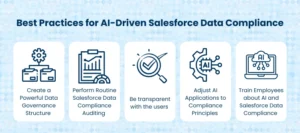
AI-Driven Salesforce Data Compliance

Salesforce Data Compliance can be greatly improved through the adoption of AI in Salesforce if best practices are implemented. This is the way organizations can achieve greater compliance and use Salesforce AI models to their advantage. 

Create a Powerful Data Governance Structure 

Salesforce Data Compliance is heavily based on a robust data governance framework. Particularly clarify the data ownership, establish stringent access control, and establish processing principles within Salesforce. 

AI in Salesforce is able to track compliance with these policies, identify exceptions, and maintain continuous adherence. Regular audits and updates ensure your governance architecture is consistent with the changing data compliance regulations and Salesforce Data Security standards. 

Perform Routine Salesforce Data Compliance Auditing 

It is necessary to conduct periodic audits to determine the effectiveness of your compliance measures. The AI models will be able to study the process of data processing within Salesforce, pinpoint the possible gaps, and propose the corrective measures automatically. 

Automated reporting tools give in-depth information about compliance performance and assist organizations in continually improving and actively managing Salesforce Data Compliance. 

Train Employees about AI and Salesforce Data Compliance 

Employee awareness is key to maintaining Salesforce Data Compliance. Regularly conduct data protection principles, AI use in Salesforce, and secure data management best practice training. 

Artificial intelligence is able to complement training initiatives, provide personalized learning content, interactive lessons, and performance testing, so that your staff is ready to work with data responsibly. 

Be transparent with the users 

Salesforce Data Compliance is based on transparency. Advertise the application of AI to data processing, describe data processing and collection practices, and educate people on their rights. 

AI may help to create explicit privacy statements and find methods of controlling communications channels to build trust without violating Salesforce Data Security policies. 

Adjust AI Applications to Compliance Principles 

When incorporating AI in Salesforce, it is essential to make sure that the AI models comply with the most important principles of fairness, accountability, and transparency. 

Complete Data Protection Impact Assessments (DPIAs) of AI projects, reduce the risks of the projects, and make the decisions made by AI explainable. By connecting AI applications to Salesforce Data Compliance, organizations can access AI use without losing regulatory compliance.  

Future of Salesforce Data Compliance: AI and Evolving Regulations 

The future of Salesforce Data Compliance will be determined by the progressive AI opportunities, the changing regulations, and the adoption of ethical AI practices, which will help organizations to remain at the forefront of data protection. 

The future of AI in Salesforce Data Compliance 

The Salesforce AI is a constantly developing field, and predictive analytics and compliance monitoring are being improved with the help of machine learning and natural language processing. 

These AI models enable organizations to actively predict possible risks, foresee compliance challenges, and take corrective measures before they deteriorate and enhance Salesforce Data Security and general compliance frameworks, on the whole. 

Compliance with changing security rules for data 

With the increase in data protection issues, the movement of regulations such as GDPR and other international standards is likely to change and come with more stringent demands. 

AI can assist companies in tracking changes in regulations, evaluating how it will affect current Salesforce Data Compliance mechanisms, and implement strategies as quickly as possible, so that uninterrupted compliance with the legal requirements and Salesforce development services can be maintained. 

Integrating AI Ethics into Compliance Strategies 

Ethical AI is becoming a critical component of Salesforce Data Compliance. Organizations have to make sure that AI applications in Salesforce are just, open, and considerate of individual rights. 

Combating AI bias, providing explainable judgments, and responsible AI practices would both assist organizations in earning trust and support Salesforce’s Data Security and compliance initiatives. 

Improved AI in Salesforce to meet Compliance 

Salesforce is still bolstering its AI services to contribute to compliance work. Such technologies as more sophisticated AI-based data classification, anomaly detection, automated reporting, and real-time monitoring may be added to Salesforce Data Compliance in the future so that it will become more efficient and reliable than ever. 

Conclusion 

Maintaining Salesforce Data Compliance is no longer a manual, time-consuming process. Through Salesforce with the integration of AI, companies are capable of automating the monitoring process, enhancing Salesforce Data Security, and compliance with changing regulatory requirements. Other best practices, such as effective governance systems, employee education, and open data management, also contribute to compliance efforts. Collaborating with a professional Salesforce development service, e.g., the ones at AnavClouds Software Solutions, gives companies an opportunity to take the best out of AI and remain in full compliance. Use the force of Salesforce AI models in the modern world to protect your data, optimize your workflows, and earn the confidence of your customers. 

Agentic AI

Running a small business often means wearing too many hats—managing sales, supporting customers, marketing your brand, and juggling operations. What if an intelligent system could handle these tasks for you, without needing constant supervision? That’s where Agentic AI comes in. 

Unlike traditional automation tools or even generative AI, Agentic AI systems are designed to act with purpose. They understand goals, plan strategies, take initiative, and adapt in real-time. Whether it’s crafting emails, resolving customer issues, or optimizing financial workflows, AI agents powered by Agentic AI function like reliable team members, making smart decisions and delivering results. 

In this guide, we’ll explore how Agentic AI for small business is changing the way companies operate. You’ll also learn how it differs from generative and agentive AI, how it works behind the scenes, and how tools like Agentforce and AI, backed by expert Salesforce Consultant’s are helping small teams achieve big outcomes. 

How Can Agentic AI Transform Small Businesses? 

Agentic AI is a significant advancement in how small firms can function more efficiently and intelligently; it’s not simply another catchphrase. Fundamentally, it gives AI agents the ability to behave independently, making choices, establishing objectives, adjusting, and even reasoning—all with little to no assistance from humans. These intelligent AI systems are made to work in unison with people, giving corporate operations a new degree of speed and flexibility. 

Consider it an intelligent overlay that complements your current technologies, particularly your CRM programs like Salesforce. This layer, which is frequently referred to as the agentic AI layer, has deep integration with the systems you now use to hold marketing, sales, and service data. What makes it powerful is how it takes action on your behalf. Instead of just storing customer info, it interprets it and acts on it. 

Let’s say you’re using Salesforce AI  tools like Agentforce can learn from human behavior and apply that knowledge to help manage complex business scenarios in real-time. Unlike traditional automation or rule-based chatbots, AI agents don’t just respond—they adapt. They personalize responses, predict needs, and even solve problems based on customer history and context. 

What Sets Agentic AI Apart from Generative and Agentive AI? 

Generative AI is renowned for its ability to generate material, such as emails, graphics, and code, only in reaction to human user input. It is reactive rather than proactive. Generative AI can produce creative results or answers to questions, despite its lack of initiative. It just doesn’t do anything without a prompt. This makes it helpful for content development or brainstorming, but its utility is constrained by its need for ongoing human input. 

By automating simple chores and making recommendations, agentive AI makes a modest advancement. It still requires human clearance before doing anything, even if it suggests calendar actions, email responses, or predictive insights. A recommendation system might, for instance, write a response, but it won’t send it; you will need to choose what to do next. Workflows are streamlined by this semi-autonomous behavior, but the user still makes the final decisions. 

On the other hand, agentic AI offers a new degree of freedom and intelligence. These AI systems, such as Agentforce, may both produce material and operate independently toward a predetermined objective, in contrast to generative or agentive systems. It is highly contextual, proactive, and flexible. Without any human input, an AI agent could compose an email, schedule it for the best time, examine engagement data, and improve subsequent messages. This AI is a potent ally for small businesses because of its intelligent autonomy, particularly when it is included in platforms like Salesforce AI with the help of professional Salesforce Development Services. 

Empower Your Business with Agentic AI—Build Smarter Workflows with AnavClouds.


How Does Agentic AI Actually Work? 

Automation, machine learning, and natural language processing (NLP) are the three primary technologies that AI uses to make wise decisions and act on its own. When combined, they enable AI bots to function independently, learn from mistakes, and complete jobs without constant supervision. 

  • Machine learning helps the system get better over time. It examines data, searches for patterns, and becomes better with every interaction, just like people do. 
  • The AI can comprehend spoken or written language thanks to NLP.  This enables the AI to naturally carry on a conversation, follow directions, and answer inquiries. 
  • The AI can act independently thanks to automation technologies. The technology completes tasks without waiting for approval, whether it’s sending an email or making changes to a marketing campaign. 

What sets agentic AI systems apart is how they connect these pieces. Say your goal is to improve customer engagement. A traditional tool might give suggestions. But an AI, like Agentforce, figures out what needs to be done, takes action, and adjusts based on results. It works like a self-managing assistant, especially powerful when used through platforms like Salesforce AI and supported by expert Salesforce Development Services. 

How Are Businesses Using Agentic AI Today? 

Agentic AI uses

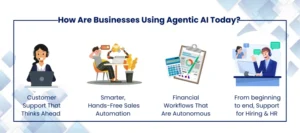
AI isn’t just a futuristic idea—it’s already helping real businesses solve real problems. Whether it’s sales, customer service, finance, or HR, smart AI agents are quietly taking over repetitive tasks and handling them with more intelligence and speed. Here’s how agentic AI systems are being used across different areas of a business:

Customer Support That Thinks Ahead

Forget basic chatbots that follow scripts. With this AI, businesses can now use AI agents that analyze a customer’s history, predict their needs, and resolve issues instantly—without bouncing the customer to five different departments. These systems don’t just respond—they act with context, improving support quality and response time. When paired with Salesforce AI, the results are even more impressive.

Smarter, Hands-Free Sales Automation

Imagine your sales process running on autopilot. Agentic AI for small business can research new leads, tailor email outreach, schedule meetings, and even tweak presentations based on how prospects interact with your content. It’s not just automation—it’s initiative. Backed by the right Salesforce Development Services, these systems can plug directly into your CRM and optimize your sales funnel without constant oversight.

Financial Workflows That Are Autonomous

These AI systems are analyzing transactions, identifying anomalous activity, creating reports, and monitoring compliance in finance departments—all while gaining knowledge from historical data. These AI agents improve daily tasks and lessen the workload associated with regular financial inspections.

From beginning to end, Support for Hiring and HR

These AI streamlines the hiring process, which can be time-consuming. AI agents are capable of handling every step of the hiring process, from organizing interviews and reviewing resumes to creating personalized onboarding materials for every new employee. Companies minimize manual bottlenecks, save time, and enhance the applicant experience. 

Conclusion 

Agentic AI is a significant change in the way small businesses may think, act, and expand; it’s not just another tech fad. These AI systems are doing more than just helping; they are actively influencing results, from automating customer service and sales to making real-time decisions in HR and finance. 

Small businesses can include AI agents in their everyday operations and begin to see results right away by utilizing platforms like Salesforce AI and collaborating with the best Salesforce Development Services. The goal is to empower your team with proactive, intelligent systems that reduce workloads and increase your success, not to replace individuals. 

Do you want to integrate AI into your Salesforce setup? Collaborate with AnavClouds Software Solutions, a reputable Salesforce consulting firm, to create scalable, intelligent solutions for your company. 

AI in Salesforce

What if small firms had access to the same intelligent tools that large corporations do, but without the expense or complexity? AI in Salesforce for small businesses has made it possible. You do not require a large group of employees or technical expertise to begin taking advantage of what AI is capable of accomplishing. That means small and growing businesses can now apply artificial intelligence capabilities in ways that improve their efficiency, lead to better decision making, and ultimately provide better customer experiences. 

AI-enabled CRM systems can help teams save time, eliminate mundane tasks, and give teams clear insights into customer behavior, all without creating more work. With platforms like Salesforce Einstein, you can use strategy to handle sales and support and have the ability to personalize your marketing and respond to what customers are asking for with greater speed. 

We’ll look at how Salesforce AI for small businesses is enabling small businesses to become more resilient, operate more effectively, and expand with assurance in this blog post—all while keeping things straightforward and useful. 

What is AI in Salesforce for Small Business? 

Salesforce AI for small businesses is an intelligent solutions, pioneered by Salesforce Einstein, that offer intelligent automation and profound insights into your day-to-day activities. Moreover, these technologies are embedded in the Salesforce Customer 360 platform. Small businesses can easily have customer data handled, workflows optimized, and overall engagement augmented without needing to invest in a big IT infrastructure. 

Consider using AI in Salesforce for your business to automate tasks that would otherwise be energy and time-consuming. AI-powered CRM software enables small teams to automate responses, personalize communication, and make data-driven decisions on time. 

Even small companies with minimal technology assistance can benefit. Intelligent chatbots, predictive analytics, and auto-monitoring add up to a lighter load and more effective operations. That is, small business CRM with AI is not only easy to use; it’s also an affordable way to do more with less. 

Use the power of AI in Salesforce to make smarter decisions, streamline sales, and grow faster.


How AI-Powered CRM Solutions Drive Small Business Success 

Artificial intelligence is no longer limited to enterprise giants. AI in Salesforce for small businesses has made strong automation and analytics accessible to even the smallest teams. Small businesses may employ AI solutions to optimize every step of the customer journey, from lead generation to revenue forecasting, as they become more widely available and easier to use. Here are some examples of how Salesforce’s AI is opening up new avenues for expansion, productivity, and cost savings.

Providing 24/7 Customer Service with Lean Staffing

Consumer demand and expectations are changing fast; customers want personalized service and instant replies at all hours. Unfortunately, most small businesses cannot hire sufficient customer service representatives. 

That is where Salesforce Einstein Bots can come into play. These AI-powered virtual assistants handle frequently asked questions with customers in real time and will keep working indefinitely. Bots can comprehend casual, conversational language, determine consumer intent, and pass on uninterrupted conversations to an actual customer service representative when necessary. The bots can even learn from their previous experiences to develop higher intelligence and accuracy. 

With this AI-powered CRM solution, you could continue to provide excellent service while avoiding the cost of increased staffing. The AI in Salesforce will enhance small business owners’ operating roles by improving customer satisfaction, reducing human agents’ workloads, and speeding up resolution time. 

Working More Efficiently with Smart, Automated Systems

For small business owners, time is a precious resource, just like in any other small firm. Repetitive, tactical duties like creating sales reports, setting up follow-ups, and entering customer data take up a large portion of their day. Salesforce’s AI-powered technologies can completely automate or eliminate many of these time-consuming chores, freeing up time for more strategic work. 

For instance, AI in Salesforce can create automated workflows, send out timely email reminders, and auto-fill data as part of your established processes. By being able to shift from tactical, legacy tasks, your small business will be able to focus on key issues related to relationship building, closing deals, and providing excellent service, instead of wasting time on administrative tasks.  

According to recent research, more than 75% of small business owners believe that AI allows them to focus on high-impact tasks. Salesforce development services enable your team to become more agile and results-driven by providing solutions that decrease distractions and increase daily output.

Cutting Down Operational Costs with AI Efficiency

Although it may seem like the only way to expand is to hire more staff or work longer hours, doing so comes with higher overhead. AI in Salesforce provides a more intelligent route instead. Small businesses can save a lot of money by using AI to automate low-level tasks that have historically required human input. 

With AI in Salesforce, you can perform tasks like appointment scheduling, simple query processing, and invoice generation without the possibility of human error. You can extend your services without increasing your payroll by using these technologies, which also function during off-peak hours. 

CRM systems driven by AI offer a more scalable configuration. You don’t have to scale your team proportionately to accommodate an increased workload. Because of this, Salesforce AI is an affordable partner for long-term expansion.

Personalizing Marketing at Scale with Einstein AI

Previously, personalized marketing was something that only larger companies could afford. That is no longer the case now, even small business teams can deliver the right content, the right offer, and the right campaign with Salesforce Einstein AI marketing solutions. 

By using tools such as Einstein Engagement Scoring and Einstein Content Selection, companies can deliver highly relevant messages in the appropriate channel based on a customer’s preferences and previous behavior. Whether sending emails, retargeting ads, or providing product recommendations, the platform provides assurance that the content is personalized while saving you hours of work executing complicated segmentation. 

AI in Salesforce not only increases overall marketing ROI, but click-through rates and email open rates as well. Generative AI capacity allows small businesses to quickly write draft content ideas for blogs, ad copy, and even social media posts saving time and creative energy while maintaining consistency. 

Prioritizing the Right Leads with Predictive Scoring

Your sales performance is dependent on how well you manage your leads. Pursuing cold leads can cause your efforts to falter when time and resources are few. This is where Salesforce Einstein Lead Scoring helps you make your process more accurate. 

Every new lead is given a score by AI in Salesforce using machine learning to examine engagement history, activity logs, and previous conversions. Sales teams can spend less time on unqualified prospects by concentrating on leads that have the best probability of converting. 

This is a game-changer for tiny companies. It guarantees that your team is closing more business in less time by working smarter, not harder. Salesforce AI tools help sales representatives remain productive and goal-focused by improving targeting and reducing sales cycles.

Forecasting Revenue with Confidence

Making plans for the future is one of the most difficult tasks small business owners have. Predicting revenue is frequently done with antiquated spreadsheets or intuition. AI in Salesforce, however, provides precise, AI-driven forecasts with Einstein Forecasting by utilizing historical data and current pipeline trends. 

This enables you to forecast monthly or quarterly revenue, identify bad deals early, and make well-informed choices regarding marketing expenditures, inventory, and recruiting. You can better manage your cash flow and lower the possibility of unpleasant surprises when you have a better understanding of performance. 

Salesforce AI technologies give small businesses aiming to scale responsibly the data-driven clarity they need to grow confidently and plan with accuracy. 

Role of AI in Salesforce

7 Smart Ways Small Businesses Can Leverage AI in Salesforce 

As competition heats up, growth requires more than simply hard work—it also requires the use of better tools. Small business CRM with AI allows firms to automate operations, optimize customer interactions, and make faster choices based on real-time data. Here are seven practical ways AI in Salesforce may help small businesses. 

Personalize the customer experience and automate

AI in Salesforce can improve the user experience by creating personalized routes based on real behavior. Within a single dashboard, you can categorize audiences, implement automated email campaigns, and tailor messages according to user behavior. 

Without using up all of their resources, small businesses may achieve a consistent and customized touch across the client lifecycle, from lead to retention, using AI-driven CRM systems. It means increased client loyalty and enhanced conversion rates with less effort. 

Utilize Generative AI to Automate Content Creation

From training material to e-mail promotional campaigns, generative AI capabilities integrated in platforms like Salesforce can produce world-class material in a matter of minutes. They are also sensitive to natural language and respond in real time, and that makes them ideal for social media tweets, product descriptions, and client e-mails. 

Although human intervention is still required, such AI in Salesforce enables teams to experiment, refine, and roll out content creation without compromising brand consistency and message consistency. 

Leverage Support with AI Chatbots

Modern AI-driven chatbots are much more than canned responses. They can pass on tough questions to a human representative seamlessly, identify customer intent, and provide context-sensitive responses. This enables small teams to receive round-the-clock assistance without the need to hire staff. Businesses can enhance service and lower ticket volume by integrating chatbots with solutions like Salesforce Service Cloud. The outcome? Better satisfaction, quicker response, and simpler-to-scale support strategy. 

Instantly Summarize Meetings and Capture Action Items

Not only is it time-wasting, but also ineffectual, to take notes by hand during meetings. With Salesforce AI tools, businesses are now able to record, document, and summarize their meetings in real-time. 

AI even identifies key decisions, action items, and follow-ups to keep the team on track without leaving out the important details. This is a very simple but very effective way to enhance inter-team communication. 

Automate Administrative and Repetitive Tasks

AI in Salesforce proves to be handy to small business owners who are used to having their hands full of numerous things at once. AI does administrative work effectively and efficiently, ranging from organizing calendars and filtering emails to billing and keeping records updated. By working in the back end, these activities free the work time of a team from routine tasks so that they can allocate their time to high-value activities that drive growth. In the long term, this creates valuable time and cost savings. 

Turn Customer Data into Predictive Insights

Small firms frequently find it difficult to have a comprehensive understanding of their clientele due to scattered data across platforms. Salesforce’s AI-powered CRM solutions combine your data to generate a 360-degree client profile, particularly with the help of products like Data Cloud. 

Einstein AI in Salesforce can identify churn concerns, forecast sales patterns, and suggest the best course of action once your data is integrated. AI improves your comprehension of client needs while ensuring data security and compliance for sectors like healthcare and finance. 

Optimize Your Social Media Strategy with AI

Success on social media requires more than just publishing frequently; it also requires posting intelligently. Artificial intelligence (AI) systems may evaluate performance data, spot trends in audience behavior, and suggest the ideal posting formats and times. 

You can also track engagement, A/B test content, and swiftly adjust to trends by utilizing AI in Salesforce. Without requiring a specialized social media team, this offers you an advantage in increasing brand recognition and turning engagement into leads. 

Conclusion 

AI in Salesforce is leveling the playing field for small enterprises. Salesforce AI solutions are revolutionizing what lean teams can accomplish, from streamlining processes and forecasting revenue to enhancing customer service and marketing personalization. 

We at AnavClouds Software Solutions assist small businesses in utilizing Salesforce development services to their fullest potential, including custom CRM setups driven by AI. If you’re prepared to expand more quickly and intelligently, schedule a free consultation with our experts to see what intelligent transformation might entail for your company. 

Frequently Asked Questions 

What advantages does AI have for small businesses? 

By automating mundane tasks, accelerating data analysis, and creating more sophisticated customer service tactics, artificial intelligence (AI) allows small enterprises to operate more effectively. Without the requirement for extensive IT infrastructure, it can lower operating expenditures, enhance decision-making, and enable groups to focus on more significant matters. 

How Salesforce leverages AI to help businesses expand?

Salesforce leverages these technologies to automate, enhance customer service, and tailor sales and marketing with products like Agentforce, Einstein GPT, and Einstein Lead Scoring. From enhanced consumer targeting to accelerated lead conversion, such products allow small businesses to achieve more with less. 

Does Salesforce AI only benefit large corporations? 

Not at all. Because Salesforce AI solutions are scalable, small and medium-sized enterprises can use them as well. Small departments can automate routine tasks, derive valuable insights, and fight more effectively against big companies with a small amount of resources using AI-powered CRM solutions. 

What are some actual uses of AI in small business operations? 

AI can be utilized by small businesses in numerous formats, such as utilizing chatbots for customer service management, forecasting sales trends, personalizing email marketing, or even summarizing meetings. These features are now more easily installable and accessible than ever before, thanks to tools such as Salesforce Einstein. 

Salesforce AI Strategy

Imagine a CRM that does more than just store data; it also actively learns from it, forecasting client needs, automating repetitive processes, and providing accurate guidance to your sales staff. That is the strength of a well-thought-out Salesforce AI strategy. Businesses can achieve new levels of efficiency and personalization by combining natural language processing, machine learning, and Salesforce Einstein AI. This is the new standard for Salesforce AI deployment, which turns your CRM into a strategic growth partner. It is not futuristic technology. Using AI in Salesforce is a game-changer that enables quicker, more intelligent decisions at every touchpoint, whether your goal is to improve customer experiences or shorten sales cycles. 

How a Strong Salesforce AI Strategy Fuels Smarter CRM 

Salesforce’s AI feature is fundamentally altering how businesses interact with their customers and data. Numerous industries are undergoing a revolution thanks to technologies like machine learning, natural language processing (NLP), Salesforce generative AI, and predictive analytics. 

With a clever Salesforce AI strategy, companies can do more than just gather data. Your CRM can anticipate customer behavior, learn from previous encounters, and assist your team in making quicker, more informed decisions by utilizing Salesforce Einstein AI. Rather than responding to issues, you are able to take proactive measures. 

Imagine receiving recommendations to seal a deal powered by AI, or being notified the instant a decline in client engagement takes place. Implementing Salesforce AI in this way transforms your CRM into a real growth engine that facilitates individualized interactions, real-time insights, and calculated business decisions. 

6 Key Benefits of a Well-Defined Salesforce AI Roadmap 

AI in Salesforce

More than just updating your CRM, a strong Salesforce AI strategy transforms how your company makes choices, provides value, and spurs expansion. Businesses that strategically integrate AI in Salesforce obtain a competitive edge through speed, intelligence, and personalization as AI becomes more and more integrated into digital transformation. 

Here are the core advantages of investing in a well-planned Salesforce AI strategy:

Smarter Forecasting with Predictive Intelligence

Your CRM can accurately predict customer behavior, market trends, and sales outcomes by combining Salesforce Einstein AI and cutting-edge machine learning. Your company can proactively spot fresh opportunities, highlight possible churn, and make real-time strategy adjustments thanks to this predictive intelligence. AI in Salesforce provides strategic foresight that improves decision-making and promotes steady growth, whether it is used to estimate quarterly sales or identify seasonal variations in demand. 

Personalized Customer Journeys at Scale

Delivering highly customized customer experiences at each touchpoint is made possible by Salesforce AI. With the help of Salesforce generative AI and natural language processing, your CRM can comprehend the specific intent of each customer and adjust communications, whether it be through customer service, product recommendations, or customized email content. This degree of customization not only increases interaction but also fosters enduring trust, giving your business a more responsive, relevant, and human feel on a large scale. 

Faster, Data-Backed Decision Making

Dispersed data is transformed into real-time insights via a strong Salesforce AI implementation, which leads to more intelligent business decisions. Service teams receive recommendations for future steps, sales representatives receive insightful prompts on deal progression, and marketers obtain insight into the effectiveness of their campaigns. AI in your Salesforce CRM guarantees that your entire team works with up-to-date counsel supported by data, not conjecture, as opposed to manual reports or assumptions. 

Operational Efficiency Through Intelligent Automation

The way artificial intelligence (AI) in Salesforce automates routine tasks is among its most obvious advantages. Lead scoring, follow-ups, and process routing are among the duties that AI-powered systems handle, reducing manual labor and accelerating execution. By enabling people to focus on higher-value work while maintaining consistent output and customer experience, intelligent automation boosts productivity across sales, service, and marketing departments. 

Optimized Resource Allocation

AI may be used by businesses to make better use of their time, talent, and resources. Salesforce AI analyzes data from many channels to determine what works, where gaps exist, and where to refocus efforts for maximum impact. By applying these insights, your Salesforce Development Services team can enhance workflows and boost ROI in areas such as customer service interactions, sales outreach, and campaign effectiveness. Real-time AI analytics facilitates and improves the accuracy of strategic resource allocation. 

Scalable Intelligence Across Business Units

Across teams, departments, and business divisions, a strategic Salesforce AI architecture is made to grow. AI capabilities adjust to new objectives, clients, and procedures as your company expands, guaranteeing uniformity and cooperation at all levels. AI becomes more than just a tool when you work with the appropriate Salesforce CRM consulting partner; it gets ingrained in your company’s DNA, bringing data, processes, and insights together for cohesive, smart business growth. 

How to Build a High-Impact Salesforce AI Solution 

A well-crafted Salesforce AI strategy doesn’t happen by chance—it’s a thoughtful, phased process that transforms your CRM into a proactive growth engine. Here’s a step-by-step guide to successfully implementing AI in Salesforce for long-term business value: 

Assess Business Needs and Define AI Goals

Begin by conducting a thorough evaluation of your present Salesforce CRM processes. Determine any bottlenecks, such as variable service quality, missed follow-ups, or poor lead response times. Once these holes have been identified, fill them with Salesforce AI features like chatbots with AI or predictive lead scoring. Establish quantifiable, explicit objectives, like lowering churn or speeding up lead qualifying. These established KPIs give you a standard by which to measure the effectiveness of your AI strategy and help your team stay on the same page. 

Prepare for Seamless AI Integration

Make sure your data is correct, consistent, and clean before beginning implementation. Even the strongest Salesforce AI deployment can be hampered by poor data. Collaborate with skilled Salesforce Development Services teams to adapt Salesforce Einstein AI and other solutions to your workflow. Integration should be done carefully; if necessary, integrate internal systems or third-party apps, but give compatibility and scalability first priority. Keep in mind that AI can only produce as good insights as the data it is fed. 

Drive Adoption Through Training and Culture

Although AI tools are strong, their value lies in their uptake. Encourage an internal culture that views Salesforce generative AI as an ally rather than a substitute. Organize training sessions, include staff in test projects, and acknowledge immediate successes. Teams are more willing to adopt AI when they realize how it may help with repetitive chores like manual reporting or initial customer responses. Often, a mentality change is just as crucial as the technology. 

Monitor Results and Optimize Continuously

After deployment, use your Salesforce CRM consulting dashboards to monitor results in real time. Examine performance metrics such as customer satisfaction ratings, response times, and sales velocity. The flexibility of AI in Salesforce allows you to modify NLP models, fine-tune algorithms, or retrain chatbots in response to user input. Your Salesforce AI strategy will adapt to changing market conditions and client demands thanks to ongoing optimization. 

Scale AI Use Across Departments

Look beyond sales and service after the first results are in. Apply your Salesforce AI strategy to operations, marketing, or finance. While finance might utilize AI to estimate revenue or identify anomalies, marketing teams can profit from intelligent segmentation and content creation. Every team will benefit from intelligent automation thanks to a scalable AI model, which increases organizational efficiency and synergy. 

Leverage Expert Support for AI Customization

Collaborate with professionals in Salesforce CRM consulting and Salesforce AI deployment to maximize your investment. These experts can integrate specialized technologies, provide long-term support, and customize solutions to fit your business model. From setting up machine learning models to using natural language processing to optimize workflows, professional advice increases success rates while lowering the possibility of errors. 

Conclusion 

Businesses may embrace proactive, data-driven growth instead of reactive decision-making with the help of a well-executed Salesforce AI strategy. Deeper customer insights, improved operational efficiency, and scalable automation throughout your company are all achieved by integrating Salesforce generative AI and other intelligent technologies into your CRM. Clear objectives, clean data, team adoption, and ongoing improvement are necessary for successful deployment since they guarantee that your AI-driven Salesforce solutions develop in tandem with your business requirements. By collaborating with experienced Salesforce CRM consulting experts like AnavClouds Software Solutions, you may quicken your path and fully use AI-powered Salesforce tools to support more intelligent, long-term growth. 


FAQs 

How does AI improve Salesforce CRM? 

Salesforce AI translates data patterns into predictions of customer behavior, automates repetitive tasks, and provides real-time insights. It leads to improved forecasting, personalized messaging, and intelligent resource allocation for sales, marketing, and service teams. 

Do I need professional help with Salesforce AI deployment? 

Though there are firms that are capable of doing it independently, partnership with experienced Salesforce CRM consulting and Salesforce Development Services can ensure flawless integration of AI, customization, and ongoing optimization for optimal ROI. 

How do businesses start integrating AI into Salesforce? 

Start by examining your current CRM processes and identifying areas of pain. Establish appropriate AI goals, cleanse your data, and collaborate with Salesforce Development Services to customize and implement AI technology like Einstein AI. Training employees and constant monitoring of outcomes are also steps required. 

What is the role of Salesforce Einstein AI in CRM?

Salesforce Einstein AI is AI technology native to Salesforce that powers predictive analytics, natural language processing, and automation. It allows your CRM to learn by experience and offers valuable insights to help you achieve improved business outcomes.