
Salesforce Unmanaged vs Managed Packages: A Clear Comparison
In the manner of application building, distribution, and maintenance, Salesforce packaging has a vital role to play. The problem is that it is not always possible to find the appropriate type of package to be successful in the long term. The concept of Salesforce unmanaged vs managed packages assists organizations in preventing technical debt, security, and scalability challenges.
The Salesforce packages provide a way to determine how metadata, custom logic, and configurations are provided in different environments. The false package decision may multiply the working efforts and restrict its future development. The guide describes Salesforce unmanaged and managed packages in a non-technical and business-oriented manner.
Understanding Salesforce Packages in the Modern Ecosystem
Salesforce packages metadata items such as objects, Apex classes, flows, and Lightning pages into deployable items. These packages assist in the grouping of features between the environments in a way that is consistent and can be controlled. New Salesforce packages include quicker releases, cleaner deployments, and collaboration to a greater extent amongst development teams. They are also significant towards scalable Salesforce development services and long-term platform governance.
Salesforce has various packaging models that can address various business and distribution requirements. Managed and unmanaged packaging models are the most popular models. The unmanaged vs managed packages of Salesforce assist in planning secure deployments and upgrades of Salesforce to organizations. Before making AppExchange or enterprise distribution decisions, it is necessary to have clear knowledge of Salesforce managed and unmanaged packages.
What Is a Salesforce Unmanaged Package
A Salesforce Unmanaged Package consists of metadata that can be entirely edited once it is installed in any Salesforce organization. An Unmanaged Package has no limitations on the editing of objects, Apex classes, and configurations. The unmanaged packaging is flexible enough to be customized quickly and deployed internally. Nevertheless, in Salesforce managed vs unmanaged packages, this freedom lessens the long-term control and consistency.
Organizations are known to deploy Salesforce packages to their internal tools and short-term projects in an unmanaged format. These are good packages when there is a need to have client-specific changes that are to be performed frequently. Uncontrolled packages, on the other hand, do not have version control, upgrade paths, and governance. In comparison between Salesforce unmanaged and managed packages, unmanaged packaging is more flexible in nature and not scalable or well-structured in its maintenance.
What Is a Salesforce Managed Package
A Salesforce managed package is created to be distributed under control, secured, and long-term application management. The package owner does have control over updates, guarded parts, and versioning. Such a structure guarantees upgrades are predictable and the consistency of performance in Orgs. Managed vs unmanaged packages: Salesforce Unmanaged Enterprise solutions and commercial applications are more popular using managed packages. They are required for any Salesforce AppExchange package made for public distribution. The benefit of working with a Salesforce managed service provider is that the businesses experience automated upgrades and lifecycle control. In the Salesforce unmanaged vs managed packages comparison, it is evident that managed packaging places more emphasis on stability, security, and long-term maintenance.
Core Difference Between Salesforce Unmanaged vs Managed Packages
The major distinction between Salesforce unmanaged and managed packages is control and ownership. Intellectual property protection and upgrade support are achieved by protected managed packages. Unmanaged packages are easy to customize but provide maintenance difficulties.
Namespace protection and version tracking are done in managed packages. Uncontrolled packages leave everything to alter. The difference will have an effect on security, scalability, and operational efficiency.
Customization Flexibility Compared
Unmanaged packages allow developers to edit every component after installation. This approach suits internal tools and experimental implementations. However, uncontrolled changes often lead to technical debt and inconsistent environments.
Managed packages restrict edits to protected components while allowing extensions. Customization happens through configurations and add-ons. This ensures predictable behavior across orgs. In Salesforce unmanaged vs managed packages, flexibility comes at the cost of long-term control.
Upgrade and Maintenance Considerations
Unmanaged packages do not support automated upgrades or version alignment. Each update requires manual changes or redeployment. This increases risk during Salesforce releases and organizational scaling.
Managed packages offer structured upgrade paths with backward compatibility. New versions deploy without breaking existing configurations. This makes them ideal for scalable solutions and Salesforce managed service provider models. Maintenance effort is a key factor in Salesforce unmanaged vs managed packages decisions.
Security and Intellectual Property Protection
Unmanaged packages expose Apex code, configurations, and logic. This creates security risks and limits intellectual property protection. Businesses distributing proprietary solutions face higher exposure with this model.
Managed packages secure sensitive components using namespace protection. Unauthorized changes are prevented by design. This security is essential for enterprise-grade solutions and commercial offerings. Security heavily influences Salesforce unmanaged vs managed packages selection.
AppExchange Distribution Readiness
Only managed packages qualify for public distribution on Salesforce AppExchange. Salesforce enforces strict review standards covering security, performance, and upgrade safety. This builds trust for customers and partners.
Unmanaged packages cannot be listed publicly and remain limited to private sharing. They are unsuitable for commercial distribution. For ISVs, Salesforce unmanaged vs managed packages is a strategic decision, not a technical preference.
First Generation Packaging (1GP) vs Second Generation Packaging (2GP)
Salesforce originally introduced First Generation Packaging (1GP) to support early managed and unmanaged models. While effective initially, 1GP offers limited version control and weak DevOps alignment. These limitations affect upgrade flexibility and release management in complex environments. In Salesforce unmanaged vs managed packages, 1GP often restricts long-term scalability.
Second Generation Packaging (2GP) was designed to support modern development practices and automation. It aligns closely with source control systems and CI/CD pipelines. Managed Packages in Salesforce increasingly rely on 2GP for modular development and faster releases. Understanding this evolution improves strategic decisions around Salesforce unmanaged vs managed packages and enterprise deployment planning.
Use Cases for Salesforce Unmanaged Packages
Salesforce Unmanaged Package models are best suited for controlled, non-commercial scenarios. They provide full access to metadata, enabling unrestricted customization after deployment. These packages work effectively when long-term upgrades and governance are not required. In Salesforce unmanaged vs managed packages, unmanaged packaging supports speed and flexibility over stability.
Organizations commonly use Salesforce packages in unmanaged form for internal development needs. They are ideal for environments where teams want direct control over components. However, unmanaged packages should not be used for scalable or revenue-generating solutions. A clear use case definition is critical when evaluating Salesforce unmanaged vs managed packages.
Key use cases and highlights include:
- Internal tools requiring rapid customization without upgrade dependencies
- Proof-of-concept projects validating business ideas or technical feasibility
- Sandbox testing and developer experimentation environments
- One-time deployments with no recurring update requirements
- Temporary solutions during early-stage Salesforce development services
While unmanaged packages offer freedom, they lack version control and upgrade paths. This limitation increases risk as systems grow. Understanding these boundaries ensures better decisions in Salesforce unmanaged vs managed packages planning.
Use Cases for Salesforce Managed Packages
Salesforce managed package models are built for scalability, security, and long-term product management. They are the preferred choice for ISVs, SaaS providers, and enterprises delivering repeatable solutions. In Salesforce unmanaged vs managed packages, managed packaging enables structured growth and predictable lifecycle control.
Organizations offering Salesforce managed service solutions depend on managed packages for controlled upgrades and governance. These packages ensure consistent performance across multiple orgs. Businesses working with a Salesforce managed service provider benefit from reduced operational risk and centralized management.
Key use cases and important highlights include:
- ISVs building commercial applications for the public Salesforce AppExchange package distribution
- SaaS providers requiring secure code protection and controlled releases
- Enterprises managing multiple client orgs with standardized deployments
- Long-term solutions need recurring upgrades and version control
- Organizations delivering ongoing Salesforce development services at scale
- Teams requiring licensing, dependency tracking, and namespace protection
Managed packaging supports consistency, security, and automation. It minimizes manual intervention and future rework. These strengths clearly define success in Salesforce unmanaged vs managed packages selection.
Salesforce Unmanaged vs Managed Packages: Cost & Efficiency Comparison
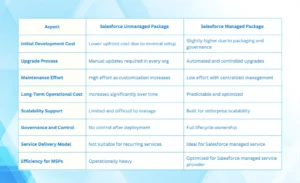
Understanding cost and operational impact is critical when comparing Salesforce unmanaged vs managed packages. While upfront costs may look similar, long-term efficiency varies significantly. The table below highlights key operational differences clearly.
How to Choose Between Salesforce Unmanaged vs Managed Packages
Selecting between Salesforce unmanaged vs managed packages is a strategic decision that affects scalability, security, and long-term costs. Instead of viewing this as a technical choice, businesses should evaluate it through usage, growth, and operational lenses.
Define Your Distribution and Usage Model
Start by identifying how the solution will be used and distributed. Internal tools with limited users often align with a Salesforce Unmanaged Package. These packages support quick customization without distribution complexity.
Commercial products, client-facing solutions, and AppExchange offerings require a Salesforce managed package. Managed packaging supports controlled releases and broader adoption. Distribution intent is the first filter in Salesforce unmanaged vs managed packages selection.
Evaluate Scalability and Upgrade Requirements
Scalability requirements clearly separate Salesforce unmanaged vs managed packages. Unmanaged packages struggle as environments expands and updates increase. Each upgrade requires manual intervention, increasing operational risk.
Managed packages support structured upgrades and version control. This makes them suitable for growing businesses and recurring deployments. Scalability planning strongly favors managed packaging.
Assess Security and Governance Needs
Security expectations vary by business model. Unmanaged packages expose metadata and logic, increasing security and intellectual property risks. This model works only in controlled internal environments.
Managed packages protect Apex code and enforce governance through namespace control. Businesses delivering Salesforce managed service solutions require this level of protection. Security is a defining factor in Salesforce unmanaged vs managed packages decisions.
Compare Customization vs Control
Customization flexibility is often misunderstood in Salesforce unmanaged vs managed packages. Unmanaged packages allow unrestricted edits but create inconsistency over time. This leads to technical debt and support challenges.
Managed packages limit direct edits but support extensions and configurations. This balance ensures stability while still meeting business-specific needs. Control becomes more valuable as solutions mature.
Consider Long-Term Maintenance and Support
Maintenance effort grows with system complexity. Unmanaged packages demand continuous manual updates and troubleshooting. This increases dependency on development resources.
Managed packages reduce maintenance overhead through automation and lifecycle management. Organizations working with a Salesforce managed service provider benefit from predictable support models. Long-term efficiency favors managed packaging.
Final Thoughts
Choosing between Salesforce unmanaged vs managed packages is a strategic decision that shapes scalability, security, and long-term success. Unmanaged packages suit short-term internal use, while managed packages support growth and controlled distribution. Businesses must evaluate lifecycle costs, upgrade needs, and governance requirements carefully. Partnering with experts simplifies this decision. AnavClouds Software Solutions helps organizations choose, build, and manage the right Salesforce packaging strategy. With deep expertise in Salesforce development and managed services, AnavClouds ensures secure, scalable, and future-ready Salesforce solutions.

