

Salesforce Sales Cloud Implementation Challenges Decoded
Salesforce Sales Cloud is one of the most popular CRM systems, which is used to assist companies in the optimization of sales, customer service, and revenue optimization. Nevertheless, Salesforce Sales Cloud implementation challenges are faced by many organizations in the implementation process. Strategic constraints such as data migration are common; user adoption is low; over-customization is evident; and there are problems integrating with sales and marketing platforms. It is essential to understand these obstacles and overcome them in the initial stages to maximize Salesforce Sales Cloud ROI by 2026. The use of professional Salesforce development services or the employment of an authorized Salesforce Sales Cloud consultant can make the implementation even easier, streamline procedures, and make the adoption of Sales Cloud successful.
Common Salesforce Sales Cloud Implementation Challenges
The advantages of adopting Sales Cloud are enormous, and many organizations encounter all types of challenges that might impede its adoption and reduce ROI. Knowing these challenges in advance will enable a business to plan efficiently, prevent expensive errors, and have a seamless deployment. These pitfalls tend to include strategy misalignment, data challenges, resistance to adopting it, and technical constraints.
Strategic Misalignment Across Teams
Strategic misalignment is among the most prevalent Salesforce Sales Cloud implementation challenges that organizations have encountered. Opposing objectives of sales, marketing, and leadership lead to confusion and sluggish adoption. Categories of KPIs, ambiguous ownership, and mixed expectations are common in the teams. Sales Cloud initiatives cannot take off without a healthy executive commitment. The Salesforce Sales Cloud implementation challenges are more pronounced in the context of the sales and marketing data integration process. This results in disjointed reporting, as well as the inability to see the pipeline.
Data Migration and Integration Complexities
The challenges associated with Salesforce Sales Cloud Implementation remain a controversial aspect of data-related issues. Movement of the old CRM data into Sales Cloud is difficult and time-consuming. Duplications, old records, and differences in forms impact data reliability and reporting accuracy. Many businesses do not estimate how tough data cleansing and validation would be. Incorporating Sales Cloud into the ERP systems, Marketing Cloud, or custom CRM development for SMBs, these Salesforce Sales Cloud implementation challenges are only multiplied.
Change Resistance and Adoption Issues
One of the most significant causes of Salesforce Sales Cloud implementation challenges is user resistance. Sales teams tend to view Sales Cloud as an administrative aspect of the company, and not a productivity facilitator. Lack of communication and generic onboarding reinforce Salesforce Adoption Challenges. When the user cannot grasp the Salesforce features, then the adoption can drop drastically. Poor adoption can impact the forecast’s accuracy and pipeline management, as well as Salesforce Sales Cloud ROI.
Over-Customization and Configuration Pitfalls
One of the Salesforce Sales Cloud implementation challenges that has been ignored is over-customization. Such additional custom workflows, unneeded fields, and uncontrolled triggers create additional technical debt. Although these customizations will address short-term requirements, they will make upgrades and long-term maintenance difficult. The Sales Cloud is not easily scaled in organizations that lack governance structures. Such Salesforce Sales Cloud implementation challenges commonly lead to greater costs and a lack of flexibility in the system.
Budget Overruns and Resource Limitations
Budget excesses are very common results of ill-calculated Salesforce Sales Cloud implementation challenges. Sudden integrations and additions of scope, as well as longer timelines, add to the overall expenses. Other training needs and the dependency on outside consultants further limit budgets. There is a lack of internal expertise that makes it hard to manage the costs of implementation. These Salesforce Sales Cloud implementation challenges will slow the realization of value and decrease ROI without realistic planning.
Compliance, Security, and Governance Gaps
Security and compliance vulnerabilities are grave Salesforce Sales Cloud implementation challenges. The Sales Cloud stores sensitive consumer and revenue information, and as such, there must be effective governance. Weak access control and low compliance planning expose them to data breaches. Violation of such regulations as GDPR or HIPAA may result in punishment and loss of reputation. These Salesforce Sales Cloud implementation challenges can only be overcome by having strong governance structures.
Release Management and Platform Evolution
Another essential Salesforce Sales Cloud implementation challenge is the frequent Salesforce updates that are very difficult to manage. Unless tested appropriately, new releases may interfere with custom workflows, integrations, and reports. Several companies do not perform sandbox testing, which exposes them to more risks in production. Failure to adhere to the planned release results in downtime and frustration for the users. These Salesforce Sales Cloud implementation challenges can be minimized by efficient release management to maintain the stability of the system.
Performance and Scalability Challenges
Scalability is one of the Salesforce Sales Cloud implementation challenges because performance challenges to the business arise with expansion. The large volumes of data, automation of complex natures, and inefficient reporting slow down system responsiveness. Inadequate architecture hinders scalability in the long-run and affects the user experience. These Salesforce Sales Cloud implementation challenges are best solved at the outset and will guarantee uniform performance. Scalable design will be directly aligned with a greater Salesforce Sales Cloud ROI 2026.
Proven Solutions to Overcome Salesforce Sales Cloud Challenges
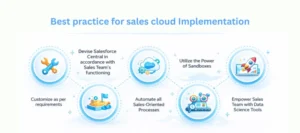
Although the Salesforce Sales Cloud implementation issues are critical, they can be addressed using the appropriate tactics. Through responding to every challenge proactively, businesses will be able to enhance adoption, streamline the process, and maximize Salesforce Sales Cloud ROI. The following practical fixes offer actionable steps to overcome these hurdles and ensure successful implementation.
Align Teams and Define Clear Goals
A successful Salesforce Sales Cloud implementation requires a definition of sales and marketing alignment as well as leadership alignment. Setting the common goals, KPIs, and ownership allows all to work in the same direction. Effective direction and executive backing minimize mix-ups and eliminate early-stage Salesforce Sales Cloud implementation challenges. Clear objectives also assist teams to gauge success, monitor advancement, and ensure accountability in the implementation lifecycle.
Clean and Integrate Data Effectively
Data quality issues are one of the most prevalent Sales Cloud problems during implementation. Data audits, deletion of duplicates, and standardization of records make sure that there is accuracy and reliability in the records. The data integration of sales and marketing is smooth, thereby enhancing reporting, forecasting, and cross-team visibility. Clean data also enhances automation accuracy and ensures Salesforce features deliver meaningful insights.
Boost User Adoption with Targeted Training
The low adoption rate is a significant element that lowers the value of Sales Cloud and affects ROI. Training roles assists users in finding out how Salesforce can facilitate daily sales and pipeline management. Continued enablement, in-app directions, and utilization tracking mitigate resistance and overcome Salesforce Adoption Challenges. The increased adoption will enhance productivity, reporting accuracy, and the system’s effectiveness.
Control Customization and Configuration
Excessive customization raises the technical debt and slows down the system performance over time. A configure first, customize strategy intentionally, guarantees the complete utilization of native Salesforce features by businesses. Scalability controlled through customization is easy to upgrade and maintain. Frequent reviews avoid unwarranted complexity and safeguard the platform’s stability in the long term.
Manage Budgets Proactively
Salesforce Sales Cloud implementation does not always go according to plan, with integrations or change requests usually occurring or costs being incurred during implementation. Priority-based phased budgeting is useful in cost management of businesses. The collaboration with the experienced Salesforce development services will allow for allocating resources efficiently. Financial planning beforehand ensures ROI is safeguarded and avoids project delays.
Ensure Compliance and Security
The Sales Cloud deals with sensitive customer and revenue information, hence the importance of governance. Security threats are minimized by providing clear access controls, permission audits, and compliance checks. In-built Salesforce security features assist in addressing regulatory needs without the loss of credibility. Well-established governance models also contribute to the accuracy of data and scalability.
Plan Releases Strategically
Salesforce issues update regularly, which are capable of affecting workflows and integrations. The exercises of variation within a sandbox environment ensure that the production systems are not interrupted. Planned release allows businesses to gain new features without taking risks to their operation. Correct documentation will aid in the smooth transition and stability of the system.
Optimize Performance and Scalability
With the expansion of organizations, Sales Cloud will need to process an increased amount of data and automation load. Speed, reliability- Scalable data models and optimized workflow. Monitoring of performance makes the user experience similar across teams. Sustainable growth and increased Salesforce Sales Cloud ROI 2026 are facilitated by long-term optimization.
Essential Tips for Leveraging Salesforce Sales Cloud Effectively
- Using both the Marketing Cloud ROI and Sales Cloud will make the customers more engaged and campaign tracking better.
- A tailor-made CRM development for SMBs must be oriented on scalability and usability without necessarily complicating working processes.
- Bringing on board a qualified Salesforce Sales Cloud consultant expedites implementation, adoption, and ROI.
Conclusion
Preventing Salesforce Sales Cloud implementation challenges can enable organizations to realize the full potential of their CRM. Strategic alignment, user adoption, proper customization, and the pursuit of clean data can help businesses become more efficient and achieve measurable outcomes. Together with professional Salesforce development services and complete Sales and marketing data integration, make sure that Salesforce Sales Cloud ROI 2026 is maximum. Collaborating with a reliable provider such as AnavClouds Software Solutions enables organizations to implement Sales Cloud without issues, address obstacles that may occur, and realize growth in the long-term, increased efficiency in their operations, and higher sales.
FAQs
What are Salesforce Sales Cloud challenges?
Salesforce Sales Cloud implementation challenges that are common to businesses include poor user adoption, challenges in migrating data, and excessive customization. These integrations may also cause delays and inefficiencies unless they are planned well.
How can I improve Salesforce Sales Cloud adoption?
Role-specific training, in-app instructions, and effective alignment between the sales, marketing, and leadership teams are the factors that enhance adoption. Salesforce can be made easy to accept by using its features.
Why hire a Salesforce Sales Cloud consultant?
An official Salesforce Sales Cloud consultant assists the companies to deploy the platform most efficiently, address frequent Salesforce Sales Cloud issues, and streamline operations. Their professionalism guarantees an increase in adoption and ROI.
What are the benefits of Salesforce Sales Cloud?
Salesforce Sales Cloud facilitates sales, customer management and increases the accuracy of the reporting. It also enables Sales and marketing data integration to make more decisions and grow in the long-term.

