
Salesforce Low-Code Platform Explained for Modern Businesses
Construction of the business applications must not hinder the process of innovation and suck up the development of funds. The Salesforce Low-Code Platform transforms the way companies develop applications by eliminating unnecessary complexity. Visual tools and ready-to-use logic allow businesses to design, automate, and deploy applications more quickly than in long development cycles. This will allow teams to be responsive to shifting needs and still provide enterprise-level security and scalability. The Salesforce low-code platform allows fast and flexible development of solutions, enabling IT teams and business users to work together, simplify processes, and create solutions that work directly in business growth.
What Is Salesforce Low-Code Platform?
The Salesforce Low-Code Platform aims to ease the process of application development for companies of any size. This platform uses visual development tools, drag-and-drop interfaces, and ready-made templates to develop business applications, unlike the traditional method of coding. By adopting Salesforce’s low-code platform, businesses can optimize the development time, enhance productivity level, and ensure high quality compliance and security. This platform is suitable for creating applications ranging from simple internal tools to complex, enterprise-wide solutions.
The low-code style provides an opportunity for business users and IT teams to be involved in development. This is a collaborative model that minimizes bottlenecks and allows organizations to provide apps that align with their operational and strategic objectives. With this, businesses can innovate faster, adapt to the evolving markets, and streamline the processes with minimal knowledge of coding.
7 Top Features of Salesforce Low-Code Platform
The Salesforce Low-Code Platform is a full package comprising features created to speed up application development, while maintaining performance, security, and usability. The following is a closer examination of the main characteristics that render Salesforce low-code development an optimal platform to consider in the contemporary business domain.
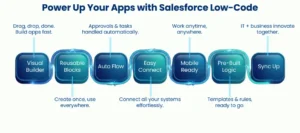
Visual App Builder
Visual App Builder allows Salesforce to develop its low-code using a simple drag-and-drop interface. This is one of the best low code features through which businesses can create applications, dashboards, and workflows without excessive amounts of coding. This aspect enhances quicker development cycles, better co-operation among teams, and offers user-friendly applications that are enterprise-ready with the changing demands of business.
Reusable Components
Reusable components make Salesforce low-code development easier by enabling developers to reuse built-in UI, logic, and workflow in more than one application. This eliminates redundancy, as well as consistency and expediency in delivery. The organizations enjoy the scalability of development without compromising quality and can develop solutions faster and with governance.
Workflow Automation
It is also a great Salesforce low code features with the capability to automate approvals, task routing, alerts, and data updates. Businesses save on repetitive manual labor, which helps in error reduction and enhances efficiency. The use of automated workflows assists the teams in concentrating on strategic activities, whereas the operations are consistent and reliable.
Integration Capabilities
The Salesforce low-code platform features have good integration capabilities with Salesforce clouds, ERP systems, and third-party applications. This facilitates data flow and integration of cross-platform operations. Companies can break down data silos, improve connectivity between systems, and develop applications that are compatible with existing technology ecosystems.
Mobile Responsiveness
Mobile responsiveness guarantees that low-code features developed using Salesforce are compatible with all devices. Whenever needed, the users have access to dashboards, approvals, and workflow monitoring. The feature allows supporting the latest work settings, productivity, and user engagement without the necessity of additional mobile application development.
Pre-Built Business Logic
Pre-built business logic offers pre-crafted rules, templates, and compliance structures in Salesforce low-code development. Organizations can adopt standardization processes within a short time and minimize risks with regard to development. The feature provides reliability, speed in deployment, and compatibility with industry best practices in custom applications.
Summary of Low-Code Platform Features
Salesforce low-code platform features make it possible for faster application development, effortless integrations, and scalability. Salesforce low-code platform allows organizations to be more agile, operationally efficient, and innovative, without adding to the technical complexity, which is why it is perfect in the modern growth-oriented enterprise.
Benefits of Salesforce Low-Code Development
The development of Salesforce on the low-code platform offers several strategic and operational benefits to organizations. It facilitated quicker development of applications, cost reduction, and enhanced cooperation. In the following part, the major advantages of low-code development that justify it as a sensible investment by businesses will be explained in detail.
Shortened Development Lifecycle
Salesforce Low-Code Platform saves a lot of time when it comes to creating applications. The use of drag-and-drop, ready-made templates, and visual workflows enables teams to design, test, and deploy solutions at a faster rate. This is the fast-tracked development that allows organizations to respond promptly to business demands, roll out important applications in a shorter time, and have an advantage over the competition in the digital environment.
Lower Development Costs
Salesforce’s low-code development lowers the cost of application development by helping citizen developers and eliminating the need for large IT teams. Ready-to-use modules, re-use components, and automation save time and effort, as well as offer enterprise-quality solutions. Organizations can optimize their budget, conserve resources, and realize a cost-effective digital transformation without any functionality or security compromise.
Improved Collaboration Between IT and Business Teams
The concept of Salesforce allowing low-code development facilitates the interaction between IT and business departments since both teams have a common application creation platform. The workflow and logic can be designed by both technical and non-technical users. Such alignment will make sure that solutions are delivered to the real business needs, approvals are made swiftly, and less confusion among teams is achieved, thus improving the effectiveness of operations.
Enhanced Agility
The Salesforce Low-Code Platform enables companies to respond swiftly to changes in business requirements, regulatory, or market trends. Applications may be changed, new workflows may be implemented, or tools may be integrated without long code. Such agility keeps organizations agile, delivers faster time-to-market, and keeps them efficient, making low-code development a competitive advantage to businesses.
Simplified Application Maintenance
Salesforce’s low-code development is simpler to maintain enterprise applications because of its modularity and reusability. They can be used to make updates, fix bugs, and make enhancements in several applications very fast. This makes it less technical, minimizes downtimes, and enables IT staff to concentrate on strategic projects with a stable and consistent performance of the applications.
Scalability for Growing Enterprises
The Salesforce Low-Code Platform enables scalable application development, which enables solutions to expand along with organizations. Standardized, reusable parts and logic ensure enhanced user experience, transactions, and functionality. Those businesses that embrace Salesforce low-code development will experience a smooth expansion of applications, which will not disrupt operations, enabling them to support growth and comply with the changing technology needs.
Fostering Innovation Through Citizen Developers
Low-code solutions enable citizen developers to add innovative solutions. The Salesforce low-code platform allows employees who may lack knowledge of coding to build workflows, automate activities, and experiments. This democratization enhances innovation and speed of resolving issues, as well as enables organizations to use the shared wisdom of teams in providing innovative applications in an efficient manner.
Measurable ROI and Operational Efficiency
The use of the Salesforce Low-Code Platform can generate a tangible ROI by delivering applications more quickly, at a lower cost, and more efficiently. Robots, teamwork, and efficient development increase team productivity. Those businesses that have embraced Salesforce low-code development realize real value, cut on investments in technology, and speed up digital transformation programs in operations.
Low-Code vs No-Code Salesforce Development
This Low-code vs No-code Salesforce Development understanding is one of the factors that require businesses to choose the correct platform. The no-code platforms enable users who are not technical to build applications using pure visual interfaces without any code. Low-code platforms, in turn, offer the freedom to add custom code where necessary, and they work with complex workflows and integrations. The low-code platform offered by Salesforce is a medium-ground that allows collaboration between professional developers and business users. Such a hybrid model enables organizations to retain control over the important processes and speed up the process of application delivery.
Challenges and Solutions for Adopting Salesforce Low-Code Platform
The implementation of the Salesforce Low-Code Platform has the potential to change the way business is conducted, yet there might be obstacles to adoption by organizations. The hurdles and remedies that can be used to overcome obstacles to a successful adoption of Salesforce low-code development are as follows:
Challenges
- Limited Customization for Complex Processes: Very complex processes can need extra code to be written that low-code software cannot support, restricting the adaptability in complicated situations.
- Resistance from IT Teams: Teams that are used to the traditional development process can be reluctant to use low-code systems due to the fear of losing control or the ability to disrupt current processes.
- Learning Curve for Business Users: Drag and drop tools, automation, and pre-built templates require non-technical employees to take time to master in order to be effective users of these application development tools.
- Governance and Quality Assurance Concerns: Without adequate monitoring, mass deployments may end up with inconsistent processes, unsecured deployments, or non-conforming applications.
Solutions
- Partner with Salesforce Development Services: Professional advice will help in achieving the correct configuration and integration, along with best practices, which will facilitate easy low-code adoption.
- Provide Training for Citizen Developers: Proactive training programs will enable non-technical users with the capacity to build applications with the goal of ensuring quality standards.
- Gradual Implementation: The low-code applications should be introduced in phases and alongside other systems to give the teams time to test, adjust, and embrace the new platform.
- Implement Governance and QA Frameworks: Put documentation, approval process, and regular audits in place to enforce compliance, security, and consistency in operations.
Best Practices for Salesforce Low-Code Development
The Salesforce Low-Code Platform offers the best practices to use to ensure the best utilization of what it offers, which is efficiency, scalability, and collaboration. The strategies can be used to create teams that create reliable, secure, and innovative applications, as well as to ensure that the Salesforce low-code platform adoption is smooth.
- Start Small: Cases start small and increment complex cases.
- Document Everything: Document the workflows, components, and templates so that they can be easily maintained.
- Set Governance Standards: Define rules, approval, and accessibility to promote compliance and security.
- Update Regularly: Maintain regular updates on the applications based on the changing needs of the business and new features.
- Foster Collaboration: Pairing IT and businesspeople are a good way to enhance adoption and innovation.
- Use Reusable Components: Reuse ready-made modules to be faster and more error-free.
- Test Thoroughly: Distinct workflows and integrations, to sustain high performance and reliability.
- Plan for Scalability: Develop applications capable of scaling as the number of users and functions increases.
Conclusion
The Salesforce Low-Code Platform has ceased to be an agility and efficiency shortcut in development; it is an organizational strategic asset. Low-code development can be used to keep businesses current in dynamic markets because it provides businesses with faster delivery, easier maintenance, and scalable innovation. When the appropriate approach and implementation are adopted, enterprises would be able to realize quantifiable ROI on their Salesforce investments. Being a proven Salesforce consulting partner and development partner, AnavClouds Software Solutions assists companies in embracing Salesforce low-code development in the correct manner that guarantees governance, performance, and scalability over time and transforms ideas into high-impact business applications.

