
Salesforce Hybrid Cloud Strategy for SMBs in 2026
Salesforce hybrid cloud strategy is becoming more popular among small and medium-sized businesses in 2026 to drive efficiency, flexibility, and cost savings. Integrating the private and public clouds enables the SMBs to streamline their resources, expand their operations without any hitches, and enhance the security of their data. Multi-cloud Salesforce for SMBs makes cloud migration easier in SMB Salesforce cloud migration and allows advanced Salesforce integrations in 2026. Using the most recent Salesforce development trends 2026, as well as implementing the structured Salesforce CRM implementation 2026, businesses will have the chance to remain competitive, increase the quality of decisions, and create more positive customer experiences. The collaboration with such experts as AnavClouds Software Solutions will help to have a seamless, strategic, and future-resistant hybrid cloud deployment.
Why SMBs Need a Salesforce Hybrid Cloud Strategy
The small and medium-sized businesses have their own set of problems, such as the budget constraints on IT, the limitation of resources, as well as the need to grow at an alarming rate. A Salesforce hybrid cloud strategy will enable SMBs to maximize both cost and technology and ensure that the business operations are running well. Through the use of the multi-cloud Salesforce for SMBs, organizations will be able to safely operate their mission-critical applications on the private clouds and then use the public clouds to provide flexible and scalable computing power. It is a hybrid methodology that develops an agile and resilient environment that can respond to the evolving business demands.
In addition to that, the cost-effective Salesforce hybrid cloud strategy will promote data security, Salesforce integrations 2026, and facilitate SMB Salesforce cloud migrations. It lets the companies scale effectively, adopt newer solutions, and remain competitive without the need to overstretch their resources. Flexibility, cost-efficiency, and high-performance cloud operations are offered as one package in 2026, and the businesses that implement such a strategy will have a strategic advantage.
Key Benefits of a Salesforce Hybrid Cloud Strategy
Cost-Effective Operations
An efficient Salesforce hybrid cloud strategy will enable SMBs to reduce infrastructure expenses and retain optimal performance of the system. Through the workload distribution between the private and the public clouds, the business will not pay for newly unused resources and will have improved ROI. This strategy makes the Salesforce cloud migration more cost-effective and sustainable for expanding organizations.
Enhanced Flexibility and Scalability
Salesforce hybrid cloud strategy enables organizations to easily expand their operations to suit the dynamic business requirements. The workloads can be transferred between public and private clouds, and in this way, the growth will not affect the efficiency. This scalability helps multi-cloud Salesforce for SMBs, allowing them to adapt to the transformations in the market easily without cloud operations becoming disrupted.
Improved Security and Compliance
The hybrid cloud Salesforce deployment enables data to be stored in private clouds, where sensitive data is stored, whereas less important applications are placed in the public clouds. This segregation makes sure that the industry standards are met and the data security is enhanced in general. Companies that apply this strategy are enjoying a solid, safe, and cost-effective Salesforce hybrid cloud infrastructure.
Seamless Salesforce Integrations
A hybrid model simplifies and makes Salesforce integrations 2026 more efficient. Businesses are able to integrate various applications, automate business processes, and continue to perform highly without compromising the level of security. By taking advantage of Salesforce hybrid cloud strategy, SMBs can receive the optimal value of their Salesforce development services and build an integrated and flexible system.
Enhanced Performance and Reliability
There is an overall performance due to the fact that hybrid cloud Salesforce systems ensure that there is a balance in workloads across the environments. Priority of operation lies in critical operations of the cloud in the private clouds, whereas the public clouds deal with changeable workloads. This will guarantee that Salesforce CRM implementation 2026 provides high-performance and reliable outcomes to SMBs.
Future-Proof Technology Adoption
A Salesforce hybrid cloud strategy enables SMBs to embrace newer technologies without distorting the current workflow. Salesforce development trends 2026 can help businesses to combine AI, analytics, and automation, allowing them to grow and innovate over the long term.
Simplified Disaster Recovery
The hybrid models enhance the strength and control of disaster recovery. Storing the crucial information in both the private and public clouds, SMBs decrease the risks of downtime and continue their businesses. This reinforces the worth of a cost-effective Salesforce hybrid cloud deployment, besides offering tranquility.
Planning the Best Cloud Strategy for Salesforce in 2026
The development of the best cloud strategy for Salesforce 2026 would demand SMBs to critically consider their existing IT infrastructure, business objectives, and budgetary limitations. A carefully laid Salesforce hybrid cloud strategy will result in the best performance, cost-efficient and scalability. Utilization of Salesforce development services experts makes the process of planning, implementation, and continued management easy.
A strategic approach not only makes it easy to move SMB Salesforce to the cloud but it also provides a chance for the business to embrace the emerging technologies and remain competitive. Thoughtful integration of both the private and public clouds can provide organizations with a flexible, secure, and cost-effective environment, which is in line with their specific requirements.
Steps for a Successful SMB Salesforce Cloud Migration
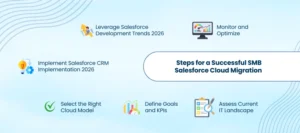
Assess Current IT Landscape
Assess current systems, applications, and workflows in order to find the workloads that can best be moved to the cloud. A detailed examination assists in shaping an economical Salesforce hybrid cloud configuration and cannot disrupt the very important functions.
Define Goals and KPIs
Definitely state what the hybrid cloud Salesforce implementation should accomplish, such as better performance, less expenditure, and greater scalability. The measurement of KPIs will enable SMBs to monitor the effectiveness of their Salesforce CRM implementation 2026.
Select the Right Cloud Model
Select the best combination of both private and public clouds based on business priorities and workload demands. Multi-cloud Salesforce for SMBs’ balancing approach ensures smooth operations because of the balance between security, flexibility, and efficiency.
Implement Salesforce CRM Implementation 2026
Implement the Salesforce CRM 2026 in phases in order to reduce disruptions. A well-thought-out process, proper integration with the existing systems will make Salesforce integrations in 2026 easier.
Leverage Salesforce Development Trends 2026
The Salesforce development trends on automation, AI, predictive analytics, and other areas would also be incorporated to ensure the company is ahead of its rivals in 2026. Such innovations optimise the value of Salesforce hybrid cloud strategy and make the business grow in the long term.
Monitor and Optimize
Monitor cloud usage, performance, and cost in real time so that the hybrid cloud environment can be efficient. Constant optimization ensures that the SMBs receive the maximum advantages of cost-effective Salesforce hybrid cloud operation and the reliability of the systems.
Future Outlook of Hybrid Cloud Salesforce for SMBs
SMBs are likely to move towards a Salesforce hybrid cloud strategy at an accelerated pace, since they are more focused on flexibility, security, and cost effectiveness. The Salesforce development trends 2026 reveal that AI-based insights, predictive analytics, automation, and the use of advanced automation will significantly influence the development of hybrid cloud strategies.
There will be an increased adoption of multi-cloud Salesforce for SMBs, which will enable businesses to evenly distribute the workloads between privately and publicly provided clouds. Those companies that can harness these innovations earlier are able to optimize their SMB Salesforce cloud migration, enhance their operational efficiencies, as well as have a considerable competitive edge.
Furthermore, the adoption of the new technologies into a cost-effective Salesforce hybrid cloud environment will help SMBs to apply smarter Salesforce CRM implementation 2026 and advanced Salesforce integrations 2026. Those businesses that embrace such trends will not only have their operations future-proofed but will equally have their ROI optimized as well as be agile in a rapidly changing market.
Conclusion
A strategic Salesforce hybrid cloud strategy equips the SMBs with cost-effective, secure, and scalable cloud solutions. The use of multi-cloud Salesforce by SMBs assists in simplifying SMB Salesforce cloud migration, simplifying Salesforce integrations 2026, and capitalizing on advanced Salesforce development trends 2026. A well-planned Salesforce CRM implementation in 2026 will enable businesses to streamline processes, enhance performance, and become leaders in the market. The collaboration with AnavClouds Software Solutions offers valuable advice on implementing a cost-efficient Salesforce hybrid cloud model, to smoothly deploy it, guarantee future expansion, and demonstrate ROI to the SMBs adapting to the dynamic world of the digital environment.
FAQs
What is a Salesforce hybrid cloud strategy?
Salesforce hybrid cloud strategy is the integration of both a private and a public cloud to maximize its performance, security, and cost. It enables SMBs to operate with ease and be flexible at the same time.
Why should SMBs adopt a hybrid cloud Salesforce model?
The SMBs are flexible, scalable, and enhanced with a minimum of data security. It also makes Salesforce integrations 2026 simpler and minimizes the total infrastructure expenses.
How does SMB Salesforce cloud migration work?
The SMB Salesforce migration moves applications to a hybrid environment. Critical workloads remain in the private clouds, whereas the operations that can be scaled are effectively done in the public clouds.
What are the key benefits of a multi-cloud Salesforce approach?
MultiCloud Salesforce solution will guarantee the use of cost-effective operations, Salesforce CRM implementation 2026 without hassles, improved security, and scalability to the growing SMBs.

