

Salesforce Heroku Uncovered: Features, Value, and Use Cases
The businesses of the modern era require dynamic platforms in which to develop and expand applications in a short time. Salesforce Heroku allows a team to develop applications based on the cloud and infrastructure, free of complexity. It is a strong Heroku PaaS working in the Salesforce ecosystem. The platform takes care of performance and security, allowing developers to be concerned with innovation. Coupled with the Salesforce integration of Heroku, there is no limit to the capabilities that a business can build on CRM. Heroku cloud network helps in deploying, scaling, and supporting current development practices. With the rising need for intelligent applications, Heroku AI introduces new features to real-life applications. This guide describes the functionality of Heroku, its features, and its business value.
What Is Salesforce Heroku?
Salesforce Heroku is an operating cloud application platform that aims to make application development and deployment easier. It is an effective Heroku PaaS that enables the developer to create, deploy, and scale applications without server management. The platform accepts all the responsibility of infrastructure, security patches, operating environments, and reliability of the systems. This helps development teams to work 100 percent on creating high-quality code and providing business value at a faster rate.
Heroku is based on dynamically isolated lightweight containers called dynos. These dynos execute programs in all environments and automatically start and stop depending on real-time demand. Dynos are automatically scaled up as traffic goes up. This renders the Heroku cloud platform as the appropriate one in startups, growing businesses, and even big businesses. The performance and stability algorithms allow developers to deploy applications in various programming languages and frameworks.
In addition to simple app hosting, Salesforce Heroku provides more advanced features such as add-ons, continuous delivery, and intelligent automation. As more companies are now supporting Heroku AI, it is also possible to add intelligent functionality to applications at scale with security. Through this flexibility, teams can produce customer-facing applications, internal applications, and data-driven platforms effortlessly.
Core Purpose of Salesforce Heroku
Salesforce Heroku intends to offer a cloud-native application based on Salesforce capabilities and to be scalable. It assists businesses in developing personalized solutions that will integrate well with the CRM data.
Key purposes of Salesforce Heroku include:
- Allow Heroku to be integrated with custom applications and external systems without any problems.
- Enable developers to develop Salesforce with flexible and open-language development environments.
- Support real-time data synchronization with Salesforce and the cloud applications.
- Assist companies in developing front office applications other than normal Salesforce applications.
- Limit infrastructure management by a dependable Heroku PaaS model.
- Increase the speed of innovation through modern tools, automation, and the Heroku AI service.
- Develop teams on Salesforce with services to empower and create scalable digital experiences.
Heroku assists organisations in becoming innovative quickly by integrating cloud flexibility with CRM knowledge. It guarantees bespoke applications to be interconnected, secure, and capable of further development.
Top Salesforce Heroku Features That Power Modern Applications
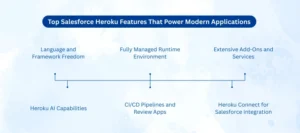
Salesforce Heroku provides an extensive environment with features that make the development, deployment, and scaling of applications easier. These are the Heroku features that are aimed at serving modern development teams with the consideration of performance, security, and flexibility. The platform is a major Heroku PaaS that eliminates the complexity of infrastructure and enables faster development.
These are the most essential Heroku features that every business and developer must be familiar with.
Language and Framework Freedom
Salesforce Heroku will take several programming languages and well-known frameworks. Applications may be developed in Node.js, Python, Java, Ruby, Go, and PHP, among others. This flexibility enables the teams to leverage on skills that they have at hand instead of having to learn new stacks. The Heroku cloud service is easy to scale to various development requirements.
Fully Managed Runtime Environment
A Heroku-managed runtime environment is one of the largest Heroku benefits. Heroku does automated maintenance of servers, operating systems, patches, and security updates. Infrastructure management is removed, and developers can concentrate on application logic. This strategy accelerates the development cycles and lowers the operational risk.
Extensive Add-Ons and Services
There are over 200 add-ons that are available in Salesforce Heroku. These are databases, caching tools, logging, monitoring, messaging, analytics, and email services. Teams do not require the construction of integrations when they need to extend applications at a rapid pace. This component ecosystem enhances the experience of the Heroku cloud platform.
Heroku Connect for Salesforce Integration
One of the great features is Heroku Connect, which allows Salesforce integration, which is secure. It synchronizes Salesforce with Heroku Postgres almost in real time. This gets rid of the expensive, complex custom APIs and minimizes development. Live CRM information can be used by businesses to create data-driven applications.
CI/CD Pipelines and Review Apps
Salesforce Heroku enables the application of modern DevOps with default CI/CD pipelines. There is a GitHub integration that allows automated testing and deployments. Review applications enable teams to review changes before production release. They enable teamwork and accelerated and secure deployments.
Heroku AI Capabilities
In Heroku AI, developers are able to integrate intelligence into applications. The platform can be used to support AI frameworks, vector databases, and up-to-date AI workflows. The Salesforce Heroku AI allows companies to create smarter applications with predictive understanding and automation. This renders the platform AI-ready to be innovative in the future.
Coupled with the above Heroku capabilities, Salesforce Heroku is an excellent option when it comes to scalable, connected, and smart development of applications. It encourages quick innovation and also integrates fully in Salesforce ecosystems.
Why Salesforce Heroku Is the Platform Businesses Trust to Scale
Salesforce Heroku is quite popular among companies that are interested in speed, flexibility, and reliability when applying to application development. It assists organizations to innovate at a quicker pace, and the operational and technical risks are minimized. Being a reliable Heroku PaaS, the system eases the complicated development cycles and offers long-term scalability. The above advantages render Heroku an option of choice in the context of digital transformation in the modern world.
The following are the top Heroku benefits that contribute to improving the performance of the development team and business team in order to come up with better applications.
Faster App Development
Salesforce Heroku eliminates the aspect of infrastructure management in the development procedure. Teams cease to be concerned about servers, patches, or run-time problems. This enables developers to work on feature development and enhance the user interactions. Reduced development cycles mean shorter time to the market.
Built-In Scalability
The Heroku cloud platform programs automatically increase or decrease application demands according to the needs of the traffic. Dynos are either raised or lowered automatically. This is to give a steady performance even at peak usage times. Applications do not need to be re-architected to give business confidence in growing a business.
Security and Compliance
Salesforce Heroku offers isolated and secure runtime environments to all applications. The system facilitates the industry security standards and compliance. Frequent maintenance and monitoring minimize the vulnerabilities and operational risks. This causes it to be appropriate for enterprise-level applications.
Efficient Data Integration
Through smooth Salesforce Heroku integration, companies will be able to tie their own applications to Salesforce CRM data. Live information synchronization enhances the automation of workflow and decision-making. CRM data is available in customer-facing and internal applications. Complex custom development is removed through this integration.
Reduced Total Cost of Ownership
Salesforce Heroku reduces the maintenance costs by including infrastructure and operations. Companies do not need to spend on server administration and physical scaling. There is efficiency in development, which brings more ROI in the long run. This is one of the greatest reasons why companies prefer the platform due to this cost advantage.
Real-World Business Value
Enterprises today are using Salesforce Heroku to create customer portals and digital commerce platforms, analytics dashboards, and Salesforce Heroku AI solutions. The platform complements Salesforce applications such as Sales Cloud and Service Cloud. Companies that employ an organization that has a Heroku consulting partner or Salesforce development services are able to provide interrelated and high-performance applications at a quicker rate.
Salesforce Heroku is a service that helps businesses to build future-ready digital experiences with agility, security, and CRM intelligence at scale.
How Salesforce Heroku Works Seamlessly with Salesforce
The Salesforce Heroku is developed in order to closely integrate with Salesforce. With Salesforce Heroku integration, which is very powerful, businesses can have additional CRM functionality through application-based extensions that are cloud-native. The connection enables developers to integrate Salesforce data with adaptable application logic on the Heroku cloud platform.
The following are the most significant Salesforce Heroku collaborations with Salesforce to develop joined and clever solutions.
Key Integration Capabilities of Salesforce Heroku
- Real-Time CRM Data Access
The Salesforce Heroku integration enables applications to retrieve Salesforce CRM data safely. This provides smarter and data-driven application experiences.
- Heroku Connect for Data Synchronization
Heroku Connect maintains Salesforce and Heroku Postgres data in sync with each other. It is updated almost instantly with no sophisticated custom code. This saves time and maintenance expenses on development.
- Heroku AppLink for API-Based Integration
Heroku AppLink makes the applications in Heroku accessible as Salesforce APIs. The interaction between Salesforce users with Heroku logic is possible in the Salesforce interface. This eases platform cross-integration.
- Low-Code and Pro-Code Compatibility
Salesforce Flows and automation tools can be used by admins to invoke Heroku logic. Apex and custom code can invoke Heroku services that developers may construct. This latitude favors both technical and non-technical teams.
- Event-Driven Architecture Support
Salesforce Heroku is associated with Salesforce Data Cloud and event-based workflows. CRM updates and business events can be instantly responded to using applications.
- Secure and Scalable Integration Layer
The PaaS model of Heroku ensures a secure run-time environment and scalable integration services. Integrations do not need to be redesigned to facilitate business expansion.
Having CRM intelligence and cloud-native flexibility, Salesforce Heroku can help organizations develop smarter applications. The Salesforce development services and teams that collaborate with a consulting partner of Heroku can also provide integrated and scalable solutions at a quicker pace. This is a smooth integration that makes Salesforce Heroku an extension of the Salesforce platform.
Conclusion
Salesforce Heroku has remained a reliable platform to develop scalable and interconnecting applications. It integrates cloud flexibility and intensive Salesforce interconnection. The benefits of faster development, built-in scalability, and safe operations are in favour of businesses. With robust Salesforce Heroku connectivity, customer data drives more intelligent workflows and customer experiences. The intelligent applications are future-ready as the platform is supported by Heroku AI. A business that has a trusted Heroku consultancy partner will achieve maximum outcomes more quickly. Using specialized Salesforce development solutions, such as AnavClouds Software Solutions, companies can realize the potential of Salesforce Heroku fully and expand with ease. Call us today and find out more!

