
Salesforce Adoption Challenges Every Business Must Address
Salesforce Adoption Challenges remain a persistent challenge to an organization, even with increased investments in Salesforce platforms and digital transformation programs. A large number of companies adopt Salesforce with high expectations and fail to maintain a steady level of user adoption. These Salesforce Adoption Challenges are usually due to ineffective planning, ineffective training, and ineffective workflows. As Salesforce grows into various new services and solutions, the complexity of adoption at Salesforce grows even more. The emergence of AI solutions and smart automation makes the use of these options even more challenging. Lack of organized Salesforce adoption planning means that the teams cannot use automation, data, and insights to their advantage. An early solution to the Salesforce adoption issues can assist organizations in enhancing productivity, data quality, and ROI. A strategically planned adoption model will help Salesforce sustain scalable expansion and not necessarily turn into an encumbrance.
Why Salesforce Adoption Challenges Persist Across Organizations
Salesforce Adoption Challenges is that most people implement the technology without giving much attention to user experience. A great number of projects are interested in features rather than in real-world utility. Customers do not know how Salesforce facilitates their respective tasks. This lack of connection leads to the formation of resistance and the shortening of the long-term use of the platform.
Rapid innovation in the Salesforce ecosystem is another key reason why Salesforce has been a challenging entity to adopt. Unexpected changes, AI functionality, and growing Salesforce clouds torment unready teams. The absence of organized enablement prevents users from using sophisticated features. In the long run, such a practice decreases system utilization and ROI.
Core Salesforce Adoption Challenges Affecting Business Performance
Salesforce adoption challenges directly affect productivity, data accuracy, and the scalability of operations. In the case of adoption gaps, the teams are not capitalizing on Salesforce capabilities. Salesforce adoption challenges minimize business decision-making as well as platform ROI. To have long-term Salesforce success, it is significant to address core adoption barriers.
Salesforce Agentforce and New Adoption Complexities
Salesforce Agentforce is also a concept that proposes intelligent automation that transforms the operational processes in Salesforce Cloud. Nevertheless, the problem of adoption of Salesforce grows when customers find it difficult to believe in AI-driven decision-making. Poor knowledge of AI logic results in fear and apprehension. Salesforce Agentforce limitations make adoption even more difficult in cases where automation is not transparent or explainable.
Numerous teams need further training integrating Agentforce into the actual business processes. AI solutions are not supportive without adequate enablement. Lack of confidence in intelligent workflows is caused by poor rollout strategies. All these play a crucial role in Salesforce adoption challenges in AI-enabled settings.
Integration Gaps as a Driver of Salesforce Adoption Challenges
Weak Salesforce-native integration remains a major contributor to Salesforce adoption challenges. Lack of integrated systems does not allow for smooth data transfer between sales, service, and marketing processes. Consumers receive conflicting information on Salesforce Clouds. Such fragmentation lowers the confidence of Salesforce as a platform.
A proper Salesforce-native integration will enhance the reliability of automation and accuracy of reporting. Integrated systems improve user experience and operational continuity. In cases of integration failure, it leads to the growth of manual work. These inefficiencies further increase the Salesforce adoption challenges across departments.
Over-Customization and Its Impact on Adoption
Over-customization introduces unnecessary complexity and increases Salesforce adoption challenges. Too many custom objects and fields come in the way of users in their daily operations. Laden designs take up time and decrease productivity. Salesforce is made hard to use instead of facilitating efficiency.
Usability and adoption are enhanced by balanced customization via Salesforce development services. Good configurations are representations of the actual working processes. The strategy will make sure Salesforce is not overly complex to support business requirements. Effective customization also decreases the Salesforce adoption issues.
Inadequate Role-Based User Enablement
Lack of role-based enablement intensifies Salesforce adoption challenges across organizations. Generic training cannot solve department-specific workflows. The users find it difficult to relate Salesforce capabilities to their day-to-day tasks. This lack of connection reduces use and interaction.
Role-based onboarding enhances platform relevance and confidence. Workflows that align with operational requirements are embraced more quickly by the users of Salesforce. Contextual learning minimizes resistance and errors. Good enablement policies will go a long way in reducing the Salesforce adoption challenges.
Misaligned Salesforce Adoption Strategies
Didactically blurred Salesforce adoption plans bring about sustainability problems with regard to performance. The main characteristic of the implementation that organizations pay attention to is how fast to implement, as opposed to how ready it is. This methodology does not take into account user behavior and process alignment. Consequently, post-deployment Salesforce adoption challenges continue to exist.
Effective Salesforce adoption plans match the objectives of the business with the functions of the platform. Success measures are determined by clear measures that are used to guide configuration and optimization. Technology and people should have a strategy on their side so that adoption is enhanced. This is one of the key elements of sustainable Salesforce performance.
The Importance of Salesforce Adoption Strategies
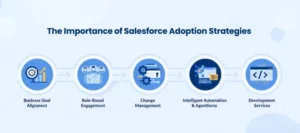
The strategies of Salesforce adoption can either make Salesforce investments bring real operational value or persistent inefficiencies. Most organizations do not take adoption planning sufficiently and instead are concerned with technical implementation. Such laxity makes Salesforce more difficult to adopt at the team and departmental levels. Powerful adoption plans will guarantee Salesforce to sponsor business objectives, user requirements, and scalable expansion. When properly done, it makes the process of adoption an ongoing improvement process and not a one-time process.
Aligning Salesforce Adoption Strategies with Business Goals
Sound Salesforce adoption plans enable the alignment of the platform with quantifiable business results at the outset. Configuration, automation, and AI solutions on Salesforce Clouds are under clear objectives. The interaction with Salesforce increases naturally if the KPI is directly supported. Teams will know how their day-to-day activities can influence performance and outcomes. This alignment means a lot in terms of minimizing the Salesforce adoption challenges over the long term.
Improving User Engagement Through Role-Based Experiences
Salesforce adoption strategies cannot be effective without role-based experiences. Workflows that are based on actual work tasks and operational requirements allow users to interact more rapidly. Minimized interfaces decrease learning and confusion. Individualized trips raise the level of trust and usage of the platform daily. These enhancements target typical Salesforce adoption issues.
Reducing Salesforce Adoption Challenges Through Change Management
One of the key pillars of Salesforce adoption strategies is change management. Lack of communication breeds uncertainty and resistance among users. Structured messaging enables teams to know about changes in Salesforce value and workflow. The participation of the leadership reinforces the significance of the platforms at the interdepartmental level. This will reduce Salesforce adoption challenges during implementation and updates.
Supporting Intelligent Automation and Salesforce Agentforce Adoption
The strategies of Salesforce usage should adhere to smart automation and AI-based workflows. There should be good governance in Salesforce Agentforce adoption. Salesforce Agentforce limitations are more exposed to users without any prior preparation. Slow AI implementation fosters trust and familiarity. This business strategy minimizes Salesforce adoption difficulties in smart settings.
Strengthening Adoption with Salesforce Development Services
With Salesforce development services, Salesforce adoption strategies are implemented successfully. Scalable solutions utilizing business workflows are developed by expert teams in scalable, user-friendly solutions. Data reliability and better Automation performance are enhanced with Clean Salesforce-native integration. The continuous optimization process makes Salesforce keep pace with organizational development. These undertakings go a long way to curb the repetitive Salesforce adoption of headaches.
Why Hiring Salesforce Agentforce Consultants Is Critical for Adoption Success
Salesforce adoption challenges increase when advanced automation is implemented without expert guidance and structured planning. Salesforce Agentforce provides potent AI solutions on Salesforce clouds, yet the inappropriate implementation reveals the weaknesses of Salesforce Agentforce and retards user acceptance. These risks can be mitigated through organizations employing the help of Salesforce Agentforce Consultants because this approach guarantees that AI-based workflows are in line with actual operational requirements.
Organizations that hire Salesforce Agentforce Consultants reduce these risks by ensuring AI-driven workflows align with real operational needs. They integrate automation logic and business objectives and governance systems, enhancing their usability and trust. This high-performance model empowers Salesforce adoption plans and has a direct impact on Salesforce adoption challenges within departments.
Key Advantages of Hiring Salesforce Agentforce Consultants
Companies that recruit Salesforce Agentforce Consultants have a higher and more sustainable adoption success. Professional assistance enhances the platform stability, user confidence, and facilitates scalable automation. Key benefits include:
- Less adoption of Salesforce struggles with orderly AI implementation.
- Proper governance of Salesforce Agentforce.
- Enterprise systems Seamless Salesforce-native integration.
- Intelligence applications were consistent with actual operational processes.
- Better Salesforce adoption plans led by guru thinking.
When organizations recruit Salesforce Agentforce Consultants, Salesforce will continue to be a productivity platform. Professional advice fills the gaps among users, automation, and the reliability of data. Adoption is enhanced when AI becomes intuitive and supportive. This narrow scope of the approach provides long-term value and reduces Salesforce adoption challenges.
Best Practices to Overcome Salesforce Adoption Challenges
Salesforce adoption challenges need to be overcome with discipline and well-articulated best practices. Successful organizations put their emphasis on usability, relevance, and continuous optimization instead of a one-time implementation. The best practices to overcome these challenges are as follows:
- Identify explicit Salesforce adoption plans that are in line with quantifiable business objectives:
The adoption strategies are supposed to integrate Salesforce usage with KPIs, outcomes, and team operational priorities.
- Provide role-based training based on actual working operations:
The training should be based on the daily user duties rather than the generic functionality of the platform.
- Make user interfaces easier to use to simplify complexity and training:
Clear interfaces and committed workflows assist users in accomplishing tasks at a faster rate and with reduced confusion.
- Manage Salesforce Agentforce constraint with articulated AI control:
Concrete regulations, openness, and understandable AI create confidence in the automation under Agentforce.
- Secure Salesforce-native integration between Salesforce clouds:
Integrated systems help enhance data integrity, dependability in automation, and user confidence.
- Ideally, collect feedback on the users regularly to discover adoption churn early:
Feedback frequently assists teams in fixing usability problems before adoption levels fall.
- Implement continuous optimization using Salesforce development services:
Salesforce keeps abreast with the changes in the business processes through continuous improvements.
- Outsource Salesforce Agentforce Consultants to sophisticated AI and automation:
The use of experienced advice can make AI solutions bring value but minimise the risk of adoption.
Conclusion
Salesforce adoption challenges are not so much a technical problem as a sort of business risk in the long run. Adoption is a process that organizations need to approach as a continuous process that is compatible with people, processes, and technology. Sound Salesforce adoption plans enhance user participation, workflow effectiveness, and automation effectiveness. Such AI solutions as Salesforce Agentforce can only bring value when transparency and governance are in place. Outsourcing specialist support assists the organizations in breaking down Salesforce Agentforce barriers and integration challenges. The constant optimization creates a Salesforce that keeps up with the business requirements. AnavClouds Software Solutions aims to help businesses to overcome Salesforce adoption by offering professional consulting services, Salesforce development services, and smart AI-based solutions. With the right attitude, Salesforce can grow to be a scaled growth platform instead of a resisted system by the users.
FAQs
What are the most common Salesforce adoption challenges?
The issues that affect the adoption of Salesforce are poor user engagement, ineffective training, ineffective integration, and excessive customization. These problems diminish productivity and platform ROI.
How can Salesforce adoption strategies improve user engagement?
Proper Salesforce implementation plans revolve around role-based processes and business alignment. This assists users with Salesforce’s value in everyday activities.
What role does Salesforce Agentforce play in adoption challenges?
Salesforce Agentforce makes the salesforce more automated, although it adds complexity without proper governance. Salesforce Agentforce limitations lead to enhanced trust and adoption.
When should businesses hire Salesforce Agentforce Consultants?
When adopting AI-based workflows, businesses ought to employ Salesforce Agentforce Consultants. Professional advice will decrease the risk and speed up the adoption of success.

