Gaurav AnavClouds Software Solutions +1 917 266 9985 info@anavcloudsoftwares.com
Uncategorized – Page 3
Generative AI in Salesforce

Salesforce’s incorporation of Generative AI is transforming customer relationship management by increasing its intelligence, speed, and predictiveness. Manual methods are no longer the only method used by businesses. Rather, companies are adopting Salesforce development driven by AI to improve decision-making, automate repetitive operations, and provide highly customized client experiences. 

Generative AI is opening up new avenues for expansion, from employing sophisticated data to forecast consumer behavior to intelligently automating processes to streamline communication. In addition to increasing operational effectiveness, these features allow Salesforce to provide tailored suggestions and forge closer bonds with clients. 

How Generative AI Enhances Salesforce Development 

The entire Salesforce ecosystem is changing as a result of the revolutionary leap that is the implementation of generative AI in Salesforce. Generative AI helps businesses to build more flexible, responsive, and effective CRM environments by fusing automation, intelligent data modeling, and predictive analytics. AI-powered Salesforce development is being used by developers, consultants, and companies to achieve new heights of creativity and scalability. The main places where this impact is most noticeable are listed below. 

Improved Salesforce Assistance 

Salesforce support is being redefined by generative AI, which turns it from reactive to proactive. It continuously examines large datasets to find early indicators of performance snags or system faults. Businesses can handle possible disruptions before they have an impact on operations thanks to this predictive method. 

  • In addition to saving important developer time, automated ticket resolution expedites the support process and minimizes manual intervention. 
  • Salesforce’s AI-powered chatbots expedite first-level help by responding to inquiries immediately and elevating only when required. 

Because of these developments, companies looking to increase uptime, lower operating costs, and improve customer experience must use generative AI technologies for Salesforce.

Unlock the Full Potential of Salesforce with Generative AI to Drive Smarter Growth.


Cloud-Based Predictive Sales Features 

Generative AI-powered enhanced predictive intelligence is now available to sales teams utilizing Salesforce Sales Cloud. 

  • Sales teams can increase targeting efficiency by ranking prospects according to their likelihood of converting thanks to predictive lead scoring. 
  • AI-powered dynamic pricing tactics evaluate market swings, rival pricing, and consumer behavior to maximize deal value instantly. 

Businesses are guaranteed to close more deals with greater profitability and more accurate forecasts thanks to this AI-driven sales methodology. This kind of innovation shows how generative AI development services are becoming more and more important in sales-driven companies. 

Changing Consulting Services for Salesforce 

Generative AI gives consultants access to highly customized, evidence-based solutions. Consultants now create adaptable roadmaps that change based on the needs of the client rather than static implementation plans. 

  • Third-party integrations, custom app creation, and data migration are all sped up by generative AI. 
  • With the use of these technologies, consultants can design Salesforce environments that precisely match corporate objectives in industries like manufacturing, healthcare, retail, and finance. 

This feature demonstrates how Salesforce developers are becoming more than just implementers; they are also strategic enablers. 

Increasing Client Engagement and Success 

Nowadays, one of the most important factors in Salesforce development driven by AI is customer success. Businesses can: Produce automated customer journey maps that dynamically adjust to user interactions thanks to generative AI. 

  • Provide tailored advice at various touchpoints, such as marketing efforts and after-sales interactions. 
  • Predictive behavior analysis can help you resolve consumer issues before they become more serious. 

Generative AI raises retention rates and fosters long-term client loyalty by fusing automation and deep customisation, so establishing a new benchmark for Salesforce development services. 

The Evolution of Generative AI in Salesforce: A Timeline of Transformation 

Salesforce’s generative AI journey has been characterized by ongoing innovation and strategic breakthroughs. Salesforce has improved its core products over the years by incorporating strong AI capabilities and automation features, enabling developers, consultants, and companies to accomplish more with less work. A thorough examination of the turning points that influenced this evolution may be found below: 

2016: Salesforce Einstein’s Arrival 

An important advancement in AI-powered Salesforce development was made with the release of Salesforce Einstein. Across the Sales, Service, and Marketing Clouds, features like automatic email answers, predictive lead scoring, and advanced analytics allowed users to make well-informed, data-driven decisions. 

2017: Einstein Image Recognition and Vision 

Salesforce brought AI-driven image recognition with Einstein Vision, allowing developers to create unique models for visual tasks like product identification right within the CRM ecosystem. 

2018: Advances in Natural Language and Cognitive 

This year saw several developments: 

  • Natural language processing (NLP), made possible by Einstein Voice, allowed voice commands and smooth transcription for improved user engagement. 
  • By employing intelligent chatbots to automate typical client contacts, Einstein Bots allowed agents to concentrate on more challenging instances. 
  • Salesforce’s AI capabilities were further enhanced through a collaboration with IBM Watson that enabled deeper cognitive analytics.

2019: Analytics Are Strengthened by Tableau Acquisition 

Developers and companies may now more easily extract valuable insights from large data sets thanks to Salesforce’s acquisition of Tableau, which combined powerful analytics and visualization capabilities. 

2020: Improved Analytics and AI Infrastructure 

While the Hyperforce project offered a scalable cloud architecture to support large-scale generative AI development services, Einstein Analytics updates improved machine learning and predictive analytics. 

Automation using Einstein Automate in 2021 

Salesforce developers’ jobs became even easier with the advent of Einstein Automate, which brought with it tools like Flow Orchestrator and MuleSoft Composer that allowed for low-code and no-code automation. 

Using AppExchange to Expand AI 

Additionally, Salesforce integrated external generative AI tools through the AppExchange marketplace, guaranteeing that companies could easily take advantage of a variety of AI advancements. 

Why Generative AI Matters for Modern Salesforce Development 
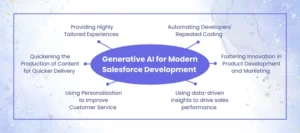
Generative AI for Modern Salesforce

Salesforce’s generative AI is now a fundamental force behind innovation, productivity, and expansion rather than a sci-fi idea. By automating intricate procedures, improving customisation, and opening up new avenues for innovation and speed, businesses implementing AI-powered Salesforce development are gaining a significant competitive edge. The main ways that generative AI is changing company processes are listed below, along with how Salesforce developers are contributing to this change.

Quickening the Production of Content for Quicker Delivery

Businesses may now produce high-quality content at previously unheard-of speeds thanks to generative AI. AI can produce precise drafts of marketing campaigns, sales presentations, and product documentation in a matter of minutes. This translates to quicker go-to-market plans and better responsiveness to changing customer demands for Salesforce teams. Teams can concentrate on growth-promoting strategic initiatives by automating repetitive content development.

Using Personalization to Improve Customer Service

More than ever, customers expect prompt resolutions and individualized attention. Teams may create precise, contextualized answers using generative AI tools for Salesforce that draw from a variety of information sources. This entails producing thorough post-call reports, proactive suggestions, and predictive solutions—all of which improve client happiness and free up agents to concentrate on developing sincere connections.

Providing Highly Tailored Experiences

Success now depends on hyper-personalization, which is scalable thanks to generative AI. It generates customized offers, recommendations, and communications for every stage of the customer journey by examining consumer data and behavioral trends. AI-enabled Salesforce development services guarantee that each interaction is timely, pertinent, and significant.

Using data-driven insights to drive sales performance

By automating processes like pipeline projections, follow-up emails, and meeting notes, generative AI revolutionizes sales operations. It offers useful information on sales success indicators such as pipeline advancement, conversion rates, and average transaction value. After that, sales teams can concentrate on closing high-value deals rather than handling paperwork.

Fostering Innovation in Product Development and Marketing

Generative AI is a creative collaborator for product designers and marketing teams. It speeds up time to market and boosts creativity in everything from AI-generated design concepts to campaign brainstorming. Product launches and marketing effect are accelerated by this collaboration between AI-powered content and human innovation.

Automating Developers’ Repeated Coding

With generative AI, the role of Salesforce developers is also changing. With the automation of mundane coding, script authoring, and setup tasks, developers can now concentrate on high-value architecture and integrations. Even non-technical teams may create workable solutions thanks to low-code and no-code tools, which further democratize application development. 

Organizations implementing generative AI development services need to combine innovation with a well-defined plan, taking into account scalable use cases, operational integration, and cost considerations. Early adoption of this change will position businesses for long-term success and faster expansion. 

Exploring Salesforce GPT Innovations: Next Era of AI-Powered Salesforce Development 

A new phase in the development of generative AI in Salesforce has begun with the release of Salesforce GPT solutions. Salesforce has developed an ecosystem where automation, personalization, and predictive analytics combine to revolutionize how companies interact with their clientele by integrating generative AI into its core platforms. These developments give Salesforce developers, consultants, and businesses access to Generative AI capabilities that improve productivity, optimize processes, and create memorable customer experiences. 

Salesforce Sales GPT: Revolutionizing Sales Operations  

Sales GPT uses unified data platforms and AI-powered Salesforce development to transform sales processes. 

  • Tailored Sales Emails: Based on consumer behavior, automatically generate personalized outreach emails, plan follow-ups, and emphasize the advantages of your products. 
  • Automated call transcriptions improve follow-up activities and sales productivity by recording, transcribing, and analyzing calls to extract important points. 
  • Predictive Sales Insights: Prioritize leads with the highest conversion potential and forecast prospects using past data and market trends. 

Sales GPT enables sales teams to spend more time closing high-value deals and less time on administrative duties by automating these operations. 

Improving Customer Support Services: Salesforce Service GPT  

Through generative AI solutions for Salesforce that expedite case management and offer immediate, tailored responses, GPT improves the customer service experience. 

  • Responses from Service: AI-generated answers increase accuracy and resolution speed. 
  • Work Summaries: Provide a concise synopsis of instances to speed up decision-making. 
  • Create and update knowledge bases with the newest fixes and industry best practices by creating knowledge articles. 
  • Mobile Work Briefings: Give workers who are constantly on the go vital client information to improve customer support. 

The efficiency and responsiveness of service operations are increased by this innovation, which eventually raises client satisfaction. 

GPT for Salesforce Commerce: Automating Customization 

Creating highly customized purchasing experiences throughout the client journey is the main goal of Commerce GPT. 

  • Serves as a personal shopper, making product recommendations based on the tastes of the client. 
  • Automates repetitive processes such as checkout help, promotional offers, and product descriptions. 
  • Lowers operating expenses for retail and e-commerce companies while increasing customer engagement.  

Salesforce Marketing GPT 

With AI-powered content creation, marketers can design and implement campaigns at scale with Salesforce Marketing GPT’s Intelligent Creative Assistant. 

  • Email Content Creation: Create distinctive email campaigns tailored to individual customers. 
  • Data Cloud Segment Intelligence: Effectively analyze and target client segments. 
  • Engagement & Identity Resolution: Arrange audiences and convey the appropriate message at the appropriate moment. 
  • AI-driven Data Integration: Improve targeting by integrating customer data from various sources in a seamless manner.  

Smarter Analytics for Better Decisions with Salesforce Tableau GPT 

Through the automation of analytics and reporting procedures, Tableau GPT improves business intelligence. 

  • Tableau Pulse, an automated analytics tool, Provides campaign performance data in real time to facilitate prompt decision-making. 
  • Customized Metrics: Create financial dashboards that monitor KPIs in line with corporate objectives. 
  • Data Security & Compliance: Make sure that client and company information is safe and complies with legal requirements. 

Conclusion 

A tremendous leap in the redefinition of business intelligence, customer engagement, and operational effectiveness has been achieved with the deployment of GPT technology across Salesforce’s platform. Customized sales emails, AI-based customer service, and advanced marketing segmentation are only some of the ways that these solutions make it possible for businesses to forecast patterns, streamline mundane tasks, and deliver tailored interactions across all points of contact. 

Companies can remain ahead of the curve, reduce operational costs, and develop a deeper connection with their customers by strategically leveraging these developments. Collaborating with experienced Salesforce experts such as AnavClouds Software Solutions ensures you not only deploy these future-proof solutions but also pair them with your business strategy to maximize their impact. 

Salesforce Winter ’26 Release

The Salesforce Winter ’26 Release is set to strengthen trust, scale automation, and prepare orgs for agentic AI at the enterprise level. Anticipate significant advancements in Salesforce Service Cloud, Experience Cloud, and Data Cloud, a unified AI Data Platform vision, a solid push on security and governance, a realistic runway for Agentforce 3 features, and verified permission enforcements. What matters, why it matters, and how to get ready are all covered in detail below. 

Salesforce Winter ’26 Release: Key Innovations to Watch 

Security, Compliance, and Governance Built for AI at Scale 

Security is the foundation for any credible AI solutions program. Winter ’26 is expected to advance this foundation so teams can move faster without sacrificing control. 

What’s likely coming 

  • Granular access controls and encryption by default. Expect more precise permission scoping, stronger at-rest and in-transit protections, and cleaner propagation of access policies across records, objects, and data services inside Salesforce.
  • Identity hardening with modern patterns. Deeper MFA options, step-up authentication for sensitive actions, and improved session management reduce lateral movement and privilege misuse.
  • Threat detection that understands context. Behavior-aware detections catch anomalies across flows, Apex calls, and API usage, strengthening the defensive posture for agentic AI workloads.
  • Compliance tooling aligned to AI governance. Controls and dashboards that help admins map processes to GDPR, CCPA, and emerging AI risk frameworks, without duct-tape spreadsheets or manual audits.  

Zero Trust, applied 

Zero Trust is not a slogan here. It means every request is authenticated, authorized, and evaluated for risk, every time. That extends to Flow, Apex, APIs, and Agentforce 3 orchestrations. Expect clearer audit trails, tighter token lifetimes, and stronger guardrails where agents read or act on customer data. 

How to prepare 

  • Run a permissions gap analysis on critical objects and flows. Fix broad grants, and convert public access into named permissions.
  • Standardize profile + permission set strategy. Avoid custom snowflakes; adopt modular permission sets for cleaner governance.
  • Document data lineage for sensitive attributes. Know who can see, update, export, and feed that data into any AI Data Platform process. 

Stay ahead of the curve with Salesforce Winter ’26 updates tailored for your business.


Agentforce 3: A Practical Runway to Autonomous Agents 

There is a lot of excitement around Agentforce 3—and for good reason. The rollout across mid-2025 lays the groundwork for teams to hit Winter ’26 with fully configured, measurable, and safe agent workflows. 

Where things stand 

  • Available now: Core Agentforce 3 features, adoption analytics, Testing Center enhancements, and 100+ pre-built industry actions available on AgentExchange.
  • July track: Anthropic Claude model integrations, MuleSoft MCP and A2A support, Heroku AppLink, and Agentforce native MCP support.
  • August track: Session Tracing Data Model, agent health monitoring, Agentforce Command Center, and the Agentforce Studio app for building, testing, and governing agents.  

With this foundation in place by the end of August 2025, Winter ’26 becomes the moment to scale: connect domain-specific skills, wire in governed data, and push agents from pilot to production with real SLOs. 

What this unlocks in Winter ’26 

  • Deeper Einstein infusions for context and decision support inside agent workflows.
  • Cross-cloud orchestration where agents span Service Cloud, Experience Cloud, Data Cloud, and integrated apps via MuleSoft.
  • Safer flow executions with better permission awareness, reducing brittle automation and unexpected failures.  

How to prepare 

  • Catalog your top agentic AI use cases by value, feasibility, and data readiness.
  • Use Agentforce Command Center to define KPIs, guardrails, and rollback paths.
  • Source pre-built actions from AgentExchange to speed time to value and avoid bespoke code where a proven asset exists. 

Confirmed for Winter ’26: Permission and User Access Enforcements 

This is the part you should plan for now. These changes are confirmed for Winter ’26 and may impact production flows, Field Service schedules, and user access patterns. 

I. Permission requirements for built-in Apex classes 

Previously targeted for Spring ’25, this enforcement ensures Apex actions with file-based classes respect explicit permission requirements. Flows will run in the component’s current context, preventing silent failures where underlying permissions were missing. 

Action checklist 

  • Inventory flows calling custom or packaged Apex actions.
  • Map each to required permissions and update profiles/permission sets.
  • Add runtime checks and admin alerts where high-risk failures are unacceptable.  

II. Migration from Maintenance Plan Frequency fields to Work Rules 

After multiple deferrals since Winter ’22, Maintenance Plan Frequency and Frequency Type are retiring. You must migrate to maintenance work rules, which govern scheduling more consistently and are easier to audit. 

Action checklist 

  • Export existing plan frequencies and build a mapping to work rules.
  • Validate rules for edge cases: seasonal loads, blackout windows, and SLAs.
  • Run a shadow schedule in a sandbox for two full cycles before cutover.  

III. Restricted user access to run flows 

The broad FlowSites org permission is deprecated. Users will need explicit profile or permission set grants to execute flows. This closes a major gap where anyone could trigger critical automations. 

Action checklist 

  • Identify flows previously exposed through FlowSites.
  • Define least-privilege execution groups and assign targeted permissions.
  • Add usage telemetry and error routing to triage missed grants quickly. 

Service Cloud and Experience Cloud: Smarter Content, Faster Resolution 

Expect meaningful upgrades across Salesforce Service Cloud and Experience Cloud that turn knowledge into action. The headline capability to watch is Einstein Article Recommendations, designed to surface the best content at the exact moment of need—for both agents and customers. 

Why this matters 

  • Lower handle times. Agents receive context-aware article suggestions based on case type, past resolutions, and similar customer journeys.
  • Self-service that actually works. Customers see relevant guidance in portals without wading through outdated or generic content.  
  • Personalization without heavy lifting. New Experience Cloud templates and components help teams compose personalized digital experiences with fewer custom builds.  

How to prepare 

  • Audit your knowledge base. Consolidate duplicates, retire stale content, and tag by intent, audience, and lifecycle stage.
  • Structure article metadata to fuel recommendations. Clear titles, crisp summaries, and consistent fields drive better AI matches.
  • Wire behavioral signals. Feed search queries, click paths, and failed deflections back into content strategy. 

Toward a Unified AI Data Platform: Salesforce + Informatica 

A major storyline shaping Winter ’26 readiness is Salesforce’s announced acquisition of Informatica (May 2025, ~$8B equity). The vision is a trusted, explainable, and scalable AI Data Platform, combining Salesforce Einstein with Informatica’s CLAIRE to power governed, end-to-end AI solutions. 

What this means in practice 

  • Data Transparency. Rich lineage and cataloging show where data originated, how it transformed, and who touched it—vital for audits and model accountability.
  • Data Understanding. Metadata and a unified model allow agents to interpret data with business context, not just column names.  
  • Data Governance. Embedded MDM, quality rules, and policy controls standardize data so agents act on the right, current, and compliant information.  

Ecosystem impact 

  • Data Cloud enhancement. Stronger identity resolution, cleaner unification, and more actionable segments to drive personalization and analytics.
  • Agentforce improvement. Agents gain safe access to complex enterprise data with confidence scores, lineage cues, and quality indicators.
  • MuleSoft governance. APIs inherit standards for quality and cataloging, reducing downstream drift and brittle integrations.
  • Tableau insights. Analysts see context-rich dimensions and measures, improving trust in dashboards and decisions.  

Rollout expectations 

While the full transaction targets early Salesforce fiscal year 2027, you can expect data-level readiness steps in Winter ’26 to prepare orgs for the integration layer. Think reference connectors, governance templates, and metadata conventions that help teams “snap in” once the deeper fusion lands. 

How to prepare 

  • Classify systems of record and systems of engagement; map truth sources for each entity.
  • Define golden records and survivorship rules now, not later.
  • Establish a data contract for any dataset feeding Agentforce 3 or Einstein models: schema, freshness, lineage, and owner.  

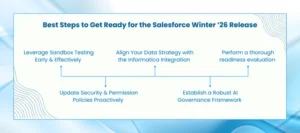
What Are the Best Steps to Get Ready for the Salesforce Winter ’26 Release? 

Salesforce Winter ’26

With the help of a more secure AI Data Platform, the Salesforce Winter ’26 Release brings significant improvements to Agentforce 3, Data Cloud, Experience Cloud, and Salesforce Service Cloud. These technologies only provide value, though, if your company is prepared to implement them successfully. Being well-prepared guarantees that you will not only maintain compliance but also take full use of the AI-powered features and Salesforce development services available with the release. 

Perform a thorough readiness evaluation 

Examine your present Salesforce setup carefully before releasing the new functionalities. Draw out user permissions, AI agents, integrations, and modifications. Custom code, third-party apps, and flow automations should receive special attention because they will be the most impacted by the new permission and security changes that will be implemented with Winter ’26. 

  • Document existing data governance practices to identify gaps where the release can add immediate value.
  • Highlight critical dependencies on deprecated permissions or old maintenance rules.
  • Assess readiness for Agentforce 3 features and their potential impact on cross-cloud workflows.  

This assessment becomes your blueprint, helping you decide which features to prioritize once the release is live. 

Leverage Sandbox Testing Early and Effectively 

Once Salesforce provides sandbox access for Winter ’26, begin rigorous testing. Focus not only on functional validation but also on real-world scenarios that stress-test AI agents and Agentforce 3 workflows.

  • Use synthetic or anonymized customer data to evaluate AI behavior without compromising compliance.
  • Test AgentExchange assets and pre-built agent actions to accelerate adoption without reinventing the wheel.  
  • Simulate cross-cloud orchestration between Service Cloud, Experience Cloud, and Data Cloud to ensure seamless transitions when features go live.  

Remember, the quality of AI outputs is only as good as the quality of your underlying data. 

Update Security and Permission Policies Proactively 

Winter ’26 emphasizes data security, Zero Trust principles, and granular permission enforcement. Review your organization’s security policies now, rather than scrambling post-release. 

  • Map existing permission sets and profiles against the new enforcements for Apex classes, flows, and maintenance plans.
  • Align your identity management strategy with upcoming multi-factor authentication (MFA) and session management enhancements.
  • Conduct targeted training sessions for admins, developers, and business users to ensure everyone understands new access models.

This proactive approach minimizes disruptions and accelerates compliance once the release is deployed. 

Align Your Data Strategy with the Informatica Integration 

Salesforce’s acquisition of Informatica signals a major shift toward a unified AI Data Platform. If you’re currently using fragmented integration tools, now is the time to evaluate whether consolidating under this new architecture will simplify your data ecosystem. 

  • Audit your current data workflows and integration points.
  • Identify how Informatica’s metadata-driven governance, lineage tracking, and MDM features can improve your Data Cloud strategy.
  • Plan a phased migration where possible to avoid business disruptions during Winter ’26 upgrades.  

By aligning your strategy now, you position your organization to fully leverage AI-powered Salesforce development services and cross-cloud intelligence when the new platform matures. 

Establish a Robust AI Governance Framework 

With Agentforce updates rolling out every few months, your organization needs a clear framework for responsible AI usage. This framework ensures your agents operate within defined ethical, legal, and operational boundaries. 

  • Set policies for AI decision-making, escalation workflows, and quality assurance checks.
  • Include key stakeholders from IT, legal, operations, and customer service teams to ensure a well-rounded policy.
  • Define clear metrics for agent performance, data access, and compliance across your Salesforce ecosystem.  

Strong AI governance ensures that the benefits of agentic AI and AI solutions are realized without exposing your organization to unnecessary risks. 

Are You Ready to Unlock the Full Potential of the Salesforce Winter ’26 Release? 

The Salesforce Winter ’26 Release is more than an upgrade—it’s your chance to reimagine how your business operates. With Agentforce 3 features, a smarter AI Data Platform, enhanced Data Cloud, and deeper Salesforce Service Cloud capabilities, this release sets the stage for intelligent automation and exceptional customer experiences. 

However, success isn’t about adopting new features blindly—it’s about strategic preparation. From assessing your current Salesforce environment to aligning your teams and testing in a sandbox early, every step matters to ensure a seamless rollout. 

This is where AnavClouds Software Solutions can help. As a certified Salesforce Consulting Partner, we specialize in helping businesses make the most of every release. Whether you want to explore Agentforce 3 or implement robust AI solutions, our team ensures smooth adoption, faster ROI, and minimal disruptions. 

Ready to prepare your Salesforce for Winter ’26? Get in touch with us today, and let’s make this release a turning point for your business. 

Agentic AI in Retail

As customer needs evolve faster than ever before, the retail industry is undergoing tremendous change. Customers currently require customized, frictionless, and instant experiences instead of standard offers or delayed reactions. Agentic AI in retail is making a huge difference in this space. AI agents allow retailers to predict customer needs, streamline processes, and produce fantastically engaging shopping experiences by combining automation with intelligence. Companies that leverage AI agents for customer experience, drive inventory management, and personalize shopping experiences are standing out in a saturated business environment. This blog will discuss the retail digital transformation by agentic, the obstacles to adoption, and the actions that companies may take to be successful. 

Why Agentic AI Is the New Driving Force in Retail 

In the retail sector, smart autonomous systems that can make and act on decisions without ongoing human oversight are agentic AI. Such artificial intelligence (AI) agents perceive, reason, and respond in real time as a human agent. Moreover, agentic AI in retail also helps with price optimization, inventory management, targeted marketing campaigns, and even product suggestions based on customer preferences. 

Why, therefore, is the retail industry now accepting this change? Several important variables are propelling adoption: 

  • Growing Retail Complexity: Manual procedures are no longer able to keep up with the demands of multichannel shopping, dynamic pricing, and a wide range of client requests. 
  • Slow insights and data overload: Despite having a lot of data, retailers frequently find it difficult to take swift action. The time between data and judgments is shortened by agentic AI. 
  • Mature AI Technology: AI is becoming more dependable and scalable because to developments in intelligent store assistants, reinforcement learning, and massive language models.

Alongside these changes, consumer behavior is changing as well. Nearly one-third of consumers currently use AI-powered tools for online purchases, according to a recent survey that showed a sharp increase in retail traffic in the UK. This demonstrates how rapidly consumers are adjusting to AI-powered tailored buying. 

Collectively, these patterns demonstrate how agentic AI in retail is about more than just automation; it’s about boosting customer satisfaction, increasing productivity, and opening up new business prospects. 

Transform your retail strategy with Agentic AI-driven engagement.


Beyond Automation: How Agentic AI Brings Retail to Life 

Consider the following scenario: A consumer walks into a store after work, and their phone immediately displays business wear that has been carefully chosen for an impending trip, including alternatives that are appropriate for the weather. Those clothes are waiting for them when they arrive at the changing room. This isn’t just science fiction; it’s the potential of agentic AI in retail, which can offer hyper-personalized shopping by seamlessly integrating weather predictions, purchase history, inventory data, and even calendar information. 

An AI agent for customer experience is more advanced than standard AI, which mostly analyzes data and makes recommendations. Without awaiting human approval, these smart shop assistants may automatically reorder inventory, modify prices, and handle customer service concerns. This liberty can make the difference between stores staying relevant and falling behind in the face of tight margins and growing competition. 

This demonstrates a noteworthy digital change in retail, as preemptive measures are developed from predictive insights. Imagine having a digital worker who never sleeps, keeps track of every conversation, and consistently improves the client experience. 

Five key capabilities define agentic AI in retail at its core: 

  • Goal Orientation: Complies with retail goals such as increasing sales or enhancing consumer happiness. 
  • Adaptive planning modifies plans in real time when circumstances shift. 
  • Autonomy: Makes decisions on their own while adhering to company policies. 
  • Tool Access: Easily integrates with databases, APIs, and systems. 
  • Execution Continuity: Retains uniformity even in the face of interruptions.

Think about the difference in client engagement: an AI agent for customer experience may detect issues, access inventory, provide refunds, provide alternatives, and proactively send tailored offers, whereas a normal chatbot can just respond to inquiries. Agentic AI in retail is a real game-changer for improving the customer experience because of this change, from reactive support to proactive action. However, enhancing retail CX with AI can be easily done with the help of Salesforce development services. 

Inside the Engine: The Operation of Agentic AI in Retail 

Agentic AI in retail is a radical change in the way technology informs decision-making, not just a more intelligent form of conventional AI. Retail digital transformation through agentic AI is designed to detect, reason, decide, and act on its own, in contrast to traditional systems that only forecast or categorize results. Retailers can now proactively create better customer experiences rather than just responding to issues, thanks to this purpose-driven design. 

Real-Time Viewing of Everything 

Sensing and contextual awareness are the main goals of the initial layer of agentic AI. Transaction systems, inventory databases, client interactions, rival pricing, social media, and even weather signals are some of the sources from which it gathers data. The technology generates a real-time representation of the retail environment by evaluating these inputs, allowing for seamless and pertinent AI-powered tailored purchasing. 

Improved Decision-Making through Smarter Thinking 

The reasoning engine is the central component of this architecture. To assess potential courses of action, this layer uses consumer segmentation, demand forecasting models, and business rules. It considers trade-offs and selects the best course of action in line with retail goals rather than merely flagging insights. This enables merchants to use agentic AI in retail to make judgments quickly and accurately to improve the consumer experience. 

Gaining Knowledge and Improving With Time 

The learning capacity is one of the most potent characteristics of intelligent retail assistants. All actions, results, and feedback are recorded by the memory module. This ongoing learning process enables Agentic AI to enhance efficiency and optimize strategies over time, guaranteeing a retail digital transformation that only improves with scale. 

Acting Without Postponement 

The action layer puts decisions into immediate effect once made. These solutions work in unison with ERP, CRM, and eCommerce. It does everything from introducing promotions and repricing products to restocking inventory and customizing communications with customers. This guarantees that, rather than merely evaluating data, AI agents for customer experience produce tangible commercial results. 

Maintaining AI Aligned and Ethical  

Autonomy requires accountability. Strict guidelines and governance regulations restrict the use of agentic AI in retail. These uphold vendor agreement compliance, safeguard consumer data protection, and guarantee moral business practices, including reasonable pricing. In order to keep the system in line with corporate principles, guardrails also establish limits to stop excessive discounting or dangerous choices. 

Working Together with Individuals 

Agentic AI is not a secret, even though it is autonomous. Through a feedback loop, business groups can monitor decisions, establish new objectives, and take appropriate action. This human-in-the-loop makes sure AI acts as a collaborator, promoting productivity and personalization while retaining the power to make decisions when necessary. 

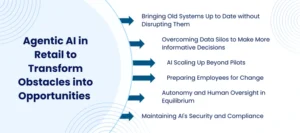
Using Agentic AI in Retail to Transform Obstacles into Opportunities 

AI agents for customer experience

While it is exciting to deliver through agentic AI in retail, its adoption is not without challenges. Legacy systems, data handling, and extending AI across operations are challenges facing most shops. Tapping into the full capability of AI agents to enhance customer experience requires clear strategies that find a balance between individuals, technology, and governance. 

Bringing Old Systems Up to Date without Disrupting Them 

Legacy infrastructure is one of the greatest challenges. Numerous merchants still utilize old technologies that were not written with automation in mind. Firms can blend newer intelligent retail assistants into existing systems with the help of middleware technologies, cloud-based adapters, and API layers instead of ripping everything out at once. Routine operations are preserved while seamless conversion is enabled by this gradual process. 

Overcoming Data Silos to Make More Informative Decisions 

The integrity of AI relies on the information it is working with. Retailers often struggle with fragmented systems where sales, stock, and customer data are locked in silos. Companies must create unified data architectures with automated cleansing and real-time validation to counter this. Agentic AI in retail ensures AI-driven personalized buying is underpinned by the right and reliable data, leading to better decision-making and higher consumer confidence. 

AI Scaling Up Beyond Pilots 

Most stores find it difficult to scale up their early small-scale AI projects. There must be a scalable machine learning infrastructure and robust cloud or edge computing capacity for an actual retail digital transformation. Companies can achieve a competitive advantage along supply chains, stores, and digital channels by scaling up from small pilots to enterprise-wide deployment of AI models that are performance- and cost-optimized. 

Autonomy and Human Oversight in Equilibrium 

Though agentic AI in retail is independent, retailers must still exercise governance. Threshold-defining decision frameworks ensure that humans remain involved in important work. Transparency is heightened by employing features such as role-based access controls, explainability reports, and real-time dashboards. Enhancing retail CX with AI is done responsibly while ensuring human intervention. 

Preparing Employees for Change 

Adoption of AI is a cultural shift as well as a technological one. Even though customer experience AI agents are designed to augment human knowledge and not supplant it, employees often fear automation. By initiating AI training programs, offering hands-on experience, and making it clear how automation allows staff to focus on activities of greater value, retailers can ease the transition. This builds long-term readiness and confidence. 

Maintaining AI’s Security and Compliance 

In contemporary retail, security and compliance are non-negotiable. Retailers are required to employ robust encryption, anomaly detection, and AI-specific security mechanisms to comply with data protection rules such as the CCPA and GDPR. Frequent compliance audits guarantee that agentic AI in retail keeps providing value while safeguarding consumer information and abiding by moral principles. 

The Unspoken Difficulties of Using Agentic AI in Retail 

Although implementing agentic AI in retail is revolutionary, there are significant obstacles to overcome. To fully reap the benefits of AI agents for customer experience, retailers need to overcome a number of operational and technological challenges, ranging from staff readiness to antiquated technologies. A closer look at the most typical obstacles is provided here. 

Antiquated Mechanisms Impeding Innovation 

Numerous retailers continue to rely on antiquated systems that were never intended to be automated. Intelligent retail assistants are unable to obtain the data they require in the absence of contemporary APIs or cloud-based integration. While it is expensive to upgrade everything at once, AI adoption becomes fragmented and delayed in the absence of modernization. 

Data Stuck in Silos 

Retailers produce enormous volumes of data about supplier chains, sales, inventory, and customer interactions. The issue? A lot of it is dispersed across silos. The accuracy of insights is decreased in retail when agentic AI is unable to obtain the complete picture or when the data is inconsistent. AI-powered tailored buying requires clean, linked, and trustworthy data. 

Having Trouble Scaling AI 

It is simple to launch small AI pilots, but it is more difficult to scale them across operations. Many companies struggle with bandwidth constraints, infrastructure expenses, or cloud migration. Retail digital transformation stops in the absence of scalable solutions, which keeps AI adoption in experimental stages rather than propelling enterprise-wide change. 

Striking the Correct Balance with Human Supervision 

Although the autonomy of agentic AI in retail is positive, retailers cannot totally cut people out of the process. Pricing and promotion decisions must be in line with consumer expectations and brand values. Strong governance structures guarantee that using AI to improve customer experience is done ethically and without expensive mistakes. 

Teams Getting Ready for the AI Era 

Implementing automation alters how workers operate. Adoption may be slowed by a lack of technical expertise, fear of losing one’s career, and resistance to change. For this reason, funding AI literacy initiatives and effective communication are essential. AI agents for customer experience must be viewed by staff members as tools that complement them rather than take their place. 

Maintaining Compliance and Safeguarding Data 

Tremendous responsibility accompanies tremendous ingenuity. Retail AI systems are a potential target for cyber threats because they handle sensitive client data. Strong cybersecurity measures, along with adherence to data protection regulations like the CCPA and GDPR, guarantee that agentic AI in retail adds value without putting companies at risk of legal trouble or damage to their reputation. 

Conclusion 

Agentic AI in retail is a turning point for businesses. Retailers are well-positioned to prosper in the modern, digital-first economy if they use AI agents to automate procedures, aggregate data, and customize encounters. However, current systems, competent teams, robust governance, and a dedication to customer trust are all necessary for success; technology alone is not enough. Retailers can realize the full potential of AI-powered retail digital transformation and provide experiences that entice customers to return by tackling these issues. 

AnavClouds Software Solutions can assist you in creating scalable, intelligent, and smooth AI-driven solutions that are customized to meet the demands of your retail company if you want to expedite your Salesforce development journey. 

Agentic AI vacation planning

Experiences have always been the focus of travel, but modern tourists demand more than just convenience—they want trips tailored to their tastes. Agentic AI in travel planning is revolutionizing the travel business in this regard. Autonomous AI agents think, decide, and act with intent, which makes every trip smarter and more personalized than traditional apps that adhere to strict rules. Agentic AI vacation planning is opening new possibilities for travel and hospitality firms, from real-time itinerary modifications and booking assistance to predictive customer support and loyalty benefits. The potential of agentic AI trip planning services, implementation best practices, and the reasons why companies need to take immediate action to remain competitive will all be covered in this blog. 

What Is Agentic AI Vacation Planning? 

Let’s first examine what agentic AI vacation planning entails before delving into how it will change travel. 

Agentic AI vacation planners are powered by autonomous AI agents that can make decisions, learn from feedback, and adapt in real-time, unlike common AI devices that merely respond to prompts. Such systems are ideal for the fast-changing travel business as they work proactively towards achieving pre-determined goals as opposed to responding passively. 

Think of them as your personal AI travel buddies. They can plan your itinerary, suggest destinations to visit, and even adjust your travel itinerary based on last-minute revisions, local happenings, or weather forecasts. This degree of flexibility gives intelligent vacation planning with AI agents a new meaning. 

Transform Travel Experiences with Agentic AI & Salesforce Development Services. Let’s build the future together.


Why Agentic AI Vacation Planning Is Transforming Travel 

Consider the hours you spent researching ticket costs, reading many hotel reviews, examining cancellation conditions, and locating local experiences the last time you organized a trip. Imagine now giving all of that to a travel planner powered by an agentic AI that not only helps but also fully comprehends your intentions and takes command. Agentic AI vacation planning holds that promise. 

This reform is revolutionary for businesses and passengers alike for the following reasons: 

Changing Expectations of Travelers

Sixty-three percent of travelers want brands to swiftly adjust to their specific demands, per a Salesforce survey. This is made possible by agentic AI travel planning services. In order to provide timely, relevant, and personalized travel recommendations, agenctic AI vacation planning solutions examine historical preferences, behavioral patterns, and contextual cues.

Making Operational Complexity Simpler

Behind the scenes, hospitality companies deal with issues like personnel shortages, volatile pricing, and disjointed technology. By integrating data from revenue management, staffing, and guest services, intelligent vacation planning with AI agents is made easier. Decisions are made more quickly and intelligently without overtaxing human teams.

Proactive Guest Personalization

Generic recommendations are no longer the only kind of personalization. Travelers can receive customized offers from personalized AI holiday assistants, such as flexible check-in options based on previous stays or spa bonuses for regular wellness visitors. Instantaneous system adaptation results in genuinely one-to-one experiences.

Navigating Uncertainty in Travel with Ease

Travel can be disturbed by cancellations, weather conditions, or global disruptions, as travel is ever-unpredictable. With monitoring of real-time indicators and self-organizing route adjustments, accommodation bookings, or alerts being sent within time, agentic AI trip planners shine here. With smart vacation planning with AI agents, companies maintain faith as travelers stay stress-free. 

10 Ways Agentic AI Vacation Planning Is Revolutionizing Travel 

The objective of agentic AI vacation planning is to deliver more intelligent, resilient, and personalized travel experiences instead of merely booking a trip. Companies can expect customer needs, respond immediately to disruptions, and deliver loyalty-driven services by utilizing self-sufficient AI agents that learn, adapt, and operate in real-time. Agentic AI holiday planners and customized AI holiday attendants are transforming the travel and hospitality industry in the following 10 real-world ways:

Active Management of Disruptions

Holidays don’t need to be sabotaged by sudden weather conditions, flight cancellations, or delays. Real-time disruption alerts, flight rebooking, rapid updates, and even hotel vouchers are all made available by agentic AI vacation planning systems, which ease stress and build trust.

Extremely Tailored Travel Arrangement

Smart vacation planning with AI agents customizes plans to each traveler’s specific preferences, whether those be luxury getaways or low-cost excursions, rather than making general recommendations. Because of the system’s constant adaptation, planning is simple.

Adaptive Pricing to Increase Revenue

Static price is no longer relevant. Hotels and airlines can use autonomous AI agents to dynamically modify prices in response to demand, rival rates, or booking patterns. This maximizes revenue prospects and guarantees competitive offerings.

More Astute Engagement with Loyalty

Conventional point systems frequently fall short in establishing an emotional bond with passengers. AI vacation assistants that are tailored to each consumer can anticipate disengagement, provide benefits that increase brand loyalty, and prod clients with pertinent offers.

Immediate AI-Assisted Customer Service

Today’s travelers demand answers. Agentic AI trip planners allow virtual assistants to serve as round-the-clock concierges, offering smooth, real-time assistance with anything from restaurant recommendations to hotel rebooking.

Simplified Hotel Management

Using AI agents to plan vacations intelligently helps improve tasks like housekeeping, maintenance, and scheduling. AI makes sure resources are allocated effectively by evaluating demand signals, which raises visitor happiness and lowers operating expenses.

Automated Checks for Safety and Compliance

In terms of guest service, health, and food safety, compliance is essential. Real-time system monitoring by autonomous AI agents helps brands stay out of trouble and preserve consumer trust. Smart vacation planning with AI agents helps in identifying infractions and initiating remedial measures before problems worsen.

Management of Predictive Inventory

Agentic AI vacation planning guarantees that the proper stock is always accessible for everything from hotel minibars to aircraft amenities. By anticipating consumption patterns, waste and shortages can be avoided, increasing sustainability and efficiency.

Opportunities for Contextual Upselling

When done correctly, upselling no longer feels forced. Travelers can receive timely, relevant offers from personalized AI holiday assistants, such as lounge access before a delayed flight or a spa discount during check-in. This improves the journey and increases income.

Effective Cross-Channel Marketing

Through the analysis of consumer behavior across email, SMS, and push notifications, agentic AI trip planning services optimize marketing campaigns. It increases engagement and lessens marketing fatigue by guaranteeing timing and relevance. 

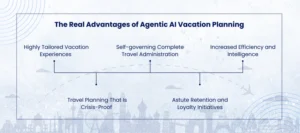
The Real Advantages of Agentic AI Vacation Planning 

Advantages of Agentic AI Vacation Planning

Travel brands may move from merely serving clients to anticipating their requirements and taking proactive measures since agentic AI vacation planning systems have goals, evolve constantly, and make decisions on their own. Travelers will find these encounters effortless, and businesses will find them effective. 

Here are some real-world examples of how agentic AI travel planning services function:

Highly Tailored Vacation Experiences

Personalized AI holiday helpers generate distinct micro-profiles in real time, in contrast to rule-based segmentation that divides visitors into “business” and “leisure” travelers. For instance, a person may value Wi-Fi and quick check-ins when traveling for work, but prefer boutique accommodations when on vacation. Agentic AI trip planners instantly adjust to these preferences.

Self-governing Complete Travel Administration

Consider a self-governing artificial intelligence (AI) agent that arranges your travel, verifies your visa needs, tracks delays, and even recommends travel insurance without your request. This enhances customer satisfaction, boosts upsell prospects, and lessens reliance on human employees for firms.

Increased Efficiency and Intelligence

In the hospitality industry, manual input is often used in tasks including staff scheduling, inventory forecasting, and housekeeping. Through intelligent agentic AI vacation planning, hotels may evaluate local events, demand signals, and weather updates in real-time to optimize operations before issues arise.

Travel Planning That Is Crisis-Proof

Travel is prone to delays, ranging from pandemics to last-minute cancellations. Agentic AI vacation planning speeds up and improves the empathy of crisis management. It can manage cancellations, recommend different hotels, and redirect visitors during storms, keeping both businesses and travelers stress-free.

Astute Retention and Loyalty Initiatives

Loyalty is no longer increased by generic incentives. Offers can be highly customized using Agentic AI travel planning services, such as spa benefits for wellness travelers, surprise birthday upgrades, or early check-ins for regular travelers. These encounters convert one-time clients into ardent supporters. 

Best Practices for Agentic AI Vacation Planning: Do’s and Don’ts 

Both how businesses provide services and how travelers plan their trips are being revolutionized by agentic AI vacation planning. Autonomous AI agents provide intelligence and personalization to every aspect of the travel experience by making decisions, learning continuously, and adapting in real time. Organizations must, however, properly adopt these systems if they hope to have a significant influence. Strong data foundations, fair supervision, and constant improvement are essential for success. 

The following are crucial dos and don’ts for successfully adopting agentic AI trip planning services: 

Dos for Successful Implementation 

Begin with Use Cases That Provide Explicit Benefits 

Start with examples that offer advantages right away. Customer satisfaction is directly increased, and manual workloads are decreased when an agentic AI trip planner is used to handle interruptions. Starting with high-impact use cases generates internal momentum and aids with ROI demonstration. 

Assure Smooth Integration and High-Quality Data 

Clean, real-time data from several systems, including booking platforms, CRM platforms, hotel databases, and support channels. It is necessary for intelligent agentic AI vacation planning to be successful. The system is guaranteed to offer precise, context-aware recommendations when it has high-quality integrated data. The passenger experience is weakened, and trust is diminished by inaccurate or compartmentalized facts. 

Continue to Monitor Human Oversight 

The majority of activities can be completed by individualized AI vacation assistants, but in certain situations, human judgment is needed. For example, human inspections are necessary to prevent mistakes like booking unavailable rooms or processing cancellations incorrectly. This equilibrium protects consumer confidence and guarantees a more seamless integration of AI-powered procedures. 

Give explainability and transparency top priority

The rationale for specific enhancements or recommendations must be made clear to travelers. By giving concise justifications for its choices, an open Agentic AI vacation planning system increases trust. This guarantees regulatory compliance, lowers escalations, and boosts consumer confidence. 

Continuously Pilot, Measure, and Iterate 

Risks might arise from extensive rollouts without testing. Organizations can get feedback, improve workflows, and adjust decision-making logic by testing Agentic AI trip planning services in controlled circumstances. Customer satisfaction and long-term efficiency are guaranteed by iterative improvement. 

Don’ts to Avoid with Agentic AI 

Avoid Demanding Full Autonomy Too Early 

It may have adverse effects to grant full autonomy to AI systems before thorough testing. For example, making whole itineraries over again in case of bad weather without human checks can lead to errors, inconvenience passengers, and damage a brand’s reputation. 

Be Vigilant About Compliance and Data Privacy 

Protecting client data is necessary in the hospitality and travel sectors. When relying on autonomous AI agents, violating privacy regulations such as the CCPA or GDPR will attract costly fines and erode consumer trust. Compliance must be built into the system from the outset. 

Agentic AI should not be configured once

With every interaction, holiday-planning agentic AI technologies evolve. Left untamed, the decisions will potentially drift away and yield outcomes that are not aligned with customer needs or business goals. Accuracy and justice need to be upheld by incessant observation and adaptation. 

Avoid Relying on Just One Data Source 

Personalization is diminished when AI is restricted to internal booking history. A variety of data sources are taken into account by efficient agentic AI trip planners, such as rival prices, local events, weather forecasts, and even real-time traveler behavior. This wide viewpoint guarantees that suggestions stay accurate, current, and dynamic. 

Conclusion 

Anticipating client requirements before they ever materialize is key to the future of travel. Travel and hospitality companies may now offer flexible, individualized, and effective experiences at scale thanks to agentic AI vacation planning. In order to accomplish this, businesses require the proper framework, where Salesforce development services are essential for integrating customer data, streamlining processes, and enabling sophisticated AI-powered systems. By fusing Salesforce with innovative agentic AI, we at AnavClouds Software Solutions assist companies in realizing this promise. Are you prepared to improve customer loyalty, optimize processes, and develop cutting-edge travel experiences? Together, let’s shape the travel industry of the future. 

Salesforce Architect

As companies are rapidly transforming their business models into digital transformations, the Salesforce architect role is more important than ever. In the Salesforce Architect Landscape 2025, architects will bring together leadership, strategy, and automation skills to build scalable and future-ready Salesforce solutions, beyond being just subject-matter experts. The rise of AI, automation, and cross-cloud features in Salesforce will create demand for architects who can leverage platform innovation against business initiatives. This article examines the critical, underappreciated, and forward-thinking abilities that every Salesforce Architect will require in order to succeed in 2025. 

Important Skills Influencing the Salesforce Architect Market in 2025 

Positioning as a Salesforce Architect has become one of the most strategic roles of this digital era. These experts are shaping the architecture landscape in Salesforce by 2025 and enabling organizations to leverage Salesforce solutions through the combination of business and technical knowledge.  

Their responsibilities span far more than platform knowledge, as they are visionaries, engineers, and implementers of scalable systems, ability to automate processes, and a guiding force for organizations to go through change. Salesforce Architects must develop a diverse skill set to meet future demand, with a balance of technology and innovation, collaboration, and leadership. 

Build smarter Salesforce solutions with expert architects by your side. Let’s shape your success today!


The following is a summary of the critical skills that will influence the Salesforce Architect role in 2025

Creating Integrations and Systems That Are Future-Ready

For any Salesforce Architect, having a solid understanding of system architecture and integration is a must. These experts make that Salesforce is designed for sustainability, security, and size in addition to implementation. They create automated procedures, link Salesforce to external systems, and create clever frameworks that enable companies to run smoothly.

Salesforce Solutions’ Strategic Business Acumen

The contemporary Salesforce Architect is a strategist in addition to a tech specialist.  In order to match Salesforce solutions with business priorities, they need to be aware of an organization’s vision, operational model, and long-term objectives. Process mapping, business analysis, and strategy alignment abilities guarantee that each implementation yields quantifiable results and a competitive edge.

Technologically savvy and Salesforce automation-savvy

Technical expertise remains a crucial aspect of a Salesforce Architect candidate. Architects need to have an in-depth understanding of technology trends, from current Salesforce updates to their expertise in Salesforce Architect automation. Architects are mighty drivers of efficiency and innovation for organizations, fault-finding, process streamlining, and AI-powered automation integration.

Stakeholder Communication and Collaboration

The value of Salesforce Architects working together will grow in 2025. Architects play an unusual role in being a bridge between highly technical teams and business stakeholders, making sense of hard technical terminology, and ensuring stakeholder alignment. Architects can use their excellent communication, empathy, and active listening skills to build clarity and trust along a project.

Intelligent Management and Data Architecture

Decision-making now relies heavily on data; thus, Salesforce architects need to create data structures that optimize its usefulness. Data expertise is crucial for everything from managing migration strategies and guaranteeing compliance to modeling safe, scalable databases. This guarantees that businesses may use their data to develop tailored customer journeys and well-informed plans.

Encouraging Change and Leadership

Major organizational changes are frequently a part of Salesforce deployments. For Salesforce Architects, leadership and change management are therefore essential competencies.  Successful adoption requires leading teams, fostering creativity, and overcoming opposition.  Successful architects make sure that Salesforce solutions are adopted by the entire company in addition to being executed. 

Must-Have Salesforce Architect Skills Shaping 2025 

In 2025, the Salesforce Architect Landscape will be much more dynamic than it has ever been.  The position calls for more than simply technical expertise because companies are requesting scalable, secure, and intelligent solutions. To create solutions that genuinely add value, a great Salesforce Architect blends product experience, enterprise design knowledge, and a strong customer-first mentality. 

Let’s examine the key competencies that will distinguish Salesforce Architects in 2025. 

Enterprise Architecture for Salesforce Solutions That Are Scalable 

Creating future-ready Salesforce solutions is one of the most important abilities. Architects need to think beyond today’s specifications and develop adaptable system designs that can change as a company expands. Long-term scalability and robustness are guaranteed by enterprise-level design, whether it is enabling automation across various clouds or connecting Salesforce with ERP platforms. 

Knowledge of the Salesforce Ecosystem and Products 

Salesforce Architects can’t afford to only explore the platform in 2025. To unleash creativity, they require a thorough understanding of MuleSoft, Salesforce Clouds, Industries, and Einstein AI. The real game changers in digital transformation will be architects who customize solutions to meet industry-specific demands as Salesforce’s capabilities grow. 

Constructing Architectures Focused on Customers 

Every architect should prioritize the client, much like the top Salesforce development services do. The ability to create end-user-pleasing experiences is essential for everything from user behavior analysis to customer journey optimization. Architects will guarantee greater acceptance and better commercial results if they incorporate customer-centric thinking into their designs. 

Knowledge of DevOps and Agile Techniques 

Adaptability and speed are now essential. Architects who are skilled in DevOps pipelines, CI/CD processes, and Agile frameworks may complete projects faster without compromising quality. This not only shortens time-to-market but also ensures that Salesforce solutions consistently adjust to business needs. 

Critical Thinking and Solving Complicated Issues 

As business requirements become more complex, Salesforce Architects must possess advanced analytical and problem-solving skills. Whether they are fixing problems with data transfer or optimizing automation procedures, architects are crucial due to their ability to assess problems and offer practical solutions. 

Interaction That Brings Stakeholders Together 

Only when great architecture is recognized and embraced can it have an impact. In order to keep IT teams in sync and demystify technical designs for business executives, architects need to be effective communicators. They serve as the link between strategy and technology in many respects, and by 2025, their significance will only increase. 

Data Governance and Security Knowledge 

Data protection is important to organizations, and therefore, governance and security cannot be overlooked. Architects’ role is significant while implementing Salesforce; they need to develop an ecosystem as per regulations like CCPA and GDPR. This ensures secure access to sensitive information, ensuring organizational assets are safe when security and compliance remain in harmony. 

Promoting Adoption and Change 

Without acceptance, even the most advanced architecture fails. Salesforce Architects are therefore essential to change management. They guarantee that Salesforce products are adopted by users and yield the most return on investment by assisting firms with training, communication, and onboarding tactics. 

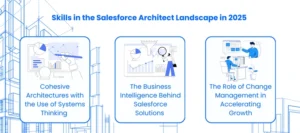
Overlooked Yet Vital Skills in the Salesforce Architect Landscape in 2025 

Skills in the Salesforce Architect

Although technical proficiency frequently takes center stage, a Salesforce architect’s success is subtly defined by a number of underappreciated abilities.  Although these features might not often garner much attention, they are crucial for creating robust structures and guaranteeing that Salesforce solutions have a real economic impact. 

Cohesive Architectures with the Use of Systems Thinking 

A forward-thinking Salesforce architect needs to consider the wider picture in addition to specific features. Architects can assess each component’s interactions within the larger Salesforce ecosystem by using systems thinking. This all-encompassing strategy avoids compartmentalized solutions, encourages scalability, and guarantees that the Salesforce Architect Landscape in 2025 is prepared for the future. 

The Business Intelligence Behind Salesforce Solutions 

Business savvy makes you stand out from the competition, even in highly technical positions.  Salesforce skills can be matched with long-term company objectives by architects who are aware of organizational priorities and financial targets. By connecting strategy and technology, they guarantee that Salesforce solutions not only address issues but also spur expansion. 

The Role of Change Management in Accelerating Growth 

Adoption of technology frequently involves more people than systems. Architects with strong change management skills guide companies through changes with ease and make sure staff members accept new systems and procedures. A Salesforce setup becomes a company-wide success story thanks to this underappreciated talent. 

Salesforce Architect Skills Across Career Stages in 2025 

A Salesforce Architect’s path is one of constant development. Professionals’ abilities change as they progress through different stages of their careers, from driving enterprise-wide Salesforce strategy to mastering essential platform functionalities. Knowing these benchmarks in the Salesforce Architect Landscape of 2025 aids architects in staying ready and companies in appreciating the need for knowledge at all levels. 

Early Career: Building Firm Foundations 

Learning the basics is the path for junior Salesforce Architects. A solid grasp of declarative technologies such as Flow and Sales and Service Cloud is necessary. They can now design valuable Salesforce solutions from their experience in hands-on configuration and minimal coding knowledge of Apex and Visualforce. Analytical thought and stakeholder communication are also the path to take to make sure that what they deploy equates to real business needs. 

Mid-Level Development: Translating Knowledge into Capability

As architects reach mid-level, the expectations are greater. At this level, data architecture, intricate integrations, and enterprise design are the concerns. Having experience in the middleware, APIs, and data transfer mechanisms, they are better able to tackle more intricate projects. By sponsoring junior team members, conducting impact analyses, and making new Salesforce installations align with business objectives, they also begin assuming leadership roles. 

Senior Level: Driving Strategy and Enterprise Innovation 

Senior Salesforce Architects turn into visionaries. They lead long-term digital transformation, design at the enterprise level, and provide system-wide strategy. They shift from implementation to strategic alignment of Salesforce solutions with business goals. One needs to become an expert at high-level communication, change leadership, and stakeholder management. Next-generation Salesforce ecosystems will be powered by the cutting-edge trends and Salesforce Architect automation, power senior architectsto  continue to develop, as well as driving innovation. 

Developing Future Skills: Succeeding as a Salesforce Architect in 2025 

Salesforce architects today require more than technical skills. The Salesforce Architect Landscape in 2025 will require one to learn, evolve, and innovate on an ongoing basis. One will need to acquire new technologies, develop business acumen, and leadership skills to remain relevant. Upskilling, and not a choice anymore, is what will distinguish an implementer from a strategic partner. 

How do Salesforce Architects prep for the future of their career, then? Let’s break it down.

Becoming Proficient in New Salesforce Technologies

With the advent of automation, AI-based analytics, and cross-cloud, the Salesforce platform is transforming significantly. Architects can adequately design Salesforce solutions to address the business needs of the modern era if they take an active effort to find these breakthroughs.

Increasing Certifications and Credentials

Achieving senior-level designations like Application Architect or Certified Technical Architect (CTA) is more than just a certification; it’s a statement of capability and stature. Certifications guarantee the capability to lead complex, large-scale projects in the age of Salesforce Architect automation expertise.

Developing Stronger Community Bonds

Salesforce is not a platform but a world ecosystem. New architecture is possible through networking, peer-to-peer sharing, and exposure to best practices by attending conferences like Dreamforce, TrailblazerDX, or virtual webinars.

Building Data and Cross-Cloud Proficiency

Sales, Marketing, and Commerce are just a few of the Salesforce Clouds that a well-rounded architect needs to be familiar with. Scalable, safe, and insights-driven solutions are guaranteed when this is combined with an in-depth understanding of data architecture and administration.

Developing Outside of Technology

Real Salesforce architecture leaders are not just technical experts. They master change management, improve communication, and bolster business acumen. They transform Salesforce investments into growth engines by coordinating technology with company objectives. 

Conclusion 

There will be a more vibrant Salesforce Architect community by 2025 that requires a balanced blend of technical abilities, automation skills, and business acumen. Salesforce Architects are responsible for empowering businesses to build high-performance, future-proof solutions, from guiding strategic decisions to acquiring knowledge in system integration. To be viable in the future, companies will have to sync up with professionals knowledgeable about such requirements. AnavClouds Salesforce Development Services can help you build rock-solid frameworks for your business workflows and leverage Salesforce solutions for measurable impact. 


Frequently Asked Questions 

What is a Salesforce Architect? 

A Salesforce Architect designs and delivers solutions that enable businesses to thrive in a rapidly evolving market. They are the technical delivery lead for the delivery teams and stakeholders. Although most architects have a development background, it’s not a must; what is most important is that they can design scalable and efficient systems. 

How is a Salesforce Developer different from a Salesforce Architect? 

A Salesforce Developer is concerned with coding, setting up features, and keeping Salesforce applications running. In contrast, a Salesforce Architect has a larger role, making sure the overall design and organization of Salesforce solutions fit business objectives. To put it simply, developers construct the parts, and architects create the plan. 

What are the main Salesforce Architecture concepts? 

Salesforce Architecture is composed of several fundamental building blocks that collaborate: 

  • Data Model – specifies the way information is organized. 
  • User Interface (UI) – controls the way users interact with Salesforce. 
  • Business Logic – makes processes and rules operate seamlessly. 
  • APIs – integrate Salesforce with other applications and systems. 

It also has data services, artificial intelligence capabilities, and solid APIs that make Salesforce flexible and strong. 

What is the three-tier architecture in Salesforce? 

The three-tier architecture in Salesforce explains how the platform classifies its core services: 

  • Database Layer – controls data storage and business logic. 
  • Application/Controller Layer – controls processing, rules, and coordination. 
  • Presentation Layer (View) – delivers the graphical user interface for end users. 

All these layers collectively make Salesforce perform efficiently, providing speed, scalability, and a user-friendly experience. 

CRM for M&A

Simplifying relationships, monitoring data, and making faster, more accurate decisions are now important aspects of managing mergers and acquisitions. Traditional solutions like spreadsheets or siloed platforms are inadequate as businesses manage more complicated transactions. Consequently, increasing numbers of investment banks, private equity firms, and corporate development teams are deploying the best CRM for M&A-focused solutions. As these systems are expected to annual growth of 12.74% by 2030. These systems aim to automate laborious processes, unlock relationship intelligence, and provide a transparent, real-time picture of their entire transaction pipeline. How the best CRM for business is transforming M&A is what we’ll be exploring in this article, and why technology is now crucial to making thoughtful, competitive decisions. 

Why Is a CRM for M&A Essential for Your Business Growth? 

Long-term, intricate projects, acquisitions, and mergers require a smooth team, time, and data synchronization. Integration failure and delays, and data silos are caused by relying on spreadsheets or isolated solutions. Hence, the utilization of a CRM for M&A is central to business expansion. Besides providing process transparency, real-time intelligence, and continuous communication, a unified platform such as Salesforce CRM supports transaction sourcing, due diligence, and post-merger operations. Organizations can gain faster, smarter expansion in competitive markets by automating processes, performing multiple acquisitions effortlessly, and removing friction throughout the M&A process with professional Salesforce Integration Services. 

What Are the Real Benefits of Using a CRM for M&A? 

Best CRM for business

Mergers and acquisitions come with enough complexity—why add more with outdated systems? The best CRM for M&A helps you streamline operations, enhance collaboration, and drive clarity across the entire deal lifecycle. Here’s how: 

Obtain Complete Exposure Throughout the Deal Pipeline 

A real-time, centralized picture of each deal, contact, and pipeline stage is provided by an M&A-specific CRM. You can monitor progress, steer clear of bottlenecks, and make data-driven decisions with the help of solutions like Salesforce CRM. Clarity is maintained throughout the M&A lifecycle because of this visibility. 

Facilitate Cooperation in All Departments 

Through the removal of departmental information barriers, the finest CRM for the company promotes real-time communication. Teams can manage relationships without misunderstandings, provide updates, and align deal strategy using Salesforce Consulting. Analysts and executives alike remain in harmony. 

Simplify the Management of Complex M&A Projects 

M&A teams can simplify processes, assign tasks, and manage deadlines on a single platform by utilizing a Salesforce Integration Service. In high-stakes deals, a CRM for M&A centralizes complex deal administration, guaranteeing accountability and lowering manual errors. 

Get Rid of Spreadsheets and Manual Monitoring 

Using Excel alone reduces productivity and increases hazards. Spreadsheets are replaced by clever automation and organized data management in the best CRM for M&A, such as Salesforce CRM. Businesses get quicker access to real-time updates, documents, and relationship analytics. 

CRM Customization for Your Deal Lifecycle 

Custom Salesforce development guarantees that your CRM aligns with your process, as every deal is different. You may create tools for monitoring EBITDA, net debt, and investor interactions with Salesforce Development Services, resulting in a CRM that can be tailored to your M&A plan. 

Protect Your Information and Automate Procedures 

In M&A, security and automation cannot be compromised. Compliance tools, controlled access, and enterprise-level protection are all features of the finest CRM for M&A. Businesses can also benefit from advanced automation using Salesforce Consulting, such as due diligence procedures and AI-based transcriptions. 

5 Best CRM for M&A to Consider for Your Business 

Salesforce 

Salesforce is one of the top platforms where over 150,000 companies around the world rely on while deciding on the ideal CRM for M&A. To those companies engaged in sophisticated mergers and acquisitions, their cloud platform, enterprise security, and high scalability are an attractive choice. 

Due to its robust data analytics capabilities and high degrees of customization, Salesforce allows organizations to track and monitor acquisitions from all stages of M&A, from sourcing through integration following the merger. Its robust set of features allows departments and teams to work in ideal harmony. 

Key Benefits: 

  • Custom Workflows & Dashboards: Configure fields, objects, and stages to your M&A process. 
  • Advanced Analytics: Products such as Sales Cloud, Einstein AI, and Data Cloud provide real-time deal insight, pipeline forecasting, and investor engagement metrics. 
  • Integrated: Integrate third-party applications like DocuSign, Zoom, and Slack, without the need for additional coding. 
  • Robust security: Salesforce offers role-based access, audit trails, and encryption capabilities that offer security and compliance. 
  • M&A-Specific Tools: Leverage industry-ready applications on AppExchange that facilitate project management, due diligence, and post-merger integration. 
  • Training & Onboarding: Trailhead learning paths drive CRM adoption by M&A teams.  

Challenges: 

  • Sales-Focused Core: M&A procedures necessitate customisation or third-party software, while native setup is targeted at B2B sales. 
  • Complex Implementation: Expert assistance is frequently required for custom setup, particularly for deal-specific customizations. 
  • Costlier: It is a more expensive option that is less appropriate for small businesses due to licensing, development, and maintenance costs. 
  • Steep Learning Curve: Internal champions and training may be necessary for initial acceptance.  

Best Fit For: 

Enterprises and mid-sized organizations managing high-volume or complex M&A activities, and looking for a highly scalable, customizable, and secure CRM ecosystem.  

DealCloud 

DealCloud is a CRM developed for capital markets and M&A that is trusted by over 25,000 users globally. It’s tailored for business development teams, investment banks, and private equity firms with easy, no-code customizations, compliance capabilities, and links to S&P Capital IQ and PitchBook. 

DealCloud’s key benefits for M&A are: 

  • Built with Capital Markets in Mind: Companies can start faster with pre-configured modules for agreements, mandates, investors, and funds. 
  • No-Code Personalization: Built fields, dashboards, and approvals easily and without code. 
  • Compliance Built-In: Pre-built reports, audit trails, and access controls make compliance-focused firms happy! 
  • Integrated Data Sources: DealCloud integrates with PitchBook and other platforms for market data to help support decision-making. 
  • Outlook & Mobile Access: Sync contacts and pipeline management on the go. 

Challenges to Consider:  

  • Manual Data Entry: DealCloud does not auto-sync calendars and emails; therefore, you will need to enter everything manually.  
  • Long Implementation: It can take about four to six months to implement, and very little change will be allowed post-launch.  
  • Learning Curve: Harder interfaces require training to use.  
  • High Cost: Implementation and annual fees may exceed $85k, and be out of reach for smaller firms. 

Best Fit For: 

Private equity firms, investment banks, M&A consultants, and capital markets teams are seeking a compliance-ready, customizable, and data-rich CRM for M&A operations.  

Midaxo 

Designed to optimize the whole deal lifecycle, from deal sourcing to post-merger integration, Midaxo is a cloud-based CRM for M&A. By providing end-to-end deal management capabilities that combine project management, diligence workflows, pipeline tracking, and virtual data rooms into a single, centralized solution, this platform serves M&A teams. 

Key Benefits of Midaxo for M&A: 

  • Unified Deal Management: Provides data rooms, trackers, and checklists in one package, eliminating the need for different solutions. 
  • Standardized Playbooks: Consistency throughout acquisition procedures is facilitated by integrated templates and diligence. 
  • Safe Document Management: Compliance and audit-readiness are guaranteed by centralized storage with role-based access. 
  • Excel & Outlook Sync: Makes it simple for users to import spreadsheets and record communication data. 
  • Custom Dashboards & Scoring: Makes it possible to focus on high-impact possibilities by enabling customized dashboards and deal scoring. 
  • Multi-Pipeline Tracking: Perfect for big or diverse M&A teams, this feature allows you to manage many acquisition pipelines at once. 

Challenges to Consider: 

  • Limited CRM Intelligence: Lacks the advanced automation and connection analytics present in more traditional CRMs. 
  • Outdated Interface: When preparing reports in particular, the user interface may seem outdated and challenging to grasp. 
  • Manual Data Input: Because of the limited enrichment features, teams must manually update contacts and company information. 
  • Limited third-party integrations in a closed integration system could restrict flexibility and scale. 

Best Fit For: 

M&A teams who want a standardized, organized platform to handle the entire acquisition process—from deal origination to post-merger integration—without depending on several disparate tools are the greatest candidates for Midaxo.  

Affinity 

Affinity is a relationship-focused CRM for M&A that is intended for teams working in corporate development, investment banking, private equity, and venture capital. By integrating automation, relationship intelligence, and analytics, it enhances transaction flow management and warm introductions through network insights. 

Key Benefits of Affinity for M&A: 

  • Automated Data Capture: Affinity records meetings, conversations, and attachments by integrating with calendars and emails, saving users the trouble of manual data entry. 
  • Relationship Intelligence: Businesses that rely on relationships would benefit greatly from integrated AI, which maps internal networks, evaluates the strength of links, and recommends cordial introductions. 
  • Customized Deal Flow Tracking: M&A teams can use list views and Kanban boards to customize pipelines so they match internal procedures. 
  • Analytics Extension: Throughout the M&A lifecycle, add-on capabilities provide data-backed clarity by visualizing important KPIs like team engagement and sourcing efficiency. 

Challenges to Consider: 

  • Limited Lifecycle Support: For complete M&A support, external solutions are needed as Affinity does not cover the post-deal or due diligence phases. 
  • Additional Fees for Complete Features: Businesses looking for an all-in-one CRM for M&A may be impacted by the higher cost of advanced analytics. 
  • Modules that aren’t relevant: Features like marketing lists and event monitoring could make workflows unique to M&A too complicated. 
  • Absence of Real-Time Updates: Affinity does not proactively highlight corporate milestones or market events like other M&A CRM platforms do.  

Best Fit For: 

Firms that are network-driven and prioritize relationship visibility. Affinity is best for M&A teams looking for automated relationship tracking and are open to investing in analytics to enhance sourcing performance. 

Navatar 

Navatar is an M&A CRM built on Salesforce that is designed for corporate development teams, private equity firms, and investment banks. For quicker deployment and more intelligent deal execution, it connects Salesforce’s infrastructure with specialist M&A CRM capabilities through pre-built modules for deal monitoring, pipeline management, and financing. 

Key Benefits of Navatar for M&A Teams: 

  • AI-Powered Data Capture: To reduce manual labor and improve firm-wide intelligence, Navatar leverages AI to extract contact details, deal data, and meeting insights from emails and notes. 
  • Built on Salesforce: It is a powerful and expandable CRM for mergers and acquisitions, inheriting Salesforce’s scalability, superior security, and AppExchange compatibility. 
  • Advanced Search and Workflow Automation: Teams can quickly query big datasets and assign tasks to the appropriate parties automatically, which simplifies decision-making and pipeline management. 
  • Extremely Customizable: Navatar enables businesses to fully customize M&A workflows, allowing them to match their deal management CRM to their procedures and tactics.   

Challenges to Consider: 

  • Still Requiring Manual Input: When integrations aren’t fully enabled, certain actions still need to be manually logged, even with AI. 
  • No Native Relationship Intelligence: In certain editions, Navatar does not have sophisticated internal network mapping, in contrast to other relationship intelligence CRMs. 
  • Complex User Experience: The interface may be too sophisticated or scary for non-Salesforce users, which could prevent adoption. 
  • Experience Is Needed for Implementation: Often, full customisation requires authorized Salesforce partners and technical personnel, which can be costly and time-consuming. 

Best Fit For: 

For mid-to-large M&A teams that require a CRM that is customized and built on Salesforce, Navatar is the best option. It works best for companies looking for intelligence-driven, centralized M&A management, particularly those that are already using the Salesforce ecosystem. 

Conclusion 

A successful M&A strategy requires more than just a clear vision; it also requires an intelligent, structured system that maintains the alignment of your data, people, and choices. By using the best CRM for M&A, businesses may decrease inefficiencies, improve transparency, and process transactions more rapidly and precisely. Platforms like Salesforce CRM offer the scalability, security, and flexibility needed to support every step of your acquisition process with the aid of expert Salesforce Integration Services. Are you prepared to streamline your M&A procedure and boost expansion? To create a CRM solution that is as intelligent as your plan, collaborate with AnavClouds Software Solutions, your go-to Salesforce Consulting Partner.