Salesforce Implementation Challenges Businesses Cannot Ignore
Salesforce is an effective CRM, and to be adopted properly, it has to be more than just installed. Many businesses encounter Salesforce implementation challenges because of improper planning, insufficient knowledge, and haste. The problem of data issues, low adoption, and an increase in costs are experienced by organizations when implementing Salesforce without a clear strategy. These issues tend to slow the ROI and decrease the overall effectiveness of CRM.
Knowing the Salesforce implementation challenges at an early stage enables businesses to make more intelligent decisions. By employing the appropriate strategy, professional direction, and scalable strategies, organizations can escape typical traps. In this blog, the author discusses the most significant implementation challenges in Salesforce and how companies may address them.
Why Salesforce Implementations Become Complex Without the Right Strategy
Salesforce can serve businesses of all sizes and types; hence the platform is very flexible. Nevertheless, this flexibility tends to be the primary cause of Salesforce implementation challenges. When organizations begin adopting Salesforce, failing to have a roadmap, they find it difficult to align features to real business purposes. Teams often get into customization without any idea of what can be done in standard, which adds complexity to the technical system and maintenance down the line.
Salesforce implementation challenges also grow when businesses ignore process mapping and data readiness. Poor planning results in ineffective workflow, missing reports, and user adoption. When the requirements of Salesforce integration with existing systems are defined late, it becomes hard to manage. Moreover, Salesforce implementation increases the cost due to rework and hasty fixes.
Organizations lose time, become disoriented, and achieve lower ROI without adequate Salesforce Consulting and Management. The involvement of an expert Salesforce cloud implementation partner will guarantee well-organized planning, customization control, and easier adoption. Strategic implementation is a key contributor to lowering Salesforce implementation complexities and boosting long-term success.
Common Salesforce Implementation Challenges Organizations Face
Knowledge about the common Salesforce implementation challenges is essential to businesses that have long-term CRM success. Salesforce is an effective platform, and it has the propensity to make matters complicated when implementation is not structured. The challenge of Salesforce implementation is evident in many organizations because of improper planning, insufficient expertise, and haste in making decisions in the initial phases.
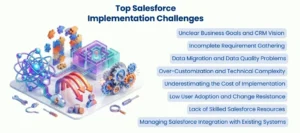
These challenges are not tackled proactively, and this results in slow adoption of CRM, increased cost, and poor business performance. The following are the major Salesforce implementation challenges that will affect the usability, scalability, and payback period.
Unclear Business Goals and CRM Vision
The lack of clearly defined business goals is one of the largest Salesforce implementation challenges. Organizations tend to roll out Salesforce without CRM functionality being consistent with sales, service, or operational goals. The teams are not interested in solving business issues; they are interested in configuring features.
Such a sense of being lost leads to workflows that are out of sync, idle modules, and dysfunctional dashboards. The reporting process becomes inaccurate, and automation does not aid in the process of decision-making. Measurable objectives can be used to define the objectives being evaluated and provide actual business results, and this minimizes Salesforce implementation challenges.
Incomplete Requirement Gathering
Poor discovery leads to long-term Salesforce implementation challenges that are hard to reverse in the future. Companies do not put down workflow, approval process, role of user, and dependency of data. That translates into a big gap in business expectations and solutions provided.
When the requirements are not clear, it leads to scope changes and rework during Salesforce implementation. Formal requirement gathering process enhances configuration and alignment with the stakeholders. Powerful planning enables Salesforce implementation services to provide future-ready and scalable solutions.
Data Migration and Data Quality Problems
Data problems are also one of the costliest Salesforce implementation challenges. Old systems can easily have duplicate, old, or inconsistent data. There is a loss of trust and harm to reporting quality when the data of poor quality is migrated into Salesforce.
Failed data affects automation, forecasting, and analytics. Migration should not start before data cleansing, data validation, and mapping. Clean data enhances adoption, develops better insights, and decreases continued Salesforce Consulting and Management.
Managing Salesforce Integration with Existing Systems
Contemporary organizations rely on several platforms in terms of operations and analytics. The technical complexity of Salesforce integration with ERP, marketing, finance, and support systems management arises. Lack of proper integration planning leads to failure in data syncing and operational delays.
Businesses find it difficult to work with incomplete workflows and unreliable information unless they have the help of reliable Salesforce integration services. The early definition of integration strategies must be made to prevent disruption during the later phases of the launch. Due to proper planning, Salesforce implementation challenges are minimized, and the system communications are seamless.
Underestimating the Cost of Salesforce Implementation
Most organizations do not take the real Cost of Salesforce implementation seriously. They offer licensing, customization, integrations, training, and long-term support. Solutions are rushed, leading to poor quality solutions due to poor cost planning.
Unexpected expenses increase Salesforce implementation challenges and delay ROI. A seasoned Salesforce cloud implementation partner can estimate realistic costs and arrange gradual implementations. Clear budgeting guards against the quality of implementation and continuity of the business.
Low User Adoption and Change Resistance
One of the least considered Salesforce implementation challenges is low adoption. Salesforce faces resistance from employees when the workflows seem difficult or detached from everyday activities. Low training causes a manual process and does not use the full system.
Lack of adoption leads to poor accuracy of data and CRM values. Engagement is enhanced through structured onboarding, role-based training, and active involvement of leaders. Work should not be made more difficult because of the Salesforce, but rather favourable in the cause of productivity.
Over-Customization and Technical Complexity
Over-customization is also one of the common Salesforce implementation challenges that increase difficulties over time. Native features are frequently bypassed, and businesses use extensive custom code. This increases the maintenance expense and restricts scalability in the future.
Performance and flexibility can be achieved without compromising flexibility due to the strategic use of Salesforce Lightning Web Components. Customization will be balanced to provide consistency in upgrading and stability of the platform. The native Salesforce capabilities have to be checked in the first place.
Lack of Skilled Salesforce Resources
Salesforce is dynamic, and it keeps updating and adding new features. Firms that lack talented resources find it difficult to perform, secure, and govern. Lack of expertise enhances stasis and delays innovation.
Many companies choose to hire Salesforce developers to fill technical gaps. Specialized teams lessen Salesforce implementation difficulties and help sustain the improvement. Professional Salesforce development services ensure clean architecture and scalable solutions.
How to Overcome Salesforce Implementation Challenges Successfully
To overcome Salesforce implementation challenges, it is necessary to take a systematic approach, have a more experienced mentor, and oversee ownership in the long term. A significant number of businesses fail, not due to Salesforce limitations, but because they made poor decisions in their execution. An effective plan is based on planning, adoption, scaling, and continuous improvement during Salesforce implementation.
The following are tested and proven, search engine optimized strategies to reduce risks, costs, and experience success with CRM in the long term.
Partner with Salesforce Experts Early
With a reputed Salesforce cloud implementation partner, there is a mitigation of critical execution risks. Skilled people offer an architectural understanding and bring Salesforce and actual business goals into balance. They assist businesses in not making unnecessary customizations and bad design choices.
Professional Salesforce implementation services guarantee to deliver services in a structured manner, with quicker and more determined results. The early engagement of experts reduces Salesforce implementation challenges in terms of integrations, data, and scalability.
Prioritize Standard Features and Scalable Design
Salesforce provides powerful native automation, analytics, and security tools. Standard capabilities minimize complexities and long-term maintenance expenses. Custom development must be based on well-defined business needs.
Standard features reduce technical debt and increase upgrade compatibility. This strategy helps to considerably decrease the Salesforce implementation challenges as the platform matures.
Strengthen Salesforce Consulting and Management Practices
Continued Salesforce Consulting and Management keeps the platform abreast with the business changes. The project Salesforce should not be a one-time project. The constant optimization enhances performance, adoption, and ROI.
Ongoing audits, performance reviews, and roadmap planning help avoid Salesforce implementation challenges over a long period. Vigorous administration makes CRM scalable and safe.
Invest in Training and Change Management
Training should not be limited to the first go-live stages. Role-based enablement enhances user faith and everyday performance. Workflows are more rapidly adopted by the employees when they match real tasks using Salesforce.
Good change management is one that assists the teams in knowing the value of Salesforce. Effective adoption plans minimize the resistance and Salesforce implementation challenges over time.
Plan Integration and Data Strategy from Day One
The discovery phase should be the start of integration planning. The ownership of data, frequency of synchronization, and policies regarding errors should be specified at an early stage of businesses. Managing Salesforce integration becomes easier with proper documentation.
Effective Salesforce integration solutions ensure system stability and precision of reporting. Good governance of the data guarantees uniform insights and reliability of the platforms in the long run.
Control the Cost of Salesforce Implementation Proactively
The Cost of Salesforce implementation demands open planning and step-by-step implementation. Customization, integration, training, and support are some of the costs that businesses should budget. Unforeseen costs worsen the Salesforce implementation environment and postpone ROI.
A Salesforce cloud partner is highly experienced in estimating achievable costs. This is because controlled budgeting can guarantee quality without compromising scalability.
Choosing the Right Salesforce Development Approach for Long-Term Success
The correct developmental strategy will be crucial in minimizing Salesforce implementation challenges and long-term platform success. Most organizations are in a hurry to do excessive customization in the process of rolling out Salesforce without considering scalability and maintenance needs. This leads to problematic architecture, performance, and high technical debt in the long run.
The services of professional Salesforce development are oriented on clean architecture, reusable components, and scalable design. Certified teams adhere to best practices to balance standard Salesforce capability and required customization. Companies that employ Salesforce developers who have successful implementation experience minimize redundancy and risks in the future. The proper development strategy will make sure Salesforce is able to sustain innovation, stability, and growth as an option.
Conclusion
When applied with precision and professionalism, Salesforce can be used to provide unparalleled value. Nevertheless, the failure to acknowledge Salesforce implementation challenges can result in the squandering of investment and low adoption. Companies need to be systematic in adopting Salesforce, do not overbudget, and with a long-term perspective.
Collaboration with the correct Salesforce cloud implementation partner, like AnavClouds Software Solutions, will decrease the risks in terms of customization, integration, and scalability. With Strong Salesforce Consulting and Management, it will be possible to optimize the process continuously based on business changes. With an appropriate development strategy and investments in the adoption process, organizations can transform the Salesforce implementation challenges into long-term growth opportunities.
FAQs
What are the most common challenges in Salesforce implementations?
The most frequent Salesforce implementation pitfalls are a lack of business objectives, ineffective gathering of requirements, data migration problems, low adoption, complexity of integration, and underestimation of the cost of implementation.
How can businesses reduce Salesforce implementation challenges?
Some of the ways businesses can ease the Salesforce implementation challenges are by engaging a seasoned Salesforce cloud implementation partner, leveraging standard features, integrating early planning, and investing in training and change management.
Why does user adoption fail after implementing Salesforce?
The reason why user adoption fails is that Salesforce becomes complicated or inaccessible to the everyday workflow. Lack of training and change management increases the resistance and decreases CRM use.
How much does Salesforce implementation cost?
Implementation of Salesforce is based on licensing, customization, integrations, training and support. Collaboration with experts would assist the businesses in making decent estimates on costs and preventing occurrence of unforeseen costs.
Search Posts
Popular Posts
Author profile: Saransh Maurya, Content Writer at AnavClouds Software Solutions
Saransh
Maurya
About the author
Saransh Maurya is a dynamic and results-driven professional with a passion for innovation and problem-solving. Known for his analytical mindset and attention to detail, he excels at delivering high-quality solutions that drive business growth and operational efficiency. With strong communication skills and a collaborative approach, Saransh effectively bridges ideas and execution, contributing to successful projects and meaningful outcomes across diverse domains.
Recent Posts