Sales and Marketing Data Integration for Salesforce Success
The modern growth of revenues is based on sales and marketing data integration. In cases where the teams access the same data, their work is quicker, and the decision is more effective. The integration of sales and marketing data ties customer touchpoints into a single transparent experience and eliminates speculation with practical knowledge. Companies that do not pay attention to sales and marketing data integration usually have problems with delays and slips in leads, as marketing might receive interest, and sales never clearly see that. Such disparity damages the conversion rates and customer trust, yet integration of sales and marketing data bridges this divide by providing a common visibility and working together.
Salesforce Sales Cloud is constructed to handle customer relationships on a large scale. It can be integrated with intelligent tools and become the core of sales and marketing data integration as it keeps the leads, deals, and promotes real-time cooperation. When Salesforce Sales Cloud is done properly, it will become a real engine of growth and will unite both teams and data in a single system.
Why Sales and Marketing Data Integration Is Critical
Integration of sales and marketing data forms a single source of truth in which both departments view identical leads, activities, and history. This eliminates confusion, enhances accountability, and ensures that all actions can be measured and traced. In the absence of the integration of sales and marketing data, data remains dispersed since marketing tools are used to store campaign data and sales tools to store deal data. Teams take time trying to find information, and in the process, this delays response, and momentum is killed. Data integration in sales and marketing also enhances customer experience as customers get the appropriate message at the appropriate time, and sales efforts are followed with complete context, which creates trust and adds lifetime value.
Role of Salesforce Sales Cloud in Data Sync
Salesforce Sales Cloud handles customer opportunities, contacts, and leads, and serves as the control center of customer data. It drives sales and marketing information integration when linked to additional platforms. The Salesforce Sales Cloud data sync ensures that the data is updated in all systems; therefore, when a lead is modified in one system, it will update everywhere to avoid errors and archaic records. Salesforce Sales Cloud integration relates to email technologies, advertisement networks, analytics software and CRM, and CRM. It also integrates well with Salesforce Marketing Cloud and Salesforce Data Cloud. Collectively, these platforms enhance the integration of sales and marketing information. Integration of Salesforce CRM data forms a single customer profile by eliminating duplication and enhancing the reporting, and teams have greater confidence in the data when it remains clean and consistent.
Common Problems in Sales and Marketing Data Integration
The integration of sales and marketing data is not an easy task that can be achieved effectively without proper planning, since most teams usually integrate the tools without establishing a workflow, leading to confusion and failed processes. The other significant concern is data quality since the redundancy of data and the existence of outdated data undermine the sales and marketing data integration, and makes the wrong decisions and the use of unnecessary efforts. Data is stored in various forms in different platforms, and when fields are not correctly mapped, sync errors are created, which disrupts automation and reporting. Security is also an issue since sales and marketing data integration should safeguard sensitive data, and the rules of access should be transparent and regulated at all times.
Step 1: Set Clear Integration Goals
When it comes to integrating sales and marketing data, there should always be set objectives. The teams should decide on what data is going to be moved, where to move it, and why it is important. These comprise leads, contacts, activities, and campaign results. Where there is a lack of clarity of goals, integration becomes untidy and difficult to control. Every technical and strategic decision is based on clear goals.
Success metrics should also be identified by the teams in advance. These can be lead response time, conversion, or information accuracy. Teams are focused when they all have an idea of what success is. Clear objectives also minimize the disputes between sales and marketing departments.
Step 2: Clean Data Before You Sync
Integration of sales and marketing data cannot work when the data is not accurate. Before syncing, cleanse duplicate records and repair missing or incorrect fields. Normalize names, email, and phone numbers. Clean data guarantees more fluid syncing and improved automation. Salesforce data migration tools can be used to migrate and clean data.
Cleaning up data cannot be done in haste. Go through old records and unused records. Clear such old contacts that have become irrelevant. Reliable reporting and stronger automation are facilitated by clean data. It also augments confidence in the system.
Step 3: Map Data Fields Correctly
The field mapping of the sales and marketing data should be done correctly. A right field in one system has to correspond to each field of the other system. When the mapping is not correct, then the data will not match whatsoever. A proper mapping allows the elimination of data loss and reporting mistakes. This is a precautionary measure against the quality of integration.
Both the technical and business teams should review field mapping. Business users understand the data that is important. Technical teams are aware of the manner in which that data is stored in systems. Mapping is important and correct when these two work together.
Step 4: Choose the Right Integration Method
Native Salesforce connectors or homegrown solutions can be used in sales and marketing data integration. In-built tools are good when it comes to simple needs. Salesforce Development Services might be needed to deal with complex workflows. The approach must be in accordance with the size of the business, objectives, and amount of data. Integration is made scalable and stable with the right decision.
The selection of an inappropriate approach leads to problems in the future. A small tool will not work as data increases. A complex system can be expensive for small teams. Never make a short-term decision on how you will do your integration.
Step 5: Set Security and Access Rules
The data used in sales and marketing data integration should ensure the confidentiality of data. All records should not be viewed and edited by all users. Establish access roles and permissions. This avoids risks of misusing data and compliance issues. Effective security will create confidence in the system.
Security regulations ought to be based on the business structure. The sales users might require deal access, and the marketing might require campaign data. Complete visibility may be required of managers. Clear access control prevents the error and secures the information of customers.
Step 6: Monitor, Test, and Optimize
It is not a single setup for sales and marketing information integration. Periodically test and identify mistakes beforehand. Keep track of monitor logs, alerts, and sync failures. Enhance performance-driven workflow. It remains reliable and valuable as optimization is continuous.
The performance should be reviewed by teams monthly. Test whether the leads slide well and the data is true. Fix issues before they grow. Continuous monitoring will also see the integration of sales and marketing data continue to sustain growth.
Benefits of Strong Sales and Marketing Data Integration
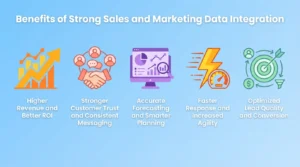
A close association of sales and marketing will transform the growth of a business. With the same data employed by both teams, predictability of results occurs. Integration of sales and marketing data eliminates confusion and creates a sense of clarity. It links strategy, implementation, and results into a single mechanism. This is alignment that generates quantifiable business value.
Higher Lead Quality and Better Sales Conversations
The quality of all leads is enhanced through the integration of sales and marketing data. Before they get in touch, sales teams view the complete lead history. They can access the information on which page was opened and which email was opened. This situation makes them begin smarter conversations. Marketing teams also get to know which campaigns bring about actual buyers. This would enable them to concentrate on the high-performance channels.
Faster Response and Shorter Sales Cycles
The integration of sales and marketing data accelerates the lead flow. Leads are immediately sent to sales teams with qualified leads. There are no manual handovers that slow down the process. The quicker the response, the higher the probability of conversion. Reduced sales cycles imply a rapid increase in revenues.
Accurate Forecasting and Smarter Planning
Sales and marketing data forecasting is more reliable. Every data resides within a single system, and it is updated. Leaders believe in the figures they are observing. This assists them in budgets, recruiting, and campaigns. The quality of data is key to good business decisions.
Stronger Customer Trust and Consistent Messaging
Sales and marketing information integration maintains consistency in messages. The tone appears similar to customers in terms of emails, advertisements, and phone calls. The sales teams understand what has already been viewed by customers. This prevents doubling and duplication. Trust and loyalty are developed by consistency.
Higher Revenue and Better ROI
The integration of sales and marketing data reveals what actions are associated with revenue. Teams invest in what works. Inefficient campaigns are eliminated. This enhances cost-efficiency. Expansion is foreseeable and expandable.
Final Thoughts
Integration of Sales and marketing data is no longer an option for growing businesses. It constitutes the essence of accelerated selling, enhanced customer experience, and smarter decisions. Teams work better when they are working with systems. This is a powerful and scalable process, enabled by Salesforce Sales Cloud along with the appropriate tools. Through the professional assistance of AnavClouds Software Solutions, companies are able to develop quality, reliable, and future integration systems. They have had experience with Salesforce integration, development, and data migration to guide companies on the expensive mistakes to avoid making. Proper planning, data hygiene, and the correct strategy will be the hallmark of success in the long-term. Integration of sales and marketing data, when performed correctly, will lead to revenue, trust, and long-run growth.
FAQs
What is sales and marketing data integration?
It refers to the linking of sales and marketing systems such that the two teams operate based on the same customer information. This enhances teamwork and decision-making.
Why is sales and marketing data integration important?
It makes sure that there is alignment of teams, it enhances quality of leads, accelerates follow-ups, and assists in boosting sales and total revenue.
How does Salesforce Sales Cloud help with data integration?
Salesforce Sales Cloud integrates with CRM, analytics, and marketing applications, which match leads, contacts, and activities across systems.
What are the common problems in data integration?
The problems that are common are poor quality of data, wrong field mapping, goals not understood, and security threats that impair the accuracy of data and performance of the system.
Search Posts
Popular Posts
Author profile: Saransh Maurya, Content Writer at AnavClouds Software Solutions
Saransh
Maurya
About the author
Saransh Maurya is a dynamic and results-driven professional with a passion for innovation and problem-solving. Known for his analytical mindset and attention to detail, he excels at delivering high-quality solutions that drive business growth and operational efficiency. With strong communication skills and a collaborative approach, Saransh effectively bridges ideas and execution, contributing to successful projects and meaningful outcomes across diverse domains.
Recent Posts