Salesforce and Heroku Integration for Enterprise-Scale Apps
Contemporary businesses are functioning within related ecosystems where information, apps, and knowledge need to flow without any hitches. Salesforce and Heroku Integration help companies to integrate CRM data with modern and scalable cloud services created to run quickly. Such integration removes silos of data and enhances responsiveness in operations, and helps create consistent digital experiences across channels. Entering Salesforce with Heroku integration allows businesses to be flexible in their innovation without overloading the main CRM system. Using Heroku Connect and the latest cloud architecture, companies facilitate real-time access to data across apps. Salesforce and Heroku Integration are essential in the agility, performance, and sustainable digital expansion of organizations as it grows.
What is Salesforce and Heroku Integration?
Salesforce and Heroku Integration is used to link Salesforce CRM with Heroku-hosted applications to guarantee the secure synchronization of data and processes. Through this integration, enterprises can expand CRM activities with scalable cloud applications that are based on Heroku. Using Salesforce Heroku integration, organizations consolidate data in a way that does not compromise governance, security, and performance. Businesses are able to become more adaptable to create new applications without interfering with Salesforce operations.
Rather than imposing heavy logic on Salesforce, companies move intensive loads to Heroku in the cloud. Through Heroku Connect, the data remains in real time between Salesforce and Heroku applications. This will alleviate API strain, enhance responsiveness in the system, and facilitate the current development practices. Consequently, Salesforce and Heroku Integration will make it possible to innovate faster and scale long-term.
Why Enterprises Choose Salesforce and Heroku Integration
Companies use Salesforce and Heroku Integration to balance between operational consistency and unceasing innovation. Salesforce will continue to be the system of record regarding customer data and workflows. Heroku allows developing applications in a scalable fashion without affecting core CRM performance. This combination promotes business development and the emerging digital practices.
Balancing Innovation with CRM Stability
Salesforce can support processes and controlled workflows of structured CRM. With Heroku, a team may develop and rework applications separately. This segregation secures Salesforce performance and allows quick innovation. Businesses do not have to worry about fixed limits of platforms and their reliability.
Supporting Scalable and Customer-Facing Applications
Applications that interact with customers may need to be fast and high in scale. Heroku is efficient in dealing with variable workloads and traffic spikes. Salesforce is still in charge of customer interactions and business logic. The Salesforce Heroku integration provides data continuity in the experiences.
Faster Deployment and Agile Development
Heroku also promotes the current DevOps, such as continuous integration and delivery. Salesforce release limitations do not limit the speed at which teams apply updates. This dexterity assists businesses in responding swiftly to change in the market. The cycle of innovation is reduced to shorter and more predictable periods.
Governance, Security, and Compliance Assurance
Organisations need stringent data access control and compliance. The policies of Salesforce governance are not removed in the integration. The Heroku programs adhere to safe authentication and permission frameworks. Salesforce and Heroku Integration provides flexibility and does not compromise security.
Role of Heroku Connect in Enterprise Integration
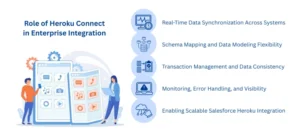
Heroku Connect is the base of Salesforce and Heroku Integration as it provides data synchronization at scale with reliability. It is a safe way of connecting Salesforce objects and Heroku Postgres databases through managed synchronization rules. This integration enables businesses to retain Salesforce as the system of record and scale the data applications throughout the cloud. The outcome is data availability, which is not complicated to integrate.
Real-Time Data Synchronization Across Systems
Heroku Connect integrates Salesforce and Heroku data with real-time precision. Heroku applications update Salesforce relatively fast. Salesforce automatically reflects application-level changes. This makes sure that enterprise teams are constantly working on up-to-date data.
Schema Mapping and Data Modeling Flexibility
Heroku Connect will enable companies to specify object-table mappings. The Salesforce fields that are synced to Heroku databases are controlled by teams. This is flexible enough to have application-performance data models. Businesses can control the amount of data that is not replicated unnecessarily.
Transaction Management and Data Consistency
Enterprise systems need to be trustworthy in terms of transaction management. Heroku Connect is safe with insert, update, and delete operations. It maintains the integrity of the data across platforms in concurrent changes. The mission-critical applications require this reliability.
Monitoring, Error Handling, and Visibility
Heroku Connect allows viewing the state of synchronization and failure. Monitoring sync events is done in teams using the dashboards and logs. Mistakes are identified at an early stage before they get into applications. This is an openness that enhances control over operations and trust in the system.
Enabling Scalable Salesforce Heroku Integration
As the amount of data increases, Heroku Connect will scale up as an enterprise. It facilitates the addition of records without degradation of performance. This scaling enhances the Salesforce Heroku integration architecture. Businesses are not redesigning systems, as they are ready to expand.
Salesforce and Heroku Integration Architecture Explained
An effective architecture of integration with Heroku establishes platform responsibility lines. Salesforce is the CRM workflow, approval, and analytics system of record. Heroku drives the application logic, external processes, and processes that need greater compute. Such a division maximizes the performance and enhances the overall Salesforce and Heroku Integration reliability.
Distributed Processing for High-Volume Operations
Businesses tend to work with big data volumes and in asynchronous operations. Heroku is efficient at managing background jobs, batch processing, and event-driven workloads. Salesforce concentrates on the functions of transactional CRM. This will avoid overloading of the system, and it will aid continuity of operations.
API Optimization and Resource Management
In the enterprise, Salesforce API restrictions are a significant issue. Heroku integration architecture lessens the redundant API calls through efficient data manipulation. Applications make use of synchronized data that is locally available in Heroku. This will conserve Salesforce resources and increase response time.
Scalability Without Platform Strain
The applications are scaled in Heroku on the basis of demand patterns. Businesses are able to handle traffic surges without compromising Salesforce. Salesforce is not frozen, and Heroku is taking the workload pressure. This design will enable expansion without redesign of the architecture.
Secure and Governed Data Flow
Heroku Salesforce integration is guided by rigid enterprise security models. Authentication, authorization, and access control are Salesforce-driven. The secure connections transfer these policies to Heroku applications. Businesses expand their possibilities without curtailing compliance.
Resilience and Fault Isolation
The Heroku architecture of integration hides application-layer failures. Problems in the Heroku application do not affect Salesforce operations. This seclusion enhances system reliability and availability. Firms are able to have business continuity in case of an incident.
Leveraging the Heroku AI Platform for Intelligent Applications
Heroku AI platform, which is provided as Heroku AI Platform as a Service, introduces intelligence to Salesforce and Heroku Integration. It is possible to implement AI-driven insights in Salesforce-related applications by the enterprise itself. This facilitates predictive analytics, automated intelligence, and customer experiences.
The use of AI-based apps has the potential to analyze customer behavior, predict their outcomes, and aid in a smarter engagement strategy. Enterprises run AI models without infrastructure control and do not operate their own infrastructures with Heroku AI Platform as a Service. This makes it less complicated and accelerates innovation in teams.
Salesforce Development Services for Custom Integration
The Salesforce professional development services are used to assist businesses in developing customized Salesforce and Heroku Integration strategies that are customized. Developers match integration logic and business processes with long-term objectives. Custom development guarantees optimized performance, accuracy of data, and scalability.
A partnership with a Heroku consultant company also provides strategic value to these services. Consultants provide an evaluation of the available systems, propose architecture enhancement, and direct best practices. This is the way to reduce risk and enhance the result of implementation.
Business Value and Salesforce Heroku Benefits
Salesforce Heroku advantages extend to much more than technical interoperability between platforms. Business organizations can realize quantifiable business potential when they integrate CRM data with scalable cloud-based solutions. Salesforce and Heroku Integration help organizations to be faster, more adaptable, and provide consistent value to every customer touchpoint. This integration enhances both the efficiency in operations and strategic decision-making.
Accelerated Time-to-Market for Digital Initiatives
Businesses do not have to wait for Salesforce release cycles to introduce new applications and features. Heroku is fast to develop and deploy. Salesforce does not stop with the core operations. This has been a definite competitive edge in vibrant markets.
Cross-Functional Data Accessibility
Salesforce and Heroku Integration gives a single access to both customer and operating information. The same sources of information are utilized by sales, marketing, and service teams. This commonality lowers the conflicts of interest and enhances cooperation. There is quicker and improved decision-making.
Improved Customer Experience Consistency
Connected applications provide unified experiences over the web, mobile, and service platforms. Salesforce data is kept in line with customer interactions. Businesses offer a tangible brand experience across all touchpoints. This gives rise to trust and satisfaction.
Business Agility Without Operational Risk
Heroku allows experimenting and innovating without affecting Salesforce stability. Business ventures can safely experiment with new concepts using cloud applications. Effective programs grow fast through incorporation. The balance provides agility without reducing reliability.
Long-Term ROI and Platform Longevity
Heroku’s advantages at Salesforce are less technical debt and increased platform longevity. Companies do not have to incur an expensive system upgrade. Investment in integration keeps on providing value as the business requirements change. This guarantees sustainable online development.
Conclusion
Salesforce and Heroku Integration help organizations to combine CRM power with the current cloud advancement. Using Heroku AI platform, Heroku connect and custom Salesforce development services, business organizations are able to create intelligent, scalable, and future-oriented applications. The agility, performance, and data-driven decision-making of business operations are made possible through this integration.
Using the experience of a Heroku partner that is trusted by the enterprise, such as AnavClouds Software Solutions, businesses have the opportunity to create secure architectures and take maximum advantage of Salesforce Heroku. A proper integration strategy will provide sustainability in terms of scalability in the long term, continuous innovation, and systems that will keep up with the needs of the business.
Frequently Asked Questions
What is Salesforce and Heroku Integration used for?
Salesforce and Heroku Integration is used to connect CRM data with scalable cloud applications. It allows enterprises to extend Salesforce functionality without impacting core platform performance. This approach supports faster development and real-time data access.
How does Heroku Connect support Salesforce and Heroku Integration?
Heroku Connect synchronizes Salesforce data with Heroku Postgres databases in near real time. It ensures data consistency across systems without custom APIs. Enterprises use it to simplify data management and improve reliability.
What are the key Salesforce Heroku benefits for enterprises?
Salesforce Heroku benefits include faster time-to-market, improved scalability, and better system performance. Enterprises also gain flexibility to innovate without risking Salesforce stability. This leads to improved customer experience and long-term ROI.
Why should enterprises work with a Heroku consulting partner?
A Heroku consulting partner helps design secure and scalable integration architectures. They ensure Salesforce and Heroku Integration aligns with business goals. Enterprises benefit from reduced risk, optimized performance, and smoother implementation.
Search Posts
Popular Posts
Author profile: Saransh Maurya, Content Writer at AnavClouds Software Solutions
Saransh
Maurya
About the author
Saransh Maurya is a dynamic and results-driven professional with a passion for innovation and problem-solving. Known for his analytical mindset and attention to detail, he excels at delivering high-quality solutions that drive business growth and operational efficiency. With strong communication skills and a collaborative approach, Saransh effectively bridges ideas and execution, contributing to successful projects and meaningful outcomes across diverse domains.
Recent Posts